Week 1 Understanding Different Battery Chemistry
Question 1:
Prepare a table that includes materials & chemical reactions occurring at the anode and cathode of LCO, LMO, NCA, NMC, LFP and LTO of lithium-ion cells. Give your detailed explanation of each type.
Solution:
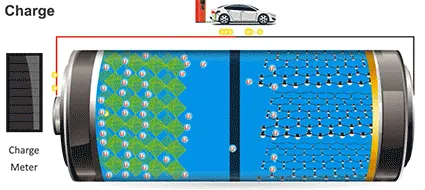
Fig: Li-ion batteries Charge and discharge cycle
Lithium-ion batteries are made of cells that store and release energy by moving electrons and ions between two electrodes, an anode, and a cathode, through an electrolyte and a separator. The anode is the negative electrode that gives out electrons, while the cathode is the positive electrode that receives electrons. The electrolyte is a liquid or solid substance that enables the flow of ions between the electrodes. The separator is a thin membrane that keeps the electrodes from touching and causing a short circuit.
Lithium-ion batteries are complex electrochemical devices with several key components working in tandem to store and deliver energy efficiently. The main elements of their construction include:
Anode (Negative Electrode): Typically made from graphite or other materials that can intercalate lithium ions, the anode serves as the site where lithium ions are stored during charging.
Cathode (Positive Electrode): The cathode material varies depending on the battery chemistry but often includes lithium cobalt oxide (LiCoO2), lithium iron phosphate (LiFePO4), or lithium nickel manganese cobalt oxide (NMC). The cathode releases lithium ions during discharge.
Electrolyte: The electrolyte is a lithium salt (e.g., LiPF6) dissolved in an organic solvent. It enables the movement of lithium ions between the anode and cathode during charging and discharging while preventing electron flow, which is achieved through the external circuit.
Separator: A porous membrane that keeps the anode and cathode from directly contacting each other while allowing the flow of lithium ions.
Current Collectors: Thin metal foils (copper for the anode and aluminum for the cathode) collect and transfer the current generated during the charge/discharge cycle.
Battery Management System (BMS): A control system that ensures the battery operates safely and efficiently by monitoring the charge/discharge cycles, state of charge, temperature, and other performance metrics.
Working Principle:
The battery's operation relies on the movement of lithium ions between the anode and cathode through the electrolyte. Here's how the battery works during charge and discharge cycles:
During Charging: Lithium ions move from the cathode through the electrolyte and separator to the anode. Electrons flow from the cathode to the anode via an external circuit, providing the electrical current needed by devices connected to the battery.
During Discharging: The lithium ions reverse their flow, moving from the anode back to the cathode through the electrolyte. The electrons flow back through the external circuit, powering the device connected to the battery. This process of moving ions and electrons between the anode and cathode, and through the external circuit, allows the battery to store and release energy.
The type of cells that you choose for your battery pack depends on your application and the characteristics that you want your battery pack to have. Different types of cells have different pros and cons in terms of energy density, power density, cycle life, safety, cost, and environmental impact.
1) LCO (Lithium Cobalt Oxide)
Lithium Cobalt Oxide (LiCoO2) is a mature battery technology, characterized by a long cycle life and high energy densities. The cathode consists of a cobalt oxide and anode is of graphite carbon. The cathode has a layered structure and during discharge, lithium ions move from the anode to the cathode. The flow reverses on charge. The drawback of Li-cobalt is a relatively short life span, low thermal stability and limited load capabilities (specific power).
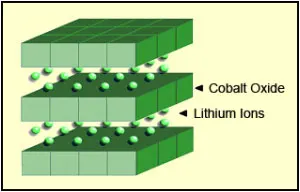
Fig: Lithium cobalt oxide structure
Table: Materials & chemical reactions occurring at the anode and cathode of LCO
Materials | Reactions | |
Anode | Graphite (C) | Li₁₋ₓC + xLi⁺ + xe⁻ → LiₓC |
Cathode | Lithium cobalt oxide (LiCoO₂) | LiCoO₂ + xLi⁺ + xe⁻ → LiₓCoO₂ |
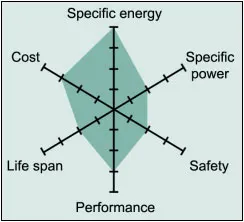
Fig: Performance of LCO
2) LMO (Lithium Manganese Oxide)
Lithium Manganese (LiMn2O4) battery cell's cathode is made out of lithium manganese oxide. It forms a three-dimensional spinel structure which improves ion flow on the electrode, which results in lower internal resistance and improved current handling, in comparsion with Cobalt based batteries. This three dimensional spinel architecture also exhibits high thermal stability and enhanced safety, but at the cost of cycle, calendar life, and energy density. Pure Li-manganese batteries are no longer commonly, they may only be used for special applications. Recent trends indicate that most Li-manganese batteries are blended with lithium nickel manganese cobalt oxide (NMC) to improve the specific energy and prolong the life span, and is popular in most Electric Vehicles.
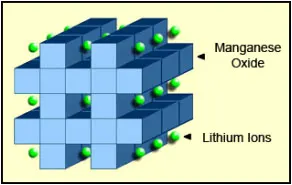
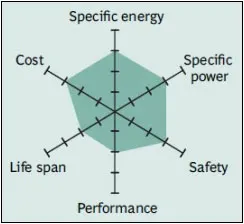
Fig: Performance of LMO
Table: Materials & chemical reactions occurring at the anode and cathode of LMO
Materials | Reactions | |
Anode | Graphite (C) | Li₁₋ₓC + xLi⁺ + xe⁻ → LiₓC |
Cathode | Lithium Manganese Oxide (LiMn₂O₄) | LiMn₂O₄ + xLi⁺ + xe⁻ → LiₓMn₂O₄ |
3) NCA (Nickel Cobalt Aluminum Oxide)
Lithium Nickel Cobalt Aluminum Oxide (LiNiCoAlO2) cathode material is highly thermally stable cathode material, doping the lithium nickel cobalt oxide with aluminum both stabilizes its thermal and charge transfer resistance. NCA shares similarities with NMC in offering high specific energy, reasonably good specific power and a long life span.
High energy and power densities, as well as good life span, make NCA a candidate for EV powertrains.
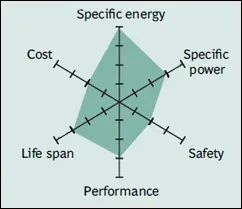
Fig: Performance of NCA
Table: Materials & chemical reactions occurring at the anode and cathode of NCA
Materials | Reactions | |
Anode | Graphite (C) | Li₁₋ₓC + xLi⁺ + xe⁻ → LiₓC |
Cathode | Nickel Cobalt Aluminum Oxide (LiNiₓCoₓAlₓO₂) | LiNiₓCoₓAlₓO₂ + xLi⁺ + xe⁻ → LiₓNiₓCoₓAlₓO₂ |
4) NMC (Nickel Manganese Cobalt Oxide)
Lithium Nickel Cobalt Manganese (Li(NiCoMn)O2) batteries are made of cathode materials which is combination of nickel, manganese and cobalt, typically one-third nickel, one-third manganese and one-third cobalt, also known as 1-1-1. Similar to Li-manganese, NMC can be tailored to serve as Energy Cells or Power Cells, like other lithium-ion battery varieties, NMC batteries can have either a high specific energy density or a high specific power. They however cannot have both properties in the same pack. For example, NMC in an 18650 cell for moderate load condition has a capacity of about 2,800mAh andcan deliver 4A to 5A. NMC in the same cell size can be optimized for specific power with capacity of about 2000mAh, but capable of delivering a continuous discharge current of 20A.
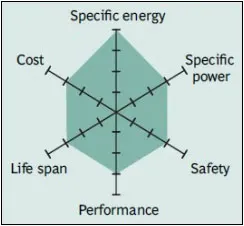
Fig: Performance of NMC
Table: Materials & chemical reactions occurring at the anode and cathode of NMC
Materials | Reactions | |
Anode | Graphite (C) | Li₁₋ₓC + xLi⁺ + xe⁻ → LiₓC |
Cathode | Nickel Manganese Cobalt Oxide (LiNiₓMnₓCoₓO₂) | LiNiₓMnₓCoₓO₂ + xLi⁺ + xe⁻ → LiₓNiₓMnₓCoₓO₂ |
5) LFP (Lithium Iron Phosphate)
In Lithium Iron Phosphate (LiFePO4) Batteries phosphate is used as cathode material, Li-phosphate offers good electrochemical performance with low resistance. This nano-scale phosphate material for cathode in Lithium Ion batteries is most viable option because of its low cost,environmental friendliness, long cycle and calendar lives (chemical stability) and good capacity (170 mAh/g). Doping with transition metals results in reduction of internal impedance. LiFePO4 batteries are incombustible in case of misuse during charging or discharging, they are more stable during overcharge or short circuit conditions and they can withstand high temperatures without decomposing. LFP is more tolerant to full charge conditions and is compartively less vunerable to stress even if kept at high voltage for a prolonged time.
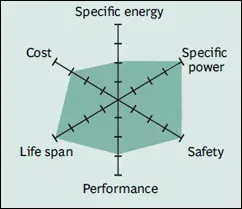
Fig: Performance of LFP
Table: Materials & chemical reactions occurring at the anode and cathode of LFP
Materials | Reactions | |
Anode | Graphite (C) | Li₁₋ₓC + xLi⁺ + xe⁻ → LiₓC |
Cathode | Lithium Iron Phosphate (LiFePO₄) | LiFePO₄ + xLi⁺ + xe⁻ → LiₓFePO₄ |
6) LTO (Lithium Titanate Oxide)
Lithium Titanate ((Li2TiO3)/(Li4Ti5O12)) battery is a modified Li Ion battery in which the graphite in the anode is replaced by Li-titanate which forms a spinel structure. LTO is the safest Anode Material for Lithium Ion Cells. As there is no volume changes upon charging and discharging, LTO chemistry battery exhibits maximum cyclic stability.
The cathode can be LMO or NMC 622 or LFP, or any other regular lithium battery Chemistry. Depending on selected cathode chemistry the LTO single cell voltage would range from 1.5 Vmin to 2.85 Vmax with nominal operating voltage of around 2.2V to 2.40V.
LTO can be fast charged and can deliver a high discharge current of 10C. Even the cycle life is higher than regular Li-ion batteries. LTO exhibits excellent low-temperature discharge characteristics (capacity of 80 percent at –30°C). Thermal stability under high temperature is comparitively better, highly tolerant to operational abuses and can comfortably perform up to 55 °C and can go up to 65 °C.
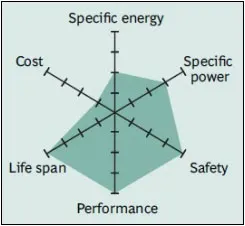
Fig: Performance of LTO
Table: Materials & chemical reactions occurring at the anode and cathode of LTO
Materials | Reactions | |
Anode | Lithium Titanate (Li₄Ti₅O₁₂) | Li₄Ti₅O₁₂ + xLi⁺ + xe⁻ → LiₓTi₄Ti₅O₁₂ |
Cathode | Lithium Manganese Oxide (LiMn₂O₄) | LiMn₂O₄ + xLi⁺ + xe⁻ → LiₓMn₂O₄ |
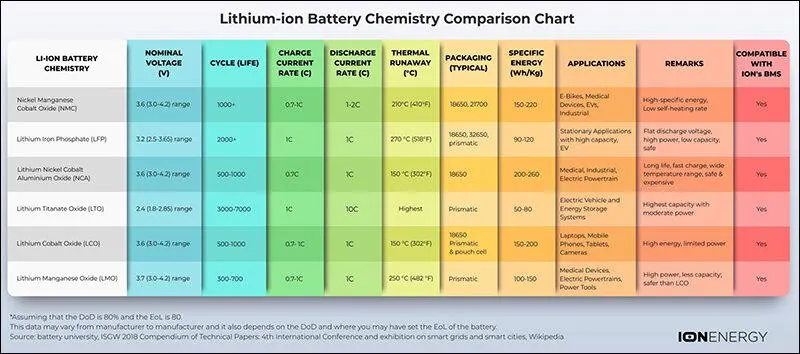
Table:Lithium-ion Battery Chemistry Comparison Chart
Reference:
https://ipowerbatteries.in/2023/12/26/lithium-battery-pack-type-designing-safety-and-performance/
https://batteryuniversity.com/article/bu-205-types-of-lithium-ion
https://www.capacitorsite.com/lithium.html
https://www.sify.com/technology/the-battery-of-tomorrow-how-lithium-ion-batteries-changed-the-world/
Question 2:
Compare the differences between each type of Li+ion batteries based on their characteristics
Solution:
Main characteristics of lithium cell chemistry types Battery cells are mainly defined by the following:
Specific energy (how much energy a system contains in comparison to its mass; typically expressed in watt-hours per kilogram, Wh/kg);
Specific power (the amount of power in a given mass; typically expressed in watts per kilogram, W/kg);
Cost (influenced by the rarity and cost of raw materials, and by technological complexity);
Safety (risk factors, like temperature threshold for thermal runaway);
Lifespan (the number of cycles leading to critically low decrease of capacity, usually 80% in material handling applications);
Performance (capacity, voltage and resistance).
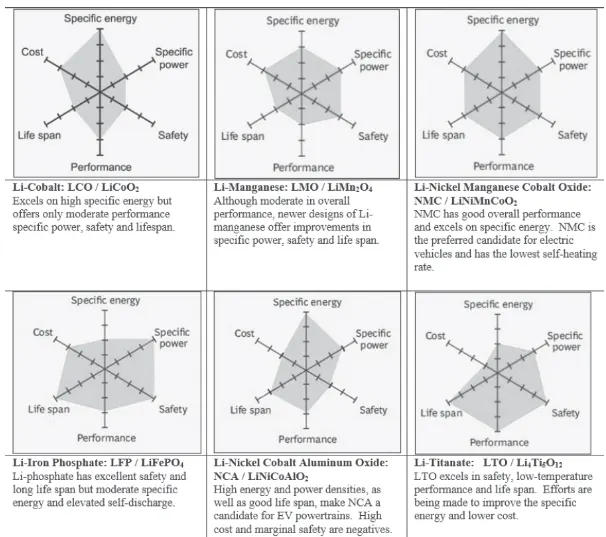
Fig: Li+ion batteries characteristics
Table: Compares various Li+ion batteries characteristics
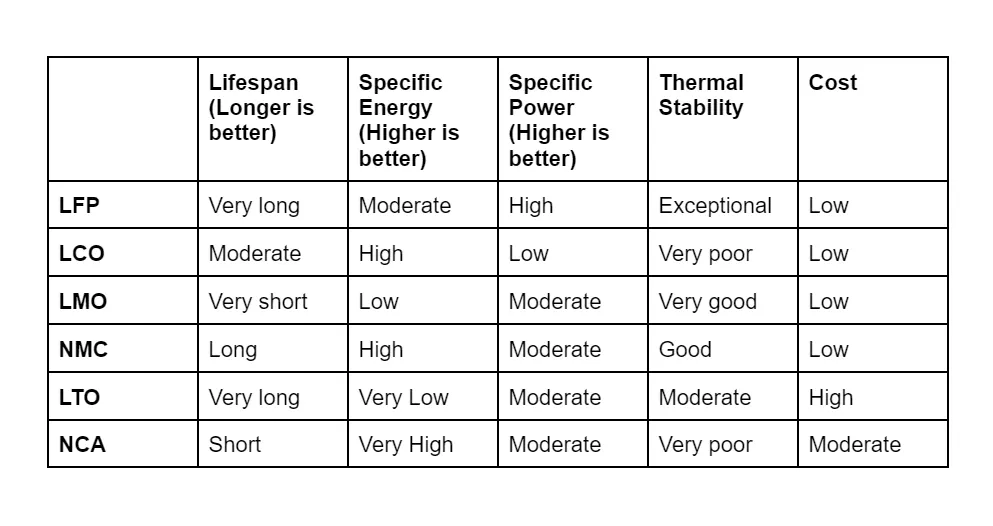
Table: The summary of different types of lithium-ion batteries characteristics, applications and performce
Battery Type | Lithium Cobalt Oxide (LCO) | Lithium Manganese Oxide (LMO) | Lithium Nickel Manganese Cobalt Oxide (NMC) | Lithium Iron Phosphate (LFP) | Lithium Nickel Cobalt Aluminum Oxide (NCA) | Lithium Titanate (LTO) |
Chemistry | LiCoO2 cathode, graphite anode | LiMn2O4 cathode, graphite anode | LiNiMnCoO2 cathode, graphite anode | LiFePO4 cathode, graphite anode | LiNiCoAlO2 cathode, graphite anode | Li2TiO3 (titanate) anode, MnO or NMC cathode |
Voltage (Nominal) | 3.60V | 3.70V (3.80V) | 3.60V, 3.70V | 3.20V, 3.30V | 3.60V | 2.40V |
Operating Range | 3.0–4.2V/cell | 3.0–4.2V/cell | 3.0–4.2V/cell (or higher) | 2.5–3.65V/cell | 3.0–4.2V/cell | 1.8–2.85V/cell |
Specific Energy (Capacity) | 150–200 Wh/kg (up to 240 Wh/kg) | 100–150 Wh/kg | 150–220 Wh/kg | 90–120 Wh/kg | 200–260 Wh/kg (up to 300 Wh/kg) | 50–80 Wh/kg |
Charge (C-rate) | 0.7–1C, 3h typical charge | 0.7–1C typical, 3C max, 3h typical | 0.7–1C, 3h typical charge | 1C typical, 3h typical charge | 0.7C typical, 3h charge (fast charge possible) | 1C typical, 5C max, charges to 2.85V |
Discharge (C-rate) | 1C, 2.50V cut-off | 1C, 10C possible, 30C pulse (5s), 2.50V cut-off | 1C, 2C possible, 2.50V cut-off | 1C, 25C (some cells), 2.50V cut-off | 1C typical, 3.00V cut-off | 10C possible, 30C pulse, 1.80V cut-off |
Cycle Life | 500–1000 cycles | 300–700 cycles | 1000–2000 cycles | 2000+ cycles | 500 cycles | 3000–7000 cycles |
Thermal Runaway | 150°C (302°F) | 250°C (482°F) | 210°C (410°F) | 270°C (518°F) | 150°C (302°F) | Very safe, among the safest |
Cost | ~$420 per kWh | N/A | ~$420 per kWh | ~$580 per kWh | ~$350 per kWh | ~$1005 per kWh |
Applications | Mobile phones, tablets, laptops, cameras | Power tools, medical devices, electric powertrains | E-bikes, medical devices, EVs, industrial | Portable and stationary energy storage | Medical devices, industrial, EVs (Tesla) | UPS, EVs, solar-powered street lighting |
Reference:
Miao, Yu & Hynan, Patrick & von Jouanne, Annette & Yokochi, Alexandre. (2019). Current Li-Ion Battery Technologies in Electric Vehicles and Opportunities for Advancements. Energies. 12. 1074-1094. 10.3390/en12061074.
https://www.onecharge.biz/lithium-cell-chemistry/
https://linkedin.com/pulse/all-types-lithium-ion-batteries-vijay-tharad-luhgc
https://nap.nationalacademies.org/read/25542/chapter/10