Week 1 Understanding Different Battery Chemistry
Prepare a table which includes materials & chemical reactions occurring at the anode and cathode of LCO, LMO, NCA, NMC, LFP and LTO type of lithium ion cells.Give your detailed explanation on it.
Compare the differences between each type of Li+ion batteries based on their characteristics.
Battery:
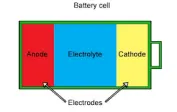
A battery is a device which converts chemical energy contained within its active materials directly into electrical energy by means of electrochemical Oxidation-Reduction (Redox) reaction. This type of reaction involves the transfer of eectrons from one material to another via an electric circuit. It consisting of one or more electrochemical cells with external connections for powering electrical devices such as flashlights, mobile phones, and electric cars. When a battery is supplying electric power, its positive terminal is the cathode and its negative terminal is the anode.
Types of Batteries:
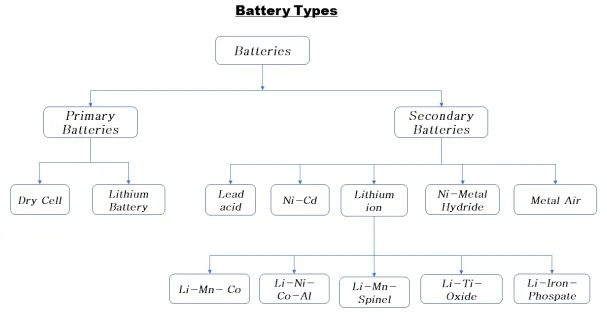
Batteries are basically two types:
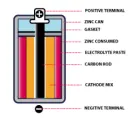
Primary Batteries (Non-Rechargeable Batteries): These are known as one time used batteries, because they can not
rechargeable.
Secondary Batteries (Rechargeable Batteries): These are known as reusable batteries, because they can rechargeable.
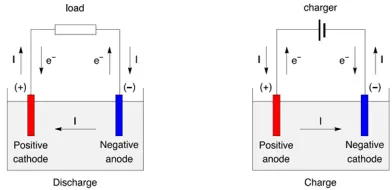
During discharge the electrons flow from anode to cathode i.e.; the flow of current is from cathode to anode. Vice-versa during
charging.
Lithium-ion Battery:
Lithium-ion is named for its active materials; the words are either written in full or shortened by their chemical symbols. A series of letters and numbers strung together can be hard to remember and even harder to pronounce, and battery chemistries are also identified in abbreviated letters.
Types of Lithium ion Battery Technologies:
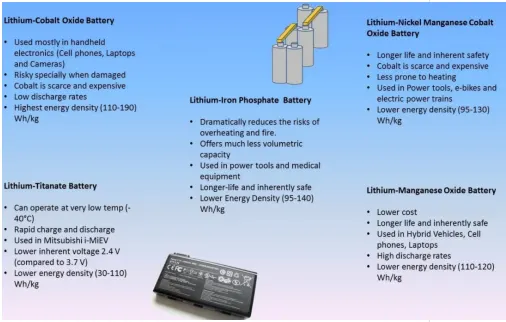
- Lithium Cobalt Oxide (LCO)
- Lithium Manganies Oxide (LMO)
- Lithium Nickel Cobalt Aluminium (NCA)
- Nickel Manganies Cobalt (NMC)
- Lithium Titanite (LTO)
- Lithium Iron Phospate (LFP)
|
Lithium Ion Type |
LCO | LMO | NMC | LFA | NCA | LTO |
|
Chemical Name |
LiCoO2 | LiMn2O4 | LiNiMnCoO2 | LiFePO4 | LiNiCoAlO2 | Li2TiO3 |
|
Anode Material |
Graphite | Graphite | Graphite | Graphite | Graphite | Li2TiO3 |
|
Cathode Material |
LiCoO2 | LiMn2O4 | LiNiMnCoO2 | LiFePO4 | LiNiCoAlO2 | LiMnO2 |
|
Electrolyte |
Ehelyne Carbonate |
Lithium Halide | Lithium Salt | Ethynal Carbonate | Ethynal Carbonate | Lithium Salt |
|
Separator |
Polyolefin | Polyolefin | Polyolefin | Polyolefin | Polyolefin | Polyolefin |
|
Anode Reaction (Discharge) |
Li+ C6 → xLi+ + C6 + xe− | Li + C6 → xLi + + C6 + xe − |
Li+ C6 → xLi+ + C6 + xe− | Li+ C6 → xLi+ + C6 + xe− | Li + C6 → xLi + + C6 + xe − |
Li+ C6 → xLi+ + C6 + xe− |
|
Cathode Reaction (Discharge) |
Li1−x + CoO2 + xLi + xe− → LiCoO2 | Li1−x + Mn2O4 + xLi + xe− → LiMnO2 | Li1−x + MO2 + xLi + + xe− → LiMO2 |
LiFe3PO4 + xLi+ + xe+ → LiFe2PO4 | Li1−x + MO2 + xLi+ + xe _ → LiMO2 |
4Mn2O4 + 4Li + + 4e _ → 4LiMn2O4 |
|
Overal Reaction |
C6 + LiCoO2 ⇔ LixC6 + Li1−xCoO2 | LiC6 + Mn2O4 ⇔ C6 + LiMnO2 | Li1−x + MO2 + LiC6 ⇔ Li1−xMO2 + C6 | LiFePO4 + 6C ⇔ LiC6 + FePO4 | Li1−xMO2 + LiC6 ⇔ Li1−xMO2 + C6 | Li4Ti5O2 + 4Mn2O4 ⇔ 4LiMn2O4 + Ti5O12 |
|
Nominal Voltage |
3.6V | 3.7-3.8V | 3.6-3.7V | 3.2-3.3V | 3.6V | 2.4V |
|
Operating Voltage |
3-4.2V/cell | 3-4.2V/cell | 3-4.2V/cell | 2.5-3.6V/cell | 3-4.2V/cell | 1.8-2.85V/cell |
|
Energy Capacity |
up to 240Wh/kg | 100-150Wh/kg | 150-220 Wh/kg | 90-120Wh/kg | 200-260Wh/kg | 50-80Wh/kg |
|
Life Cycle |
500-1000 | 300-700 | 1000-2000 | 2000 & Higher | 500 | 3000-7000 |
|
Thermal Runaway |
150°C | 250°C | 210°C | 270°C | 150°C | One of safest Li-ion cells |
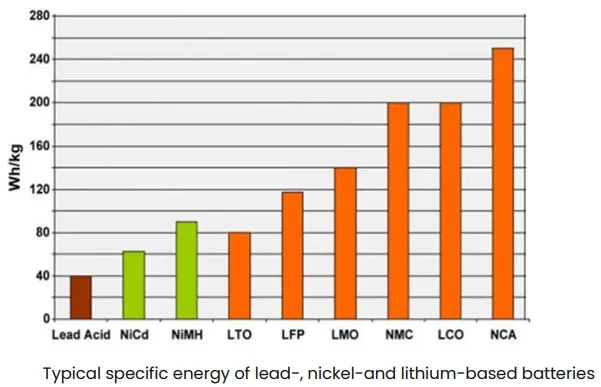
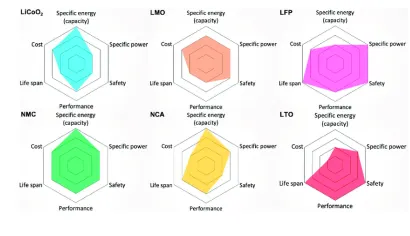
Li-aluminum (NCA) is the clear winner by storing more capacity than other systems, this only applies to specific energy. In terms of specific power and thermal stability, Li-manganese (LMO) and Li-phosphate (LFP) are superior. Li-titanate (LTO) may have low
capacity but this chemistry outlives most other batteries in terms of life span and also has the best cold temperature performance.
Moving towards the electric powertrain, safety and cycle life will gain dominance over capacity. (LCO stands for Li-cobalt, the original Li-ion.)
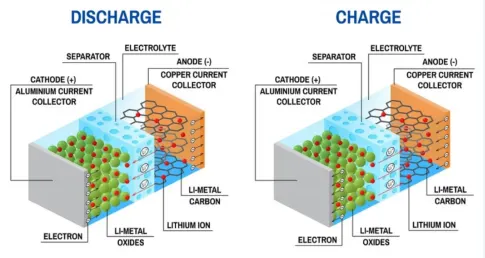
Structure of Lithium Ion Batteries: