Week 1 Understanding Different Battery Chemistry
1.Prepare a table which includes materials & chemical reactions occurring at the anode and cathode of LCO, LMO, NCA, NMC, LFP and LTO type of lithium ion cells.Give your detailed explanation on it
A lithium-ion battery is a family of rechargeable battery types in which lithium ions move from the negative electrode to the positive electrode during discharge and back when charging.
Li-ion batteries are an evolving technology of interest. Small lithium-ion batteries are widely used in portable electronic devices, and a few large lithium-ion batteries have been produced to power EVs.
Table
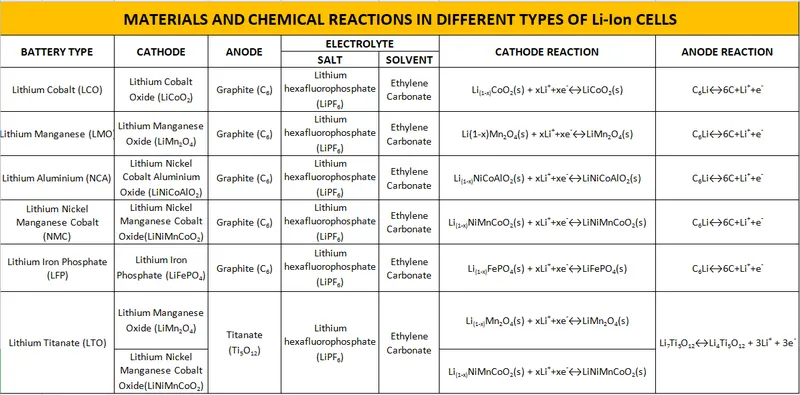
LTO: Li-titanate oxide (LTO) replaces the graphite in the anode of the typical Li-Ion battery and forms the materials into a spinel 3D crystal structure
LCO: Lithium-Cobalt batteries have three key components: The cathode is an electrode that carries a positive charge, and is made of lithium metal oxide combinations of cobalt, nickel, manganese, iron, and aluminum. The anode is an electrode that carries a negative charge, usually made of graphite
LMO:A lithium ion manganese oxide battery (LMO) is a Li-ion that uses manganese dioxide, MnO2
as the cathode material.
2.Compare the differences between each type of Li+ion batteries based on their characteristics
The six lithium-ion battery types that we will be comparing and firstly an understanding of the key terms below will allow for a simpler and easier comparison.
Specific energy: This defines the battery capacity in weight (Wh/kg). The capacity relates to the runtime. Products requiring long runtimes at moderate load are optimized for high specific energy.
Specific power: It's the ability to deliver a high current and indicates loading capability. Batteries for power tools are made for high specific power and come with a reduced specific energy.
Performance: This measures how well the battery works over a wide range of temperatures. Most batteries are sensitive to heat and cold and require climate control. Heat reduces life, and cold lowers performance temporarily.
Lifespan: This reflects cycle life and longevity and is related to factors such as temperature, depth of discharge, and load. Hot climates accelerate capacity loss.
Safety: This relates to factors such as the thermal stability of the materials used in the batteries. The materials should have the ability to sustain high temperatures before becoming unstable
Cost: Demand for electric vehicles has generally been lower than anticipated and this is mainly due to the cost of lithium-ion batteries. Hence cost is a huge factor when selecting the type of lithium-ion battery.
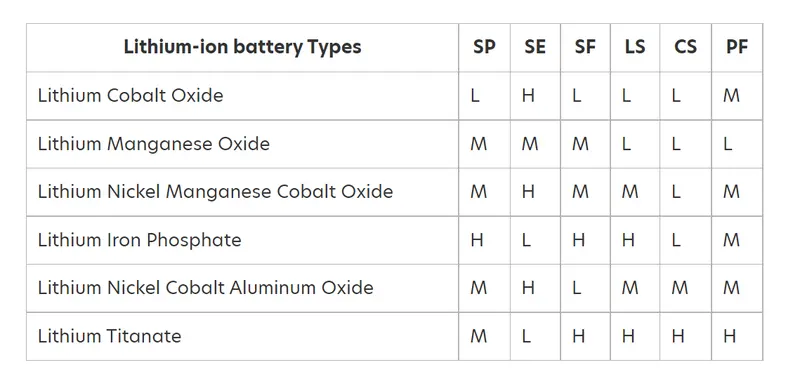
- SP stands for specific power
- SE stands for specific energy
- SF stands for safety
- LS stands for lifespan
- CS stands for cost
- PF stands for performance
- L stands for low
- M stands for moderate
- H stands for high
45-DAYS PROGRAM (EV BATCH-20)