Week 1 Understanding Different Battery Chemistry
Abstract:
The Lithium-ion battery is one of the most common batteries used in Electric Vehicles (EVs) due to the specific features of high energy
density, power density, long life span and environment friendly. With the development of lithium-ion battery technology, different materials have been adopted in the design of the cathodes and anodes in order to gain a better performance. LiMn2O4, LiN iMnCoO2,
LiN iCoAlO2, LiF eP O4 and Li4T i5O12 are five common lithium-ion batteries adopted in commercial EVs nowadays. The characteristics
of these five lithium ion batteries are reviewed and compared in the aspects of electrochemical performance and their practical
applications.
Introduction:
With increasing public concerns about rising gasoline prices and climate change, battery electric, hybrid electric, and plug-in hybrid
electric vehicles offer substantial promise of reducing fuel consumption and the impact of transportation on the environment, without
the need for a large new alternative fuel infrastructure. While their use is promising, battery and hybrid electric vehicles also present
significant engineering challenges. High-voltage battery vehicles must meet stringent safety requirements and yet achieve the
driving range, reliability, and cost targets expected by consumers.
Current vehicle manufacturers are developing and commercializing all-electric and range extended plug-in vehicles. These BEVs and
PHEVs plug directly into the electrical grid to charge the propulsion battery. When compared to current commercial hybrid vehicles,
which use a combination of battery and internal combustion engine, the BEVs and PHEVs require greatly improved battery systems.
The improved battery systems need between 15 and 50 times the amount of energy storage and must allow for greater depth of
discharge of the battery during operation. One of the leading battery types possessing the performance characteristics needed to
enable the BEVs and PHEVs is lithium-ion. The performance characteristics of large battery systems are determined by the basic
electrochemistry that occurs at the interfaces of the system components at the cell level. The main electrochemical interfaces in the
cell are between the anode, electrolyte, and cathode. The choice of the anode and cathode determines the voltage, capacity, and
specific energy. The performance requirements of the automotive drive train that uses the Li-ion battery will determine what specific
embodiment of the battery is needed. This section of the report discusses Li-ion battery electro chemistries that are available or in
development that might be considered for Li-ion battery vehicles. This section also identifies candidate materials used for the anode,
cathode, and electrolyte and their electrochemical interactions, and it describes electrical performance of different cell chemistries
and failure modes and hazards at the electrochemical level.
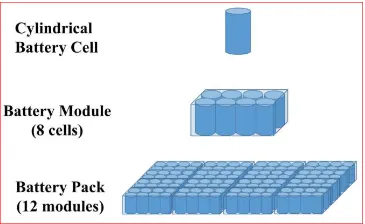
A “cell” is the fundamental building block of an electrochemical system. Cells are built up to battery modules, and modules are built
up to battery packs and battery systems, as illustrated in Figure:
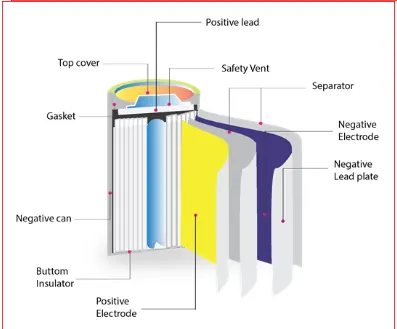
Cathode: positive electrode; accepts electrons during battery discharge.
Anode: negative electrode; gives up electrons during battery discharge.
Electrolyte: transfers ions between the anode and cathode.
Separator: solid material between the anode and cathode that serves two roles:
Prevents internal short circuiting between the anode and cathode by preventing direct electron flow from the anode to the
cathode.
Provides a path for ionic conduction in the liquid electrolyte within the interconnected porous structure of the separator
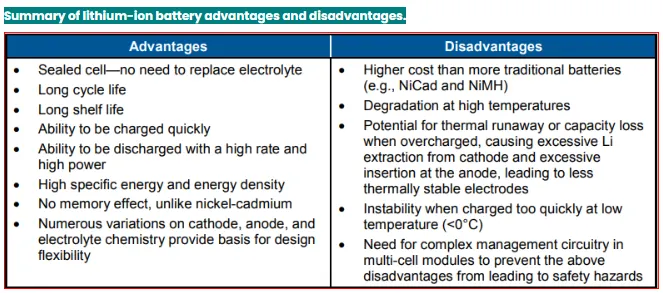
For each subcomponent, there are numerous variations both in commercially available cells and those still under research. Each
combination of cathode chemistry, anode chemistry, electrolyte composition and additives, and separator type provides a range of
power densities, charge regimes, capacities, charge management techniques, and safety concerns and challenges.
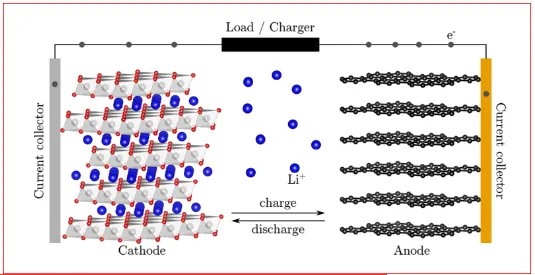
During battery operation (i.e., charging and discharging), ions move back and forth between the cathode and anode through the
electrolyte, and electrons move through the external circuit. During cell discharging, the anode oxidizes (loses electrons) and the
cathode experiences a reduction (gains electrons). While this is occurring, Li+ ions are transferred through the electrolyte from the
anode to the cathode. During charging, this process is reversed. The electrochemical process that occurs during charge and
discharge is an “intercalation” process, in which Li-ions become temporary “guests” to the host electrodes without any major
structural change to the electrodes. The majority of what happens during this process is reversible.
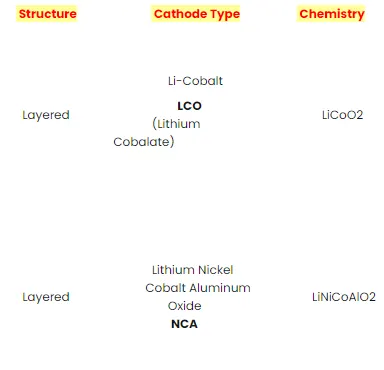
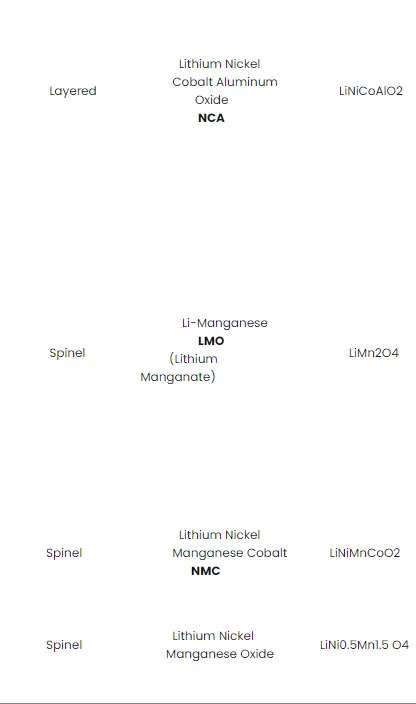
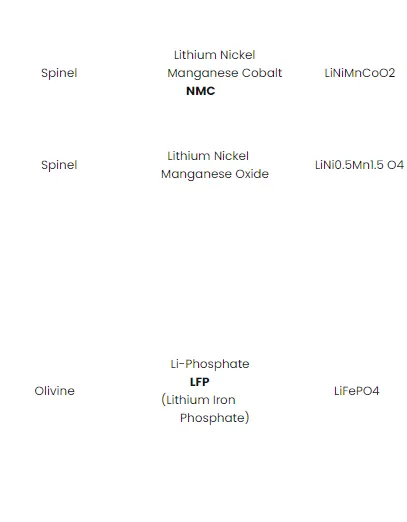
Cathode :
The cathode is a host structure, where lithium-ions can be reversibly inserted and removed. Beside a high specific capacity, a high
and stable voltage versus lithium metal; A cathode in an electrochemical cell accepts electrons and ions during discharge of a cell.
The active material of a cathode in a Li-ion cell is made from a combination of a lithium metal oxide or lithium metal phosphate, a
polymer binder (polyvinylidene fluoride [PVDF], carboxymethylecellulose or styrene/butadiene rubber) and conductive filler (carbon
black). These materials are made using standard inorganic material manufacturing processes. The active materials adhere to a metallic current collector.
Anode :
An anode in an electrochemical cell loses electrons and ions during the discharge of the cell. The anodes in Li-ion cells are typically
carbon-based materials. A wide variety of carbons are used as negative electrodes today. Common forms include graphene,
graphite, and carbon black. These forms can be oriented as planar, whiskers, or spherules. Graphite is one of the most commonly
used anode materials. It stores lithium well within its structure and maintains stability over a long cycle life.
Solid electrolyte interface (SEI) Layer :
During the first cycle in Li-ion batteries, a semi-permanent coating layer is formed on the anode and cathode, called the solid
electrolyte interface (SEI). This layer is a significant enabling feature of Li-ion technology. This is because the graphite electrode
potential is so negative that the Li-ions between the carbon layers would be expected to react immediately with the solvent of the
electrolyte. The SEI is permeable to Li-ions but not to the electrolyte, and its stability is an important requirement for long operating
life.
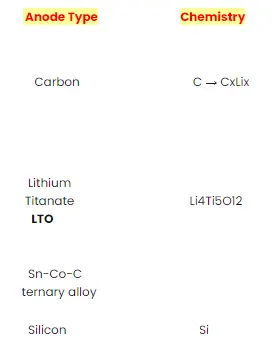
In some instances, lithium titanate is used as the active material in the anode. It has a less negative voltage than the graphite
anodes. This enables the Li-ions to be more stable and less likely to react with the electrolyte. For lithium titanate, no SEI is formed and
the cell is more stable at higher voltages. Table below outlines some of the anode materials in use or under development. The majority of cells use a carbon based anode, and the other three outlined are still primarily in the research phase of development.
Electrolyte:
The electrolyte is the physical medium that allows ionic transport between the electrodes during charging and discharging of a cell.
Electrolytes in Li-ion batteries may either be a liquid or a gel. Lithium batteries use non-aqueous electrolytes because of reactivity of
lithium with aqueous electrolytes and the inherent stability of non-aqueous electrolytes at higher voltages. Liquid electrolytes are a
combination of a solution of solvents and lithium salts, as well as additives that improve the cell performance. The liquid electrolyte in
Li-ion cells is typically lithium hexafluorophosphate (LiPF6) dissolved in a mixture of organic solvents (mainly carbonates), which must
be formulated to match the electrode materials used. With gel electrolytes, also known as lithium polymer cells, a monomer is added
to the electrolyte during the assembly of the cell and is thermally activated. This reaction creates a polymer electrolyte that
encompasses the entire internal geometry of the cell.
Separator:
The separator is a microporous, electrically insulating material that is positioned between the anode and the cathode. The separator
performs two critical roles. First, it prevents internal short circuiting between the anode and cathode by providing a physical, nonelectrically conductive barrier. Second, it provides a path for ionic transport.
What is a Battery?
A battery is a device that stores chemical energy and converts it to electrical energy.
It consists of one or more electrochemical cells with external connections for powering electrical devices such as flashlights, mobile phones, and electric cars.
The chemical reactions in a battery involve the flow of electrons from one material (electrode) to another, through an external circuit.
The flow of electrons provides an electric current that can be used to do work.
Types of Battery
Battery cells are mainly divided into 2 types :
1) Primary cells – Non chargeable cells
2) Secondary cells – chargeable cells –
Primary cells are Non chargeable cells which are used in appliances such as wrist watch, calculator & radio
e.g. Dry cell, Li battery
Secondary cells are chargeable cells which can undergo Reversible chemical process i.e., Electrical energy to chemical energy.
E.g. Lead cell, Ni-cd cell, metal air, Ni metal Hydride, Li ion Battery cells
The reason for using Li ion Battery in many application is because of High energy density.
Energy Density: The energy density is the total amount of energy that can be stored per unit mass or volume. This determines how long your device stays on before it needs a recharge
Battery cells are usually made up of three main components:
1. The Anode (Negative Electrode)
2. The Cathode (Positive Electrode)
3. The electrolytes
During Discharge, The anode is a negative electrode that produces electrons to the external circuit to which the battery is connected.
When batteries are connected, an electron build up is initiated at the anode which causes a potential difference between the two electrodes. The electrons naturally then try to redistribute themselves, this is prevented by the electrolyte, so when an electrical circuit is connected, it provides a clear path for the electrons to move from the anode to the cathode thereby powering the circuit to which it is connected.
During charging, the Li ions move back from cathode to Anode as shown in Fig.1.3.
How does Li-ion Battery work?
Lithium Battery Technologies:
Lithium Ion Battery technology is based on Intercalation, which is actually the addition of lithium ions into a host material without
significantly changing the host's structure. During a discharge cycle, lithium atoms in the anode are ionized and separated from their
electrons. The lithium ions move from the anode via electrolyteas medium and pass through micro-permeable separator which is in
between anode and cathode until they reach the cathode, where they recombine with their electrons. The lithium ions are small
enough (third only to hydrogen and helium), which translates into faster charge/discharge capabilities and high charge storage
capability per unit mass and unit volume. The single cell voltage in Li-ion battery is difference in the energy between the Li+ ions that
are present in the crystalline structure of the two electrodes.
Apart from three vital ingridents namely Cathode, Anode,and an electrolyte, an electronic controller, which regulates power,
discharge flows, and moniters battery temperature is also an important and integral part of Lithium-Ion Battery. This incorporation of
electronics takes care of special safety precautions need to be taken in order to ensure that the opera
In a lithium-ion battery, lithium atoms at the anode (-ve) split. This makes electrons and lithium ions (lithium atoms with a positive charge). The lithium ions move within the battery to the cathode (+ve) through an electrolyte. Electrons generally can’t pass through this material. So the electrons take a different path to the cathode through an external circuit. That creates an electric current that can power a device. At the cathode, the electrons meet up with the lithium ions for another chemical reaction.
To charge a battery, this process runs in reverse. The ions and electrons journey back to the anode. In a lithium-ion battery, that anode usually is graphite. The lithium ions tuck between the atom-thin layers of the graphite. The cathode can be one of several lithium-containing materials.
Before choosing the type of battery there are some important points to be considered which affects the battery performance.
Specific energy: This defines the battery capacity in weight (Wh/kg). The capacity relates to the runtime. Products requiring long
runtimes at moderate load are optimized for high specific energy.
Specific power: It's the ability to deliver high current and indicates loading capability. Batteries for power tools are made for high
specific power and come with reduced specific energy.
Nominal Voltage: It is the system voltage at which the device is designed to operate. The rated voltage is usually higher than the
nominal voltage to ensure the safe operation of the device.
Cycle: The charge and discharge make a Cycle
The current rate (C): This is used to determine the fast charging capability of a battery.
Thermal Runaway: It is a condition where an increase in temperature changes the conditions which increase the temperature
further, often leading to disaste
Performance: This measures how well the battery works over a wide range of temperature. Most batteries are sensitive to heat
and cold and require climate control. Heat reduces the life, and cold lowers the performance temporarily.
Lifespan: This reflects cycle life and longevity and is related to factors such as temperature, depth of discharge and load. Hot climates accelerate
capacity loss. Cobalt blended lithium ion also usually have a graphite anode that limits the cycle life.
Safety: This relates to factors such as the thermal stability of the materials used in the batteries. The materials should have the
ability to sustain high temperatures before becoming unstable instability can lead to thermal runaway in which flaming gases
are vented. Fully charging the battery and keeping it beyond the designated age reduces safety.
Cost: Demand for electric vehicles has generally been lower than anticipated and this is mainly due to the cost of lithium-ion
batteries. Hence cost is a huge factor when selecting the type of lithium-ion battery.
Types of Li-ion Battery
1) Lithium Cobalt Oxide (LiCoO2) — LCO
2) Lithium Manganese Oxide (LiMn2O4) — LMO
3) Lithium Nickel Manganese Cobalt Oxide (LiNiMnCoO2) - NMC
4) Lithium Iron Phosphate (LiFePO4) — LFP
5) Lithium Nickel Cobalt Aluminum Oxide (LiNiCoAlO2) — NCA
6) Lithium Titanate (Li2TiO3) — LTO
Below is the Table created to compare different Li-ion battery :
| Sl.no. | Li - ion Battery Type | Cathode | Anode | Advantages | Drawbacks | Applications | Structure | ||
| 1 | (LiCoO2) — LCO | Li Cobalt oxide | Graphite carbon | high specific energy | short life span, low thermal stability and limited load capabilities (specific power), Cobalt is expensive | mobile phones, laptops and digital cameras | |||
| 2 | (LiMn2O4) — LMO | lithium manganese oxide | Graphite carbon | lower internal resistance and improved current handling, high thermal stability and enhanced safety | cycle and calendar life are limited | Electric vehicles such as the Nissan Leaf, Chevy Volt and BMW i3, Power tools, medical devices, electric powertrains | 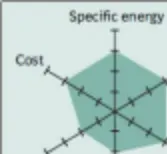 |
||
| 3 | (LiNiMnCoO2) — NMC | Lithium Nickel Manganese Cobalt Oxide | Graphite carbon | good overall performance and excels on specific energy, lowest self-heating rate | high cost due to cobalt | E-bikes, medical devices, EVs, industrial | 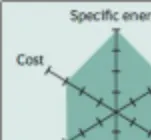 |
||
| 4 | (LiFePO4) — LFP | Lithium Iron Phosphate | Graphite carbon | high current rating and long cycle life, besides good thermal stability, enhanced safety and tolerance if abused. | higher self-discharge, less specific energy | Portable and stationary needing high load currents and endurance | 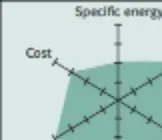 |
||
| 5 | (LiNiCoAlO2) — NCA | Lithium Nickel Cobalt Aluminum Oxide | Graphite carbon | high specific energy, reasonably good specific power, long life span | High cost and marginal safety | Medical devices, industrial, electric powertrain (Tesla) | 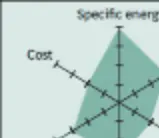 |
||
| 6 | (Li2TiO3) — LTO | lithium manganese oxide or NMC | Li2TiO3 (titanate) | Fast charging, safe, high discharge current of 10C | Low specific energy | UPS, electric powertrain (Mitsubishi i-MiEV, Honda Fit EV), solar-powered street lighting |
 |
||
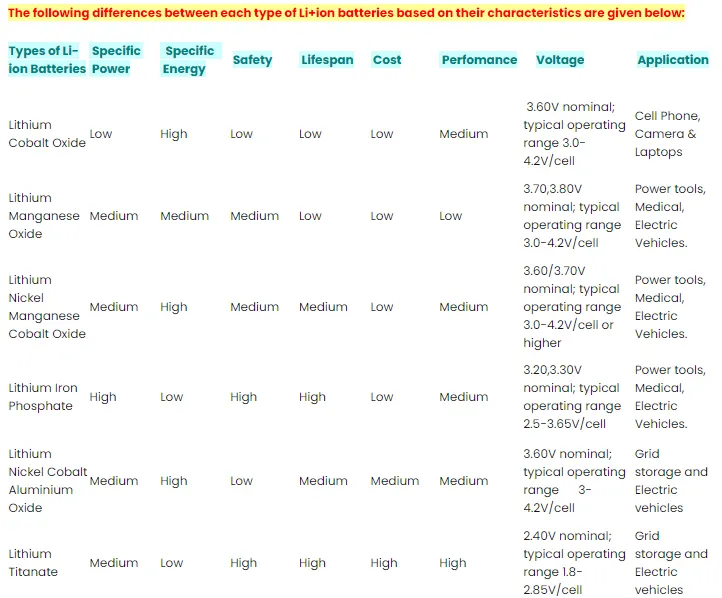
The table above compares the voltages and typical applications of the six basic lithium battery chemistries. Other characteristics
of these batteries include:
LCO– 200Wh/kg, deliver a high power, but with the tradeoff of relatively short lives, low power ratings, and low thermal stability.
LFP– 120Wh/kg, have long cycle lives and stability at high operating temperatures.
LMO– 140Wh/kg, cathodes are based on manganese-oxide components that are abundant, inexpensive, non-toxic, and provide
good thermal stability.
NCA– 250Wh/kg, offers high specific energy and long cycle lives.
NMC– 200Wh/kg, varying the proportions of the chemical constituents allows the development of batteries optimized as power
or energy cells. Because of its flexibility, it is one of the most successful lithium battery chemical systems.
LTO– 80Wh/kg, lowest specific energy, but can be fast charged, discharged at up to 10-times its rated capacity, and is safe.
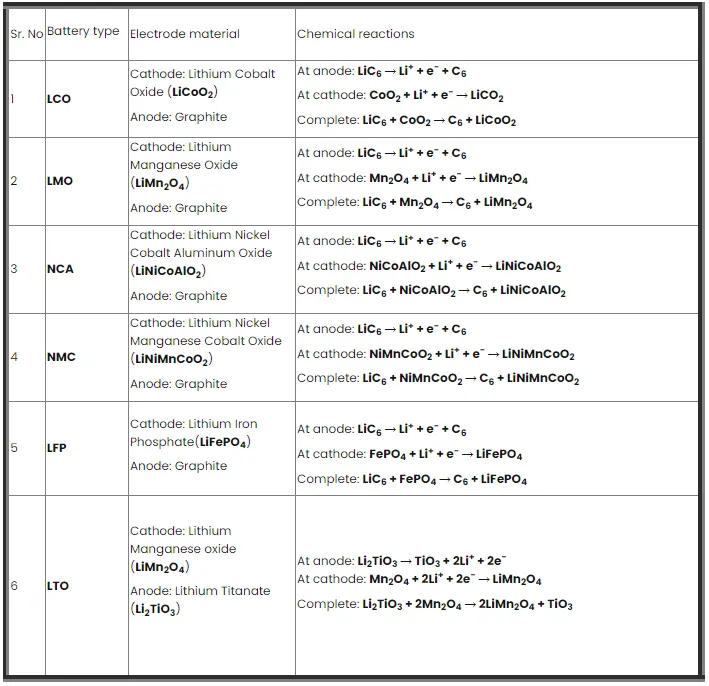
Chemical reactions in different Battery :
Conclusion:
1. LiMn2O4, LiN iMnCoO2, LiN iCoAlO2, LiF eP O4 and Li4T i5O12 batteries have been adopted in EVs successfully with their specific
features.
2. LiMn2O4 battery has low resistance due to the spinel structure, this allows LiMn2O4 battery to offer an excellent performance at
high current rate in applications. The extremely low cost makes it highly favoured by the market. Poor performance at high
temperature and limited cyclability are the downsides.
3. LiN iMnCoO2 battery has a satisfactory overall performance especially for the high specific energy. A variety of derivatives of LiN
iMnCoO2 enable this type lithium-ion battery to face different applications. The extremely high specific energy and moderate
life span allows LiN iCoAlO2 to be a good candidate for EVs. High cost and low level of safety are the negatives.
4. The key benefits of LiF eP O4 battery are the long life span and low cost. It has good thermal stability when it operates at high
temperature but the capacity is greatly attenuated at low temperature. Low specific energy and elevated self-discharge are
the main disadvantages.
5. Li4T i5O12 battery has the best thermal stability, cyclability and safety performance among these five lithium-ion batteries. No
lithium plating at high current rate supports Li4T i5O12 battery for fast charging. However, the low specific energy and extremely
high cost are the major disadvantages.