Week 1 Understanding Different Battery Chemistry
Aim: To represent the materials and chemical reactions for the types of lithium ion cells, and compare the differemces between the lithium ion batteries based on their characters.
Objective of the project:
- Prepare the table containing materials and chemical reactions of the lithium ion cells.
- Explain the reactions in details.
- Compare the differences between the lithium ion batteries.
Body of the content:
The cell materials cathode, anode and the redox reactions are tabulated in the below table:
| CELL | MATERIALS | REACTIONS (Charge `harr` Discharge) | |||
| CATHODE | ANODE | CATHODE |
ANODE |
Overall | |
| Lithium Cobalt Battery (LCO)- 1991 | LiCoO2 (60% COBALT) | GRAPHITE | `CoO_2 + Li^+ + e^- . → LiCoO_2` | `LiC_6 → C_6 + Li^+ + e^-` | LiC6 + CoO2 ⇄ C6 + LiCoO2 |
| Lithium Manganese Oxide (LMO)-1996 | LiMn2O4 | GRAPHITE | `Li_m−n Mn_2O_4 + nLi^+ + n e^− harr Li_mMn_2O_4` | `Li_nC_6 harr nLi^+ + n e^−` | `Li_nC_6 + Li_m − nMn_2O_4 harr Li_0C_6 + Li_mM_(2n) O_4` |
| Lithium Nickel Cobalt Aluminum Oxide (NCA)-1999 | LiNiCoAlO2 (9% Cobalt) |
GRAPHITE | `Li_(m − n)(Ni_xCo_yAl_z)O_2 + nLi^+ + n e^− harr Li_m(Ni_xCo_yAl_z)O_2` | `Li_nC_6 harr Li_0C_6 + nLi^+ + n e^−` | `Li_nC_6 + Li_(m − n)(Ni_xCo_yAl_z)O_2 harr Li_0C_6 + Li_m(Ni_xCo_yAl_z)O_2` |
| Lithium Nickel Manganese Cobalt Oxide (NMC)-2008 | LiNiMnCoO2 | GRAPHITE | `Li_(m − n)(Ni_xMn_yCo_z)O_2 + nLi^+ + n e^− harr Li_m(Ni_xMn_yCo_z)O_2` | `Li_nC_6 harr Li_0C_6 + nLi^+ + n e^−` | `Li_nC_6 + Li_(m − n)(Ni_xMn_yCo_z)O_2 harr Li_0C_6 + Li_m(Ni_xMn_yCo_z)O_2` |
| Lithium Iron Phosphate (LFP)-1996 |
LiFePO4 | GRAPHITE |
`LiFe(III)PO_4+xLi^++xe^−→LiFe(II)PO_4` `FePO_4+Li^++e^−→LiFePO_4` |
`LiC_6→Li^++e^−+C_6` | `Li_nC_6 + Li_(m − n)FePO_4 harr Li_0C_6 + Li_mFePO_4` |
| Lithium Titanate (LTO) -2008 | Lithium Manganese Oxide or NMC | Li2TiO3 | `4Li_(1-x)MnO_4 + 4Li^+ +4 (e^-) harr 4LiMn_2 O_4` | `Li_4 Ti_5O_(12) harr Ti_5O_(12) + 4Li^+ + 4e^-` | `Li_4Ti_5O_12 + 4Mn_2O_4 harr 4LiMn_2O_4+Ti_5O_12` |
There are four main components of a electric cell:
Anode:
- Anode is always the negative electrode which undergoes oxidation.
- Releases the electron while discharging.
Cathode:
- The cathode is the positive terminal in a cell.
- It absorbs the electrons.
Seperator:
- It is the permiable membrane between the cathode and anode.
- It ia permiable to ions.
Electrolyte:
- Electrolyte ios the medium that allows the transportation of the ions.
- The electrlyte is conductive for the ions.
- Non conductive for the electrons.
Explanation:
- Lithium Cobalt Battery (LCO):
- Cathode is LiCoO2.
- Anode is Graphite.
- Reaction at cathode:
- `CoO_2 + Li^+ + e^- . → LiCoO_2`
- Reaction at anode:
- `LiC_6 → C_6 + Li^+ + e^-`
- Overall redox reaction:
- LiC6 + CoO2 ⇄ C6 + LiCoO2
- Lithium Manganese Oxide (LMO):
- Cathode is LiMn2O4.
- Anode is graphite.
- Reaction at cathode:
- `Li_m−n Mn_2O_4 + nLi^+ + n e^− harr Li_mMn_2O_4`
- Reaction at anode:
- `Li_nC_6 harr nLi^+ + n e^−`
- Overall redox reaction:
- `Li_nC_6 + Li_m − nMn_2O_4 harr Li_0C_6 + Li_mM_(2n) O_4`
- Lithium Nickel Cobalt Aluminum Oxide (NCA):
- Cathode is LiNiCoAlO2.
- Anode is graphite.
- Reaction at cathode:
- `Li_nC_6 + Li_m − nMn_2O_4 harr Li_0C_6 + Li_mM_(2n) O_4`
- Reaction at anode:
- `Li_nC_6 harr Li_0C_6 + nLi^+ + n e^−`
- Overall redox reaction:
- `Li_nC_6 + Li_(m − n)(Ni_xCo_yAl_z)O_2 harr Li_0C_6 + Li_m(Ni_xCo_yAl_z)O_2`
- Lithium Nickel Manganese Cobalt Oxide (NMC):
- Cathode is LiNiMnCoO2
- Anode is graphite.
- Reaction at cathode:
- `Li_(m − n)(Ni_xMn_yCo_z)O_2 + nLi^+ + n e^− harr Li_m(Ni_xMn_yCo_z)O_2`
- Reaction at anode:
- `Li_nC_6 harr Li_0C_6 + nLi^+ + n e^−`
- Overall redox reaction:
- `Li_nC_6 + Li_(m − n)(Ni_xMn_yCo_z)O_2 harr Li_0C_6 + Li_m(Ni_xMn_yCo_z)O_2`
- Lithium Iron Phosphate (LFP):
- Cathode is LiFePO4.
- Anode is graphite.
- Reaction at cathode:
- `LiFe(III)PO_4+xLi^++xe^−→LiFe(II)PO_4`
- Reaction at anode:
- `LiC_6→Li^++e^−+C_6`
- Overall redox reaction:
- `Li_nC_6 + Li_(m − n)FePO_4 harr Li_0C_6 + Li_mFePO_4`
- Lithium Titanate (LTO):
- Cathode is Lithium Manganese Oxide or NMC.
- Anode is graphite.
- Reaction at cathode:
- `4Li_(1-x)MnO_4 + 4Li^+ +4 (e^-) harr 4LiMn_2 O_4`
- Reaction at anode:
- `Li_4 Ti_5O_(12) harr Ti_5O_(12) + 4Li^+ + 4e^-`
- Overall redox reaction:
- `Li_4Ti_5O_12 + 4Mn_2O_4 harr 4LiMn_2O_4+Ti_5O_12`
Advantages of the lithium ion batteries:
- Have high energy density.
- Rechargable.
- No memory effect, so no need to discharge completly before charging.
- Has longer life cycle.
- Self discharge is low.
- Shelf life is more.
Disadvnantages of lithium ion battery:
- Can explode under accidental conditions.
- Not suitable for very high temperatures.
- Lithium ions cells are expensive.
- Works for only 5-8 years after manufacturing.
- Environmental impact if not recycled or disposed properly.
2. Difference between the Lithium ion batteries based on the characteristics are mentioned below:
Lithium Cobalt Oxide (LCO):
- Voltages - 3.6V nominal (3-4.2V/cell)
- Specific energy - 150-200 Wh/kg
- C-Rate (Charge/Discharge) - 0.7-1C/1C
- Cycle life - 500 - 1000
- Thermal runaway - 150 C
- Applications - Tablets, Cameras, Laptops, Mobile.
Lithium Manganese Oxide (LMO):
- Voltages - 3.7V (3-4.2V/cell)
- Specific energy - 100-150 Wh/kg
- C-Rate (Charge/Discharge) - 0.7 -1C / 1C
- Cycle life - 300 - 700
- Thermal runaway - 250 C
- Applications - Medical devices, Electric power trains.
Lithium Nickel Manganese Cobalt Oxide (NMC):
- Voltages - 3.6-3.7V (3-4.2V)
- Specific energy - 150-220 Wh/kg.
- C-Rate (Charge/Discharge) - 0.7
- Cycle life - 1000-2000
- Thermal runaway - 210 C
- Applications - Medical devices, EVs, E-bikes.
- Remarks - High specific energy, lower selk heating rate.
Lithium Iron Phosphate (LFP):
- Voltages - 3.2 - 3.3V nominal (2.5- 3.65V cell)
- Specific energy - 90-120 Wh/kg
- C-Rate (Charge/Discharge) - 1C / 1C
- Cycle life - 2000
- Thermal runaway - 270 C
- Applications - Stationary applications with high load capacity.
- Remarks - Flat discharge voltage, high power, low capacity, safe.
Lithium Nickel Cobalt Aluminum Oxide (NCA):
- Voltages - 3.6V nominal (3-4.2V/cell)
- Specific energy - 200 - 260 Wh/kg.
- C-Rate (Charge/Discharge) - 0.7C / 1C.
- Cycle life - 500
- Thermal runaway - 150 C.
- Applications - Medical devices, Electric powertrain.
- Remarks: Wide temperature range, safe and expensive.
Lithium Titanate (LTO):
- Voltages - 2.4V nominal (1.8-2.85V/cell)
- Specific energy - 50 - 80 Wh/kg.
- C-Rate (Charge/Discharge) - 1C/10C.
- Cycle life - 3000 - 7000
- Thermal runaway - Highly safe.
- Applications - High capacity with moderate power.
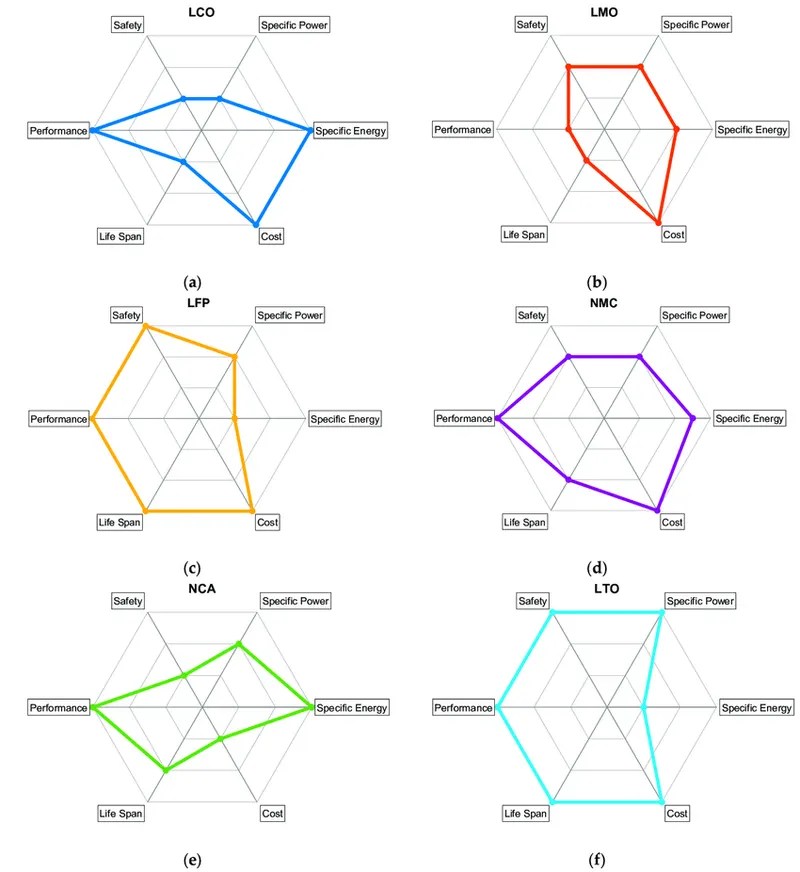
The figure below shows the spider web of the Properties of different Lithium ion cells:
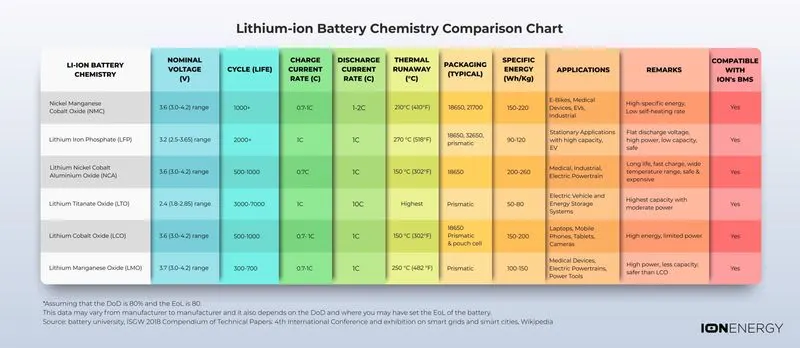
The tabular column shows the comprehensive difference in properties for the lithium ion batteries:
Results:
- The materials and reactions of the lithium ion cells are explained.
- The differences between the lithium ion batteries are explained.
Conclusions:
- The table is prepared for the materials and the reactions occuring in the different lithium ion cells and the detailed explanation is given.
- The differences between the lithium ion batteries are compared.
References:
- Front-matter,
Editor(s): Jürgen Garche, Klaus Brandt,
Electrochemical Power Sources: Fundamentals, Systems, and Applications,
Elsevier,
2019,
Pages i-iii,
ISBN 9780444637772,
https://doi.org/10.1016/B978-0-444-63777-2.00013-X
(https://www.sciencedirect.com/science/article/pii/B978044463777200013X) - Saldaña, Gaizka, José I. San Martín, Inmaculada Zamora, Francisco J. Asensio, and Oier Oñederra. 2019. "Analysis of the Current Electric Battery Models for Electric Vehicle Simulation" Energies 12, no. 14: 2750. https://doi.org/10.3390/en12142750