Week 1 Understanding Different Battery Chemistry
AIM :-
Understand the chemistry of different batteries.
OBJECTIVE :-
- To Prepare a table which includes materials & chemical reactions occurring at the anode and cathode of LCO, LMO, NCA, NMC, LFP
and LTO type of lithium ion cells.Give your detailed explanation on it. - To Compare the differences between each type of Li+ion batteries based on their characteristics.
THEORY:-
A lithium-ion battery or Li-ion battery is a type of rechargeable battery composed of cells in which lithium ions move from the negative electrode through an electrolyte to the positive electrode during discharge and back when charging. Li-ion cells use an intercalated lithium compound as the material at the positive electrode and typically graphite at the negative electrode. Li-ion batteries have a high energy density and low self-discharge. Cells can be manufactured to prioritize either energy or power density. They can however be a safety hazard since they contain flammable electrolytes and if damaged or incorrectly charged can lead to explosions and fires
The main Six types of Lithium Battery Technologies are,
1.NCA-Lithium Nickel Cobalt Aluminium
2.LCO-Lithium cobalt oxide
3.LMO-Lithium Manganese Oxide/Spinels
4.NMC-Lithium Nickel Manganese Cobalt
5.LFP-Lithium Iron Phosphate
6.LTO-Lithium Titanium Oxide
CHEMICAL REACTIONS AND MATERIALS OF LITHIUM BATTERIES
| MATERIALS | CHEMICAL REACTIONS | |
| NCA-Lithium Nickel Cobalt Aluminium |
Anode - Graphite Carbon Cathode - Lithium Nickel Cobalt Electrolyte - Ethylene Carbonate Separator - Polyolefin |
Cathode :
Anode :
Overall :
|
| LCO-Lithium cobalt oxide |
Anode - Graphite Carbon Cathode - Lithium Cobalt Oxide Electrolyte - Ethylene Carbonate Separator - Polyolefin |
Cathode :
Anode :
Overall :
|
| LMO-Lithium Manganese Oxide/Spinels |
Anode - Graphite Carbon Cathode - Lithium Manganese Electrolyte - Ethylene Halide Separator - Polyolefin |
Cathode :
Anode :
Overall :
|
| NMC-Lithium Nickel Manganese Cobalt |
Anode - Graphite Carbon Cathode - Lithium Nickel Manganese Cobalt Electrolyte - Lithium Salt Separator - Polyolefin |
Cathode :
Anode :
Overall :
|
| LFP-Lithium Iron Phosphate |
Anode - Graphite Carbon Cathode - Lithium Iron Phosphate Electrolyte - Ethylene Carbonate Separator - Polyolefin |
Cathode :
Anode :
Overall :
|
|
LTO-Lithium Titanium Oxide |
Anode - Graphite Carbon Cathode - Lithium Titanate Electrolyte - Lithium Salt Separator - Polyolefin |
Cathode :
Anode :
Overall : |
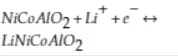
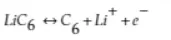


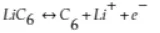


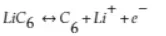

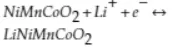



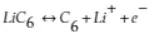

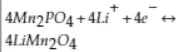
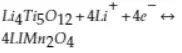
1) LITHIUM COBALT OXIDE(LiCoO2)-(LCO)
LCO stands for Lithium cobalt battery. Lithium cobalt oxide is one of the most common Lithium-ions, it has a chemical symbol which is LiCoO2 and is abbreviated as LCO.
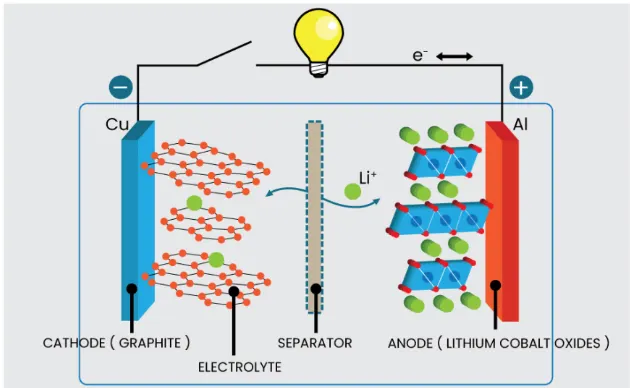
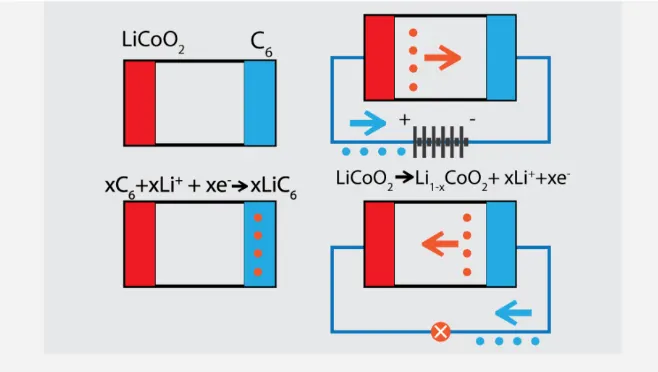
It has high specific energy but low specific power which means that charging and discharging with current rate above rated values shorten the battery's life. It has a cobalt oxide cathode and graphite anode. the cathode is layered. During discharge the Li-ions move from anode to cathode. the flow reverses during charging. the graphite anode limits its cycle life hence it has a short life span. It also has a low thermal stability. It is mainly used in mobile phones,laptops ,cameras etc. As the cathode lithium ions are absorbed by the lithium dioxode and the electrode is reduced as it also recieves the electrons from the circuit
2)LITHIUM MANGANESE OXIDE(LiMn2O4)-(LMO)
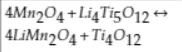
LMO stands for Lithium manganese oxide batteries, which are commonly referred to as lithium-ion manganese batteries or manganese spinel. LMO (Lithium magnesium oxide) was invented in the year 1996. Its anode material is LiaC6, the cathode material is LibMn2O4 and the carrier is Li+. It is used in different applications like power tools and electric cars.LMO batteries have the ability to deliver a lot of energy in a short period of time, which makes them extremely useful for use in power tools like drills.In 1996, lithium manganese oxide was first used as a cathode material. A three dimensional spinel structure was formed by this structure, this improves the flow of ions between the electrodes. The high flow decreases the internal resistance and increases loading capability.LMO batteries are usually used in medical devices and equipment, power tools, electric bikes and more. Because of their thermal resistance and higher safety.
3)LITHIUM NICKEL COBALT ALUMINIUM OXIDE(LiNiCoALO2)-(NCA)
NCA battery stands for Lithium nickel cobalt aluminum oxide based battery (LiNiCoAlO2). Also, NCA batteries are becoming more and more important in in-grid storage and electrical power terrain applications. NCA (Lithium nickel cobalt aluminum oxide) battery was invented in the year 1999. Its anode material is LiaC6, the cathode material is LibNi0.8Co0.15Al0.05O2 and the carrier is Li+. It is used in different applications like power grid applications, medical devices and electric cars. Most notably Tesla deploys NCA batteries in their electric vehicles system. NCA batteries can store the same amount of energy as NMC. NCA batteries are not widely common in the consumer industry, but are quite promising in the electric car industry.
4)LITHIUM NICKEL MANGANESE COBALT OXIDE(LiMnCoO2)-(NMC)
the cathodic combination of nickel manganes cobalt can be tailored to be either energy cells or power cells. NMC has a good performance and excels in specific energy. This Lithium ion battery can deliver a continous dicharge current. The advantage of nicel is its high specifc energy but it has poor stability . Wherras manganese achieves low internal resistance by forming a aspinal structure. unlike nickel , manganes offers low speciif energy.
5)LITHIUM IRON PHOSPATE(LiFePo4)-(LFP)
The lithium iron phosphate battery (LiFePO battery) or LFP battery (lithium ferrophosphate) is a type of lithium-ion battery using lithium iron phosphate (LiFePO4) as the cathode material, and a graphitic carbon electrode with a metallic backing as the anode. The energy density of an LFP battery is lower than that of other common lithium ion battery types such as Nickel Manganese Cobalt (NMC) and Nickel Cobalt Aluminum (NCA), and also has a lower operating voltage; CATL's LFP batteries are currently at 125 watt hours (Wh) per kg, up to possibly 160 Wh/kg with improved packing technology, while BYD's LFP batteries are at 150 Wh/kg, compared to over 300 Wh/kg for the highest NMC batteries. Because of its lower cost, high safety, low toxicity, long cycle life and other factors, LFP batteries are finding a number of roles in vehicle use, utility scale stationary applications, and backup power. LFP batteries are cobalt-free.
6)LITHIUM TITANIUM OXIDE(LiTiO2)-(LTO)
In this technology, Li-titanate replaces the graphite in the anode of a typical Lithium-ion battery and the material forms into a spinel structure.
The cathode can be lithium manganese oxide or NMC. Li-titanate can be fast-charged and delivers a high discharge current 10 times the rated capacity. The cycle count is higher than the regular Li-ion batteries.
Li-titanate excels in safety and has excellent low-temperature discharge characteristics and life span. The applications this lithium ion battery chemistry power include electric powertrains, UPS and solar-powered street lighting.
COMPARING THE DIFFERENCES BETWEEN EACH TYPE OF Li+ ion BATTERIES BASED ON THEIR CHARACTERISTICS
- Nominal voltage : Most of them are very close when it comes to this characteristic. LMO has the highest range and LTO has lowest range in volts.
- Life span : they differ by a significant amount from each other mostly. LTO batter has the longest life cycle thats why it can last for a
longer period of time and it is exactly the opposite for the LMO type batteries. LFP battery also have long life span . LMO has lowest life span . its 300-700 cycles .
- Charge current rate: Higher the charge current, the less time the battery will take to get fully charged. LFP and LTO are highest
- Discharge Current Rates : If the battery is being discharged very quickly (i.e., the discharge current is high), then the amount of energy that can be extracted from the battery is reduced and the battery capacity is lower.I . LTO has a discharge rate 10 times higher then the others.
- Thermal Runaway: Thermal runaway is one of the primary risks related to lithium-ion batteries. It is a phenomenon in which the lithium-ion cell enters an uncontrollable, self-heating state. Thermal runaway can result in: Ejection of gas, shrapnel and/or particulates (violent cell venting) Extremely high temperatures.LTO has the highest temperature rating in this and NCA and LCO has the lowest.
- Specific Energy : the specific energy of a battery is a measure of how much energy a battery contains in comparison to its weight, and is typically expressed in Watt-hours/kilogram (W-hr/kg). NCA has highest specific energy and LTO has lowest specific energy .
- Performance : LTO battery has highest performance and LMO has lowest performance .
- Safety : LFP and LTO batteries are safest batteries .
- Cost : LTO batteries are more costlier as compared to other lithium batteries .
CONCLUSION :-
We have acheived all the objectives and the results are satisfactory .