Understanding Different Battery Chemistry
1.Prepare a table which includes materials & chemical reactions occurring at the anode and cathode of LCO, LMO, NCA, NMC, LFP and LTO type of lithium ion cells.Give your detailed explanation on it
LCO
Lithium cobalt oxide (LiCoO2) is an inorganic compound used as a anode material for lithium ion batteries. LCO basically uses liquid phase synthesis process of lithium ion secondary battery cathode material with layered structure in the current commercial lithium battery (Cobalt acid lithium).
lithium cobalt oxide battery works
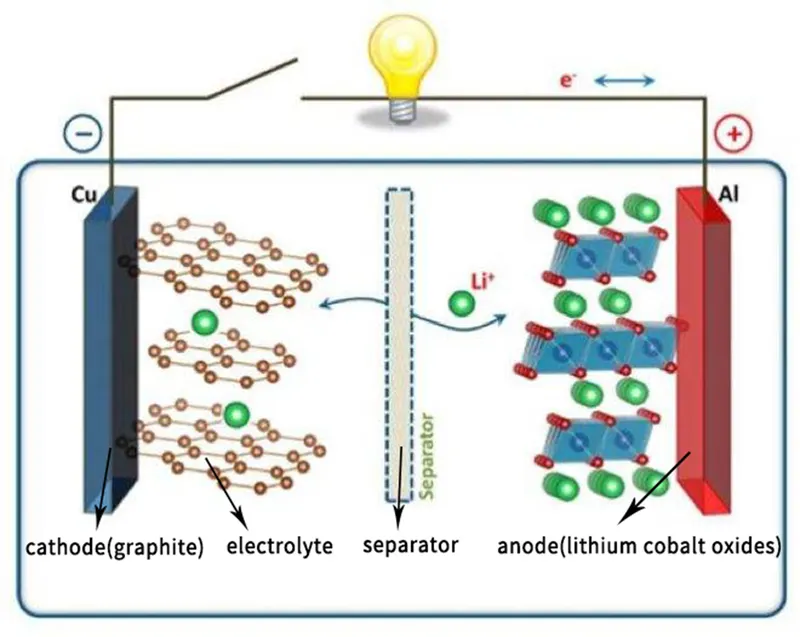
Lithium cobalt oxide battery mainly relies on the intercalation and disintercalation of lithium ions between anode and cathode to realize the storage and release of energy.
While charging, at the external electric field, lithium elements in the LiCoO2 molecules of the anode material become lithium ion with positive charge, which moves from the anode to cathode. After chemical reaction with the carbon atoms of the cathode, LiC6 is formed, which is stably embedded into the layered graphite cathode.
When discharging, on the contrary, in the internal electric field turns, Li+ breaks away from the cathode, goes along the direction of the electric field, returns to the anode, and then becomes LiCoO2. This process called a "rocking chair battery". The more lithium ions involved in back-and-forth embedding and disembedding activities, the more energy the battery can store.
Lithium Cobalt Oxide Battery Reactions
Charging
Anode: LiCoO2 = Li1-xCoO2+xLi++xe-
Cathode: 6C+xLi++xe- = LixC6
Discharging
Anode: Li1-xCoO2+xLi++xe-=LiCoO2
Cathode: LixC6=6C+xLi++xe-
LMO-
Lithium manganate oxide, whose chemical formula is LiMn2O4 (LCM), is one of the promising lithium ion anode materials. Compared with traditional anode materials such as lithium cobalt oxides, lithium manganate oxide has rich resources, low cost, no pollution, good safety and nice rate capability. It is an ideal anode material for power battery.
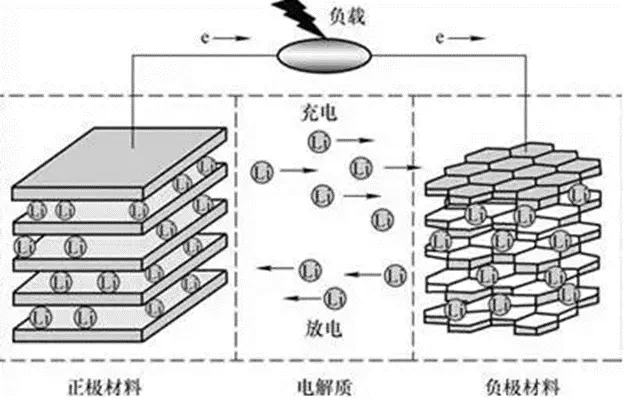
When a lithium manganate oxide battery is charged, lithium ions in the anode detach from the lattice, pass through the electrolyte to the cathode surface and embed into the graphite layer. When you discharge, the process is reversed. In charging and discharging process, lithium ions go between the anode and cathode, which is also known as the "rocking chair" battery.
Charging
When the battery is charged by the power source, the electron on the anode runs to the cathode from the external circuit. The lithium ion (Li+) goes into the electrolyte from the anode, passes through the small winding hole in the separator, reaches the cathode, and combines with the electrons that have already come over.
The reaction on the anode: LiMn2O4==Li1-xMn2O4+Xli++Xe(electron)
The reaction on the cathode: 6C+XLi+Xe==LixC6
Discharging
When the battery discharges, the electron on the cathode runs from the external circuit to the anode, and the lithium ion goes into the electrolyte from the cathode, passes through the small winding hole in the separator runs to the anode, and combines with the electrons that have already come over.
The reaction on the anode Li1-xMn2O4+xli++xe(electron)==LiMn2O4
The reaction on the cathode LixC6==6C+xLi+xe
NCA-
Lithium Nickel-Cobalt-Aluminum Oxide (NCA) is used as the cathode material for lithium ion batteries, and is mainly used in electric automobiles. Due to a high nickel content of the Lithium Nickel-Cobalt-Aluminum Oxide (NCA) manufactured by the company, the capacity of batteries can be increased, which contributes to a longer distance that can be covered with a single-time charging. The company’s strength lies in integrated production from the nickel raw material up to the battery material.
A nickel-cadmium cell has two plates. The active material of the positive plate (anode) is Ni(OH)4 and the negative plate (cathode) is of cadmium (Cd) when fully charged. The electrolyte is a solution of potassium hydroxide (KOH) with a small addition of lithium hydrate which increases the capacity and life of the battery. The specific gravity of the electrolyte is 1.2.
Since the voltage produced by a single cell is very low, many cells are connected in series to get the desired voltage output and then this arrangement is known as the nickel-cadmium battery.
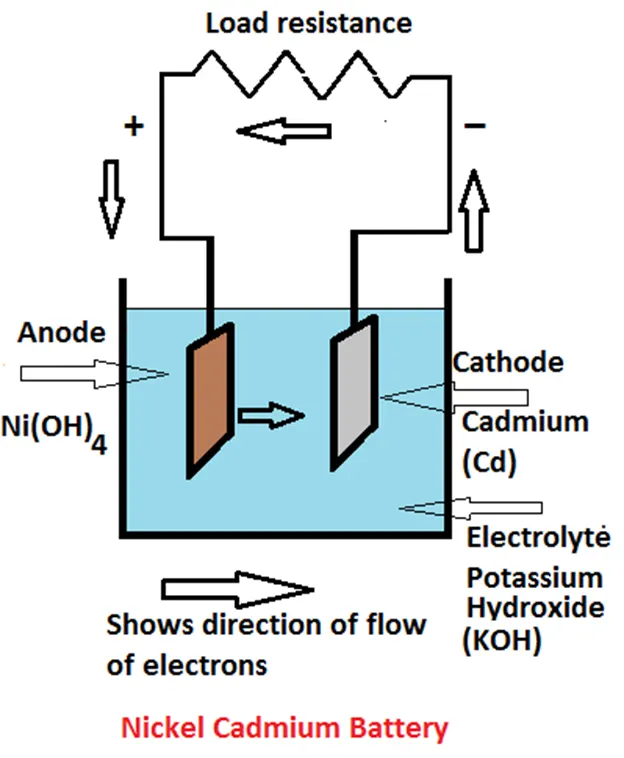
In these batteries, the number of positive plates is one more than that of negative plates. The container of this battery is electrically connected to the positive plates.
When the cell is fully charged, its positive plate is of Ni(OH)4 and its negative plate is of cadmium (Cd).
Discharging
When the cell discharges, the potassium hydroxide (KOH) is dissociated into potassium (K+) and hydroxyl (OH–) ions.
The hydroxyl ions go to cathode and potassium ions go to the anode. The following chemical reaction takes place during discharging.
At cathode: Cd + 2OH —–> Cd(OH)2
At anode: Ni(OH)4 + 2K ——> 2KOH + Ni(OH)2
Thus, the anode is converted from Ni(OH)4 to NI(OH)2 and cathode is converted from cadmium (Cd) to cadmium hydroxide [Cd(OH)2]. The strength of the electrolyte remains the same.
Charging
When the battery is put on charging, the hydroxyl (OH-) ions move towards the anode, whereas the potassium ions (K+) move towards the cathode. The following chemical reaction takes place during the charging:
At anode: Ni(OH)2 + 2OH —–> NI(OH)4
At cathode: Cd(OH)2 + 2K —–> Cd + 2KOH
Thus anode and cathode regain their previous chemical composition without changing the strength of electrolyte.
NMC-
Lithium Nickel manganese cobalt oxide(NiMnCoO2) batteries are a type of lithium rechargeable battery. The main difference between such products is the use of a complex alloy that contains nickel, manganese and cobalt. A battery anode is made from a mixture of these metals, which can significantly increase the power of the power source. A feature of the Li-Nickel-Manganese-Cobalt oxide battery is that even at the production stage, you can change the characteristics of the battery by increasing or decreasing the content of the elements that make up the battery.
Lithium Nickel Manganese Cobalt Oxide Structure
The cambium-like structure of nickel-cobalt-manganese ternary material is composed of hexagonal dense stacking. Its structure and charge - discharge chemical equation are as follows:
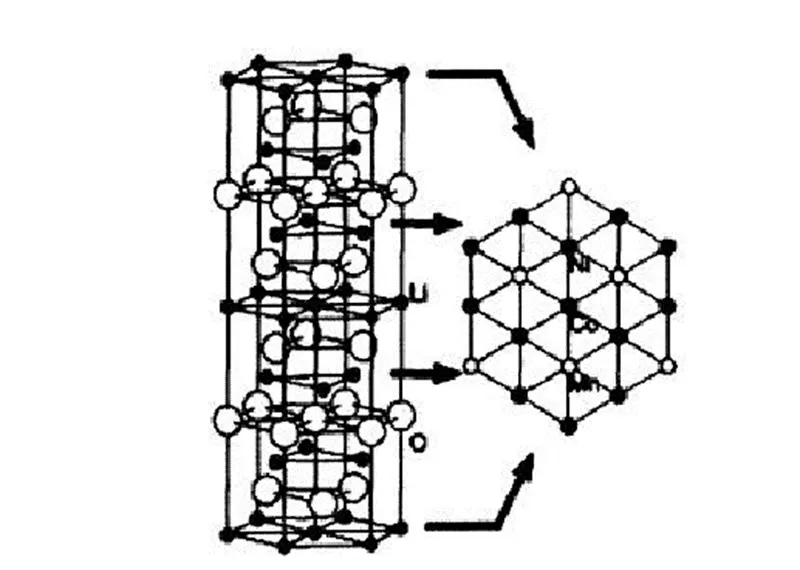
Crystal Structure of Nickel Cobalt Manganese Ternary Anode Material
Chemical Equation
Discharge
LiNixMnyCozO2→Li1-tNixMnyCozO2+tLi++te
Charge:
Li1-tNixMnyCozO2+tLi++te→LiNixMnyCozO2
LFP-
A lithium iron phosphate (LiFePO4) battery is a type of lithium-ion battery that is capable of charging and discharging at high speeds compared to other types of batteries. It is a rechargeable battery consisting of LiFePO4 as its cathode material; hence the name.
Lithium iron phosphate batteries have several distinctive features, including:
Better power density
Low discharge rate
Flat discharge curve
Less heating
Higher number of charge cycles
Increased safety
Lithium iron phosphate (LFP) batteries are also known as lithium ferrophosphate batteries.
Chemical Reaction:-
Discharging
In the anode, lithium is oxidized. Lithium ions are released from carbon, as well as electrons:

Charging

At the cathode, the lithium-ion is absorbed by the lithium dioxide, and the electrode is reduced as it recovers electrons from the cycle:
The Overall Reaction :

LTO-
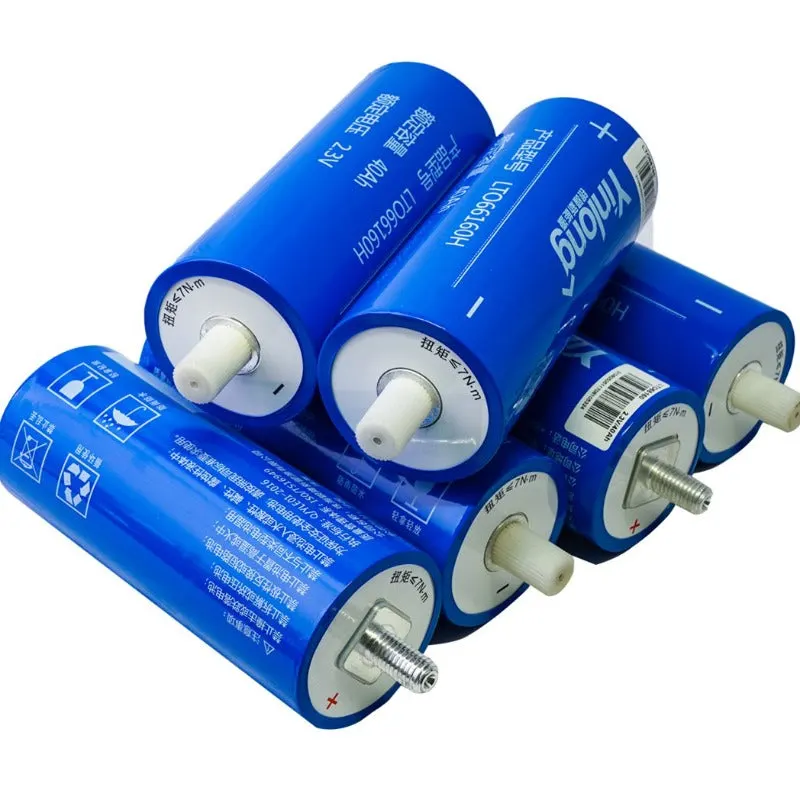
The lithium–titanate battery (Li4Ti5O12,referred to as LTO in the battery industry) is a type of rechargeable battery based on advanced nano-technology, which has the following advantages than other lithium batteries.
Chemical Reaction:-
Charging
In the anode, lithium is oxidized. Lithium ions are released from carbon, as well as electrons:

Discharging-

At the cathode, the lithium-ion is absorbed by the lithium dioxide, and the electrode is reduced as it recovers electrons from the cycle:
The Overall Reaction :

2.Compare the differences between each type of Li+ion batteries based on their characteristics.
Ans:-
Lithuim – ion Battery characteristics Table:-
|
Li-ion types |
LCO |
LMO |
NCA |
NMC |
LFP |
LTO |
|
Specific Energy |
High |
Low |
High |
High |
Low |
Low |
|
Specific Power |
High |
Medium |
High |
Medium |
Low |
Low |
|
Cycle Life |
Medium |
Low |
Medium |
High |
Low |
Low |
|
Energy Density (Wh/kg) |
150 To 200 |
100 To 150 |
150 To 220 |
90 To 120 |
200 To 260 |
50 To 80 |
|
Perfor- mance |
High |
Low |
High |
High |
High |
Low |
|
Saftey |
Highest saftey concern |
Good Saftey |
Some saftey concern |
Good saftey |
Saftey Li-ion cell chemistry |
Highest safe |
|
Cost |
Low |
Medium |
Medium |
Medium |
High |
High |