Understanding Different Battery Chemistry
WEEK 1- UNDERSTANDING BATTERY CHEMISTRY CHALLENGE
Aim:-
1.To prepare a table which includes materials & chemical reactions occurring at the anode and cathode of LCO, LMO, NCA, NMC, LFP and LTO type of lithium ion cells.Give your detailed explanation on it
2.Compare the differences between each type of Li+ion batteries based on their characteristics
General description of the project:-
Batteries:-
An electric battery is a source of electric power consisting of one or more electrochemical cells with external connections for powering electrical devices.
When a battery is supplying power, its positive terminal is the cathode and its negative terminal is the anode. The terminal marked negative is the source of electrons that will flow through an external electric circuit to the positive terminal. When a battery is connected to an external electric load, a redox reaction converts high-energy reactants to lower-energy products, and the free-energy difference is delivered to the external circuit as electrical energy. Historically the term "battery" specifically referred to a device composed of multiple cells; however, the usage has evolved to include devices composed of a single cell.
Lithium ion batteries:-
A lithium-ion battery is a type of rechargeable battery that is charged and discharged by lithium ions moving between the negative (anode) and positive (cathode) electrodes. (Generally, batteries that can be charged and discharged repeatedly are called secondary batteries, whereas disposable batteries are called primary batteries.)
Because lithium-ion batteries are suitable for storing high-capacity power, they are used in a wide range of applications, including consumer electronics such as smartphones and PCs, industrial robots, production equipment and automobiles.
Lithium-ion battery is composed of 1) the anode and the cathode; 2) a separator between the two electrodes; and 3) an electrolyte that fills the remaining space of the battery. The anode and cathode are capable of storing lithium ions. Energy is stored and released as lithium ions travel between these electrodes through the electrolyte.
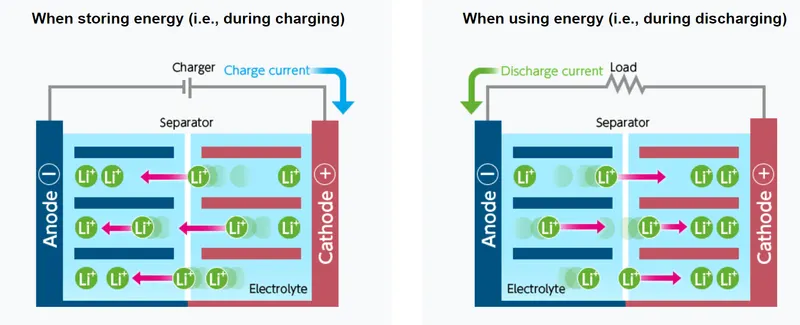
Now let us have a detailed explaination for the different types of Li-ion batteries which have been asked in our task and a detailed comparision will be given below:-
i) LCO :- Lithium Cobalt Oxide(LiCoO2)
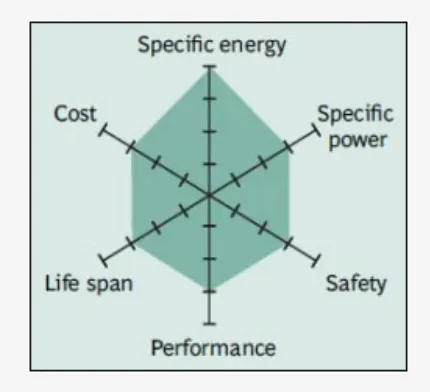
Its high specific energy makes Li-cobalt the popular choice for mobile phones, laptops and digital cameras. The battery consists of a cobalt oxide cathode and a graphite carbon anode. The cathode has a layered structure and during discharge, lithium ions move from the anode to the cathode. The flow reverses on charge. The drawback of Li-cobalt is a relatively short life span, low thermal stability and limited load capabilities (specific power)
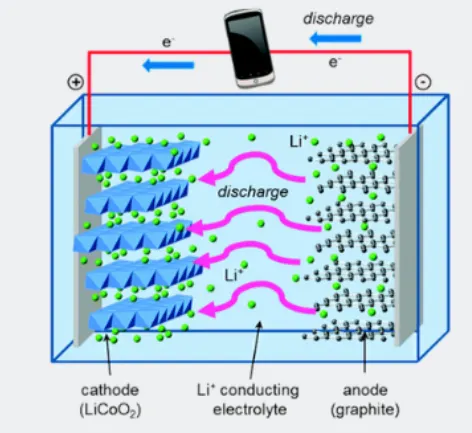
ii) LMO:- Lithium Manganese oxide (LiMn2O4)
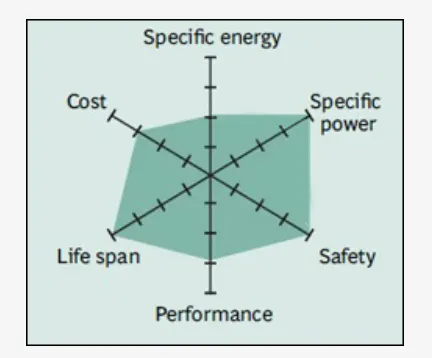
Manganese oxide (LiMn2O4) based battery, further referred to as LMO, has a higher nominal voltage than LCO-based battery cells, rated between 3.8 and 4 V. On the other hand, the energy density of LMO batteries is approximately 20% less than the ones of LCO batteries. Other important attributes of LMO battery cells are high thermal stability, lower cost, and improved safety. However, due to its relatively short cycle life and high capacity losses, the LMO battery cell is not suitable for electric vehicles, plug-in electric vehicles nor hybrid plug-in electric vehicle applications. LMO batteries do not have good power nor energy density.
iii) NCA:- Lithium Nickel Cobalt Aluminum Oxide (LiNiCoAlO2)
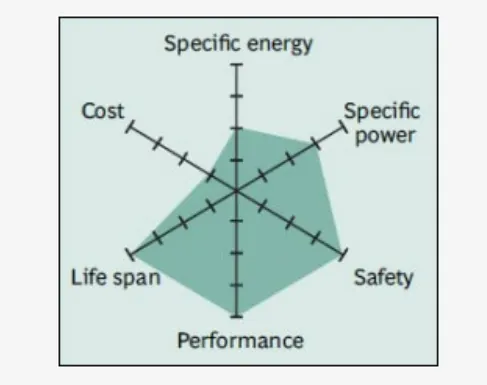
Lithium nickel cobalt aluminum oxide battery, or NCA, has been around since 1999 for special applications. It shares similarities with NMC by offering high specific energy, reasonably good specific power and a long life span. Less flattering are safety and cost.NCA is a further development of lithium nickel oxide; adding aluminum gives the chemistry greater stability.
iv) NMC:- Lithium Nickel Manganese Cobalt Oxide (LiNiMnCoO2)
One of the most successful Li-ion systems is a cathode combination of nickel-manganese-cobalt (NMC). Similar to Li-manganese, these systems can be tailored to serve as energy cells or Power cells. For example, NMC in an 18650 cell for moderate load condition has a capacity of about 2,800mAh and can deliver 4A to 5A; NMC in the same cell optimized for specific power has a capacity of only about 2,000mAh but delivers a continuous discharge current of 20A. A silicon-based anode will go to 4,000mAh and higher but at reduced loading capability and shorter cycle life. Silicon added to graphite has the drawback that the anode grows and shrinks with charge and discharge, making the cell mechanically unstable.
v) LFP:- Lithium Iron Phosphate(LiFePO4)
In 1996, the University of Texas (and other contributors) discovered phosphate as cathode material for rechargeable lithium batteries. Li-phosphate offers good electrochemical performance with low resistance. This is made possible with nano-scale phosphate cathode material. The key benefits are high current rating and long cycle life, besides good thermal stability, enhanced safety and tolerance if abused.
vi) LTO:- Lithium Titanate (Li2TiO3)
Batteries with lithium titanate anodes have been known since the 1980s. Li-titanate replaces the graphite in the anode of a typical lithium-ion battery and the material forms into a spinel structure. The cathode can be lithium manganese oxide or NMC. Li-titanate has a nominal cell voltage of 2.40V, can be fast charged and delivers a high discharge current of 10C, or 10 times the rated capacity. The cycle count is said to be higher than that of a regular Li-ion. Li-titanate is safe, has excellent low-temperature discharge characteristics and obtains a capacity of 80 percent at –30°C (–22°F).
COMPARISION TABLE:-
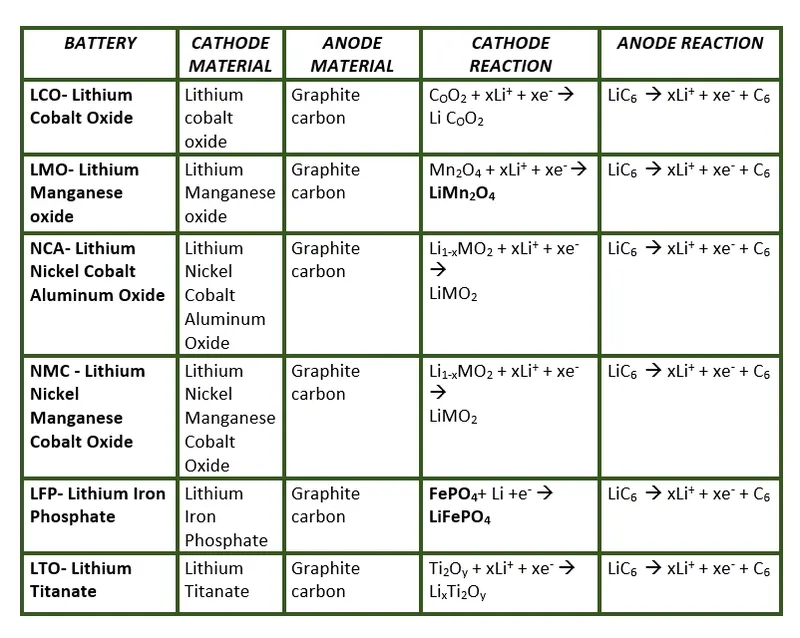
COMPARISION BASED ON THEIR CHARACTERISTICS:-
- Nominal Voltage:-
The nominal voltage of a system or circuit is the value assigned to a system or circuit of a given voltage class for the purpose of convenient designation. The actual voltage may vary above or below this value.
- Specific Energy:-
The gravimetric energy density or the specific energy of a battery is a measure of how much energy a battery contains in comparison to its weight, and is typically expressed in Watt-hours/kilogram (W-hr/kg).
- Cycle life:-
Each round of full discharge and then full recharge is called battery cycle life
- Thermal runaway:-
Thermal runaway is a chain reaction within a battery cell that can be very difficult to stop once it has started. It occurs when the temperature inside a battery reaches the point that causes a chemical reaction to occur inside the battery.
i) LCO:-
| Voltages | 3.60V nominal; typical operating range 3.0–4.2V/cell |
| Specific energy (capacity) | 150–200Wh/kg. Specialty cells provide up to 240Wh/kg. |
| Charge (C-rate) | 0.7–1C, charges to 4.20V (most cells); 3h charge typical. Charge current above 1C shortens battery life. |
| Discharge (C-rate) | 1C; 2.50V cut off. Discharge current above 1C shortens battery life. |
| Cycle life | 500–1000, related to depth of discharge, load, temperature |
| Thermal runaway | 150°C (302°F). Full charge promotes thermal runaway |
| Applications | Mobile phones, tablets, laptops, cameras |
ii) LMO:-
| Voltages | 3.70V (3.80V) nominal; typical operating range 3.0–4.2V/cell |
| Specific energy (capacity) | 100–150Wh/kg |
| Charge (C-rate) | 0.7–1C typical, 3C maximum, charges to 4.20V (most cells) |
| Discharge (C-rate) | 1C; 10C possible with some cells, 30C pulse (5s), 2.50V cut-off |
| Cycle life | 300–700 (related to depth of discharge, temperature) |
| Thermal runaway | 250°C (482°F) typical. High charge promotes thermal runaway |
| Applications | Power tools, medical devices, electric powertrains |
iii) NCA:-
| Voltages | 3.60V nominal; typical operating range 3.0–4.2V/cell |
| Specific energy (capacity) | 200-260Wh/kg; 300Wh/kg predictable |
| Charge (C-rate) | 0.7C, charges to 4.20V (most cells), 3h charge typical, fast charge possible with some cells |
| Discharge (C-rate) | 1C typical; 3.00V cut-off; high discharge rate shortens battery life |
| Cycle life | 500 (related to depth of discharge, temperature) |
| Thermal runaway | 150°C (302°F) typical, High charge promotes thermal runaway |
| Cost | ~$350 per kWh |
| Applications | Medical devices, industrial, electric powertrain (Tesla) |
iv) NMC:-
| Voltages | 3.60V, 3.70V nominal; typical operating range 3.0–4.2V/cell, or higher |
| Specific energy (capacity) | 150–220Wh/kg |
| Charge (C-rate) | 0.7–1C, charges to 4.20V, some go to 4.30V; 3h charge typical. Charge current above 1C shortens battery life. |
| Discharge (C-rate) | 1C; 2C possible on some cells; 2.50V cut-off |
| Cycle life | 1000–2000 (related to depth of discharge, temperature) |
| Thermal runaway | 210°C (410°F) typical. High charge promotes thermal runaway |
| Cost | ~$420 per kWh |
| Applications | E-bikes, medical devices, EVs, industrial |
V) LFP:-
| Voltages | 3.20, 3.30V nominal; typical operating range 2.5–3.65V/cell |
| Specific energy (capacity) | 90–120Wh/kg |
| Charge (C-rate) | 1C typical, charges to 3.65V; 3h charge time typical |
| Discharge (C-rate) | 1C, 25C on some cells; 40A pulse (2s); 2.50V cut-off (lower that 2V causes damage) |
| Cycle life | 2000 and higher (related to depth of discharge, temperature) |
| Thermal runaway | 270°C (518°F) Very safe battery even if fully charged |
| Cost | ~$580 per kWh[1] |
| Applications | Portable and stationary needing high load currents and endurance |
Vi) LTO:-
| Voltages | 2.40V nominal; typical operating range 1.8–2.85V/cell |
| Specific energy (capacity) | 50–80Wh/kg |
| Charge (C-rate) | 1C typical; 5C maximum, charges to 2.85V |
| Discharge (C-rate) | 10C possible, 30C 5s pulse; 1.80V cut-off on LCO/LTO |
| Cycle life | 3,000–7,000 |
| Thermal runaway | One of safest Li-ion batteries |
| Cost | ~$1,005 per kWh[1] |
| Applications | UPS, electric powertrain (Mitsubishi i-MiEV, Honda Fit EV), solar-powered street lighting |
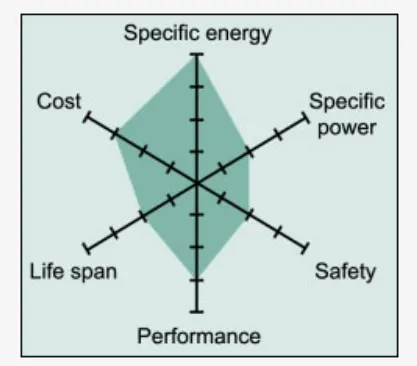
All the above specifications can be easily represented in the form of graphical diagram as follows:-
LCO:- LMO:- NCA:-
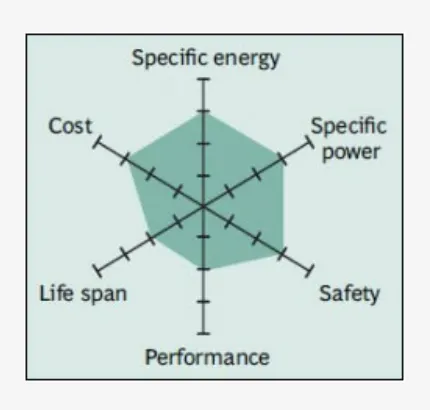
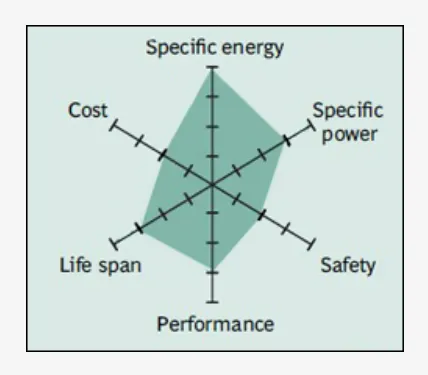
NMC:- LFP:- LTO:-