Week 1 Understanding Different Battery Chemistry
EV 17TH LIVE BATCH
1.Que:
Aim:
To make a study and understand about the electrochemistry of different types of lithium ion cells.
Battery:
- A battery is a device consisting of one or more electrochemical cells with external connections for powering electrical devices such as flashlights, mobile phones and electric cars.
- when a battery is supplying electric power, its positive terminal is the cathode and its negative terminal is the anode.
- The terminal marked negative is the source of electrons that will flow through an external electric circuit to the positive terminal.
- when a battery is connected to an external electric load, a redox reaction converts high-energy reactants to lower energy products, and the free energy difference is delivered to the external circuit as electrical energy.
Types of Batteries:
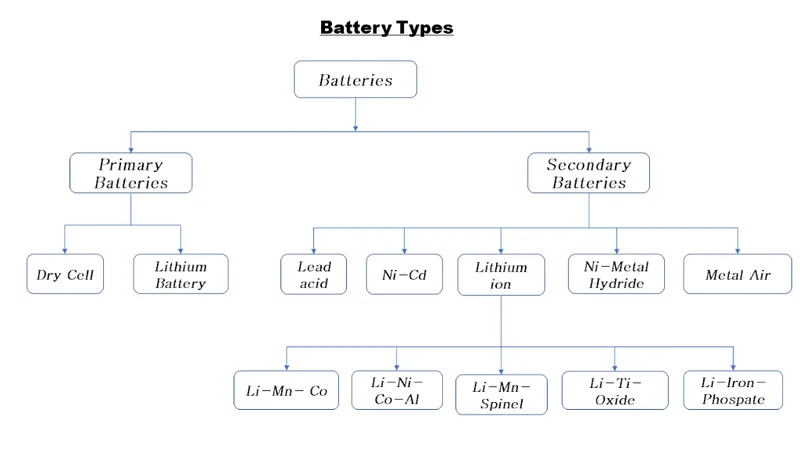
There are two types of batteries,
1.Primary cell - These batteries are one time use batteries and they cannot be recharged for further usage.
2.Secondary cell - These batteries can be recharged and can be used for multiple times.
Lithium ion cell:
- The lithium ion batteries are secondary type of batteries which can be recharged for further usage.
- The lithium ion cells have four main components in it and they are,
i) cathode
ii)anode
iii)electrolyte
iv)seperator
i) Cathode:
- They are the positive electrodes of the cell.
- The cathode electrode is usually made up of,
1.Layered transition metal oxides-has high capacity but high in cost and poor in safety.
2.spinels- High power density but poor in conductivity and stability.
3.olivines - Lees capacity but has long life and are high in safety.
ii) Anode:
- They are the negative electrodes of the cell.
- The anode electrode is usually made up of,
1. Graphite
2. Hard carbon, these anodes are less in cost and high in stability and specific capacity.
iii) Electrolyte:
- An electrolyte is a substances that produces an electrically conducting solution when dissolved in a polar solvent.
- The dissolved electrolyte separated into cations and anions, which disperse uniformly through the solvent.
- Generally lithium ion cells have electrolytes of organic solvents such as, ethylene carbonate, dimethyl carbonate, propylene carbonate and lithium salt as solute.
iv) Seperator:
- Battery seperator provide a barrier between the anode(negative) and the cathode(positive) while enabling the exchange of lithium ions from one side to the other.
- They are materials that conducts ions but they do not conduct the electrons through them.
- Li-ion cells use polylefin as a separator. This material has excellent mechanical properties, good chemical stability and is low-cost as well.
Working of Lithium ion cell:
- The battery is made up of an anode, cathode, separator, electrolyte, and two current collector the anode and cathode store the lithium.
- The electrolyte carries positively charged lithium ions from the anode to cathode and vice versa through the separator.
- The movement of the lithium ions create free electrons in the anode which create a charge at the positive current collector.
- The electrical current then flows from the current collector through a device being powered to the negative current collector. The separator blocks the flow of electrons inside the battery.
- while the battery is discharging and providing an electric current, the anode release lithium ions to the cathode, generating a flow of electrons from one side to the other.
- when charging, the opposite happens where lithium ions are released by the cathode and received by the anode.
- This is the working principle of a lithium ion battery.
Types of lithium ions battery:
- Lithium cobalt oxide(LCO)
- Lithium Manganies oxide(LMO)
- Lithium Nickel cobalt Aluminium(NCA)
- Nickel Manganies cobalt(NMC)
- Lithium Titanite(LTO)
- Lithium ion phospate(LFP)
Comparison Table:
| Lithium ion types | LCO | LMO | NMC | LFP | NCA | LTO |
| chemical name | `L_iC_oO_2` | `L_iM_n2O_4` | `L_iN_iM_nC_OO_2` | `L_iF_ePO_4` | `L_iN_iC_oAlO_2` | `L_i2T_iO_3` |
| Anode material | Graphite | Graphite | Graphite | Graphite | Graphite | `L_i2T_iO_3(Titanate)` |
| Cathode material | `L_iC_oO_2`(60% Co | `L_iM_n2O_4` | `L_iN_iM_nC_oO_2` | `L_iF_ePO_4` | `L_iN_iC_oAlO_2`(9% Co) | `L_i`Manganese oxide |
| Electrolyte | Ethylene Carbonate | Lithium Halide | Lithium salt | Ethynal Carbonate | Ethynal Carbonate | Lithium salt |
| separator | Polyolefin | Polyolefin | Polyolefin | Polyolefin | Polyolefin | Polyolefin |
| Nominal voltage | 3.6v | 3.7v,3.8v | 3.6v,3.7v | 3.2v,3.3v | 3.6v | 2.4v |
| Operating voltage | Typical range 3v-4.2v/cell | 3v-4.2v/cell | 3v-4.2v/cell or higher | 2.5v-3.65v/cell | 3v-4.2v/cell | 1.8v-2.85v/cell |
| Energy Capacity | 150-200wh/kg speciality cells provide up to 240wh/kg | 100-150wh/kg | 150-220wh/kg | 90-120wh/kg | 200-260wh/kg;300wh/kg pedictable | 50-80wh/kg |
| Life cycle | 500-1000 | 300-700 | 1000-2000 | 2000 & higher | 500 | 3000-7000 |
| Thermal runaway | 150 degree c (302 degree F) | 250 degree c(482 degree F) typical | 210 degree c (410 degree F) typical | 270 degree c(518 degree F) | 150 degree c (302 degree F) | one of safest Li-ion cells |
| charge(c-rate) | 0.7-1c, charges to 4.2v (most cells); 3h charge typical. charge current above 1c shortens battery life. | 0.7-1c, typical,3c maximum,charges to 4.2v(most cells) | 0.7-1c,charges to 4.2v(most cells);3h charge typical. charge current above 1c shorten battery life. | 1c typical charges to 3.65v;3h charge time typical | 0.7c,charges to 4.2v(most cells), 3h charge time typical | 1c typical; 5c maximum charges to 2.85v |
| discharge(c-rate) | 1c;2.5v cut-off discharge current above 1c shorten battery life. | 1c;10c possible with some cells,30c pulse(5s),2.5v cut-off | 1c;2c possible on some cells;2.5v cut off | 1c,250c on some cell; 40 A pulse(2s); 2.5v cut-off (lower than 2v) causes damage | 1c typical; 3v cut-off,high discharge rate shorten battery life | 10c possible,30c 5s pulse; 1.8v cut-off on 1CO/LTO |
| Applications | mobile phone,laptop,cameras | power tools,medical devices,electric powertrain | E-bike medical device,evs industrial | portable and stationary needing high load currents and endurance | medical device, electric powertrains(Tesla) | ups,electric powertrain |
| Advantages & disadvantages) |
very high specific energy, limited specific power. cobalt is expensive serves as energy call. market share has stabilised. |
high power but less capacity; safer than Li-co commonly mixed with NMC to improve performance. | provides high capacity power. serves as hybrid cell. favurite chemistry for many uses. market share is increasing. | very flat voltage discharge curve but low capacity. one of the safest Li-ions. used for special market elevated self discharge. | share similarities with Li-co. serves as energy cell. | Long life, fast charge, wide temperature range but low specific energy and expensive among safest Li-ions cells. |
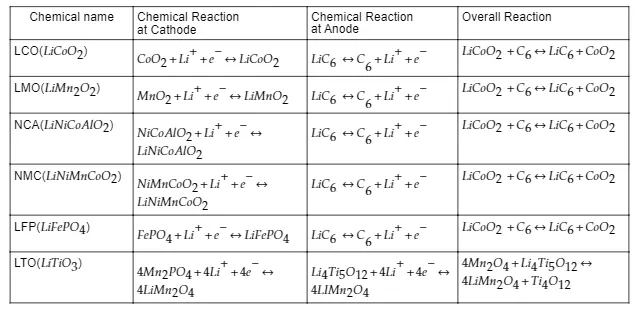
chemical reaction of Li-ion cells:
2.Que:
The major 6 types of lithium ion batteries was discussed early, now the major difference in the characteristic can be found when choosing a battery. The major things can be differenciated from one another.
- Nominal voltage:- It is the system voltage at which the device is designed to operate. The rated voltage is usually higher than nominal voltage to ensure the safe operation of the device.
- cycle:- The charge and discharge when took place for a single time makes a cycle. The higher the cycle can take place, the higher the cycle can take place then the lifespan is higher.
- Thermal runway:- The thermal runway begins when the heat generated within a battery exceeds the amount of heat that is dissipiated to its surroundings . internal battery temperature will continue to rise, causing the battery current to rise creating a domino effect. The rise in temperature in a single battery will begin to affect other batteries nearby and the pattern will continue.
- specific energy:- It is the amount of enegy stored per unit mass. This is a very important deciding factor that decides how much energy or power from different batteries with the same amount of weight.
specific energy of different types of lithium based batteries:
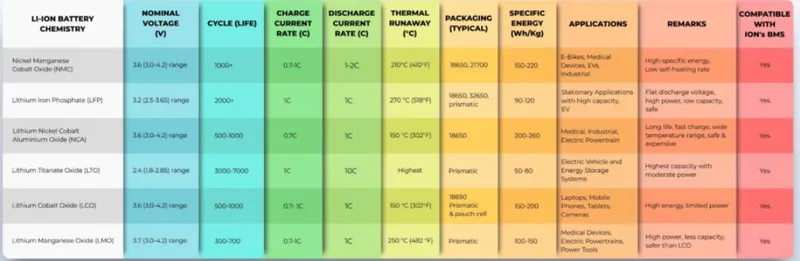
The main difference between the lithium ion batteries can be differentiated on the characteristics.
For ease of choosing a battery from laymans perspective, the 6 key features are given a value within 0-5 range for all of the ,are given with the same parameter which are considered in case of 5 point hexagonal analysis of the batteries. They are
1.specific energy
2.specific power
3.safety
4.performance
5.life span
6.cost
LCO:
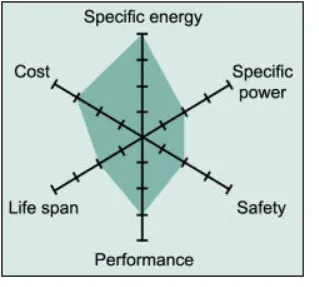
Li-cobalt excels on high specific energy but offers only moderate performance specific power, safety and life span.
LMO:
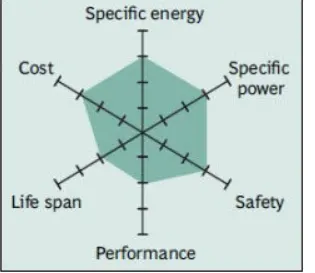
Although moderate in overall performance , newer designs of Li-manganese offer improvement in specific power, safety and life span.
NMC:
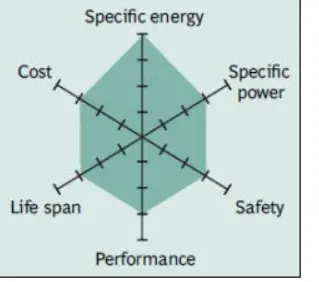
NMC has good overall performance and excels on specific energy. This battery is the preferred candidate for the electric vehicle and has lowest self heating rate.
LFP:
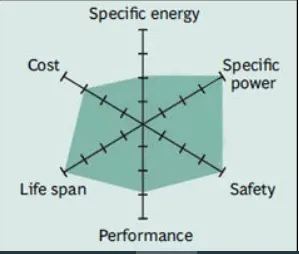
Li-phosphate has excellent safety and long life span but moderate specific energy and elevated self discharge.
NCA:
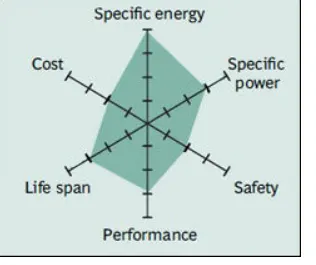
High energy and power densities as well as a good life span make NCA a candidate for EV powertrain. high cost and marginal safety are negative.
LTO:
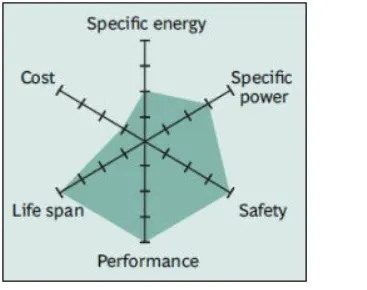
Li-titanate excels in safety, low temperature performance and life span. effort are being made to improve the specific energy and lower the cost.
- These types of lithium ion batteries are some of the most popular, as technology is continuously seeing more development, new lithium technologies are always being developed and those which exists are being developed.