Week 1 Understanding Different Battery Chemistry
1.Explaination of different types of Lithium ion batteries:
Before learning different types of Lithium ion batteries, let us first look into the construction and working of Lithium ion battery.
Lithium ion battery:
The following figure shows different types of Lithium ion cells depending upon of its shape:
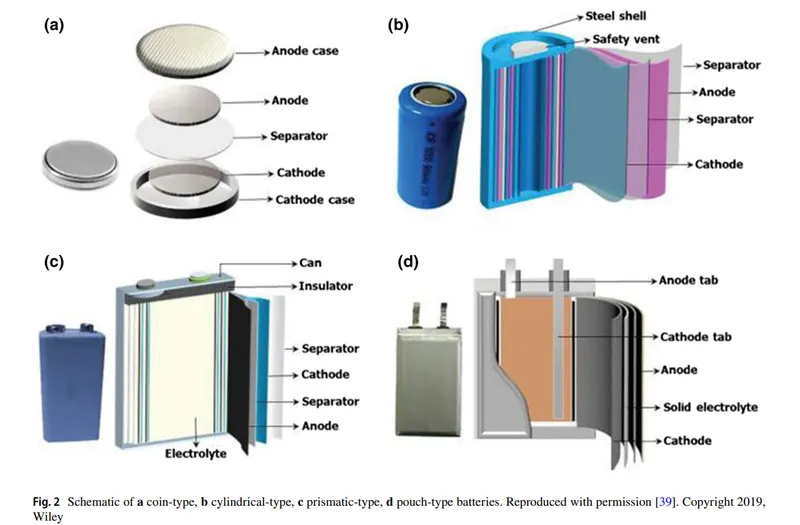
Components of a cell:
- Anode: an electrode from which the conventional current enters into a polarised electrical device.
- Cathode: an electrode from which the conventional current leaves from the electrical device.
- Electrolyte: It is an ionic conductor that provides medium for ionic charge transfer between the electrodes. Usually, aqueous electrolytes are used for most of the batteries but Lithium batteries uses non aqueous electrolytes.
- Separator: It physically isolates the positive and negative electrodes. It is ionic conductor but an electronic insulator.
- Current collectors: These are electronic conductors with which the electrodes are mixed. These do not take part in chemical reaction but instead either allow simple electronic connection to reduce the electronic resistance of electrode. In Lithium ion cells, copper foil is used as current collector for negative electrode and aluminium foil for positive electrode.
Working of Lithium ion cell:
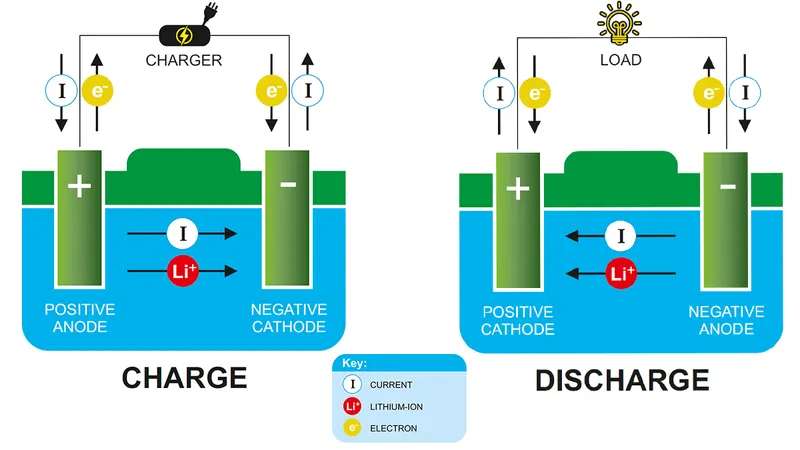
During charging state:
When a charger/DC power supply is connected across the terminals of battery, the electrons (`e^-`) which are on the outer orbit of Lithium atoms are removed and are attracted towards the positive terminal of the power supply and then Lithium ions (`Li^+`) are attracted towards the negative terminal, so the lithium ions are passed to the negative electrode through electrolyte and stays at negative electrode. When all the Lithium ions moved reached the negative electrode, the cell is fully charged.
During discharging state:
When a load is connected to the terminals of the battery, then Lithium ions (`Li^+`) are fed back to the positive electrode through electrolyte whereas the electrons (`e^-`) that are blocked by separator, passes through external circuit (load) which results in flow of current. When all the Lithium ions reaches positive electrode, then the battery is fully discharged.
The following matter describes about different types of Lithium ion batteries depending upon their chemistry:
i)LITHIUM COBALT OXIDE BATTERY:
ii)LITHIUM MAGANESE DIOXIDE BATTERY:
Lithium manganese oxide batteries (LMO) were first introduced in the early 1980’s though they took nearly 15 years to commercialize. The architecture forms a three-dimensional spinel structure that improves ion flow on the electrode, which results in lower internal resistance and improved current handling. Low internal cell resistance enables fast charging and high-current discharging. Li-manganese can be discharged at currents of 20–30 A with moderate heat buildup in an 18,650 package. This chemistry provides better thermal stability than the lithium cobalt oxide battery but results in approximately 33% lower capacity and a lower life span.
(iii) NICKEL MANGANESE COBALT OXIDE BATTERY:
Lithium Nickel Cobalt Aluminum Oxide (NCA) has been around since 1999 for special applications. It shares similarities with NMC by offering high specific energy and specific power (the rate at which the battery can deliver energy), and a long life span. NCA is not as safe as the others listed above and as such, require special safety monitoring measures to be employed for use in EVs. They are also more costly to manufacture, limiting their viability for use in other applications.
(v) LITHIUM IRON PHOSPHATE BATTERY:
| Type of battery | Cathode | Anode | Reactions at cathode | Reactions at anode |
| LCO | Lithium Cobalt Oxide (`LiCoO_2`) |
Graphite (C6) |
`Li_((1-x))CoO_2(s) + xLi^+ + xe^(-) harr LiCoO_2(s)` | `C_6Li harr 6C + Li^+ +e^-` |
| LMO |
Lithium Manganese Oxide (`LiMn_2O_4`) |
Graphite (C6) |
`Li_((1-x))MnO_4(s) + xLi^+ + xe^(-) harr LiMnO_4(s)` | `C_6Li harr 6C + Li^+ +e^-` |
| NMC |
Lithium Nickle Magnese Cobalt Oxide (`LiNiMnCoO_2`) |
Graphite (C6) |
`Li_((1-x))NiMnCoO_2(s) + xLi^+ + xe^(-) harr LiNiMnCoO_2(s)` | `C_6Li harr 6C + Li^+ +e^-` |
| NCA |
Lithium Nickel Cobalt Aluminium Oxide (`LiNiCoAlO_2`) |
Graphite (C6) |
`Li_((1-x))NiCoAlO_2(s) + xLi^+ + xe^(-) harr LiNiCoAlO_2(s)` | `C_6Li harr 6C + Li^+ +e^-` |
| LFP |
Lithium Iron Phosphate (`LiFePO_4`) |
Graphite (C6) |
`Li_((1-x))FePO_4(s) + xLi^+ + xe^(-) harr LiFePO_4(s)` | `C_6Li harr 6C + Li^+ +e^-` |
| LTO |
Lithium Manganese Oxide (`LiMnO_2`) |
Titanate (`Ti_5O_12`) | `Li_((1-x))MnO_4(s) + xLi^+ + xe^(-) harr LiMnO_4(s)` | `Li_7Ti_5O_12 harr Li_4Ti_5O_12 + 3Li^+ + 3e^-` |
Electrolyte comprises of solvent and salt. Usually, Lithium hexa fluoro phosphate (`LiPF_6`) is used for salt material and Ethylene Carbonate is used for solvent material in the electrolyte of above mentioned cells.
2.)Comparing the characteristics of different types of Lithium ion batteries:
The following figure shows the comparision of characteristics of various types of Lithium ion batteries on six axes:
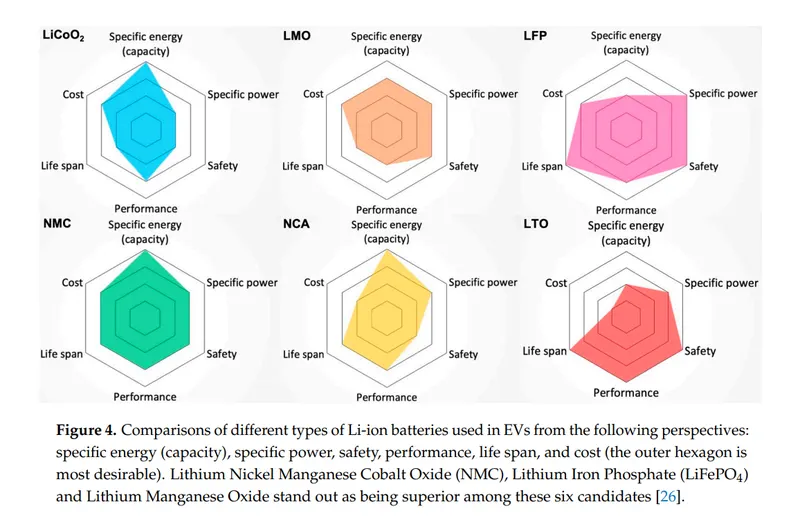
Note: The farther colour shape extend along a given axis, the better the performance along that dimension.
From the above figure, let us divide each axis into four differnet scales (i.e, High, Medium, Low+, Low-):
| LCO | LMO | LFP | NMC | NCA | LTO | |
| Specific energy (Wh/Kg) | High | Medium | Low+ | High | High | Low+ |
| Specific power (W/kg) | Low+ | Medium | High | Medium | Medium | Medium |
| Safety | Low+ | Medium | High | Medium | Low+ | High |
| Performance | Medium | Low+ | Medium | Medium | Medium | High |
| Life span (cycles) | Low+ | Low+ | High | Medium | Medium | High |
| Cost ($/Wh) | Low+ | Low+ | Low+ | Low+ | Medium | High |