Week 1 Understanding Different Battery Chemistry
Question 1:-Prepare a table which includes materials & chemical reactions occurring at the anode and cathode of LCO, LMO, NCA, NMC, LFP and LTO type of lithium ion cells.Give your detailed explanation on it
Answer 1:-
INTRODUCTION:-
A battery is made up of several individual cells that are connected to one another. Each cell contains three main parts: a positive electrode (a cathode), a negative electrode (an anode) and a liquid electrolyte. Just like alkaline dry cell batteries, such as the ones used in clocks and TV remote controls, lithium-ion batteries provide power through the movement of ions. Lithium is extremely reactive in its elemental form. That’s why lithium-ion batteries don’t use elemental lithium. Instead, lithium-ion batteries typically contain a lithium-metal oxide, such as lithium-cobalt oxide (LiCoO2). This supplies the lithium-ions. Lithium-metal oxides are used in the cathode and lithium-carbon compounds are used in the anode. These materials are used because they allow for intercalation. Intercalation means that the molecules are able to insert something into them. In this case, the electrodes are able to have lithium-ions move easily in and out of their structures.
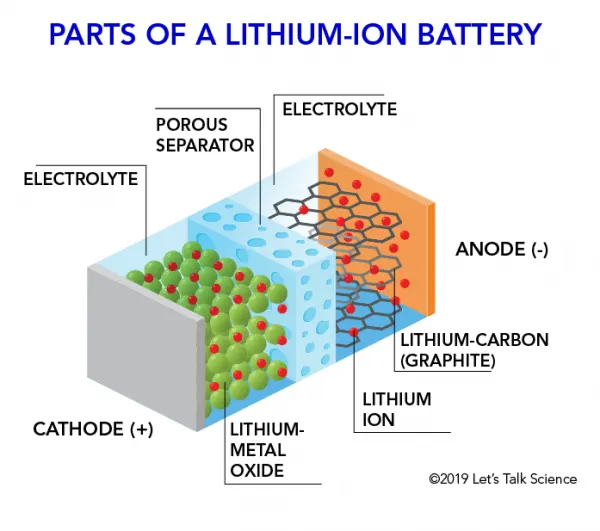
Chemistry involved in lithium-ion batteries
Inside a lithium-ion battery, oxidation-reduction (Redox) reactions take place.
Reduction takes place at the cathode. There, cobalt oxide combines with lithium ions to form lithium-cobalt oxide (LiCoO2). The half-reaction is:
CoO2 + Li+ + e- → LiCoO2
Oxidation takes place at the anode. There, the graphite intercalation compound LiC6 forms graphite (C6) and lithium ions. The half-reaction is:
LiC6 → C6 + Li+ + e-
Here is the full reaction (left to right = discharging, right to left = charging):
LiC6 + CoO2 ⇄ C6 + LiCoO2
Recharging a lithium-ion battery
When the lithium-ion battery in your device is powering it, positively charged lithium ions (Li+) move from the negative anode to the positive cathode. They do this by moving through the electrolyte until they reach the positive electrode. There, they are deposited. The electrons, on the other hand, move from the anode to the cathode.
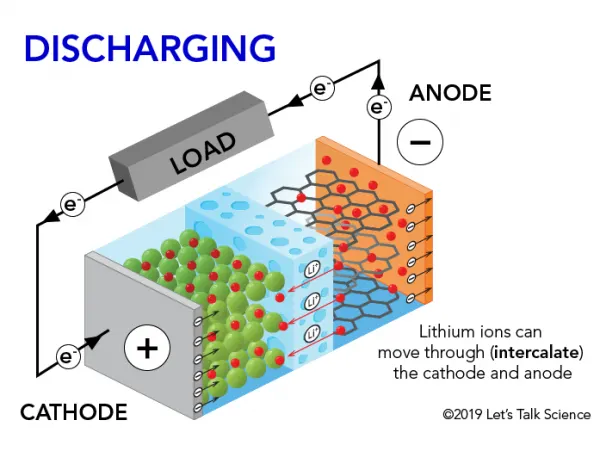
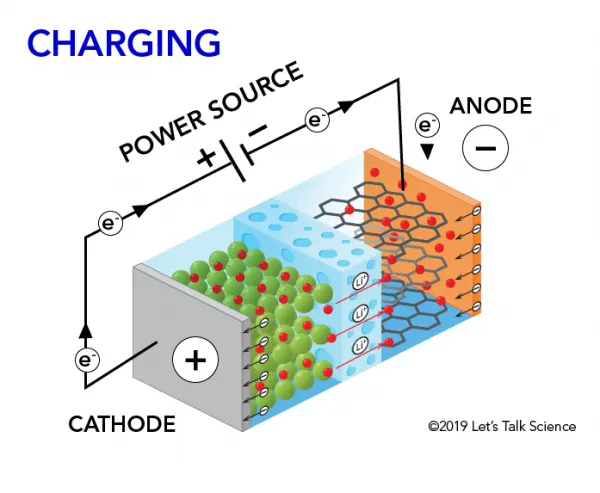
When the battery is in use, the lithium ions flow from the anode to the cathode, and the electrons move from the cathode to the anode. When you charge a lithium-ion battery, the exact opposite process happens. The lithium ions move back from the cathode to the anode. The electrons move from the anode to the cathode.
| Type of Battery | Anode | Chemical Reaction at Anode | Cathode | Chemical Reaction at Cathode | Over all Reaction | Advantages | Drawbacks | Applications |
| Lithium Cobalt Oxide(LCO) | Carbon(Graphite) | LixC6 ⟷ xLi+ +xe− + C6 | Lithium Cobalt Oxide | Li1−xCoO2 + xLi+ +xe− ⟷ LiCoO2 | C6 + LiCoO2 ⟷ LixC6 + Li1−xCoO2 | High specific energy | Short life span, low thermal stability and limited load capabilities (specific power), cobalt is expensive | Mobile phones, laptops and digital cameras |
| Lithium Manganese Oxide(LMO) | Carbon(Graphite) | LixC6 ⟷ xLi+ +xe− + C6 | Lithium Manganese Oxide | Li1−xMn2O4 + xLi+ +xe− ⟷ LiMn2O4 | C6 + LiMn2O4 ⟷ LixC6 − LiMn2O4 | Lower internal resistance and improved current handling, high thermal stability and enhanced safety | Cycle and calendar life are limited | Electric vehicles such as the Nissan Leaf, Chevy Volt and BMW i3, power tools, medical devices, electric powertrains |
| Lithium Nickel Manganese Cobalt Oxide(NMC) | Carbon(Graphite) | LixC6 ⟷ xLi+ +xe− + C6 | Lithium Nickel Manganese Cobalt Oxide | Li1-xNi0.8Mn0.1Co0.1O2 + xLi+ +xe- ⟷ LiNi0.8Mn0.1Co0.1O2 | C6 + LiNi0.8Mn0.1Co0.1O2 ⟷ LixC6 + Ni0.8Mn0.1Co0.1O2 | Good overall performance and excels on specific energy, lowest self-heating rate | High cost due to cobalt | E-bikes, medical devices, evs, industrial |
| Lithium Iron Phosphate(LFP) | Carbon(Graphite) | LixC6 ⟷ xLi+ +xe− + C6 | Lithium Iron Phosphate | LiFe(III)PO4 + xLi+ +xe− ⟷ LiFe(II)PO4 FePO4 + Li+ +e− ⟷ LiFePO4 |
LiFePO4 + 6C ⟷ LiC6 + FePO4 | High current rating and long cycle life, besides good thermal stability, enhanced safety and tolerance if abused. | Higher self-discharge, less specific energy | Portable and stationary needing high load currents and endurance |
| Lithium Nickel Cobalt Aluminum Oxide(NCA) | Carbon(Graphite) | LixC6 ⟷ xLi+ +xe− + C6 | Lithium Nickel Cobalt Aluminum Oxide | Li1-xNiCoAlO2 + xLi+ + xe- ⟷ LiNiCoAlO2 | C6 + LiNiCoAlO2 ⟷ LiC6 + NiCoAlO2 | High specific energy, reasonably good specific power, long life span | High cost and marginal safety | Medical devices, industrial, electric powertrain (tesla) |
| Lithium Titanate Oxide(LTO) | Titanate(Ti5O12) | Li4Ti5O12 ⟷ Ti5O12 + 4Li+ +4e- | LMO or NMC | 4Li1−xMn2O4 + 4Li+ +4e− ⟷ 4LiMn2O4 | Li4Ti5O12 + 4Mn2O4 ⟷ 4LiMn2O4 + Ti5O12 | Fast charging, safe, high discharge current of 10C | Low specific energy | UPS, electric powertrain (Mitsubishi i-miev, Honda Fit EV), |
Question 2:- Compare the differences between each type of Li+ion batteries based on their characteristics
Answer 2:-
Lithium-ion batteries are used in most aspects of our everyday lives. Most devices like smartphones and laptops cannot operate without these batteries. Lithium-ion batteries have also become very important in the field of electromobility as it is now the battery of choice in most electric vehicles. Its high specific energy gives it an advantage over other batteries.
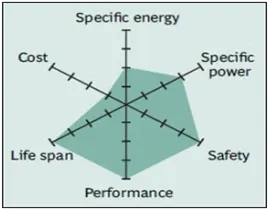
There are different types of lithium-ion batteries and the main difference between them lies in their cathode materials. Different kinds of lithium-ion batteries offer different features, with trade-offs between specific power, specific energy, safety, lifespan, cost, and performance.
The six lithium-ion battery types that we will be comparing are Lithium Cobalt Oxide, Lithium Manganese Oxide, Lithium Nickel Manganese Cobalt Oxide, Lithium Iron Phosphate, Lithium Nickel Cobalt Aluminum Oxide, and Lithium Titanate. Firstly, an understanding of the key terms below will allow for a simpler and easier comparison.
Specific energy: This defines the battery capacity in weight (Wh/kg). The capacity relates to the runtime. Products requiring long runtimes at moderate load are optimized for high specific energy.
Specific power: It's the ability to deliver a high current and indicates loading capability. Batteries for power tools are made for high specific power and come with a reduced specific energy.
A high specific power usually comes with reduced specific energy and vice versa. The pouring of bottled water in a glass is a perfect analogy of the relationship between specific power and specific energy. The water in the bottle can be thought of as specific energy. Pouring the water at a slow rate doesn’t provide enough force (low specific power) but the water lasts longer in the bottle (high specific energy). On the other hand, if we pour the water out at a faster rate it provides a greater impact (high specific power). However, the water wouldn’t last very long in the bottle ( low specific energy).
Performance: This measures how well the battery works over a wide range of temperatures. Most batteries are sensitive to heat and cold and require climate control. Heat reduces life, and cold lowers performance temporarily.
Lifespan: This reflects cycle life and longevity and is related to factors such as temperature, depth of discharge, and load. Hot climates accelerate capacity loss. Cobalt blended lithium-ion batteries also usually have a graphite anode that limits the cycle life.
Safety: This relates to factors such as the thermal stability of the materials used in the batteries. The materials should have the ability to sustain high temperatures before becoming unstable. Instability can lead to thermal runaway in which flaming gases are vented. Fully charging the battery and keeping it beyond the designated age reduces safety.
Cost: Demand for electric vehicles has generally been lower than anticipated and this is mainly due to the cost of lithium-ion batteries. Hence cost is a huge factor when selecting the type of lithium-ion battery.
Following is the comparision table for the various types of batteries:-
| Lithiumion battery Types | Specific Power | Specific Energy | Safety | Lifespan | Cost | Performance |
| Lithium Cobalt Oxide | Low | High | Low | Low | Low | Moderate |
| Lithium Manganese Oxide | Moderate | Moderate | Moderate | Low | Low | Low |
| Lithium Nickel Manganese Cobalt Oxide | Moderate | High | Moderate | Moderate | Low | Moderate |
| Lithium Iron Phosphate | High | Low | High | High | Low | Moderate |
| Lithium Nickel Cobalt Aluminum Oxide | Moderate | High | Low | Moderate | Moderate | Moderate |
| Lithium Titanate | Moderate | Low | High | High | High | High |
Summary of the Table
- Lithium Cobalt Oxidehas high specific energy as compared to the other batteries which make it the preferred choice for laptops and mobile phones. It also has a low cost and a moderate performance. However, it is highly unfavorable in all the other aspects when compared to the other lithium-ion batteries. It has low specific power, low safety, and a low lifespan.
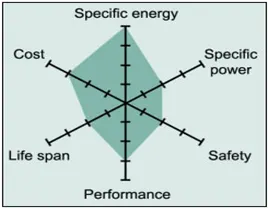
- Lithium Manganese Oxidehas moderate specific power, moderate specific energy, and a moderate level of safety when compared to the other types of lithium-ion batteries. It has the added advantage of a low cost. The downsides are its low performance and low lifespan. It is usually used in medical devices and power tools.
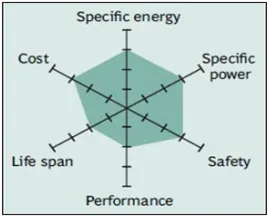
- Lithium Nickel Manganese Cobalt Oxidehas two major advantages as compared to the other batteries. The first one is its high specific energy which makes it desirable in electric powertrains, electric vehicles, and electric bikes. The other is its low cost. It is moderate in terms of specific power, safety, lifespan, and performance when compared to the other lithium-ion batteries. It can be optimized to either have high specific power or high specific energy.
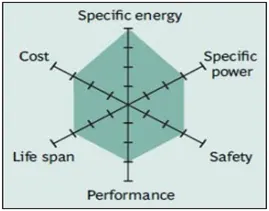
- Lithium Iron Phosphateonly has one major disadvantage when compared to other types of lithium-ion batteries and that is its low specific energy. Other than that, it has moderate to high ratings in all the other characteristics. It has high specific power, offers a high level of safety, has a high lifespan, and comes at a low cost. The performance of this battery is also moderate. It is often employed in electric motorcycles and other applications that require a long lifespan and a high level of safety.
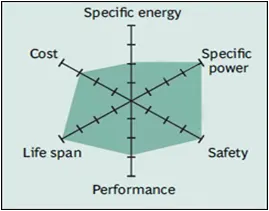
- Lithium Nickel Cobalt Aluminum Oxideoffers one strong advantage as compared to the five other batteries and that is high specific energy. It is pretty moderate in the rest of the characteristics like performance, cost, specific power, and lifespan. The only downside to this battery type is its low level of safety. Its high specific energy and moderate lifespan make it a good candidate for electric powertrains.
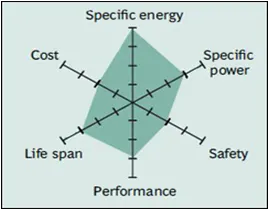
- Lithium Titanateoffers high safety, high performance, and a high lifespan which are very important features every battery should have. Its specific energy is low compared to the five other lithium-ion batteries but it compensates for this with moderate specific power. The only major disadvantage of lithium titanate as compared to the other lithium-ion batteries is its extremely high cost. Another important feature of this battery worthy of mention is its remarkably fast recharge time. It can be used for storing solar energy and creating smart grids.