Week 1 Understanding Different Battery Chemistry
Q1. Materials & Chemical Reactions in Li-ion cells
Lithium ion batteries are a type of rechargable cells, where lithium ions move from the negative electrode to the positive electrode through an electrolyte during the discharge cycle and back while charging. The different types of Lithium ion cells are:
- Lithium Cobalt Oxide ( `LiCoO_2`) (LCO`)
The battery consists of a cobalt oxide cathode and a graphite carbon anode. The cathode has a layered structure and during discharge, lithium ions move from the anode to the cathode. The flow reverses on charge. The drawback of Li-cobalt is a relatively short life span, low thermal stability and limited load capabilities.
- Lithium Manganese Oxide (`LiMn_2O_4`) ( LMO )
The battery uses Managneese dioxide as the cathode material and has a graphite carbon anode. In some architecture, a small amount of silicon is added to the anode. This provides a 25 percent capacity boost. LMO is chosen for most electric vehicles, such as the Nissan Leaf, Chevy Volt and BMW i3.
- Lithium Nickel Cobalt Aluminium Oxide ( `LiNiCoAlO_2`) ( NCA )
NCA's are a group of mixed metal oxides. The cathode material consists of oxides of Nickel - Cobalt - Aluminium having graphite anode.The cathode is composed of lattices of cations of the lithium, cobalt and aluminium. These cell types are mainly used by Panasonic and Tesla.
- Lithium Nickel Manganese Cobalt Oxide (`LiNiMnCoO_2`) ( NMC )
One of the most successful Li-ion systems is a cathode combination of nickel-manganese-cobalt (NMC). Nickel is known for its high specific energy but poor stability; manganese has the benefit of forming a spinel structure to achieve low internal resistance but offers a low specific energy. Combining the metals enhances each other strengths.The cathode combination is typically one-third nickel, one-third manganese and one-third cobalt, also known as 1-1-1.
- Lithium Iron Phosphate ( `LiFePO_4`) ( LFP )
LFP is a type of lithium ion battery using lithium iron phosphate as the cathode material, and a graphitic carbon anode with a metallic backing as the anode. The energy density of an LFP battery is lower than that of other common lithium ion battery types such as Nickel Manganese Cobalt (NMC) and Nickel Cobalt Aluminum (NCA), and also has a lower operating voltage.
- Lithium Titanate ( `Li_4Ti_5O_12`) ( LTO`)
Li-titanate replaces the graphite in the anode of a typical lithium-ion battery and the material forms into a spinel structure. The cathode can be lithium manganese oxide or NMC. LTO (commonly Li4Ti5O12) has advantages over the conventional cobalt-blended Li-ion with graphite anode by attaining zero-strain property, no SEI film formation and no lithium plating when fast charging and charging at low temperature.
| CELL TYPE | CATHODE MATERIAL | ANODE MATERIAL | CATHODE HALF- REACTION | ANODE HALF- REACTION | OVERALL REACTION |
|---|---|---|---|---|---|
| LCO | `LiCoO_2` | Graphite | `CoO_2+Li^(+2)+e^(-) hArrLiCoO_2` | `LiC_6hArrC_6+Li^(+)+e^(-)` | `LiCoO_2+C_6hArrLiC_6+CoO_2` |
| LMO | `LiMn_2O_4` | Graphite | `MnO_2+Li^(+2)+e^(-)hArrLiMnO_2` | `LiC_6hArrC_6+Li^(+)+e^(-)` | `LiCoO_2+C_6hArrLiC_6+CoO_2` |
| NCA | `LiNiCoAlO_2` | Graphite | `NiCoAlO_2+Li^(+2)+e^(-)hArrLiNiCoAlO_2` | `LiC_6hArrC_6+Li^(+)+e^(-)` | `LiCoO_2+C_6hArrLiC_6+CoO_2` |
| NMC | `LiNiMnCoO_2` | Graphite | `NiMnCoO_2+Li^(+2)+e^(-1)hArrLiNiMnCoO_2` | `LiC_6hArrC_6+Li^(+)+e^(-)` | `LiCoO_2+C_6hArrLiC_6+CoO_2` |
| LFP | `LiFePO_4` | Graphite | `FePO_4+Li^(+)+e^(-)hArrLiFePO_4` | `LiC_6hArrC_6+Li^(+)+e^(-)` | `LiCoO_2+C_6hArrLiC_6+CoO_2` |
| LTO | `Li_4Ti_5O_12` | Graphite | `4 Mn_2PO_4+4 Li^(+)+4e^(-)hArr4LiMnO_4` | `Li_4Ti_5O_12+4Li^(+)4e^(-)hArr4LiMn_2O_4` | `4Mn_2O_4+Li_4Ti_5O_12hArr4LiMn_2O_4+Ti_4O_12` |
Q2. Difference between different Li-ion cell types
| Properties | LCO | LMO | NCA | NMC | LFP | LTO |
| Voltage ( Nominal Voltage) | 3.60 | 3.70 | 3.60 | 3.60 | 3.20,3.30 | 2.40 |
| Specific Energy ( Wh/Kg) | 150-200 | 100-150 | 200-260 | 150-220 | 90-120 | 50-80 |
| Charge ( C- Rate) | 0.7-1 C | 0.7-1 C | 0.7 C | 0.7-1 C | 1C | 1C |
| Discharge ( C- Rate ) | 1 C | 1C | 1C | 1C | 1C | 10C |
| Cycle life | 500-1000 | 300-700 | 500 | 1000-2000 | >2000 | >3000 |
| Application | Mobile phone, laptop, cameras | Power tool, medical device | Medical device, Industrial Powertrains | E-bikes, EVs | Buses, Logisitic vehicles | UPS, Electric Powertrain |
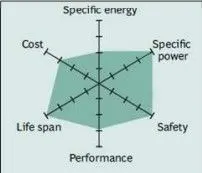
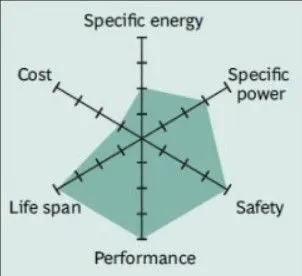
| Spider Web Graph | 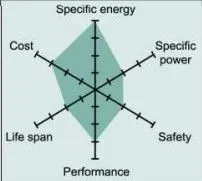 |
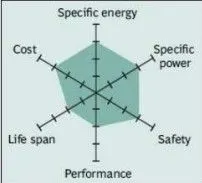 |
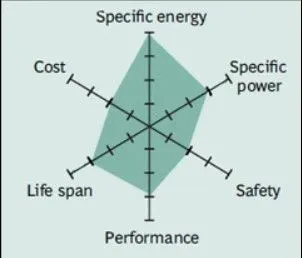 |
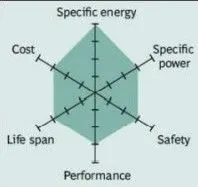 |
 |
 |