Week 1 Understanding Different Battery Chemistry
Questions:
1) Prepare a table which includes materials & chemical reactions occurring at the anode and cathode of LCO, LMO, NCA, NMC, LFP and LTO type of lithium ion cells. Give your detailed explanation on it.
2) Compare the differences between each type of Li+ion batteries based on their characteristics.
Answers:
1)
A Battery is a power source for electrical equipment that consists of one or more electrochemical cells with external connections. The positive terminal of a battery is the cathode, and the negative terminal is the anode when it is supplying power. The negative terminal is the source of electrons that will flow to the positive terminal via an external electric circuit. A redox reaction occurs when a battery is connected to an external electric load, converting high-energy reactants to lower-energy products, and the free-energy difference is provided to the external circuit as electrical energy. Historically, the term "battery" referred to a device made up of numerous cells; however, its meaning has expanded to include single-cell devices.
Batteries exist in a variety of sizes and shapes, ranging from tiny cells used in hearing aids and wristwatches to massive battery banks the size of rooms that provide standby or emergency power for telephone exchanges and computer data centres. Compared to typical fuels like gasoline, batteries have a substantially lower specific energy (energy per unit mass). In cars, this is partially countered by electric motors' superior efficiency in transferring electrical energy to mechanical work as compared to combustion engines. One such example of a battery is a Lithium ion cell.
A lithium-ion (Li-ion) battery is a high-performance battery that employs lithium ions as a key component of its electrochemistry. Lithium atoms in the anode are ionised and separated from their electrons during a discharge cycle. The lithium ions go from the anode via the electrolyte to the cathode, where they recombine with their electrons and become electrically neutral. Between the anode and the cathode, the lithium ions are tiny enough to pass through a micro-permeable separator. Li-ion batteries can have a very high voltage and charge storage per unit mass and volume, thanks to lithium's small size (third only to hydrogen and helium). The electrodes of Li-ion batteries can be made of a variety of materials. The most popular combination is lithium cobalt oxide (cathode) and graphite (anode), which can be found in cellphones and computers. Lithium manganese oxide (used in hybrid and electric vehicles) and lithium iron phosphate are two other cathode materials. The electrolyte of Li-ion batteries is usually ether (a type of organic molecule).
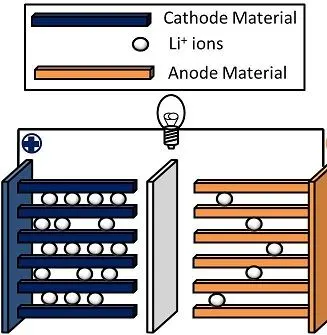
Types of Lithium ion batteries:
Lithium Cobalt Oxide:
LCO batteries, commonly known as lithium cobaltate or lithium-ion cobalt batteries, are made from lithium carbonate and cobalt. Because of their high specific energy, these batteries are employed in cell phones, laptops, and electronic cameras. Lithium ions move from the anode to the cathode during discharge, with the flow reversing when the battery is charged. They have a cobalt oxide cathode and a graphite carbon anode. Short battery life and low specific power are two downsides of this battery. We'd also like to point out that these batteries aren't as safe as others. Despite this, their qualities make them a popular choice for cell phones and other portable electrical gadgets.
Lithium Maganese Oxide:
LMO batteries are also known as lithium manganate, lithium-ion manganese, or manganese spinel batteries. This type of battery technology was first found in the 1980s, with the first publication in the Materials Research Bulletin in 1983. In 1996, Moli Energy produced the first commercial lithium-ion batteries with a lithium manganese oxide cathode. Lithium manganese oxide batteries are distinguished from others by their high temperature stability, and they are also safer than other lithium-ion battery kinds. As a result, they're common in medical devices and equipment, but they can also be found in power tools, electric bikes, and other uses. Laptop computers and electric vehicles can both benefit from lithium manganese oxide batteries.
Lithium Nickel Cobalt Aluminium Oxide:
NCA batteries are finding their way into electric vehicles and grid storage. Despite the fact that NCA batteries aren't extensively used in consumer electronics, they have a lot of potential in the automotive industry. NCA batteries provide a high-energy option with a long lifespan, but they are less safe and expensive than other lithium-ion battery types. NCA batteries must be complemented by monitoring systems to assure driver safety. Because NCA batteries are widely used in electric vehicles, demand for these batteries may rise as the number of electric vehicles increases.
Lithium Nickel Manganese Cobalt Oxide:
NMC batteries are made up of a range of elements used in lithium-ion batteries. A nickel, manganese, and cobalt-based cathode is included. Like other lithium-ion battery types, NMC batteries can have a high specific energy density or specific power. They cannot, however, have both characteristics. This battery is most typically seen in power tools and car engines. The cathode combination ratios are generally 60 percent nickel, 20 percent manganese, and 20 percent cobalt. This means that the raw material is less expensive than in other lithium-ion battery options, as cobalt is expensive. Because some battery manufacturers plan to switch to a higher amount of nickel in their chemistry to use less cobalt, the price of these batteries may fall even further in the future. This battery type is commonly utilised in electric vehicles due to its low self-heating rate.
Lithium Iron Phosphate:
In lithium iron phosphate batteries, often known as li-phosphate batteries, phosphate is employed as a cathode. Their low resistance properties improve their thermal stability and safety. Other advantages include durability and a long lifecycle — fully charged batteries can be stored without affecting their overall charge life. Li-phosphate batteries are typically the most cost-effective alternative when considering their long battery life. The lithium-phosphate battery, on the other hand, has a lower voltage than conventional lithium batteries, which implies it contains less energy. As a result, these batteries are commonly found in electric motorcycles and other applications that require a long lifecycle and high levels of safety. Electric vehicles frequently use these batteries as well.
Lithium Titanate Oxide:
LTO or lithium titanate, or li-titanate, is a form of battery with an increasing variety of applications. The lithium-titanate battery has an extraordinarily fast recharge time due to its superior nanotechnology. Electric vehicle and bicycle manufacturers use lithium-titanate batteries, and this type of battery has the potential to be used in public transportation electric buses. These batteries, however, have a lower intrinsic voltage or energy density than other lithium-ion battery types, which could present issues when it comes to powering autos efficiently. Regardless, lithium titanate batteries have a higher density than non-lithium-ion batteries, which is an advantage. These batteries could be utilised in military and aerospace applications, as well as to store wind and solar energy and build smart grids. These batteries could also be used in power system system-critical backups, according to Battery Space.
Table of Comparison:
|
COMPOSITION AND CHEMICAL REACTIONS IN LITHIUM-ION BATTERIES |
||||||
|
BATTERY TYPE |
CATHODE |
ANODE |
ELECTROLYTE |
CATHODE REACTION |
ANODE REACTION |
|
|
SALT |
SOLVENT |
|||||
|
LPO |
Lithium Cobalt Oxide (LiCoO2) |
Graphite (C6) |
Lithium Hexafluorophosphate (LiPF6) |
Ethylene Carbonate |
Li(1-x)CoO2(s) + xLi+ + xe- ⇿ LiCoO2(s) |
C6Li ⇿ 6C + Li+ + e- |
|
LMO |
Lithium Manganese Oxide (LiMn2O4) |
Graphite (C6) |
Lithium Hexafluorophosphate (LiPF6) |
Ethylene Carbonate |
Li(1-x) Mn2O4(s) + xLi+ + xe- ⇿ LiMn2O4(s) |
C6Li ⇿ 6C + Li+ + e- |
|
NCA |
Lithium Nickel Cobalt Aluminium Oxide (LiNiCoAlO2) |
Graphite (C6) |
Lithium Hexafluorophosphate (LiPF6) |
Ethylene Carbonate |
Li(1-x) NiCoAlO2(s) + xLi+ + xe- ⇿ LiNiCoAlO2(s) |
C6Li ⇿ 6C + Li+ + e- |
|
NMC |
Lithium Nickel Manganese Cobalt Oxide (LiNiMnCoO2) |
Graphite (C6) |
Lithium Hexafluorophosphate (LiPF6) |
Ethylene Carbonate |
Li(1-x) NiMnCoO2(s) + xLi+ + xe- ⇿ LiNiMnCoO2(s) |
C6Li ⇿ 6C + Li+ + e- |
|
LFP |
Lithium Iron Phosphate (LiFePO2) |
Graphite (C6) |
Lithium Hexafluorophosphate (LiPF6) |
Ethylene Carbonate |
Li(1-x) FePO4(s) + xLi+ + xe- ⇿ LiFePO4(s) |
C6Li ⇿ 6C + Li+ + e- |
|
LTO |
Lithium Manganese Oxide (LiMn2O4) |
Titanate (Ti5O12) |
Lithium Hexafluorophosphate (LiPF6) |
Ethylene Carbonate |
Li(1-x) Mn2O4(s) + xLi+ + xe- ⇿ LiMn2O4(s) |
Li3Ti5O12 ⇿ Li4Ti3O12 + 3Li+ + 3e- |
|
Lithium Nickel Manganese Cobalt Oxide (LiNiMnCoO2) |
Li(1-x) NiMnCoO2(s) + xLi+ + xe- ⇿ LiNiMnCoO2(s) |
|||||
2)
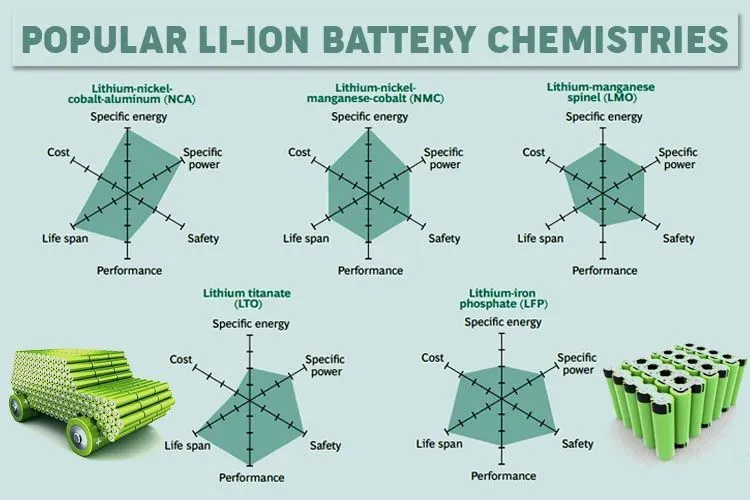
From the image given above, we can infer that when all the types of Li-ion batteries are compared the cost is high for LTO or Lithium titanate and next in the list is NCA or Lithium nickel cobalt aluminum oxide. From energy point of view, better specific energy is scene for NCA and NMC or Lithium nickel manganese cobalt oxide. Lowest specific energy is scene for LTO and LFP or lithium iron phosphate. In case of specific power, the highest is observed for NCA. From safety and performance point of view, the highest is observed for LTO hence the high cost. The lifespan is high for LTO,NCA and LFP.
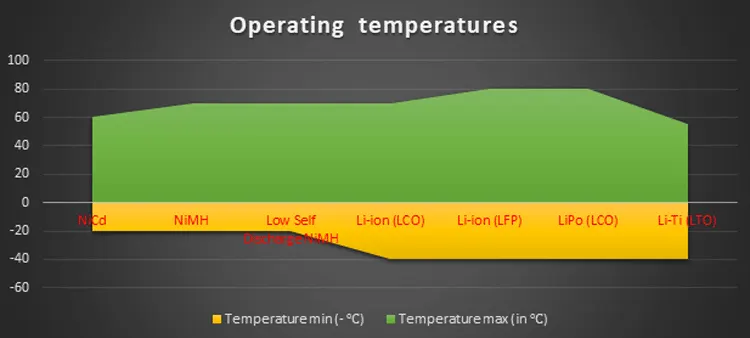
When operating temperature is considered all the types of Li-ion cells works well in normal temperature rather than in cold conditions. From the above graph, it is clear that all the Li-ion chemistries have a broader operating range than the Nickel based batteries.
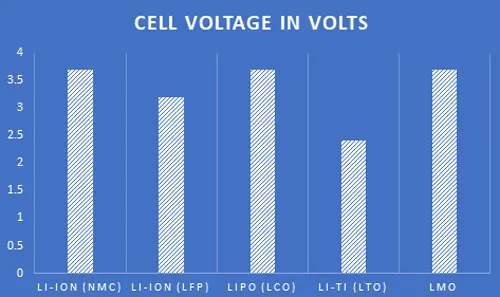
From the above graph, we can say that the nominal voltage of NMC, LCO and LMO is higher than other chemistries while that of LTO is lowest.
LFP, NMC, and LTO have the best thermal runaway, making them ideal for high-temperature processes. When it comes to costs, LTO performs well in most parameters, but the cost is not justified for consumer products and everyday portable equipment, whereas NMC and LFP offer the best of both worlds: they are competitively priced while providing adequate performance, and while NCA is less expensive than the other options, its poor thermal performance makes it dangerous for EVs and other operations where high temperatures and mechanical stress are common, resulting in additional costs.
To summarise, Li-ion batteries are the future of energy storage. The internal composition of the cell, i.e. the material used for the electrodes, separator, and electrolyte, determines the cell's specification. Specific energy, charging rates, cycle life, nominal voltage, and other features can be changed by altering the cathode, but each chemistry has its own set of advantages and disadvantages that must be considered when choosing a li-ion cell for a product.