Week 1 Understanding Different Battery Chemistry
Q1.Prepare a table which includes materials & chemical reactions occurring at the anode and cathode of LCO, LMO, NCA, NMC, LFP and LTO type of lithium ion cells.Give your detailed explanation on it
ANS1:
Li-Ion Batteries:
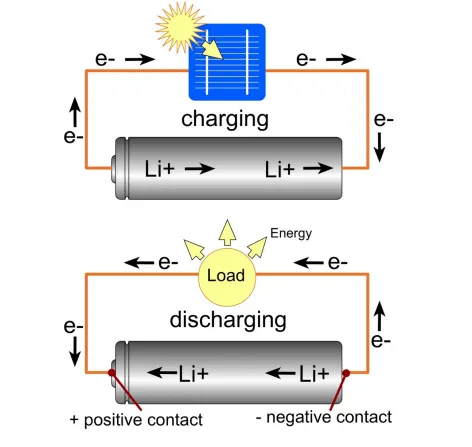
All battery cells have positive and negative terminals, and these are connected to internal electrodes (physicalchemical structures) that store and release electrochemical energy that is used to drive an external electrical load. Li-ion batteries use a process known as intercalation, in which lithium ions∗ are incorporated into the structure of the electrode materials. Inside the cell, lithium ions move from the positive to the negative electrode during charging and from the negative to thepositive electrode as the battery is discharged. Electrons move through an external circuit in the same direction as the lithium ions, driven by an external charger (when charging) or by the stored potential chemical energy(available to drive a load) when the battery is discharging.
Some of the most common types include:
Lithium cobalt oxide (LCO):
Lithium cobalt oxide was the first widely commercialized cathode material and is still in common use in consumer products. LCO has high energy density but is not well suited for use in off-grid products because of lower cyclelife and poorer safety. Nonetheless, LCO batteries are ubiquitous and still frequently used for these applications.
Lithium manganese oxide (LMO):
Pure LMO batteries have good thermal stability and safety but lower cycle life; they have declined in commercial use and have been replaced by blending the manganese oxide with nickel and cobalt (NMC).
Nickel cobalt aluminum (NCA):
Like LCO, NCA batteries have lower thermal stabilitythan competing technologies. Their cost and cycle lifealso make them less attractive for off-grid products.
Lithium nickel manganese cobalt oxide (NMC, NCM):
Different blends of nickel, manganese, and cobalt are a successful and promising approach for Li-ion batteries.The ratio of these three elements is sometimes listed in the electrode name – an equal mix would have the chemical formula LiNi1/3Mn1/3Co1/3O2 and be listed as NMC 1-1-1 or simply NMC 111. NMC blends offer combinations of good cycle life, safety, and high energy density. The ratios of elements can be tailored to emphasize qualities that target specific applications
including off-grid products.
Lithium Iron Phosphate (LiFePO4):
LiFePO4 batteries exhibit qualities that make them ideally suited for off-grid products where cost, safety, stability,and cycle life are primary requirements.3 They have lower energy density than competing Li-ion chemistries and a lower output voltage of 3.2V, but this is acceptable for most off-grid applications. Many successful off-grid products use LiFePO4 batteries.
Lithium titanate (LTO):
Lithium titanate (LTO) anode materials can be used with LMO or NMC cathodes to make a Li-ion cell. LTO cells offers very high cycle life, excellent thermal stability, excellent safety, and good low temperature operation.However, they have much lower energy density thanother Li-ion technologies and a low cell voltage of 2.4V.
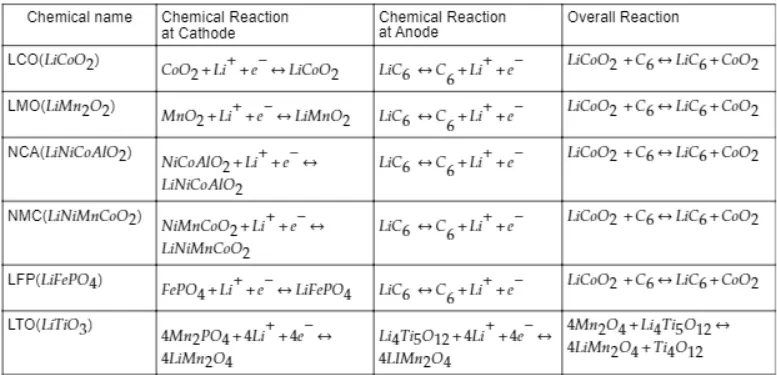
The table which includes materials & chemical reactions occurring at the anode and cathode and overall reactions of all the types of Li-ion cells are given:
Q2.Compare the differences between each type of Li+ion batteries based on their characteristics:
ANS 2 :
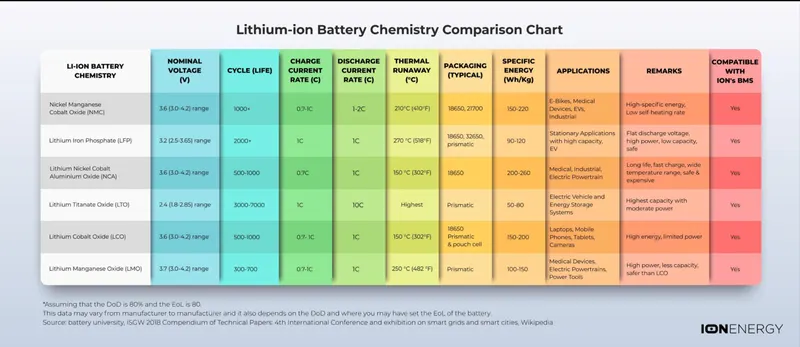
Important terms specific to Lithium-ion battery chemistry:
- Nominal Voltage: It is the system voltage at which the device is designed to operate. The rated voltage is usually higher than the nominal voltage to ensure the safe operation of the device.
- Cycle: The charge and discharge make a Cycle
- The current rate (C): This is used to determine the fast charging capability of a battery.
- Thermal Runaway: It is a condition where an increase in temperature changes the conditions which increase the temperature further, often leading to disaster.
- Specific Energy: It is the amount of energy stored per unit mass (Wh/Kg).