Week 1 Understanding Different Battery Chemistry
1)
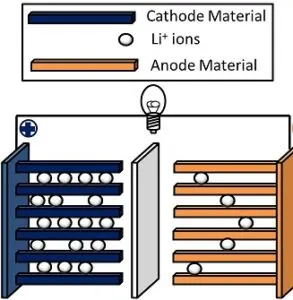
A lithium-ion (Li-ion) battery is an advanced battery technology that uses lithium ions as a key component of its electrochemistry. During a discharge cycle, lithium atoms in the anode are ionized and separated from their electrons. The lithium ions move from the anode and pass through the electrolyte until they reach the cathode, where they recombine with their electrons and electrically neutralize. The lithium ions are small enough to be able to move through a micro-permeable separator between the anode and cathode. In part because of lithium’s small size (third only to hydrogen and helium), Li-ion batteries are capable of having a very high voltage and charge storage per unit mass and unit volume.
Li-ion batteries can use a number of different materials as electrodes. The most common combination is that of lithium cobalt oxide (cathode) and graphite (anode), which is most commonly found in portable electronic devices such as cellphones and laptops. Other cathode materials include lithium manganese oxide (used in hybrid electric and electric automobiles) and lithium iron phosphate. Li-ion batteries typically use ether (a class of organic compounds) as an electrolyte.
advantages
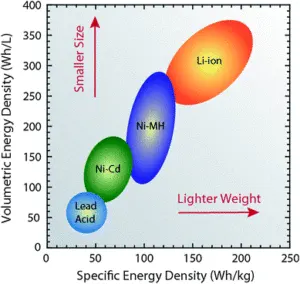
Compared to the other high-quality rechargeable battery technologies (nickel-cadmium or nickel-metal-hydride), Li-ion batteries have a number of advantages. They have one of the highest energy densities of any battery technology today (100-265 Wh/kg or 250-670 Wh/L). In addition, Li-ion battery cells can deliver up to 3.6 Volts, 3 times higher than technologies such as Ni-Cd or Ni-MH. This means that they can deliver large amounts of current for high-power applications, which has Li-ion batteries are also comparatively low maintenance, and do not require scheduled cycling to maintain their battery life. Li-ion batteries have no memory effect, a detrimental process where repeated partial discharge/charge cycles can cause a battery to ‘remember’ a lower capacity. This is an advantage over both Ni-Cd and Ni-MH, which display this effect. Li-ion batteries also have low self-discharge rate of around 1.5-2% per month. They do not contain toxic cadmium, which makes them easier to dispose of than Ni-Cd batteries.
Due to these advantages, Li-ion batteries have displaced Ni-Cd batteries as the market leader in portable electronic devices (such as smartphones and laptops). Li-ion batteries are also used to power electrical systems for some aerospace applications, notable in the new and more environmentally friendly Boeing 787, where weight is a significant cost factor. From a clean energy perspective, much of the promise of Li-ion technology comes from their potential applications in battery-powered cars. Currently, the bestselling electric cars, the Nissan Leaf and the Tesla Model S, both use Li-ion batteries as their primary fuel source.
disadvantages
Despite their technological promise, Li-ion batteries still have a number of shortcomings, particularly with regards to safety. Li-ion batteries have a tendency to overheat, and can be damaged at high voltages. In some cases this can lead to thermal runaway and combustion. This has caused significant problems, notably the grounding of the Boeing 787 fleet after onboard battery fires were reported. Because of the risks associated with these batteries, a number of shipping companies refuse to perform bulk shipments of batteries by plane. Li-ion batteries require safety mechanisms to limit voltage and internal pressures, which can increase weight and limit performance in some cases. Li-ion batteries are also subject to aging, meaning that they can lose capacity and frequently fail after a number of years. Another factor limiting their widespread adoption is their cost, which is around 40% higher than Ni-Cd. Addressing these issues is a key component for current research into the technology. Finally, despite the high energy density of Li-ion compared to other kinds of batteries, they are still around a hundred times less energy dense than gasoline (which contains 12,700 Wh/kg by mass or 8760 Wh/L by volume)
Chemical Reaction in Lithium-ion Batteries
1.Half-Cell Reactions
a.Anode Reaction (During Battery Discharge):
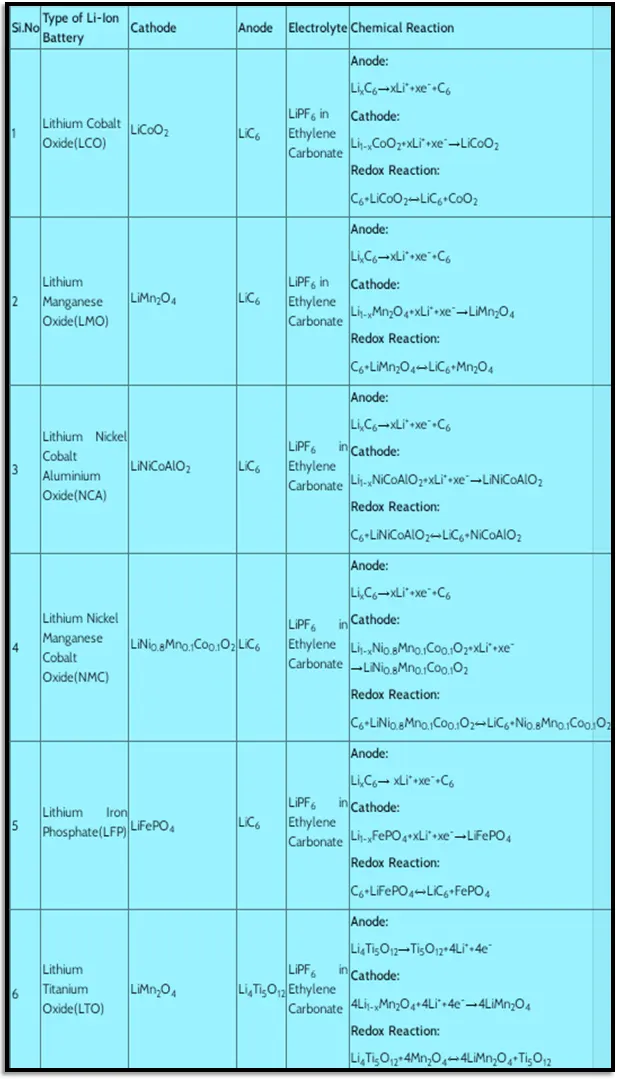
At the anode, lithium is oxidized from Li to Li +. Means the oxidation state changes from 0 to +1. The ongoing chemical reaction at the lithium-graphite anode is represented symbolically as:
LiC6 C6 + Li+ + e–
b.Cathode Reaction (During Battery Discharge):
These lithium ions from the anode migrate medium to the cathode via an electrolyte. Here they incorporate into lithium cobalt oxide. And here it reduces cobalt from +4 to +3 oxidation state. All this reaction occurring at the cathode is represented symbolically as:
CoO2 + Li+ + e- LiCoO2 (s)
2.Overall Reaction (At Battery Discharge)
These chemical reactions occur when the battery is discharging. The overall chemical reaction is represented symbolically as:
LiC6 + CoO2 C6 + LiCoO2
3.Chemical Reaction (At Battery Recharge):
At the recharging of the battery or a cell, all these reactions occur in reverse. This means the lithium ions leave, and the bond at lithium cobalt oxide cathode is broken. These lithium ions again go back to the anode. Here they again get reduced and integrate into the graphite system.
What Anode and Cathode Materials Are Good for Lithium-ion Batteries
Anode and Cathode form up the main parts of the cell which produce reactions that help the batteries perform their main function, providing electrical energy. To keep the battery performances optimum and efficient without any chemical or electrical hazards the following materials have been used in commercially available cells up till now.
Cathode Materials
Cathode materials are generally constructed from LiCoO2 or LiMn2O4.
Cobalt-Based Materials
The cobalt-based material develops a pseudo tetrahedral structure that allows for two-dimensional lithium-ion diffusion. The cobalt-based cathodes are ideal due to their high theoretical specific heat capacity, high volumetric capacity, low self-discharge, high discharge voltage, and good cycling performance.
Manganese-Based Materials
The manganese-based materials adopt a cubic crystal lattice system, which allows for three-dimensional lithium-ion diffusion. Manganese cathodes are attractive because manganese is cheaper and because it could theoretically be used to make a more efficient, longer-lasting battery if its limitations could be overcome. LiFePO4 is also a candidate for large-scale production of lithium-ion batteries such as electric vehicle applications due to its low cost, excellent safety, and high cycle durability.
Anode Materials
Currently, there are three most common materials used in the construction of anodes:
Carbon-Based Anodes
Graphite is the most common form of carbon used in the construction of carbon-based anodes. These anodes consist of hexagonal and rhombohedral shaped sheets. When Lithium-ion comes in contact with the anode, the graphite sheets go through re-arrangements. Carbon-based anodes are cost-effective and easily available. They also possess the most suitable electrochemical properties required in Lithium-ion batteries.
Non-Graphitic Anodes
Since Lithium-ion batteries are subjected to research and consistent developments, advances are being made for the use of modern-graphite carbon. Scientists reported that the use of altered graphitic forms helps to improve electrochemical characteristics. These impure forms of graphite lack the property of graphite to re-arrange itself into layers. The non-graphitic anodes work efficiently in combination with solid electrolytes and can be paired with Lithium-Manganese Oxide.
Lithium-Alloy Anodes
Lithium-Alloy anodes are one of the many recent additions applied to the Lithium-ion battery technology. The Lithium-Aluminum, Li-Al, anode is the first Lithium-Alloy anode developed under this category. These alloy anodes offer great advancements in the recycling of Lithium batteries. Lithium titanium oxide is another alloy anode developed to replace the traditional carbon anodes. These anodes offer additional advantages as they offer improved cycles due to the absence of volumetric changes that occur during the Lithium supplement and removal process. The problem with these anodes is that they can not produce high-density energy outputs due to its high operating voltage levels.
2)
|
Lithium Cobalt Oxide: LiCoO2 cathode (~60% Co), graphite anode |
|
| Voltages | 3.60V nominal; typical operating range 3.0–4.2V/cell |
| Specific energy (capacity) | 150–200Wh/kg. Specialty cells provide up to 240Wh/kg. |
| Charge (C-rate) | 0.7–1C, charges to 4.20V (most cells); 3h charge typical. Charge current above 1C shortens battery life. |
| Discharge (C-rate) | 1C; 2.50V cut off. Discharge current above 1C shortens battery life. |
| Cycle life | 500–1000, related to depth of discharge, load, temperature |
| Thermal runaway | 150°C (302°F). Full charge promotes thermal runaway |
| Applications | Mobile phones, tablets, laptops, cameras |
| Comments | Very high specific energy, limited specific power. Cobalt is expensive. Serves as Energy Cell. |
| Lithium Manganese Oxide: LiMn2O4 cathode. graphite anode Short form: LMO or Li-manganese (spinel structure) Since 1996 |
|
| Voltages | 3.70V (3.80V) nominal; typical operating range 3.0–4.2V/cell |
| Specific energy (capacity) | 100–150Wh/kg |
| Charge (C-rate) | 0.7–1C typical, 3C maximum, charges to 4.20V (most cells) |
| Discharge (C-rate) | 1C; 10C possible with some cells, 30C pulse (5s), 2.50V cut-off |
| Cycle life | 300–700 (related to depth of discharge, temperature) |
| Thermal runaway | 250°C (482°F) typical. High charge promotes thermal runaway |
| Applications | Power tools, medical devices, electric powertrains |
| Comments |
High power but less capacity; safer than Li-cobalt; commonly mixed with NMC to improve performance. |
| Lithium Nickel Manganese Cobalt Oxide: LiNiMnCoO2. cathode, graphite anode Short form: NMC (NCM, CMN, CNM, MNC, MCN similar with different metal combinations) Since 2008 |
|
| Voltages | 3.60V, 3.70V nominal; typical operating range 3.0–4.2V/cell, or higher |
| Specific energy (capacity) | 150–220Wh/kg |
| Charge (C-rate) | 0.7–1C, charges to 4.20V, some go to 4.30V; 3h charge typical. Charge current above 1C shortens battery life. |
| Discharge (C-rate) | 1C; 2C possible on some cells; 2.50V cut-off |
| Cycle life | 1000–2000 (related to depth of discharge, temperature) |
| Thermal runaway | 210°C (410°F) typical. High charge promotes thermal runaway |
| Cost | ~$420 per kWh[1] |
| Applications | E-bikes, medical devices, EVs, industrial |
| Comments | Provides high capacity and high power. Serves as Hybrid Cell. Favorite chemistry for many uses. Leading system; dominant cathode chemistry. |
| Lithium Iron Phosphate: LiFePO4 cathode, graphite anode Short form: LFP or Li-phosphate Since 1996 |
|
| Voltages | 3.20, 3.30V nominal; typical operating range 2.5–3.65V/cell |
| Specific energy (capacity) | 90–120Wh/kg |
| Charge (C-rate) | 1C typical, charges to 3.65V; 3h charge time typical |
| Discharge (C-rate) | 1C, 25C on some cells; 40A pulse (2s); 2.50V cut-off (lower that 2V causes damage) |
| Cycle life | 2000 and higher (related to depth of discharge, temperature) |
| Thermal runaway | 270°C (518°F) Very safe battery even if fully charged |
| Cost | ~$580 per kWh[1] |
| Applications | Portable and stationary needing high load currents and endurance |
| Comments | Very flat voltage discharge curve but low capacity. One of safest Li-ions. Elevated self-discharge. Used primarily for energy storage, moderate growth |
| Lithium Nickel Cobalt Aluminum Oxide: LiNiCoAlO2 cathode (~9% Co), graphite anode Short form: NCA or Li-aluminum. Since 1999 |
|
| Voltages | 3.60V nominal; typical operating range 3.0–4.2V/cell |
| Specific energy (capacity) | 200-260Wh/kg; 300Wh/kg predictable |
| Charge (C-rate) | 0.7C, charges to 4.20V (most cells), 3h charge typical, fast charge possible with some cells |
| Discharge (C-rate) | 1C typical; 3.00V cut-off; high discharge rate shortens battery life |
| Cycle life | 500 (related to depth of discharge, temperature) |
| Thermal runaway | 150°C (302°F) typical, High charge promotes thermal runaway |
| Cost | ~$350 per kWh[1] |
| Applications | Medical devices, industrial, electric powertrain (Tesla) |
| Comments | Shares similarities with Li-cobalt. Serves as Energy Cell. Mainly used by Panasonic and Tesla; growth potential |
| Lithium Titanate: Cathode can be lithium manganese oxide or NMC; Li2TiO3 (titanate) anode Short form: LTO or Li-titanate Commercially available since about 2008. |
|
| Voltages | 2.40V nominal; typical operating range 1.8–2.85V/cell |
| Specific energy (capacity) | 50–80Wh/kg |
| Charge (C-rate) | 1C typical; 5C maximum, charges to 2.85V |
| Discharge (C-rate) | 10C possible, 30C 5s pulse; 1.80V cut-off on LCO/LTO |
| Cycle life | 3,000–7,000 |
| Thermal runaway | One of safest Li-ion batteries |
| Cost | ~$1,005 per kWh[1] |
| Applications | UPS, electric powertrain (Mitsubishi i-MiEV, Honda Fit EV), solar-powered street lighting |
| Comments | Long life, fast charge, wide temperature range but low specific energy and expensive. Among safest Li-ion batteries. Ability to ultra-fast charge; high cost limits to special application. |
Future Batteries
- Solid-state Li-ion: High specific energy but poor loading and safety.
- Lithium-sulfur: High specific energy but poor cycle life and poor loading
- Lithium-air: High specific energy but poor loading, needs clean air to breath and has short life.