Week 1 Understanding Different Battery Chemistry
1) AIM: Prepare a table which includes materials & chemical reactions occurring at the anode and cathode of LCO, LMO, NCA, NMC, LFP and LTO type of lithium ion cells.Give your detailed explanation on it.
Ans:
Battery:
- A battery is an energy source consisting of one or more electrochemical cells and terminals on both ends called an anode (-) and a cathode (+). Electrochemical cells transform chemical energy into electrical energy. Inside the battery is an electrolyte, often consisting of soluble salts or acids, it serves as a conductive medium, allowing the electric charge to travel through the battery.
- When a battery is disconnected, the charge at the positive and negative ends is equal, meaning there is no electric current. When connected to an outside resistance or device, the battery experiences an imbalance in charge that pushes electrons through the device's conductive material to the positive end of the battery. But while the electrons—or the negative charge—are what moves through the circuit, the electric current is measured following the positive charge's direction, which flows from the positive to the negative end inside the battery, and vice versa outside it.
- Depending on its voltage and load, a single battery can power anything from a car's motor or a computer to a cellphone or a light bulb. When it comes to most electronic devices, working with the wrong voltage could result in your device not turning on or risk frying its electrical components, sometimes beyond repair.
- The right voltage battery would be able to power a device without hindering its performance or harming its hardware. Also, depending on the device's consumption of energy and the battery's load, a single battery charge could last you anywhere from a few hours to multiple days.
Type of Battery:
There are Two types of Batterys:
1) Primari Cells
2)Secondary Cells
1.1 Primari cells:
Primari: single discharge cycle/one time use/non rechargeable.
low Power Applications: Watches,Calculator, Radio,etc..
- Size AA&AAA
- Lithium Battery
- Low cost.
Primari cells There are Two types
1) Dry Cell
2) Lithium Battery.
Secondary Cells:
Secondary: Rechargeable battery.
- Consumer Application & Automotive.
- Reverse Chemical Process when electrical energy converted to chemical.
There are Five Type of Secondary Cells:
1) lead acid battery
2) Nickel cadmium battery
3) Metal air battery
4) Nickel metal hydride battery
5) Lithium ion battery
There are Lithium-ion Batterys Types:
1) Lithium Iron Phosphate (LFP)
2) Lithium Nickel Manganese Cobalt (NMC)
3) Lithium Manganese Oxide (LMO)
4) Lithium Nickel Cobalt Aluminium (NCA)
Lithium-Ion Battery Chemistries:
- Many battery storage devices are made from electrochemical cells. Electrochemical cells convert chemical potential to electrical potential when discharging and vice versa if the cell is charging. This study will focus on lithium-ion batteries and will exclude other popular battery types such as lead-acid and nickel-metal hydride.
- Li-ion batteries have a structured anode and cathode that houses lithium. The cathode can have three different structures that consist of a layered, spinel, or olivine structure. With changes to the cathode materials on Li-ion batteries, the characteristics of energy density and cost effectiveness can be further improved.
- Among the phosphate-based cathode materials, LFP has the highest capacity though a much lower open circuit voltage. However, when Goodenough et al. demonstrated the lithium extraction and insertion stability into FePO4, an olivine structure, LFP solidified its position as the best candidate for phosphate-based cathodes.
Lithium Iron Phosphate (LFP) Battery:
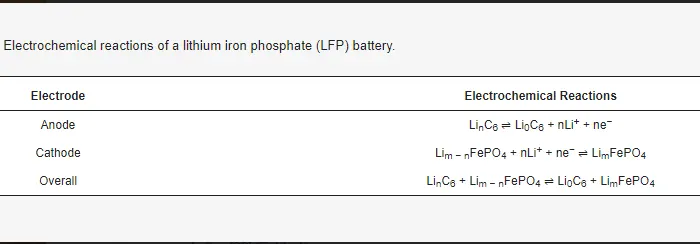
- When LFP batteries discharge, lithium molecules from the negative electrode detach from layered graphene, becoming lithium ions and electrons. The electrons travel out of the battery as lithium ions move across a separator and both integrate into iron phosphates at the positive electrode. During charge, lithium separates from the iron phosphate, generating lithium ions and electrons. The lithium ions and electrons transfer to the positive electrode and integrate into the graphene structure. The reaction occurs from right to left.
Lithium Nickel Manganese Cobalt Oxide (NMC) Battery:
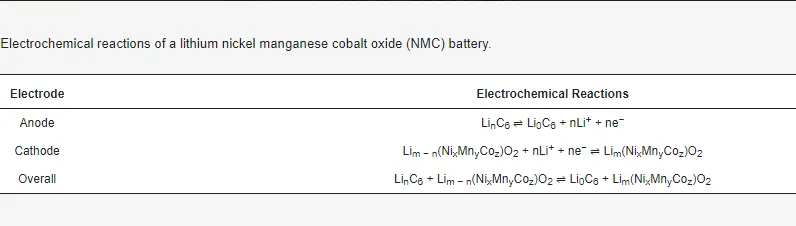
- NMC is a Li-ion battery with a different type of cathode. Unlike LFP, which possesses good capacity and stability, NMC demonstrates an improved cycle life, thermal stability, and energy density.Its layered cathode structure demonstrates a single-phase intercalation process as opposed to olivine structures with two phases.The cathode of NMC consists of Li(NixMnyCoz)O2, where the sum of the molar fractions (x, y, z) is equal to one.The discharge chemistry of NMC is similar to LFP, as they are both Li-ion batteries. It follows the process of lithium oxidation on the anode and reduces at the cathode. The discharge reaction proceeds from left to right, whilst the charge reaction proceeds from right to left.
Lithium Manganese Oxide (LMO) Battery:
- LMO batteries were first commercialized in 1975 by the Sanyo company, making it one of the first Li-ion batteries to be used commercially. Newer LMO batteries contain a three-dimensional spinel structure to improve the diffusion of lithium ions, allowing it to have high thermal stability, low cost, and environmental affinity. However, LMO batteries suffer from severe capacity fading due to the surface dissolution of manganese in the electrolyte at temperatures above 60 °C.
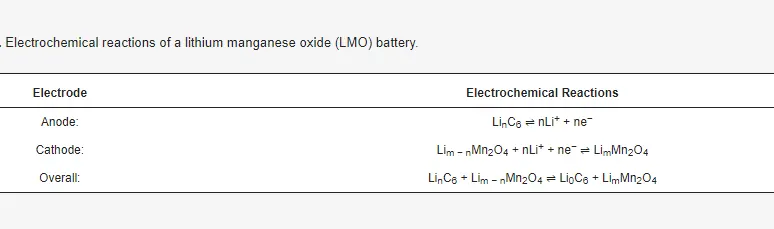
- A typical LMO battery provides a working voltage of 3.7 V and a specific capacity of 148 mAh g−1. When compared to the average NMC battery, which has a working voltage of 3.6 V and a specific capacity of 170 mAh g−1, the LMO battery has a slightly higher working voltage but a lower specific capacity.The discharge chemistry is as follows, with the discharge reaction occurring from left to right and the charge reaction occurring from right to left.
Lithium Nickel Cobalt Aluminum Oxide (NCA) Battery:
- NCA batteries share many similarities with NMC batteries as they both share the layered cathode structure. However, NCA batteries replace the manganese of the NMC batteries with aluminum. This improves the specific energy and lifespan when compared to its NMC counterpart. NCA batteries also have a high gravimetric capacity of 200 mAh·g−1 when compared to the capacities of LMO and LFP batteries at 148 mAh∙g−1 and 170 mAh∙g−1, respectively. Finally, NCA batteries are known to have a long lifespan. The main disadvantage of NCA batteries is that they are not as safe as other battery types. These batteries require special safety monitoring measures for use in applications such as electric vehicles.
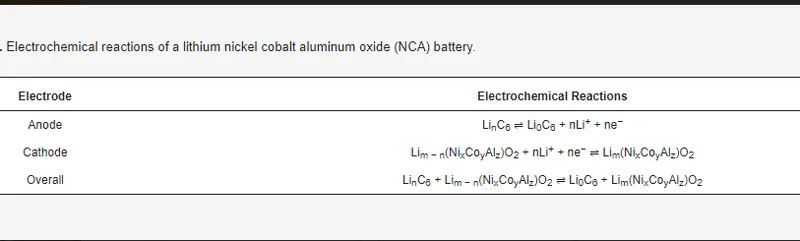
- The discharge chemistry of NCA batteries closely follows that of the other Li-ion batteries listed above. Lithium undergoes oxidation at the anode and reduction at the cathode, with the discharge reaction occurring from left to right and the charge reaction occurring from right to left.
- Lithium Titanium oxide Batteries is a type of rechargable battery which has the advantage of being faster to charge than other lithium ion battery but its disadvantages of having a much lower energy density.
2 AIM: Compare the differences between each type of Li+ion batteries based on their characteristics.
Ans:
The five principle chemistries:.
1) Lithium nickel cobalt aluminum (NCA)
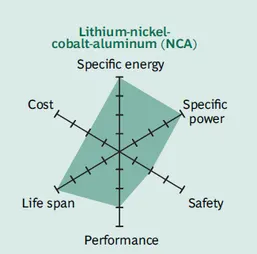
- The specific energy and specific power is very Good and safety is negative. performance is compromise, life span and cost is high.
2) Lithium nickel manganese cobalt (NMC)
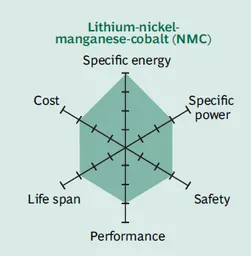
- The specific energy and specific power is Good and safety is also batter . performance is compromise, life span batter and cost is high.
3) Lithium manganese spinel (LMO)
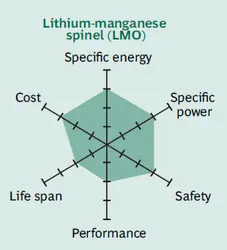
- The specific energy and specific power is Good and safety is also batter . performance is low, life span low and cost is high.
4) Lithium titanate (LTO)
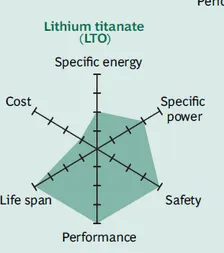
- The specific energy is low and specific power is Good and safety is also very high . performance is high, life span high and cost is high.
5) Lithium iron phosphate (LFP)
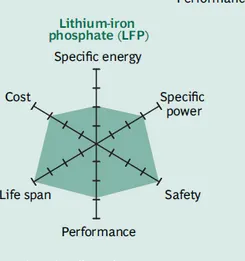
- The specific energy is low and specific power is Good and safety is also very high . performance is good, life span high and cost is high.
along six dimensions:
1) safety
2) life span (measured in terms of both number of charge-and-discharge cycles and overall battery age)
3) performance (peak power at low temperatures, state-of-charge measurement, and thermal management)
4) specific energy (how much energy the battery can store per kilogram of weight)
5) specific power (how much power the battery can store per kilogram of mass)
6) cost.