1.Prepare a table which includes materials & chemical reactions occurring at the anode and cathode of LCO, LMO, NCA, NMC, LFP and LTO type of lithium ion cells.Give your detailed explanation on it?
Solution: Lithium-ion (Li-ion) batteries are an important component of energy storage systems used in various applications such as electric vehicles and portable electronics. Li-ion battery is a type of rechargeable battery composed of cells in which lithium ions move from the negative electrode through an electrolyte to the positive electrode during discharge and back when charging. Li-ion cells use an intercalated lithium compound as the material at the positive electrode and typically graphite at the negative electrode. The cathode can have three different structures that consist of a layered, spinal or olivine structure. Li-ion batteries have a high energy density, no memory effect and low self discharge. Cells can be manufactured to either prioritize energy or power density. There are many chemistries of Li-ion battery, but LFP, NMC, LMO and NCA are four commonly used types. The following figure shows the charging and discharging operation of Li-ion battery.
The types of Li-ion batteries are LCO, LMO, NCA, NMC, LFP and LTO. Which are explained below one by one.
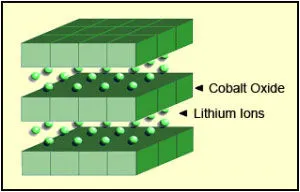
LCO: Lithium Cobalt Oxide(LCO), its high specific energy makes Li-cobalt the popular choice for mobile phones, laptops and digital cameras. The battery consists of a cobalt oxide cathode and a graphite carbon anode. The cathode has a layered structure and during discharge, lithium ions move from the anode to cathode. The flow reverse on charge. The drawback of Li-cobalt is a relatively short life span, low thermal stability and limited load capabilities. Li-cobalt should not be charged and discharged at a current higher than its C-rating. this means that an 18650cell with 2400mAh can onlybe charged and discharged at 2400mA. Forcing a fast charhe or applying a load higher than 2400mA causes overheating and undue stress. The following figure shows the LCO battery structure.
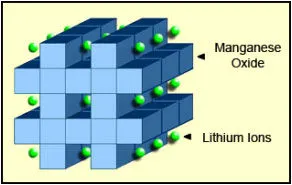
LMO: Lithium Manganese Oxide (LMO), the architecture forms a three dimensional spinel structure that improves ion flow on the elctrode, which results in lower internal resistance and improved current handling. A further advantage of spinal is high thermal stability and enhanced safety, but the cycle and caledar life are limited. Low internal resistance enables fast charging and high current discharging. Li-Manganese has a capacity that is roughly one-third lower than Li-cobalt. Design flexibility allows engineers to maximize the battery for either optimal longitivity, maximum load current or high capacity. The LMO battery has a slightly higher working voltage but a lower specific gravity. These batteries are used for power tools, medical instruments as well as hybrid and electric vehicles. The following figure shows the structure of LMO battery.
NCA: Lithium Nickle Cobalt Aluminum oxide(NCA), these batteries share many simillarities with NMC batteries as they both share the layered cathode structure. However, NCA batteries replace the managanese of the NMC batteries with aluminium. This improves the specific energy and lifespan when compared to its NMC counterpart. NCA batteries also have a high gravimetric capacity when compared to the capacities of LMO and LFP batteries. The main disadvantage of NCA batteries is that they are not safe as other battery types. These batteries require special monitoring measures for use in applications such as electric vehicles. Lithium undergoes oxidation at the anode and reduction at the cathode, with the discharge reaction occuring form the left to right and the charge reaction occuring from the right to left. The basic structure of NCA battery is shown in the following figure.
NMC: Lithium Nickel Manganese Cobalt oxide (NMC), it is a Li-ion battery with a different type of cathode. Unlike LFP, which posses good capacity and stability, NMC demonstrates an improvedcycle life, thermal stability and energy density. Its layered cathode structure demonstrates a single phase intercalation process as opposed to olivine structures wuth two phases. The cathode of NMC consists of Li(NixMnyCoz)O2, where the sum of the molar fractions (x, y, z) is equal to one. The discharge of NMC is similar to LFP, as they are both Li-ion batteries. It follows the process of lithium oxidation on the anode and reduces at the cathode. The discharge proceeds from left to right, whilst the charge reaction proceeds from right to left. The following figure shows the cathode structure of NMC battery.
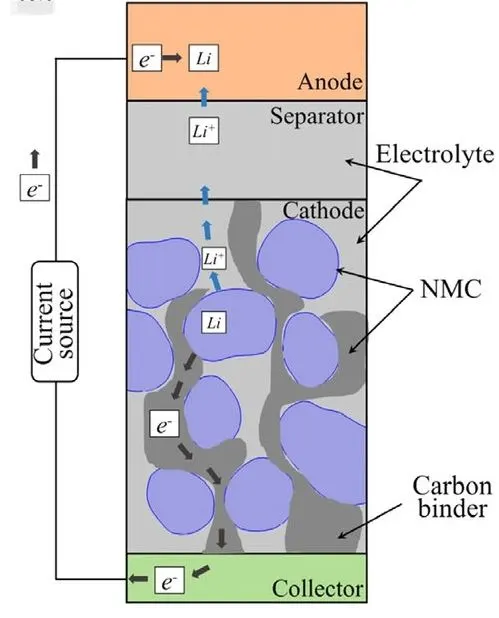
LFP: Lithium Iron Phosphate (LFP), when these batteries discharge, lithium molecules from the negative electrode detach from layered graphene, becoming lithium ions and electrons. The electrons travel out of the battery as lithium ions move across a seperator and both integrate into iron phosphates at the positive electrode. During charge, lithum seperates from the iron phosphate, generating lithium ions and electrons. The lithium ions and electrons transfer to the positive electrode and integrate into the graphene structure. The reaction occurs from right to left. Li-phosphate is more tolerant to full charge conditions and is less stressed than other Li-ion systems if kept at high voltage for a prolonged time. The following figure shows the structure of LFP battery.
LTO: Li-Titanate Oxide (LTO), it replaces the graphite in the anode of a typical Li-ion battery and the material forms into a spinel structure. The cathode can be lithium manganese oxide or NMC. Li-titanate has a nominal cell voltage of 2.4V, can be fast charged and delivers a high discharge current i.e, 10 times the rated capacity. The cycle count is said to be higher than that of a regular Li-ion. Li-titanate is safe, has excellent low temperature discharge characteristics and obtains a capacity of 80% at -30°C. LTO has advantages over the conventional cobalt-blended Li-ion with graphite anode by attaining zero-strain property, no SEI film formation and no lithium plating when fast charging and charging at low temperature. Thermal stability under high temperature is also better than Li-ion systems. These batteries are used in electric powertrains, UPS and solar powered street lighting. the following figure shows the basic structure of LTO battery.
The following table shows the materials and chemical reactions occuring at the anode and cathode of different types of Li-ion batteries which are mentioned above.
| Type of Li-ion Battery |
Chemical name |
Anode material |
Chemical reaction at anode |
Cathode material |
Chemical reaction at cathode |
Overall chemical reaction |
|
LCO
(Lithium Cobalt Oxide)
|
LiCoO2 |
Graphite |
C6Li ⇌ 6C + Li+ + e- |
Lithium Cobalt Oxide |
Lim - nCoO2 + xLi+ + xe ⇌ LiCoO2 |
C6 + LiCoO2 ⇌ LixC6 + Li1xCoO2 |
|
LMO
(Lithium Manganese Oxide)
|
LiMn2O4 |
Graphite |
LinC6 ⇌ nLi+ + ne- |
Lithium Manganese |
Lim - nMn2O4 + nLi+ + ne- ⇌ LimMn2O4 |
LinC6 + Lim - nMn2O4 ⇌ Li0C6 + LimMn2O4 |
|
NCA
(Lithium Nickle Cobalt Aluminum oxide)
|
LiNiCoAlO2 |
Graphite |
LinC6 ⇌ Li0C6 + nLi+ + ne- |
Nickel Cobalt Aluminium |
Lim - n(NixCoyAlz)O2 + nLi+ + ne- ⇌ Lim(NixCoyAlz)O2 |
LinC6 + Lim - n(NixCoyAlz)O2 ⇌ Li0C6 + Lim(NixCoyAlz)O2 |
|
NMC
(Lithium Nickel Manganese Cobalt oxide)
|
LiNiMnCoO2 |
Graphite |
LinC6 ⇌ Li0C6 + nLi+ + ne- |
Nickle Manganese |
Lim - n(NixMnyCoz)O2 + nLi+ + ne- ⇌ Lim(NixMnyCoz)O2 |
LinC6 + Lim - n(NixMnyCoz)O2 ⇌ Li0C6 + Lim(NixMnyCoz)O2 |
|
LFP
(Lithium Iron Phosphate)
|
LiFePO4 |
Graphite |
LinC6 ⇌ Li0C6 + nLi+ + ne- |
Lithium Iron Phosphate |
Lim - nFePO4 + nLi+ + ne- ⇌ LimFePO4 |
LinC6 + Lim - nFePO4 ⇌ Li0C6 + LimFePO4 |
|
LTO
(Li-Titanate Oxide)
|
LiTi2O3 |
Lithium Titanate |
Li7Ti5O12 ⇌ Ti5O12 + 4Li + 4e- |
Lithium Manganese Oxide |
4Mn2O4 + 4Li+ + 4e- ⇌ 4LiMn2O4 |
Li7Ti5O12 + 4Mn2O4 ⇌ 4LiMn2O4 + Ti5O12 |
2.Compare the differences between each type of Li+ion batteries based on their characteristics?
Solution: The following table shows the comparision of Specific power, Specific energy, Safety, Lifespan, Cost and Performance of different types of Li-ion batteries
| Lithium-ion battery Types |
Specific power |
Specific energy |
Safety |
Lifespan |
Cost |
Performance |
|
Lithium Cobalt Oxide (LCO)
|
Low
|
High
|
Low
|
Low
|
Low
|
Moderate
|
|
Lithium Manganese Oxide (LMO)
|
Moderate
|
Moderate
|
Moderate
|
Low
|
Low
|
Low
|
|
Lithium Nickel Manganese Cobalt Oxide (NMC)
|
Moderate
|
High
|
Moderate
|
Moderate
|
Low
|
Moderate
|
|
Lithium Iron Phosphate (LFP)
|
High
|
Low
|
High
|
High
|
Low
|
Moderate
|
|
Lithium Nickel Cobalt Aluminum Oxide (NCA)
|
Moderate
|
High
|
Low
|
Moderate
|
Moderate
|
Moderate
|
|
Lithium Titanate (LTO)
|
Moderate
|
Low
|
High
|
High
|
High
|
High
|
From the above table, while NCA is the clear winner by storing more capacity than other systems, this only applies to specific energy. In terms of specific power and thermal stability, LMO and LFP are superior. LTO may have low capacity but this chemistry outlives most other batteries in terms of lifespan and also has the best cold temperature performance. Moving towards the electric powertrain, safety and life cycle will gain domiance over capacity.
The following table shows the values of nominal voltage, life cycle, current charge rate, discharge current rate, thermal runaway, packaging, specific energy, applications and remarks of different types of Li-ion batteries. These values may vary from manufacturer to manufacturer but will get an basic idea through it. We can know that how they are manufacturing compared to other batteries.
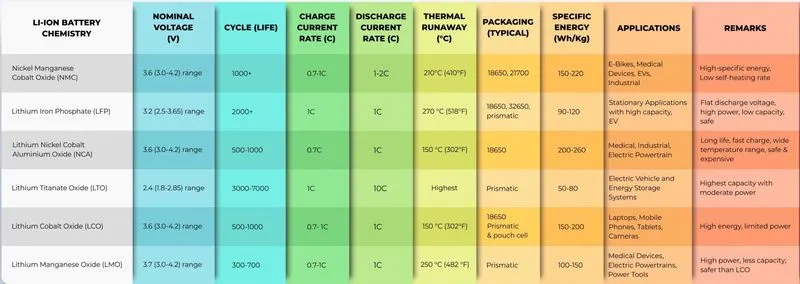
For the clear view of the diffent types of Li-ion batteries characteristics the following image is reffered. The colour representation shows the level of specific charcateristics either it is low, medium high like that. From the following image we can easily get an idea of the charcatteristics of Li-ion batteries.