Week 1 Understanding Different Battery Chemistry
1. Lithium-Ion (Li-ion) batteries falls under category of rechargeable batteries with high energy and power capabilities,it is an advanced battery technology with lithium ions as a key component of its electrochemistry. Li-ion batteries use an intercalated lithium compound like Lithium Cobalt Oxide (LiCoO2), Lithium Manganese Oxide (LiMn2O4) and Lithium Nickel Oxide (LiNiO2) as the material at the positive electrode and typically graphite intercalation material at the negative electrode. This anode and cathode assembly is isolated electrically with separator and is impregnated in electrolyte typically organic solvent consisting lithium salt. Due to high flexibility in the construction of lithium ion cells with respect to very high electrode surface area and their chemistry, Lithium-Ion batteries find applications from normal electronics gadgets applications to typically high power applications like Electric Vehicles.
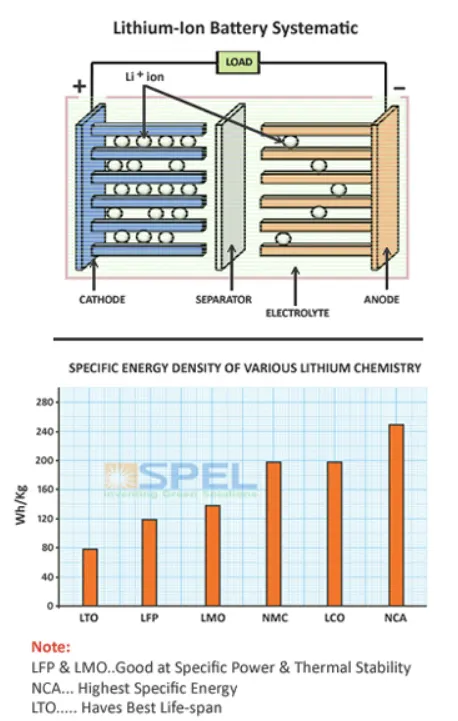
Lithium Ion Battery technology is based on Intercalation, which is actually the addition of lithium ions into a host material without significantly changing the host's structure. During a discharge cycle, lithium atoms in the anode are ionized and separated from their electrons. The lithium ions move from the anode via electrolyteas medium and pass through micro-permeable separator which is in between anode and cathode until they reach the cathode, where they recombine with their electrons. The lithium ions are small enough (third only to hydrogen and helium), which translates into faster charge/discharge capabilities and high charge storage capability per unit mass and unit volume. The single cell voltage in Li-ion battery is difference in the energy between the Li+ ions that are present in the crystalline structure of the two electrodes.
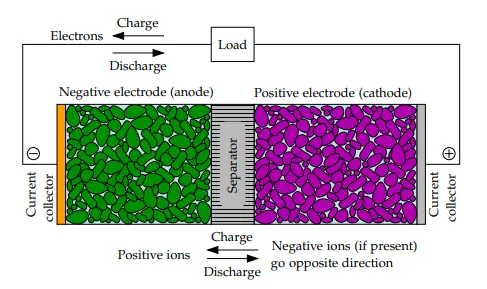
During discharge, the negative electrode gives up electrons to the external circuit, a process by which the electrode is oxidized: oxidation of a species involves the loss of electrons or, equivalently, an increase in the oxidation state of the species (it becomes more positively charged). During charge, the negative electrode accepts electrons from the external circuit and is reduced: reduction of a species involves the gain of electrons or, equivalently, a decrease in its oxidation state (it becomes more negatively charged). Thus, the chemical processes that occur in an electrochemical cell are sometimes called reduction-oxidation or redox reactions.
Different types of Li+ion batteries:
- Lithium Cobalt Oxide (LCO): Lithium Cobalt Oxide (LiCoO2) is a mature battery technology, characterized by a long cycle life and high energy densities. The cathode consists of a cobalt oxide and anode is of graphite carbon. The cathode has a layered structure and during discharge, lithium ions move from the anode to the cathode. The flow reverses on charge. The drawback of Li-cobalt is a relatively short life span, low thermal stability and limited load capabilities (specific power).
- Lithium Manganese (LMO): Lithium Manganese (LiMn2O4) battery cell's cathode is made out of lithium manganese oxide. It forms a three-dimensional spinel structure which improves ion flow on the electrode, which results in lower internal resistance and improved current handling, in comparsion with Cobalt based batteries. This three dimensional spinel architecture also exhibits high thermal stability and enhanced safety, but at the cost of cycle, calendar life, and energy density. Pure Li-manganese batteries are no longer commonly, they may only be used for special applications. Recent trends indicate that most Li-manganese batteries are blended with lithium nickel manganese cobalt oxide (NMC) to improve the specific energy and prolong the life span, and is popular in most Electric Vehicles.
-
Lithium Nickel Cobalt Aluminum Oxide (NCA): Lithium Nickel Cobalt Aluminum Oxide (LiNiCoAlO2) cathode material is highly thermally stable cathode material, doping the lithium nickel cobalt oxide with aluminum both stabilizes its thermal and charge transfer resistance. NCA shares similarities with NMC in offering high specific energy, reasonably good specific power and a long life span.
High energy and power densities, as well as good life span, make NCA a candidate for EV powertrains
- Lithium Nickel Manganese Cobalt oxide (NMC): Lithium Nickel Cobalt Manganese (Li(NiCoMn)O2) batteries are made of cathode materials which is combination of nickel, manganese and cobalt, typically one-third nickel, one-third manganese and one-third cobalt, also known as 1-1-1. Similar to Li-manganese, NMC can be tailored to serve as Energy Cells or Power Cells, like other lithium-ion battery varieties, NMC batteries can have either a high specific energy density or a high specific power. They however cannot have both properties in the same pack. For example, NMC in an 18650 cell for moderate load condition has a capacity of about 2,800mAh andcan deliver 4A to 5A. NMC in the same cell size can be optimized for specific power with capacity of about 2000mAh, but capable of delivering a continuous discharge current of 20A.
- Lihium Ion Phosphate (LFP): In Lithium Iron Phosphate (LiFePO4) Batteries phosphate is used as cathode material, Li-phosphate offers good electrochemical performance with low resistance. This nano-scale phosphate material for cathode in Lithium Ion batteries is most viable option because of its low cost,environmental friendliness, long cycle and calendar lives (chemical stability) and good capacity (170 mAh/g). Doping with transition metals results in reduction of internal impedance. LiFePO4 batteries are incombustible in case of misuse during charging or discharging, they are more stable during overcharge or short circuit conditions and they can withstand high temperatures without decomposing. LFP is more tolerant to full charge conditions and is compartively less vunerable to stress even if kept at high voltage for a prolonged time.
- Lithium Titanate (LTO): Lithium Titanate ((Li2TiO3)) battery is a modified Li Ion battery in which the graphite in the anode is replaced by Li-titanate which forms a spinel structure. The cathode can be lithium manganese oxide orNMC or LFP, or other lithium battery Chemistry. LTO has a nominal cell voltage of 2.40V, can be fast charged and can deliver a high discharge current of 10C. Even the cycle life is higher than regular Li-ion batteries. LTO exhibits excellent low-temperature discharge characteristics (capacity of 80 percent at –30°C). Thermal stability under high temperature is comparitively better, highly tolerant to operational abuses and can comfortably perform up to 55 °C and can go up to 65 °C.
| Cathode | Anode | Seperator | Electrolyte | Anode reaction | Cathode reaction | Overall reaction | |
| LCO | Lithium cobalt oxide | Graphite | Polyolefin | Ethylene carbonate | LiC6 ⇌ xLi++xe−+C6 | Li1−xCoO2+xLi++xe− ⇌ LiCoO2 | C6+LiCoO2 ⇌ LixC6+Li1−xCoO2 |
| LMO | Lithium Manganese Oxide | Graphite | Polyolefin | Lithium Halide | LinC6 ⇌ nLi+ + ne− | Lim − nMn2O4 + nLi+ + ne− ⇌ LimMn2O4 | LinC6 + Lim − nMn2O4 ⇌ Li0C6 + LimMn2O4 |
| NCA | Lithium Nickel Cobalt Aluminium Oxide | Graphite | Polyolefin | Ethylene carbonate | LinC6 ⇌ Li0C6 + nLi+ + ne− | Lim − n(NixCoyAlz)O2 + nLi+ + ne− ⇌ Lim(NixCoyAlz)O2 | LinC6 + Lim − n(NixCoyAlz)O2 ⇌ Li0C6 + Lim(NixCoyAlz)O2 |
| NMC | Lithium Nicken Manganese Cobalt Oxide | Graphite | Polyolefin | Lithium salt | LinC6 ⇌ Li0C6 + nLi+ + ne− | Lim − n(NixMnyCoz)O2 + nLi+ + ne− ⇌ Lim(NixMnyCoz)O2 | LinC6 + Lim − n(NixMnyCoz)O2 ⇌ Li0C6 + Lim(NixMnyCoz)O2 |
| LFP | Lithium Iron Phosphate | Graphite | Polyolefin | Ethylene carbonate | LinC6 ⇌ Li0C6 + nLi+ + ne− | Lim − nFePO4 + nLi+ + ne− ⇌ LimFePO4 | LinC6 + Lim − nFePO4 ⇌ Li0C6 + LimFePO4 |
| LTO | Lithium Manganese Oxide | Titanate | Polyolefin | Lithium salt | Li4Ti5O12 + 4Li + 4e ⇌ 4LiMn2O4 | 4Mn2PO4 + 4Li + 4e ⇌ 4LiMn2O4 | 4Mn2PO4 + Li4Ti5O12 ⇌ 4LiMn2O4 + Ti4O12 |
2.
Lithium Cobalt Oxide (LCO): Among all anode materials of lithium battery, LCO has the largest tap density (2.8g/cm3) and compaction density (4.3 g/cm3), which makes it have advantages in the application of battery field with strict requirements on battery volume. In addition, LCO has better cycling performance, low temperature performance and rate capability than existing ternary materials.
LCO also has its own shortcomings, the first of which is the resource. The total cobalt resources in the world do not exceed 7.1 million tons (USGS/2016) with an annual output of no more than 120,000 tons and a reserves/production ratio is 57 years. There may be a bright future in the early days of 3C lithium-ion, but the rise of power and storage means that cobalt will soon lag behind.
The second issue is safety. The safety performance of large-capacity LCO batteries is not optimistic, especially in the condition of full charge extrusion, overheating or overcharging. LCO batteries will tend to explode under these circumstances. Even if using a high-safety lithium titanate as the negative electrode of cobalt titanium battery, LCO will explode violently when overcharged and squeezed.
Typical Specifications of LCO with Graphite anode
- Voltages: 3.60V nominal; typical operating range 3.0–4.2V/cell
- Specific Energy: 150–200Wh/kg. Specialty cells provide up to 240Wh/kg.
- Charge (C-rate): 0.7–1C, charges to 4.20V
- Discharge (C-rate): 1C; 2.50V cut off. Discharge above 1C shortens battery life.
- Cycle life: 500–1000, related to depth of discharge, load, temperature
- Thermal runaway: 150°C. Full charge promotes thermal runaway
- Applications: Mobile phones, tablets, laptops, cameras
- Note: Charge current above 1C shortens life of LCO battery.
- Comment: Very high specific energy, limited specific power. Cobalt is expensive. Serves as Energy Cell. Market share has stabilized.
Lithium Manganese (LMO):
The main advantages of the LMO batteries are:
- High temperature stability and safety relative to other Li-ion types as it has integrally high thermal stability thus needs less safety circuitry than cobalt system.
- High rate capability due to low internal cell resistance which benefits fast charging and high current discharging.
The main disadvantage of the LMO batteries is:
- Lower capacity relative to cobalt-based system,yet it still has an energy density which is nearly 50% higher than the nickel based system.
Typical Specifications of LMO with Graphite anode
- Voltages: 3.70V (3.80V) nominal; typical operating range 3.0–4.2V/cell
- Specific Energy: 100–150Wh/kg
- Charge (C-rate): 0.7–1C typical, 3C maximum, charges to 4.20V (most cells)
- Discharge (C-rate): 1C; 10C possible with some cells, 30C pulse (5s), 2.50V cut-off
- Cycle life: 300–700 (related to depth of discharge, temperature)
- Thermal runaway: 250°C typical. High charge promotes thermal runaway
- Applications: Power tools, medical devices, electric powertrains
- Note: Safer than LCO, commonly mixed with NMC for improved performance.
- Comments: High power but less capacity; safer than Li-cobalt; commonly mixed with NMC to improve performance.
Lithium Nickel Cobalt Aluminum Oxide (NCA):
The main advantages of the NCA batteries are:
- High specific energy
- Reasonably good specific power
- Long life span
- NCA cathodes contain the most energy amount by weight and volume (as NMC).
The main disadvantages of the NCA batteries are:
- Less safety than other Li-ion battery types (they require extra safety features and circuits for use in electric cars for example)
- Higher cost in comparison to other Li-ion battery types
Typical Specifications of NCA with Graphite anode
- Voltages: 3.60V nominal; typical operating range 3.0–4.2V/cell
- Specific Energy: 200-260Wh/kg; 300Wh/kg predictable
- Charge (C-rate): 0.7C, charges to 4.20V, 3h charge typical, fast charge possible
- Discharge (C-rate): 1C typical; 3.00V cut-off; high discharge rate shortens battery life
- Cycle life: 500 (related to depth of discharge, temperature)
- Thermal runaway: 250°C typical. High charge promotes thermal runaway
- Applications: Medical devices, industrial, electric powertrain
- Note: High discharge rate of NCA shortens battery life.
- Comments: Shares similarities with Li-cobalt. Serves as Energy Cell.
Mainly used by Panasonic and Tesla; growth potential.
Lithium Nickel Manganese Cobalt oxide (NMC):
The main advantages of the NMC batteries are:
- NMC cells provide longer life cycle
- Lower cost
- Higher energy density
- NMC cathodes contain the most energy amount by weight and volume.
The main disadvantages of the NMC batteries are:
- Adding silicon to graphite has the downside of making the anode grow and shrink through charging and discharging, leading to mechanical instability of the cell.
- Slightly lower voltage than cobalt systems
Typical Specifications of NMC with Graphite anode
- Voltages: 3.60V, 3.70V nominal; typical operating range 3.0–4.2V/cell, or higher
- Specific Energy: 150–220Wh/kg
- Charge (C-rate): 0.7–1C, charges to 4.20V, some go to 4.30V; 3h charge typical.
- Discharge (C-rate): 1C; 2C possible on some cells; 2.50V cut-off
- Cycle life: 1000–2000 (related to depth of discharge, temperature)
- Thermal runaway: 210°C typical. High charge promotes thermal runaway
- Applications: power tools, e-bikes and other electric powertrains
- Note: Charge current above 1C shortens life of NMC.
- Comments: Provides high capacity and high power. Serves as Hybrid Cell. Favorite chemistry for many uses; market share is increasing.
Leading system; dominant cathode chemistry.
Lihium Ion Phosphate (LFP):
Some main advantages of LiFePO4 batteries are as follow:
- Less Degradation & Long Life
2. No Harm to the Environment
3. Compact Size & Lightweight
4. High Safety & Efficiency
5. Withstand Extreme Weather Condition & Temperature
6. Good Storage & Suitable for Various Applications
Disadvantages of LiFePO4
- These batteries have a low nominal voltage that reduces energy.
- You have to face balancing issues with aging, and they are a high self-discharging rate compared to other batteries.
- Lithium iron phosphate/ LFP batteries have a low energy density, and more protection is required.
- These batteries don’t perform well at low temperatures and need more protection and care.
- Transportation and aging effects are also common in lithium iron phosphate batteries.
- One of the drawbacks of LPF is deep discharge and low density. These flaws make these batteries unfit for small devices such as smartphones. Therefore mainly, these LFP batteries are used in LEV (low emission vehicles) and electric bikes.
Typical Specifications of LFP with Graphite anode
- Voltages: 3.20, 3.30V nominal; typical operating range 2.5–3.65V/cell
- Specific Energy: 90–120Wh/kg
- Charge (C-rate): 1C typical, charges to 3.65V; 3h charge time typical
- Discharge (C-rate): 1C, 25C on some cells; 40A pulse (2s); 2.50V cut-off
- Cycle life: 2000 and higher (related to depth of discharge, temperature)
- Thermal runaway: 270°C Very safe battery even if fully charged
- Applications: For high load currents & endurance, and electric powertrains
- Note: LFP if discharged lower than 2V can causes damage
- Comments: Very flat voltage discharge curve but low capacity. One of safest Li-ions.
Used for special markets. Elevated self-discharge.
Used primarily for energy storage, moderate growth.
Lithium Titanate (LTO):
he main advantages of the LTO batteries are:
- Excellent low temperature discharge characteristics
- Zero strain property, no formation of SEI film nor lithium plating when charging at low temperature or fast charging
- Long life time
- Fast charge capability and wide temperature range
- Among the safest types of Li-ion batteries
The main disadvantages of the LTO batteries are:
- High cost
- Lower inherent voltage or lower energy density
Typical Specifications of LTO (Li2TiO3) as Anode and LMO or NMC as Cathode
- Voltages: 2.40V nominal; typical operating range 1.8–2.85V/cell
- Specific Energy: 50–80Wh/kg
- Charge (C-rate): 1C typical; 5C maximum, charges to 2.85V
- Discharge (C-rate): 10C possible, 30C 5s pulse.
- Cycle life: 3000 to 7000
- Thermal runaway: One of safest Li-ion batteries
- Applications: UPS, electric powertrain, solar-powered street lighting
- Note: LTO- Long life, fast charge, safest, wide temperature range but low specific energy
- Comments: Long life, fast charge, wide temperature range but low specific energy and expensive.
Among safest Li-ion batteries.
Ability to ultra-fast charge; high cost limits to special application.