Week 1 Understanding Different Battery Chemistry
1.Prepare a table which includes materials & chemical reactions occurring at the anode and cathode of LCO, LMO, NCA, NMC, LFP and LTO type of lithium ion cells.Give your detailed explanation on it
- The Following table shows the materials and chemicals used in various types of Lithium ion cells.
- The datas are obtained from these following links
| Battery Types | LCO | LMO | NMC | LFP | NCA | LTO |
| Name | Lithium Cobalt Oxide | Lithium Manganese Oxide | Lithium Nickel Manganese Cobalt Oxide | Lithium Iron Phosphate | Lithioum Nickel Cobalt Aluminum Oxide |
Lithium Titanate |
|
Chemical name/Cathode |
LiCoO2 |
LiMn2O4 | LiNiMnCoO2 | LiFePO4 | LiNiCoAlO2 | Li2TiO3 |
| Anode | Graphite | Graphite | Graphite | Graphite | Graphite | Tiltanate (LiMn2O4) |
| Electrolyte | Ethylene Carbonate | Lithium Halide | Lithium Salt | Ethylene Carbonate | Ethylene Carbonate | Lithum Salt |
| Separator | Polyolefin | Polyolefin | Polyolefin | Polyolefin | Polyolefin | Polyolefin |
| Reaction at Anode | LiC6 -> (Li+) +(e-) + C6 | LiC6 -> (Li+) +(e-) + C6 | LiC6 -> (Li+) +(e-) + C6 | LiC6 -> (Li+) +(e-) + C6 | LiC6 -> (Li+) + (e-) + C6 | Li2TiO3 -> TiO3 + (2Li+) + (2e-) |
| Reaction at Cathode | CoO2 + (Li+)+(e-) -> LiCoO2 | Mn2O4 + (Li+)+(e-) -> LiMn2O4 | NiMnCoO2 +(Li+)+(e-) -> LiNiMnCoO2 | FePO4 + (Li+)+(e-) -> LiFePo4 | NiCoAlO2 +(Li+) + (e-) -> LiNiCoAlO2 | Mn2O4 + (2Li+) + (2e-) -> LiMn2O4 |
| Overeall Reaction | LiC6 + CoO2 -> C6 + LiCoO2 | LiC6 + MnO4 -> C6 + LiMn2O4 | LiC6 + NiMnCoO2 -> C6 + LiNiMnCoO2 | LiC6 + FePO4 -> C6 + LiFePo4 | LiC6 + NiCoAlO2 -> C6 + LiNiCoAlO2 | Li2TiO3 + 2Mn2O4 -> 2LiMn2O4 + TiO3 |
- Li Battery
- In a cathode, lithium and oxygen meet to form lithium oxide.
- When the battery is being charged the Li-ion is pulled out of the cathode and travels to the anode and when the battery is being used (or discharged) the Li-ion returns to the cathode and electricity is produced during this process.
- Due to the charge-discharge process, Li-ion batteries are reusable and therefore also termed as secondary-cell batteries or rechargeable batteries.
- Cathode
- Metal Oxide
- It has highest capacity
- It has higher cost and poor safety
- NCA , NMC , LCO are vnot suitable for Ev.
- Spinels
- High power density.
- Poor electronic conductor , structural stability (LMO , LTO).
- Olivines
- Better safety and long life.
- Low capacity and Voltage [LiFePO4].
- Metal Oxide
- Anode
- Carbon based anode (Graphite and hard carbon).
- Low cost , stable and high specific capacity.
- When lithiukm plating is reduced It leads to debdritevfoemation and capacity of the battery reduces.
- Electrolyte
- Ionic conductor that provised the medium foe internal ionic chqarge transfer between the electrodes.
- Liquid solvents containing dissolved chemicals.
- Charge transfer is through either acid , base or salt.
- It uses non aqueous electrolytes.
- Seperator
- Isolates +ve and -ve electrodes.
- An ionic conductor but electronic insulator.
- Prevents from internal short circuiting.
- Current Collectors
- Electronic conductors with which the electrodes are mixed.
- Takes no part in cxhemical reaction.
- Copper foil is used as negative electrode current collector and aluminium foil is used as positive.
2.Compare the differences between each type of Li+ion batteries based on their characteristics
- In the above question we have discussed about the materials and the chemical composition.
- Here we are going to discuss about the characteristics difference between those batteries.
- Nominal Voltage
- It is the voltage at which the device is designed to operated.
- The rated voltage is higher than nominal volatge to ensure the safet of the device.
- Life Cycle
- The charged and discharged from 0 to 100 % at a single time ,It is known as one life cycle of the battery.
- It is also denoteds the life of the battery.
- Current rate (C)
- It denotes the fast charging & short circuit capability of the battery.
- Thermal Runaway
- When the haet produced inside the battery is higher than the nominal rate.
- The internal temperature of the battery will increase continuously.
- It results in increrasing the battery current.
- Which resuts in domino effect.
- Due to the rose of the temperature of the single battery will results in affectin the other batteries as well.
- This is known as runaway.
- Specific energy
- It is the amount of energy stored in per unit mass (Wh/Kg).
- It determines the energy rating of the battery.
-
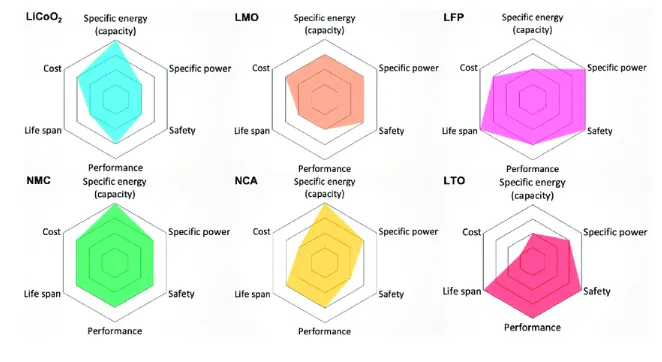
- The above represented fig shows the easy understanding of the characteristics of the battery by using (5 point Hexagonal Analysis) or Laymans perpestive.
- The shaded part indicates the performance of the battery.
- NCA
- Specific energy , Specific power & Life cycle scroes high
- the cost , safety are lower.
- NMC
- It scores the balanced performance in all five properties.
- NTO
- It scores the average performance
- The cost is high and it has lower battery life.
- LiFePO4
- It is higher cost.
- High battery life.
- Low specific energy.
- LMO
- It scores average perdformance.
- Higher battery and sttyle and safer
- Nominal Voltage