Week 1 Understanding Different Battery Chemistry
Study 1:- Detailed Explaination on types of Lithium ion cells:-
LCO - Lithium Cobalt Oxide (LiCoO2):-
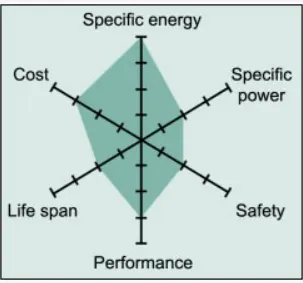
Lithium Cobalt Oxide is commonly used in mobiles, laptops and digital cameras due to its high specific energy. the battery consist of Cobalt oxide as cathode and graphite as anode. The cathode has a layered structure and during discharge, lithium ions move from the anode to the cathode. The flow reverses on charge.
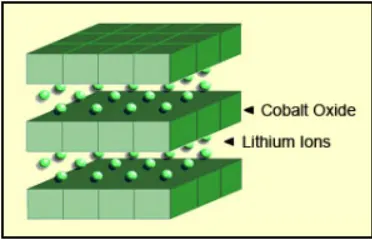
The drawback of Li-cobalt is a relatively short life span, low thermal stability and limited load capabilities (specific power).
Chemical Reaction:-
Discharge:-
`CoOunderset(2)() + Li^+ + e^- 1 rightarrow LiCoOunderset(2)()`
Charge:-
`LiCunderset(6)() rightarrow Cunderset(6)() + Li^+ + e^-1`
Full Reaction:-
`LiCunderset(6)() + CoOunderset(2)() harr Cunderset(6)() + LiCoOunderset(2)()`
LMO - Lithium Manganese Oxide (LiMn2O4)
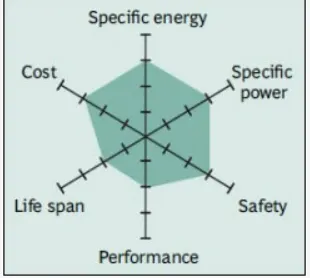
The structure formed by manganese oxide is 3D-spinel structure which improves the ion flow on the electrode which results in lower internal resistance and which in turn enables fast charging and high current discharging and adding to this it has higher thermal stability. Hence making it safer than the LCO. The main drawback is that it has a lower life cycle.
To overcome this drawback these batteries are blended with NMC to enhance the energy and prolong the battery life.
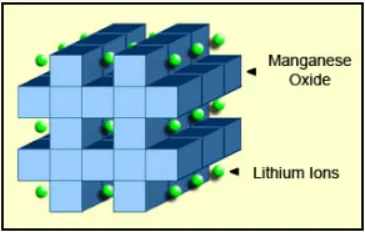
Silicon with these active metals can enhance specific energy, specific power and lifecycle. LMO has high power and less capacity and these types of batteries are used in power tools, medical devices and electric vehicle powertrains.
Chemical Reaction:-
Discharging:-
`Mn underset2() Ounderset4() + Li^+ + e^-1 rightarrow LiMnOunderset(2)()`
Charging:-
LiMnO`underset(2)() rightarrow Mn underset(2)()Ounderset(4)() + Li^+ + e^-1`
Full reaction:-
LiMnO`underset(2)() harr Mn underset2()O underset4() + Li^++e^-`
NCA - Lithium Nickel Cobalt Aluminium Oxide (LiNiCoAlO2):-
Lithium nickel cobalt aluminum oxide battery has been around since 1999 for special applications. It shares similarities with NMC by offering high specific energy, reasonably good specific power and a long life span. Less flattering are safety and cost.
NCA is a further development of lithium nickel oxide; adding aluminum gives the chemistry greater stability.
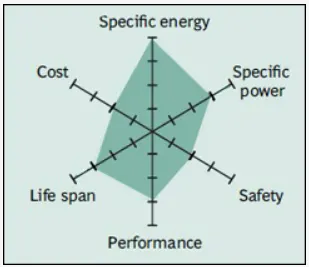
These type of batteries are used in medical devices, Electric powertrain and industrial purposes.
Chemical Reaction:-
Discharging:-
`6C +Li^++ e^-1 rightarrow LiCunderset(6)()`
Charging:-
`LiNiCoAlOunderset(2)() rightarrow NiCoAlOunderset(2)() + Li^++e^-1`
Overall:-
`6C+LiNiCoAlOunderset(2)() harr LiCunderset(6)() + NiCoAlOunderset(2)()`
NMC - Lithium Nickel Manganese Cobalt Oxide (LiNiMnCoO2):-
One of the most successful Li-ion systems is a cathode combination of nickel-manganese-cobalt (NMC). Similar to Li-manganese, these systems can be tailored to serve as Energy Cells or Power cells. For example, NMC in an 18650 cell for moderate load condition has a capacity of about 2,800mAh and can deliver 4A to 5A; NMC in the same cell optimized for specific power has a capacity of only about 2,000mAh but delivers a continuous discharge current of 20A. A silicon-based anode will go to 4,000mAh and higher but at reduced loading capability and shorter cycle life. Silicon added to graphite has the drawback that the anode grows and shrinks with charge and discharge, making the cell mechanically unstable.
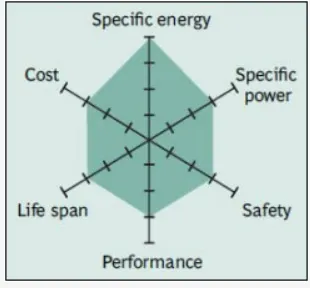
NMC is the battery which is used for applications such as power tools, e-bikes and other electric powertrains.
Chemical Reaction:-
Discharging:-
`MOunderset(2)()+Li^++e^-1 rightarrow LiMnOunderset(2)()`
Charging:-
`LiMnOunderset(2)() rightarrow MOunderset(2)()+Li^++e^-1`
Overall:-
`LiMnOunderset(2)() harr MOunderset(2)()+Li^++e^-1`
LFP - Lithium Iron Phosphate (LiFePo4)
Li-phosphate offers good electrochemical performance with low resistance. This is made possible with nano-scale phosphate cathode material. The key benefits are high current rating and long cycle life, besides good thermal stability, enhanced safety and tolerance if abused.
Li-phosphate is more tolerant to full charge conditions and is less stressed than other lithium-ion systems if kept at high voltage for a prolonged time.
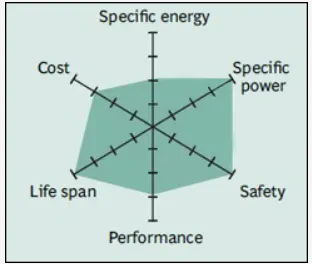
Li-phosphate has a higher self-discharge than other Li-ion batteries, which can cause balancing issues with aging. This can be mitigated by buying high quality cells and/or using sophisticated control electronics, both of which increase the cost of the pack. Cleanliness in manufacturing is of importance for longevity. There is no tolerance for moisture, lest the battery will only deliver 50 cycles.
These type of batteries are used in application which are portable and stationary needing high load current and endurance.
Chemical Reaction:-
Discharging:-
`6C+Li^++e^-1 rightarrow LiCunderset(6)()`
Charging:-
`LiFeunderset(3)()POunderset(4)() rightarrowFeunderset(2)()POunderset(4)()+Li^++e^-1`
Overall:-
LiFeP`Ounderset(4)()+6C harr LiCunderset(6)()+FePOunderset(4)()`
LTO - Lithium Titanate (Li2TiO3)
Li-titanate replaces the graphite in the anode of a typical lithium-ion battery and the material forms into a spinel structure. The cathode can be lithium manganese oxide or NMC. The cycle count is said to be higher than that of a regular Li-ion. Li-titanate is safe, has excellent low-temperature discharge characteristics.
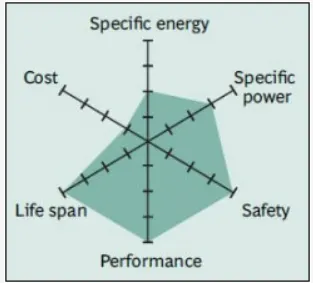
LTO (commonly Li4Ti5O12) has advantages over the conventional cobalt-blended Li-ion with graphite anode by attaining zero-strain property, no SEI film formation and no lithium plating when fast charging and charging at low temperature. Thermal stability under high temperature is also better than other Li-ion systems; however, the battery is expensive.
Typical used in applications such as electric powertrains, UPS and solar-powered street lighting.
Chemical Reaction:-
Discharging:-
`Tiunderset5()Ounderset12()+4Li^++4e^-1 rightarrow Liunderset4()Tiunderset5()Ounderset12()`
Charging:-
`4LiMn underset2()Ounderset4() rightarrow 4Mn underset2()Ounderset4()+4Li^++4e^-1`
Overall:-
`Liunderset4()Tiunderset5()Ounderset12()+4Mn underset2()Ounderset4() harr 4LiMn underset2()Ounderset4()+Tiunderset5()Ounderset12()`
Types of lithium ion cells:-
| Types of Lithium Ion batteries | LCO | LMO | NCA | NMC | LFP | LTO |
| Chemical Formula | LiCoO2 | LiMn2O4 | LiNiCoAlO2 | LiNiMnCoO2 | LiFePO4 | Li2TiO3 |
| Anode Material | Graphite Carbon | Graphite Carbon | Graphite Carbon | Graphite Carbon | Graphite Carbon | Lithium Titanium Oxide |
| Cathode Material | Lithium Cobalt Oxide | Lithium Manganese Oxide | Lithium Cobalt Aluminium Oxide | Lithium Nickel Manganese Cobalt Oxide | Lithium Iron Phosphate | Lithium Manganese Oxide |
| Electrolyte | Lithium salt in organic solvent | Lithium halide in an organic solvent | Lithium salt in organic solvent | Lithium salt in organic solvent | Lithium salt in organic solvent | Lithium salt in organic solvent |
| Chemical Reactions | `LiCunderset(6)() + CoOunderset(2)() harr Cunderset(6)() + LiCoOunderset(2)()` | `LiMnOunderset(2)() harr Mn underset2()O underset4() + Li^++e^-` | `6C+LiNiCoAlOunderset(2)() harr LiCunderset(6)() + NiCoAlOunderset(2)()` | `LiMnOunderset(2)() harr MOunderset(2)()+Li^++e^-1` | `LiFePOunderset(4)()+6C harr LiCunderset(6)()+FePOunderset(4)()` | `Liunderset4()Tiunderset5()Ounderset12()+4Mn underset2()Ounderset4() harr 4LiMn underset2()Ounderset4()+Tiunderset5()Ounderset12()` |
Study 2:- Comparision between different types of Li-ion Cells:-
Based on the above study there are 6 types of Li-ion cells and aredifferentiated based on the following parameters.
Specific Energy:-
This defines the battery capacity in weight (Wh/kg) i.e., amount of energy stored per unit mass. The capacity relates to the runtime. Products requiring long runtimes at moderate load are optimized for high specific energy.
Nominal Voltage:-
It is the voltage at which the device is designed to operate. The rated voltage is usually higher than the nominal volatage for safe operation.
Specific power:-
It's the ability to deliver a high current and indicates loading capability
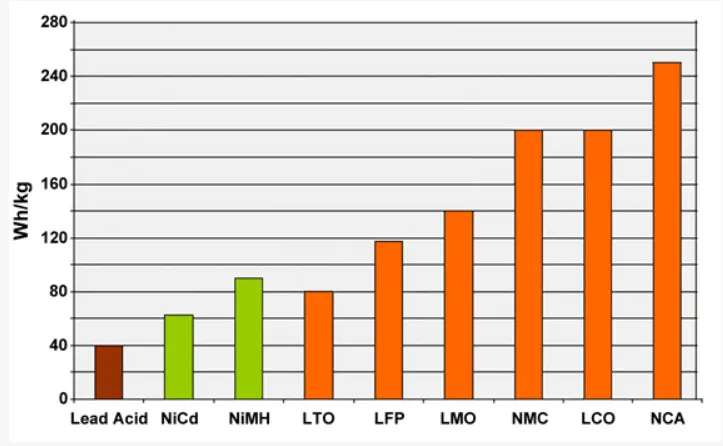
Performance:-
This measures how well the battery works over a wide range of temperatures. Most batteries are sensitive to heat and cold and require climate control. Heat reduces life, and cold lowers performance temporarily.
Lifespan:-
This reflects cycle life and longevity and is related to factors such as temperature, depth of discharge, and load. Hot climates accelerate capacity loss.
Safety:-
This relates to factors such as the thermal stability of the materials used in the batteries. The materials should have the ability to sustain high temperatures before becoming unstable.
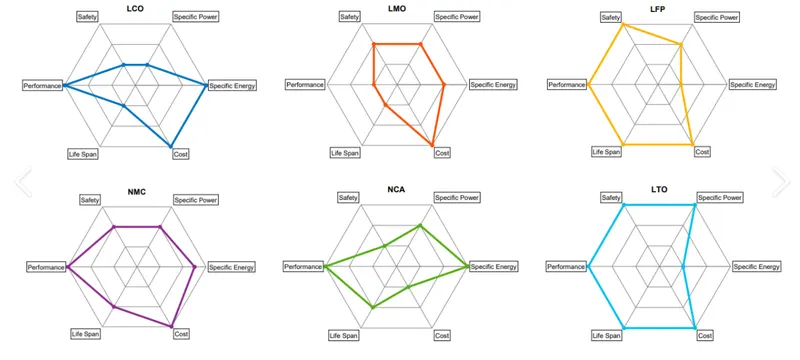
The image states the difference between the Li-Ion cell
| Type | Nominal Voltage | Saftey - Thermal Runaway | Operating Range | Performance | Specific Energy | Life Span | Application |
| LCO | 3.60V | 150 C | 3.0 - 4.2V | Medium | 150-200Wh/kg | 500-1000 | Cell phones, laptops, cameras |
| LMO | 3.70V | 250 C | 3.0 - 4.2V | Low | 100-150Wh/kg | 300-700 | Power tools, EVs, medical. |
| NCA | 3.60V | 150 C | 3.0 - 4.2V | Medium | 200-260Wh/kg | 500 | EVs, grid storage |
| NMC | 3.60V, 3.70V | 210 C | 3.0 - 4.2V | Medium | 150-220Wh/kg | 1000-2000 | Power tools, EVs, medical. |
| LFP | 3.20V, 3.30V | 270 C | 2.5 - 3.65V | Medium | 90-120Wh/kg | 2000 & higher | Power tools, EVs, medical. |
| LTO | 2.40V | safest Li-ion battery | 1.8 - 2.85V | High | 50-80Wh/kg | 3000-7000 | EVs, grid storage |