Understanding Different Battery Chemistry
SOLUTION 1 : The materials used and the Chemical reactions occuring on each battery are shown below :
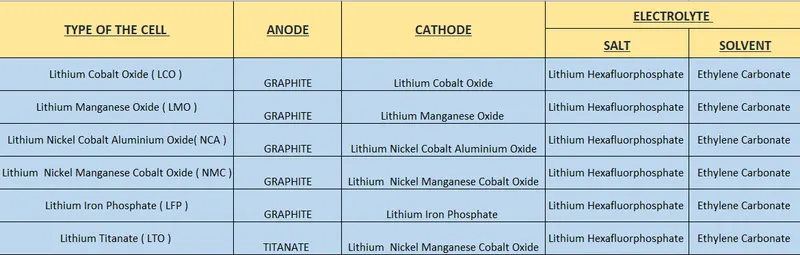
Chemical reactions in the batteries :
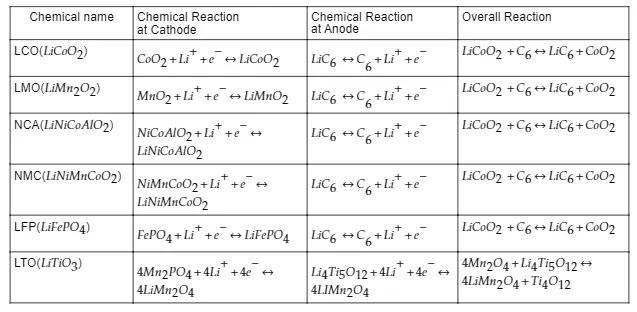
( a ) Lithium Cobalt Oxide
The cathode used is Lithium cobalt oxide and the anode used is a graphite material .
At cathode :

At anode :

The complete reaction in the battery will be as follows :

( b ) Lithium Manganese Oxide
The reaction at the cathode :

Anode reaction :

The overall reaction looks like :

( c ) NMC
Cathode reaction :
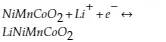
Anode reaction :
The overall reaction is :
( d ) NCA
Anode reaction :
Cathode reaction :
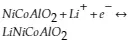
The overall reaction will be :
( e ) LFP
Anode reaction :
Cathode reaction :

Overall reaction :
( f ) LTO
Anode reaction :
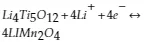
Cathode reaction :
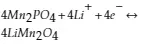
Overall reaction :
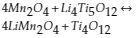
SOLUTION 2 : Types of Lithium ION Battery
a. Lithium Cobalt Oxide - ( LCO ) :
LiCoO2
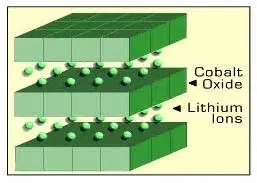
This battery consists of a Cobalt Oxide Cathode and Graphite Carbon Anode .The cathode of this battery has a layered structure . During discharge of the battery lithium ions breaks away from the cathode and move towards anode in the direction of the electric field . During charging the flow of ions is the reverse of this . When more lithium ions are involved in this back-and-forth embedding and reversal peocesses then battery can store more energy .
Structure of LCO :
Advantages of LCO :
( i ) LCO has the largest tap density (2.8g/cm3) and compaction density (4.3 g/cm3), which helps in the application of battery field with strict requirements on battery volume.
( ii ) LCO has better cycling performance
( iii ) Low temperature performance and rate capability than existing ternary materials.
Disadvantages of LCO :
( i ) Short Span
( ii ) Low Thermal Stability
( iii ) Limited Load Capabilities
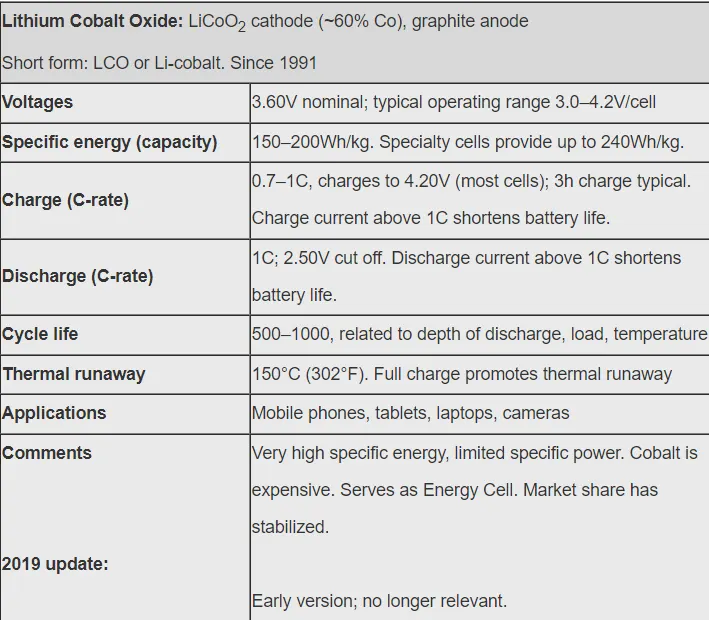
The following table shows the characteristics of the Lithium Cobalt Oxide battery
b. Lithium Manganese Oxide - ( LMO ) :
LiMn2O4
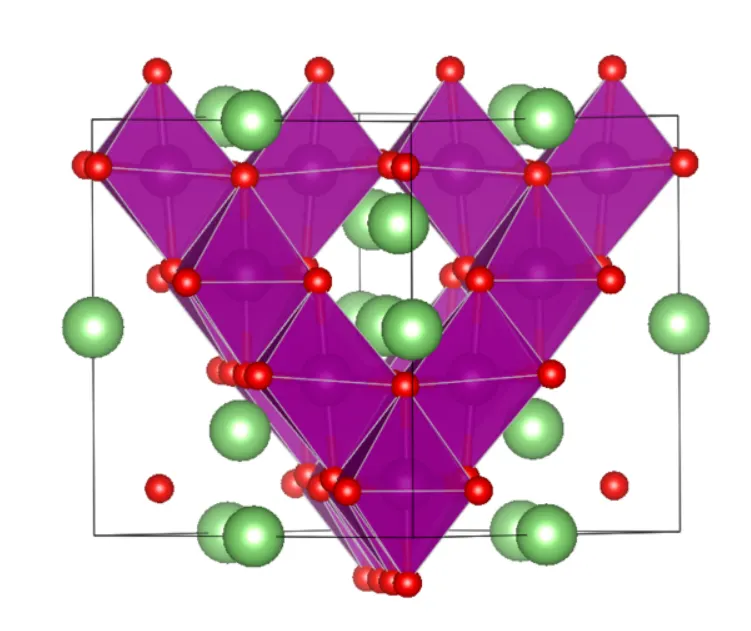
Lithium manganate oxide battery is a lithium ion battery that uses lithium manganate oxide as anode, graphite as cathode, and electrolyte with LiPF6 organic solution.toxic, and provide better thermal stability. LMO has low internal cell resistance which enables fast charging and also high-current discharging. LMO architecture forms a three-dimensional spinel structure , which improves ion flow on the electrode, resulting in lower internal resistance and thus improves current handling.
The following figure shows the spinel structure of the Lithium Manganese oxide Battery :
Advantages of LMO :
( i ) Improvement in safety
( ii ) High thermal stability
( iii ) Low cost
Disadvantages of LMO :
( i ) Low Life Cycle
( ii ) Prone to bulge
( iii ) Li-manganese has a capacity that is roughly one-third lower than Li-cobalt.
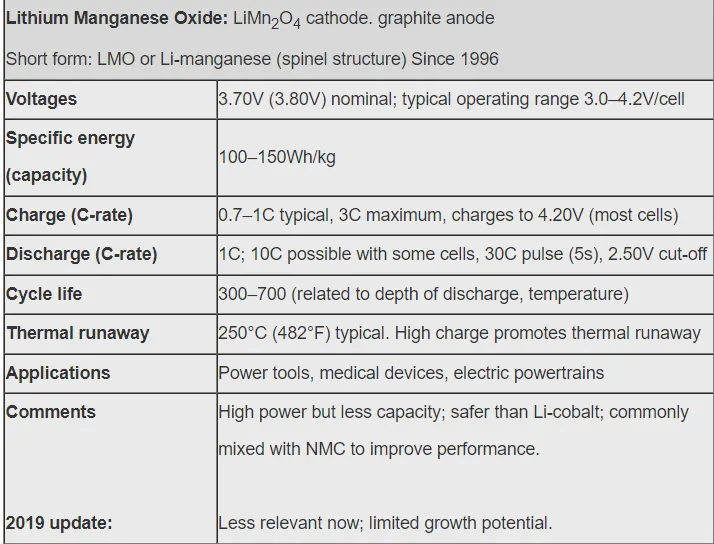
The following table shows the characteristics of the Lithium Manganese oxide battery :
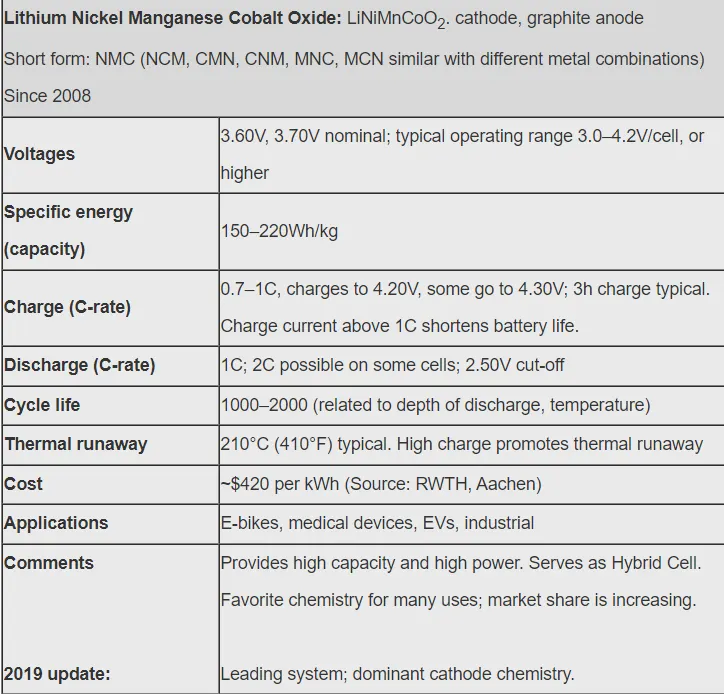
c.Lithium Nickel Manganese Cobalt Oxide - ( NMC )
LiNiMnCoO2
NMC Battery uses ternary materials of lithium nickel cobalt manganese oxide (LiNiMnCoO2, NMC) or lithium nickel cobalt aluminate (NCA) as anode material.The nickel-cobalt-manganese ternary material has cambium-like structure which is composed of hexagonal dense stacking.
The following image sg=hows the structure of the NMC Battery :
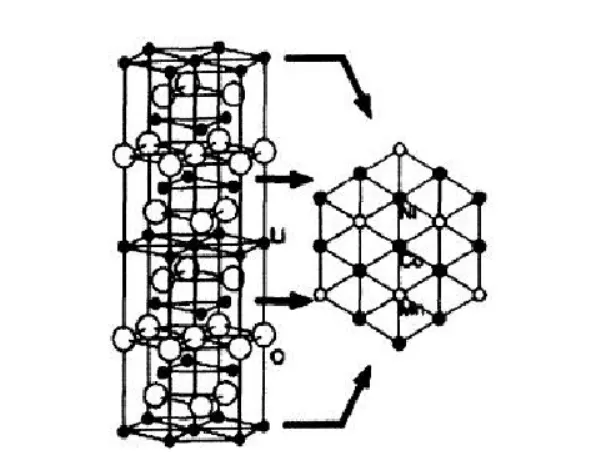
In NMC, the incorporation of manganese element enhances the stability of the material, so that the structure will not collapse due to lithium ion embedding. The addition of nickel increases the capacity and become a new valence element.
Advantages of NMC Battery :
( i ) High voltage platform
( ii ) High Energy density
( iii ) High Tap Density
Disadvantages of NMC Battery :
( i ) Poor Safety
( ii ) Short Service life
( iii ) Poor charge and discharge performance
The following table shows the characteristics of the NMC Battery :
d . Lithium Iron Phosphate ( LFP )
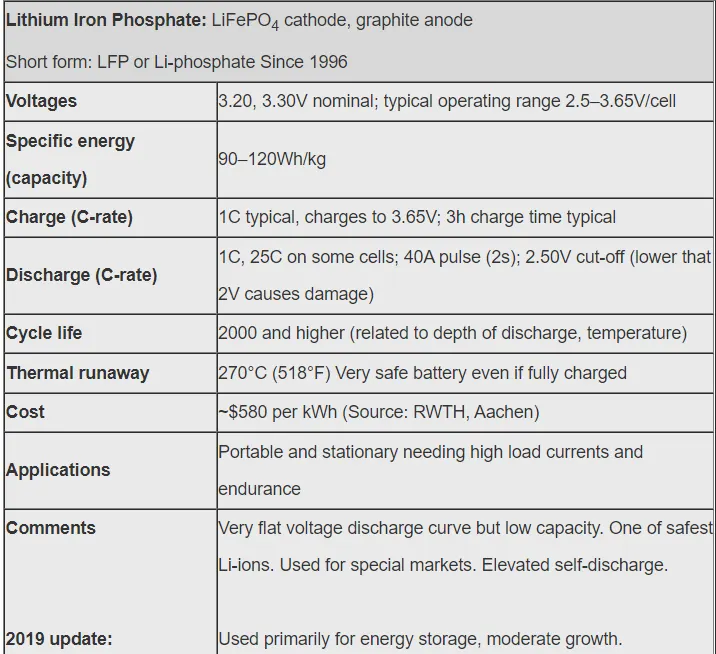
LiFePO4
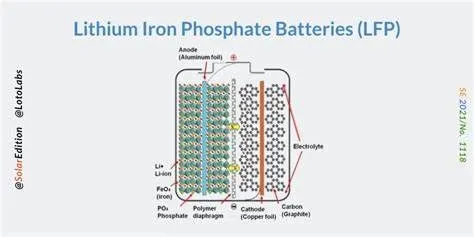
The LFP Battery uses phosphate as cathode material . Li-phosphate offers good electrochemical performance with low resistance. This is made possible with nano-scale phosphate cathode material .
Structure of LFP :
Advantages of LFP Battery :
( i ) Extended Life cycle
( ii ) Higher efficiency
( iii ) Lightweight and High temperature operation
Disadvantages of LFP Battery :
( i ) Subject to damage if over or under charged
( ii ) More susceptible to lightning damage
The following table shows the characteristics of the LFP Battery :
e. Lithium Nickel Cobalt Aluminum Oxide ( NCA ) :
LiNiCoAlO2
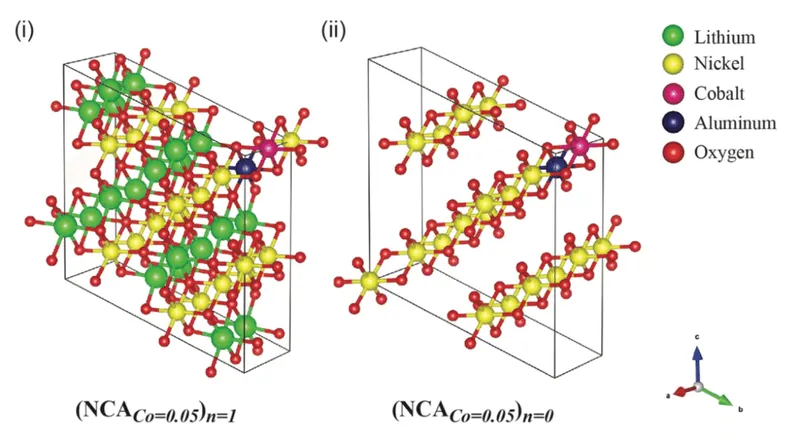
The cathode of the NCA battery is made of Nickel , Cobalt and Aluminium .This battery has some similarities with the NCM Battery .The ratio of nickel, cobalt, and aluminum in NCA is 8:1.5:0.5, and the content of aluminum is very small, so it is evident that it is close to binary materials. Instead of manganese, Aluminium (transition metal) is used to modify lithium nickel, cobalt, and manganese acid through ion doping and surface coating. Ion doping can enhance the stability of materials and improve the cycling performance of materials. However, in the production process, Al is a amphoteric metal, which is not easy to precipitate, so there is a threshold in the production process of NCA material.
The structure of NCA Battery is :
Advantages of NCA Battery :
( i ) High specific Energy and Specific Power
( ii ) Long life Span
Disadvantages of NCA Battery :
( i ) High cost
( ii ) Safety is marginal .
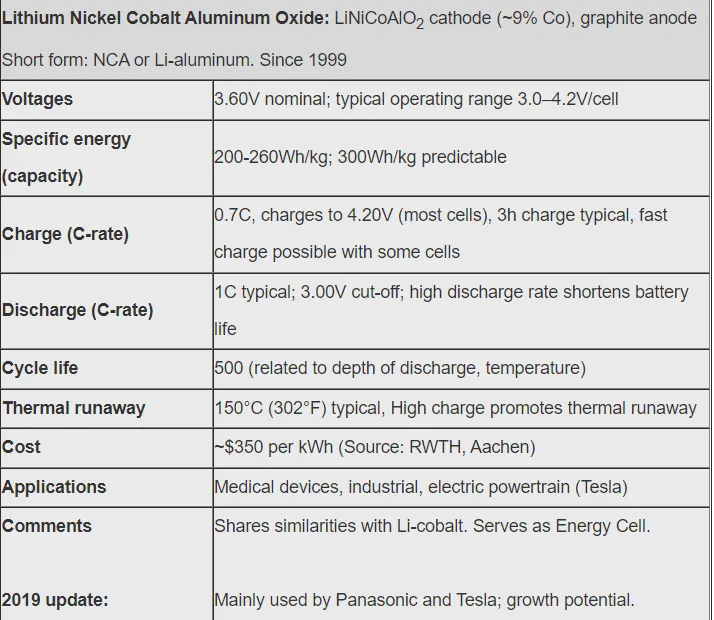
The following table shows the characteristics of the NCA Battery :
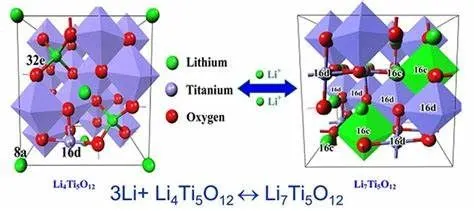
f. Lithium Titanate - ( LTO )
Li2TiO3
Li-titanate replaces the graphite in the anode of a typical lithium-ion battery and the material forms into a spinel structure. The cathode of the battery is lithium manganese oxide or NMC. LTO has advantages over the conventional cobalt-blended Li-ion with graphite anode by attaining zero-strain property, no SEI film formation and no lithium plating when fast charging and charging at low temperature.
Advantages of LTO Battery :
( i ) Good thermal stability under high temperature .
( ii ) Very safe battery and good life span
( iii ) Excellent low-temperature discharge characteristics
Disadvantages of LTO Battery :
( i ) Low Specific energy
( ii ) High Cost
Structure of the LTO battery