Week 1 Understanding Different Battery Chemistry
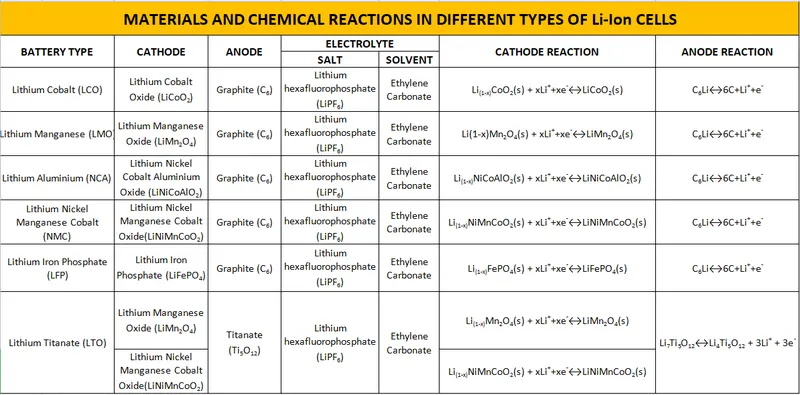
Q) Prepare a table that includes materials & chemical reactions occurring at the anode and cathode of LCO, LMO, NCA, NMC, LFP and LTO type of lithium-ion cells. Give your detailed explanation on it?
ANS:
HOW DOES A LITHIUM-ION BATTERY WORKS:
THE BASICS:
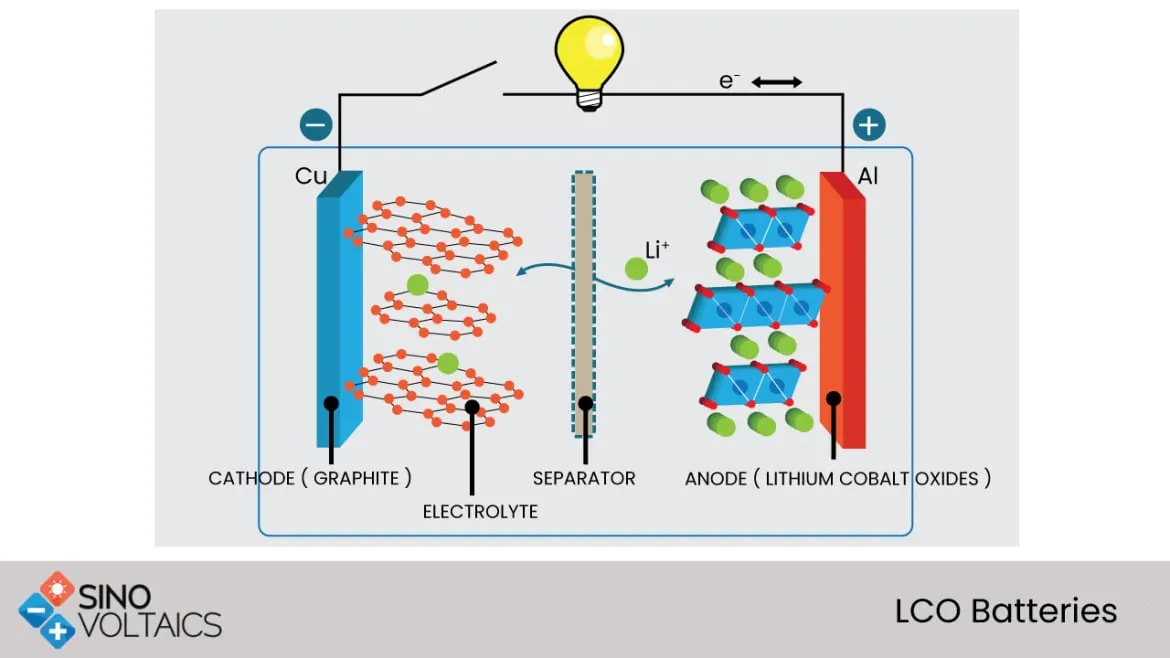
A battery comprises an anode, cathode, separator, electrolyte, and two current collectors (positive and negative). The anode and cathode store the Lithium. The electrolyte carries positively charged lithium ions from the anode to the cathode and vice versa through the separator. The movement of the lithium ions creates free electrons in the anode, which creates a charge at the positive current collector. The electrical current flows from the current collector through a device being powered (cell phone, computer, etc.) to the negative current collector. The separator blocks the flow of electrons inside the battery.
CHARGE/DISCHARGE:
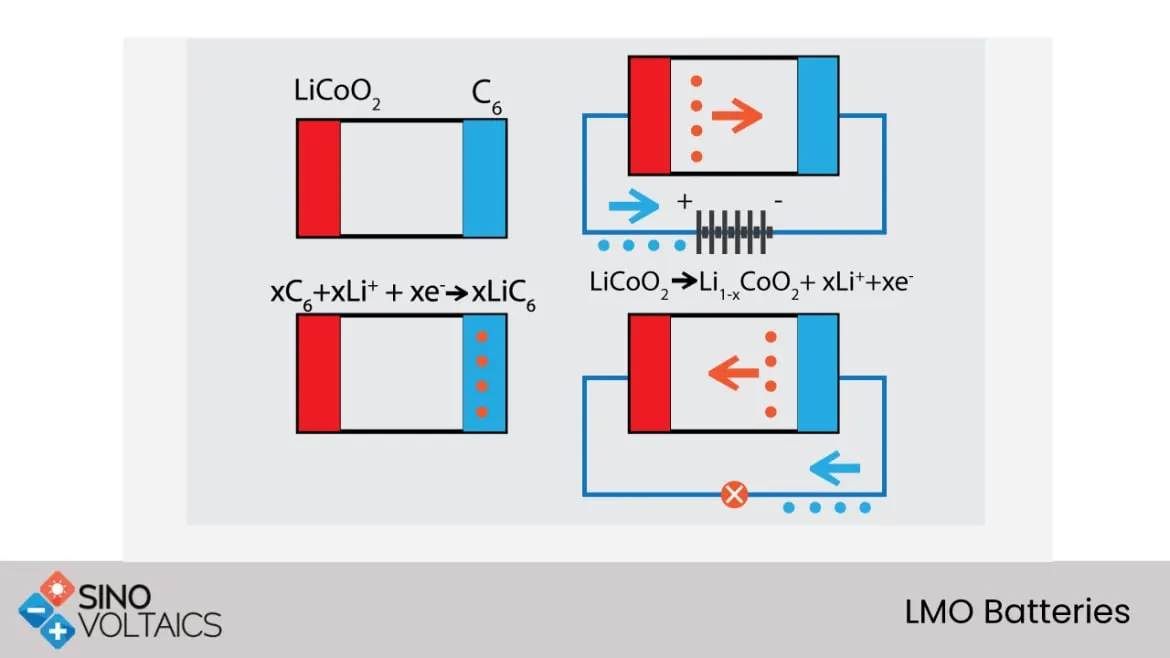
While the battery is discharging and providing an electric current, the anode releases lithium ions to the cathode, generating a flow of electrons from one side to the other. When plugging in the device, the opposite happens: Lithium ions are released by the cathode and received by the anode.
ENERGY DENSITY VS POWER DENSITY:
The two most common concepts associated with batteries are energy density and power density. Energy density is measured in watt-hours per kilogram (Wh/kg) and is the amount of energy the battery can store concerning its mass. Power density is measured in watts per kilogram (W/kg) and is the amount of power generated by the battery concerning its mass. To draw a clearer picture, think of draining a pool. Energy density is similar to the size of the pool, while power density is comparable to draining the pool as quickly as possible.
The Vehicle Technologies Office increases the energy density of batteries while reducing the cost and maintaining an acceptable power density.
The Components

Lithium-ion batteries are available in many different shapes and sizes. Inside, however, they typically look the same. To understand how a lithium-ion battery works, it's essential to know individual parts' roles.
The Cell
A lithium-ion battery is made up of several parts. The cell, serving as the workhorse of the battery, is the most critical component of the battery.
The cell is comprised of the following battery materials:
- Electrodes are the two battery ends. One is the anode, and the other is the cathode.
- The anode stores Lithium and is typically made from carbon.
- The cathode also stores Lithium and is made from a chemical compound called metal oxide.
- The separator blocks the flow of negative and positive electrons inside the battery but allows ions to pass through.
- The electrolyte liquid sits between the two electrodes. It carries the positively charged lithium ions from the anode to the cathode and vice versa, depending on whether the battery is charging or discharging.
The Battery Pack
The battery pack, which holds the lithium-ion cells, operates much like a computer. It contains the following:
- At least one temperature sensor to monitor the battery's temperature.
- A voltage converter and regulator circuit keep the voltage and current at safe levels.
- A Euro connector allows power and information to move in and out of the battery pack.
- The cell tap oversees the cells' voltages in the battery pack.
- A battery monitoring system is a small computer that supervises the whole battery and ensures safety to the user.
Movement in the Cell
So how does the cell provide power to the equipment?
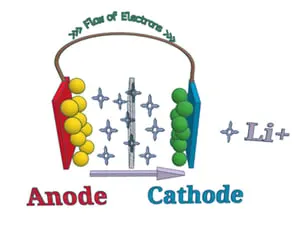
When you plug a lithium-ion battery into a device or piece of equipment, the positively-charged ions move from the anode to the cathode. As a result, the cathode becomes more positively charged than the anode. This, in turn, attracts negatively-charged electrons to the cathode.
A separator in the cell includes electrolytes that form a catalyst. This promotes ion movement between the. The movement of ions through the electrolyte solution causes the electrons to move through the device the battery is plugged into.
Lithium-ion batteries are rechargeable. When recharging, the lithium ions go through the same process but opposite. This restores the battery for additional use.
The overall design of a lithium-ion battery provides many benefits for equipment users:
- Run times dramatically increase with their use compared to other battery types.
- Fast-charging capabilities provide less downtime for shift workers and greater productivity.
- They feature flat discharge curves and provide higher constant power. This means no more annoying sluggishness in equipment as the battery charge level decreases.
Battery Management System (BMS)
The management system plays an integral role in ensuring the battery cell works at its highest levels. It also impacts how the battery functions, offering several protections and features.
For example:
- The BMS maintains cell temperatures to prevent overheating or freezing in the ideal operating range.
- The BMS monitors currents and voltage to keep both at safe levels. Dendrites begin to form in the cell if voltages drop too low, which can short the cell, so a lithium-ion battery pack must have a system to monitor this.
- No " memory " is built into the pack, so partial discharges do not hurt the battery. Lithium-ion batteries can charge and discharge during the most convenient times for equipment operators.
- Built-in controllers prevent overcharging to prevent forming that can cause significant damage to lithium-ion batteries.
- Cell balancing is monitored so that equalization charges are never needed. Because lithium-ion batteries do not need equalization charges, they do not release dangerous gasses.
- The battery management system also allows managers to track the battery health of their fleet through onboard computers that send vital data through cloud-based services.
Lithium Cobalt (LCO):
properties and usage:
LCO stands for Lithium cobalt battery. Lithium cobalt oxide is one of the most common Lithium-ions. It has a chemical symbol which is LiCoO2, and is abbreviated as LCO. For simplification, Li-cobalt –the short term- can also be used for this type of battery. Cobalt is the core active material that defines the character of the battery.
Lithium-ion batteries and concept:
The most popular technology of the battery sector currently is the lithium-ion battery. Relative to other batteries, lithium-ion batteries have better energy, power density and higher cycling ability. These qualities are essential in modern applications like electric and hybrid vehicles and, most importantly, energy storage systems used in renewable energy applications. The lithium-ion batteries chemistry is the same across the different lithium-ion battery types; during discharge, Lithium-ions are moved to the positive cathode from the negative anode through the organic electrolyte. The anodes in all various technologies of lithium-ion are all made from graphite. The differences are the cathode which contains changing cobalt, nickel or manganese concentrations. All different cathode types allow high lithium insertion and intercalation levels, resulting in large energy storage quantities.
LCO batteries technology and applications:
LCO (Lithium cobalt oxide) was invented in the year 1991. Its anode material is LiaC6, the cathode material is LibCoO2, and the carrier is Li+. It is used in various electronic devices for all laptops and phone batteries. The majority of lithium-ion batteries for portable devices are cobalt based. The system contains a cobalt oxide cathode (positive electrode) and graphite carbon anode (negative electrode).
Advantages and disadvantages of LCO batteries:
The main advantages of the LCO batteries are:
- High energy density.
- Long runtime makes it optimum for new technologies.
The main disadvantages of the LCO batteries are:
- It has a relatively low discharge current, so that that high load can lead to pack overheat
- The safety circuit of the LCO battery is typically limited to a 1C for charging and discharging.
- The internal resistance increases with cycling and ageing. This high internal resistance can cause the battery to become unserviceable due to a large voltage drop under the load after a couple of years of use.
Lithium Manganese Oxide (LMO):
properties and usage:
LMO stands for Lithium manganese oxide batteries, commonly referred to as lithium-ion manganese batteries or manganese spinel. This battery was discovered in the 1980s, yet the first commercial lithium-ion battery made with a cathode material made from lithium manganese was produced in 1996.
Lithium-ion batteries and concept:
The most popular technology of the battery sector currently is the lithium-ion battery. Relative to other batteries, lithium-ion batteries have better energy, power density and higher cycling ability. These qualities are essential in modern applications like electric and hybrid vehicles and, most importantly, energy storage systems used in renewable energy applications. The lithium-ion batteries chemistry is the same across the different lithium-ion battery types; during discharge, Lithium-ions are moved to the positive cathode from the negative anode through the organic electrolyte. The anodes in all various technologies of lithium-ion are all made from graphite. The differences are the cathode which contains changing cobalt, nickel or manganese concentrations. All different cathode types allow high lithium insertion and intercalation levels, resulting in large energy storage quantities.
LMO batteries technology and applications:
LMO (Lithium magnesium oxide) was invented in the year 1996. Its anode material is LiaC6, the cathode material is LibMn2O4, and the carrier is Li+. It is used in different applications like power tools and electric cars.LMO batteries can deliver a lot of energy quickly, which makes them extremely useful for use in power tools like drills. In 1996, lithium manganese oxide was first used as a cathode material. This structure formed a three-dimensional spinel structure, improving the flow of ions between the electrodes. The high flow decreases the internal resistance and increases loading capability.LMO batteries are usually used in medical devices and equipment, power tools, electric bikes and more. Because of their thermal resistance and higher safety. LMO batteries can also be used for laptops and electric cars.
Advantages and disadvantages of LMO batteries:
The main advantages of the LMO batteries are:
- High-temperature stability and safety relative to other Li-ion types have integrally high thermal stability thus needs less safety circuitry than cobalt system.
- High rate capability due to low internal cell resistance which benefits fast charging and high current discharging.
The main disadvantage of the LMO batteries is:
- Lower capacity relative to the cobalt-based system, yet it still has an energy density that is nearly 50% higher than the nickel-based system.
Lithium Nickel Cobalt Aluminium Oxide (NCA):
properties and usage:
NCA battery stands for Lithium nickel cobalt aluminium oxide-based battery (LiNiCoAlO2). Also, NCA batteries are becoming more and more important in in-grid storage and electrical power terrain applications.
Lithium-ion batteries and concept:
The most popular technology of the battery sector currently is the lithium-ion battery. Relative to other types of batteries, lithium-ion batteries have better energy, power density and higher cycling ability. These qualities are extremely important in the use in modern applications like electrical and hybrid vehicles and most importantly energy storage systems which are used in renewable energy applications. The lithium-ion batteries chemistry is the same across the different lithium-ion battery types; during discharge, Lithium-ions move to the positive cathode from the negative anode through the organic electrolyte. The anodes in all various technologies of lithium-ion are all made from graphite. The differences are the cathode which contains changing cobalt, nickel or manganese concentrations. All various cathode types allow high lithium insertion and intercalation levels which result in large energy storage quantities.
NCA battery technology and applications:
NCA (Lithium nickel cobalt aluminium oxide) battery was invented in the year 1999. Its anode material is LiaC6, the cathode material is LibNi0.8Co0.15Al0.05O2 and the carrier is Li+. It is used in different applications like power grid applications, medical devices and electric cars. Most notably Tesla deploys NCA batteries in their electric vehicle's system. NCA batteries can store the same amount of energy as NMC. NCA batteries are not widely common in the consumer industry but are quite promising in the electric car industry.
Advantages and disadvantages of NCA batteries:
The main advantages of the NCA batteries are:
- High specific energy
- Reasonably good specific power
- Long life span
- NCA cathodes contain the most energy amount by weight and volume (as NMC).
The main disadvantages of the NCA batteries are:
- Less safety than other Li-ion battery types (they require extra safety features and circuits for use in electric cars for example)
- Higher cost in comparison to other Li-ion battery types
Lithium Nickel Manganese Cobalt Oxide (NMC):
properties and usage:
NMC stands for Lithium Nickel Manganese Cobalt Oxide battery. (LiNiMnCoO2)The cathode combination of NMC (nickel-manganese-cobalt) is among the most successful Li-ion systems. The NMC systems can serve as a Power Cell or an Energy Cell.
Lithium-ion batteries and concept:
The most popular technology of the battery sector currently is the lithium-ion battery. Relative to other types of batteries, lithium-ion batteries have better energy, power density and higher cycling ability. These qualities are extremely important in the use in modern applications like electrical and hybrid vehicles and most importantly energy storage systems which are used in renewable energy applications. The lithium-ion batteries chemistry is the same across the different lithium-ion battery types; during discharge, Lithium-ions move to the positive cathode from the negative anode through the organic electrolyte. The anodes in all various technologies of lithium-ion are all made from graphite. The differences are the cathode which contains changing cobalt, nickel or manganese concentrations. All various cathode types allow high lithium insertion and intercalation levels which result in large energy storage quantities. The name Lithium-ion is after the active materials; it can be either expressed by words or shortened by the chemical symbols.
NMC batteries technology and applications:
NMC (Nickel Manganese Cobalt Oxide) battery was invented in the year 2008. Its anode material is LiaC6, the cathode material is LibNi1–x–yCoxMnyO2 and the carrier is Li+. They commonly use it in different applications like Energy Systems and electric cars.NMC combines the best of nickel and manganese. Nickel has high specific energy but poor stability; manganese can form a spinel structure so as to achieve low internal resistance yet provides low specific energy. Joining the metals increases the strengths of both parts.NMC batteries are widely used for power tools, energy storage systems (EES) which need frequent cycling and electrical power trains like automotives. The cathode combination typically used is 1-1-1 which means one-third nickel, one-third manganese and one-third cobalt. This reduces the raw material cost due to lowered content of cobalt. Another known combination for NCM is 5-3-2 (5 parts nickel, 3 parts cobalt and 2 parts manganese). Other combinations are also possible
Advantages and disadvantages of NMC batteries:
The main advantages of the NMC batteries are:
- NMC cells provide a longer life cycle
- Lower cost
- Higher energy density
- NMC cathodes contain the most energy amount by weight and volume.
The main disadvantages of the NMC batteries are:
- Adding silicon to graphite has the downside of making the anode grow and shrink through charging and discharging, leading to mechanical instability of the cell.
- Slightly lower voltage than cobalt systems
Lithium iron phosphate (LFP):
properties and usage:
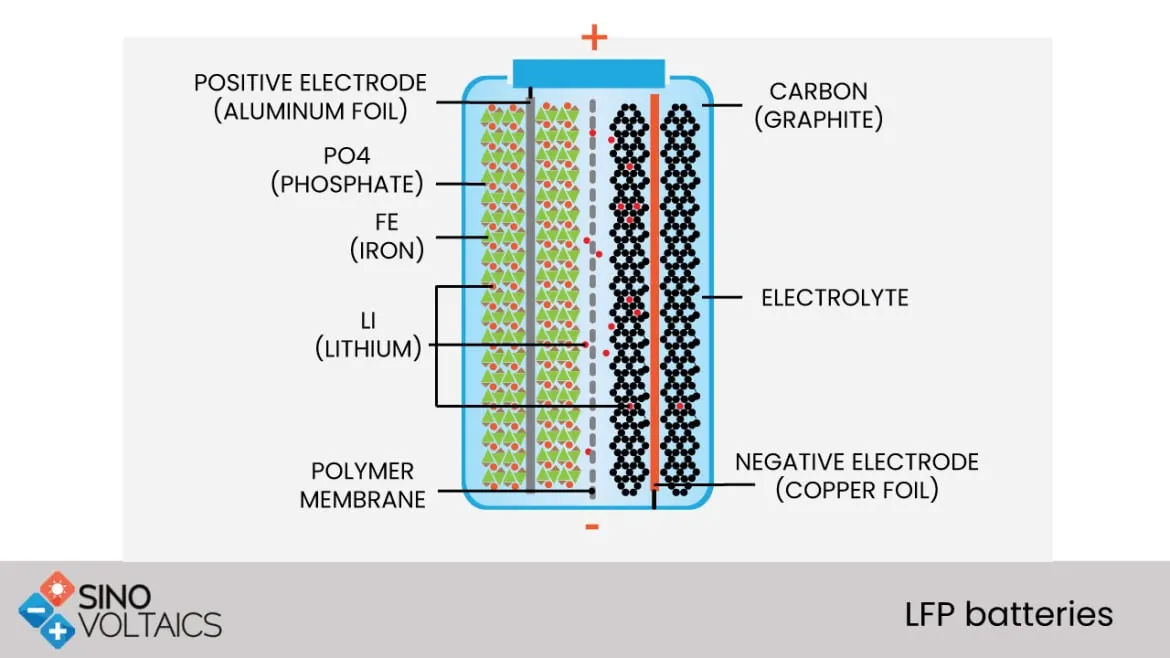
LFP batteries stand for Lithium iron phosphate(LiFePO4) batteries, which is known as li-phosphate batteries as well. They use phosphate as cathode material. In addition, they benefit from the low resistance properties that enhance their thermal stability and safety.
Lithium-ion batteries and concept:
The most popular technology of the battery sector currently is the lithium-ion battery. Relative to other types of batteries, lithium-ion batteries have better energy, power density and higher cycling ability. These qualities are extremely important in the use in modern applications like electrical and hybrid vehicles and most importantly energy storage systems as in renewable energy applications. The lithium-ion batteries chemistry is the same across the different lithium-ion battery types; during discharge, Lithium-ions move to the positive cathode from the negative anode through the organic electrolyte. The anodes in all various technologies of lithium-ion are all made from graphite. The differences are the cathode which contains changing cobalt, nickel or manganese concentrations. All various cathode types allow high lithium insertion and intercalation levels which result in large energy storage quantities.
LFP batteries technology and applications:
LFP (Lithium iron phosphate) was invented in the year 1996. Its anode material is LiaC6, the cathode material is LibFePO4 and the carrier is Li+. They use LFP batteries in different applications like electric cars, electric buses and electric trucks. The LFP is ideal for use in electric trucks or buses – as volume or weight isn't really a restriction as is in cars- because the battery is less energy-dense yet cheaper to manufacture than other Li-ion batteries types. In addition, they use LFP batteries in other applications like electric motorcycles which need a longer life cycle and increased safety. LFP provides good electrochemical performance with lower resistance. This is enabled by the nanoscale phosphate cathode material. The main benefits are long cycle life, higher current rating and thermal stability which means extra safety.
Advantages and disadvantages of LFP batteries:
The main advantages of the LFP batteries are:
- Durability
- Long lifecycle
- Low cost
- Excellent safety
The main disadvantages of the LFP batteries are:
- More tolerant to conditions of full charge and is less stressed at higher voltage for a long time.
- the lower nominal voltage which reduces the specific energy
- Higher self-discharge than other types of Li-ion batteries, which causes balancing issues with ageing
lithium titanate (LTO):
properties and usage:
LTO batteries are lithium titanate (Li2TiO3) or li-titanate batteries, which is a class of batteries that is used in a growing number of applications. They are high power batteries, so they are perfect for use in fast-charging stations.
Lithium-ion batteries and concept:
The most popular technology of the battery sector currently is the lithium-ion battery. Relative to other types of batteries, lithium-ion batteries have better energy, power density and higher cycling ability. These qualities are extremely important in use in modern applications like electrical and hybrid vehicles and most importantly energy storage systems for renewable energy applications. The lithium-ion batteries chemistry is the same across the different lithium-ion battery types; during discharge, Lithium-ions move to the positive cathode from the negative anode through the organic electrolyte. The anodes in all various technologies of lithium-ion are all made from graphite. The differences are the cathode which contains changing cobalt, nickel or manganese concentrations. All various cathode types allow high lithium insertion and intercalation levels which result in large energy storage quantities.
LTO batteries technology and applications:
LTO (Lithium tint) was invented in the year 2008. Its anode material is Li4+aTi5O12, the cathode material is LibFePO4 and the carrier is Li+. They use it in different applications like UPS, electrical power trains, solar-powered street lights, fast-charge stations and forklifts. Other applications for LTO batteries include aerospace and military uses, and more importantly wind and solar energy storage and smart grids creation. Li-titanate is used instead of the graphite in the anode of a common lithium-ion battery and the material is formed into a spinel structure. The cathode material is either LMO or NMC. As mentioned, they use li-titanate batteries in electric vehicles, yet LTO batteries have lower energy density than other Li-ion battery types, which can be a disadvantage in efficiently powering vehicles. Still, the density of LTO batteries is higher than other non-Li-ion batteries.
Advantages and disadvantages of LTO batteries:
The main advantages of the LTO batteries are:
- Excellent low-temperature discharge characteristics
- Zero strain property, no formation of SEI film nor Lithium plating when charging at low temperature or fast charging
- Long lifetime
- Fast charge capability and wide temperature range
- Among the safest types of Li-ion batteries
The main disadvantages of the LTO batteries are:
- High cost
- The lower inherent voltage or lower energy density
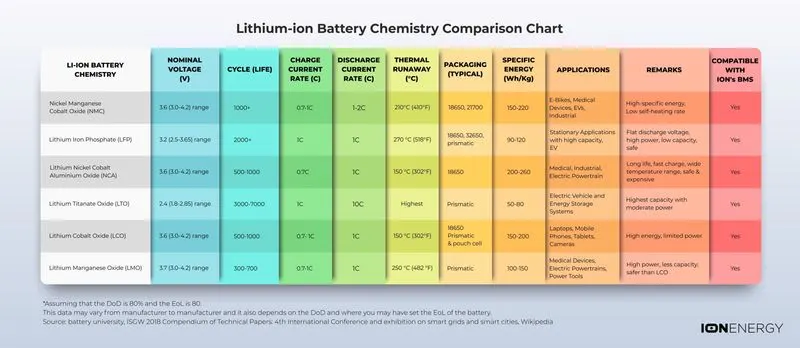
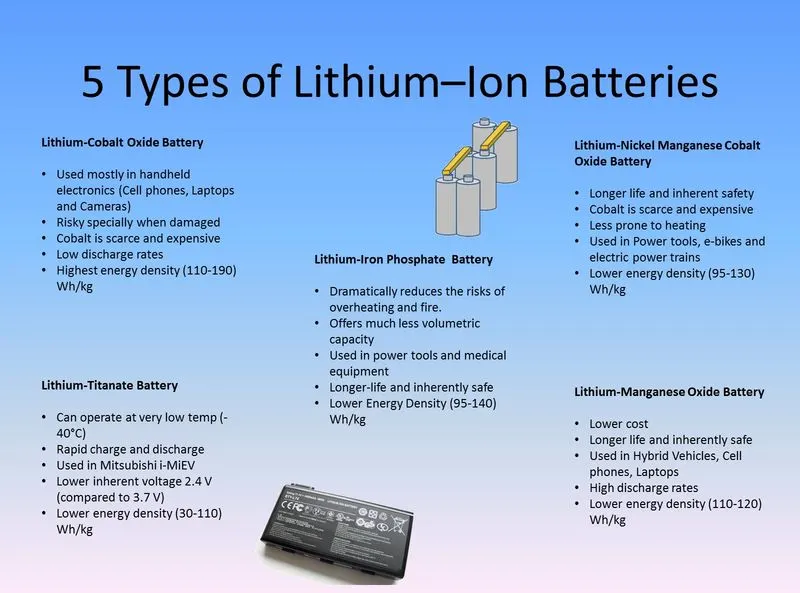
Q) Compare the differences between each type of Li+ion battery based on their characteristics?
ANS:
Lithium Cobalt (LCO):
properties and usage:
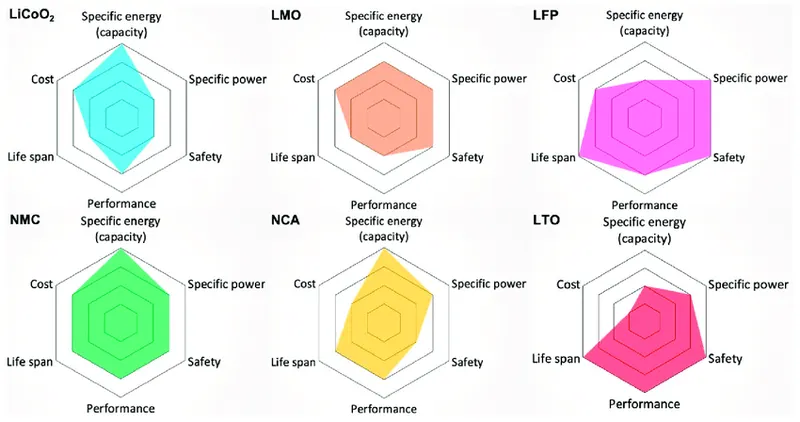
LCO stands for Lithium cobalt battery. Lithium cobalt oxide is one of the most common Lithium-ions. It has a chemical symbol which is LiCoO2, and is abbreviated as LCO. For simplification, Li-cobalt –the short term- can also be used for this type of battery. Cobalt is the core active material that defines the character of the battery.
Lithium-ion batteries and concept:
The most popular technology of the battery sector currently is the lithium-ion battery. Relative to other batteries, lithium-ion batteries have better energy, power density and higher cycling ability. These qualities are essential in modern applications like electric and hybrid vehicles and, most importantly, energy storage systems used in renewable energy applications. The lithium-ion batteries chemistry is the same across the different lithium-ion battery types; during discharge, Lithium-ions are moved to the positive cathode from the negative anode through the organic electrolyte. The anodes in all various technologies of lithium-ion are all made from graphite. The differences are the cathode which contains changing cobalt, nickel or manganese concentrations. All different cathode types allow high lithium insertion and intercalation levels, resulting in large energy storage quantities.
LCO batteries technology and applications:
LCO (Lithium cobalt oxide) was invented in the year 1991. Its anode material is LiaC6, the cathode material is LibCoO2, and the carrier is Li+. It is used in various electronic devices for all laptops and phone batteries. The majority of lithium-ion batteries for portable devices are cobalt based. The system contains a cobalt oxide cathode (positive electrode) and graphite carbon anode (negative electrode).
Advantages and disadvantages of LCO batteries:
The main advantages of the LCO batteries are:
- High energy density.
- Long runtime makes it optimum for new technologies.
The main disadvantages of the LCO batteries are:
- It has a relatively low discharge current, so that that high load can lead to pack overheat
- The safety circuit of the LCO battery is typically limited to a 1C for charging and discharging.
- The internal resistance increases with cycling and ageing. This high internal resistance can cause the battery to become unserviceable due to a large voltage drop under the load after a couple of years of use.
Lithium Manganese Oxide (LMO):
properties and usage:
LMO stands for Lithium manganese oxide batteries, commonly referred to as lithium-ion manganese batteries or manganese spinel. This battery was discovered in the 1980s, yet the first commercial lithium-ion battery made with a cathode material made from lithium manganese was produced in 1996.
Lithium-ion batteries and concept:
The most popular technology of the battery sector currently is the lithium-ion battery. Relative to other batteries, lithium-ion batteries have better energy, power density and higher cycling ability. These qualities are essential in modern applications like electric and hybrid vehicles and, most importantly, energy storage systems used in renewable energy applications. The lithium-ion batteries chemistry is the same across the different lithium-ion battery types; during discharge, Lithium-ions are moved to the positive cathode from the negative anode through the organic electrolyte. The anodes in all various technologies of lithium-ion are all made from graphite. The differences are the cathode which contains changing cobalt, nickel or manganese concentrations. All different cathode types allow high lithium insertion and intercalation levels, resulting in large energy storage quantities.
LMO batteries technology and applications:
LMO (Lithium magnesium oxide) was invented in the year 1996. Its anode material is LiaC6, the cathode material is LibMn2O4, and the carrier is Li+. It is used in different applications like power tools and electric cars.LMO batteries can deliver a lot of energy quickly, which makes them extremely useful for use in power tools like drills. In 1996, lithium manganese oxide was first used as a cathode material. This structure formed a three-dimensional spinel structure, improving the flow of ions between the electrodes. The high flow decreases the internal resistance and increases loading capability.LMO batteries are usually used in medical devices and equipment, power tools, electric bikes and more. Because of their thermal resistance and higher safety. LMO batteries can also be used for laptops and electric cars.
Advantages and disadvantages of LMO batteries:
The main advantages of the LMO batteries are:
- High-temperature stability and safety relative to other Li-ion types have integrally high thermal stability thus needs less safety circuitry than cobalt system.
- High rate capability due to low internal cell resistance which benefits fast charging and high current discharging.
The main disadvantage of the LMO batteries is:
- Lower capacity relative to the cobalt-based system, yet it still has an energy density that is nearly 50% higher than the nickel-based system.
Lithium Nickel Cobalt Aluminium Oxide (NCA):
properties and usage:
NCA battery stands for Lithium nickel cobalt aluminium oxide-based battery (LiNiCoAlO2). Also, NCA batteries are becoming more and more important in in-grid storage and electrical power terrain applications.
Lithium-ion batteries and concept:
The most popular technology of the battery sector currently is the lithium-ion battery. Relative to other types of batteries, lithium-ion batteries have better energy, power density and higher cycling ability. These qualities are extremely important in the use in modern applications like electrical and hybrid vehicles and most importantly energy storage systems which are used in renewable energy applications. The lithium-ion batteries chemistry is the same across the different lithium-ion battery types; during discharge, Lithium-ions move to the positive cathode from the negative anode through the organic electrolyte. The anodes in all various technologies of lithium-ion are all made from graphite. The differences are the cathode which contains changing cobalt, nickel or manganese concentrations. All various cathode types allow high lithium insertion and intercalation levels which result in large energy storage quantities.
NCA battery technology and applications:
NCA (Lithium nickel cobalt aluminium oxide) battery was invented in the year 1999. Its anode material is LiaC6, the cathode material is LibNi0.8Co0.15Al0.05O2 and the carrier is Li+. It is used in different applications like power grid applications, medical devices and electric cars. Most notably Tesla deploys NCA batteries in their electric vehicle's system. NCA batteries can store the same amount of energy as NMC. NCA batteries are not widely common in the consumer industry but are quite promising in the electric car industry.
Advantages and disadvantages of NCA batteries:
The main advantages of the NCA batteries are:
- High specific energy
- Reasonably good specific power
- Long life span
- NCA cathodes contain the most energy amount by weight and volume (as NMC).
The main disadvantages of the NCA batteries are:
- Less safety than other Li-ion battery types (they require extra safety features and circuits for use in electric cars for example)
- Higher cost in comparison to other Li-ion battery types
Lithium Nickel Manganese Cobalt Oxide (NMC):
properties and usage:
NMC stands for Lithium Nickel Manganese Cobalt Oxide battery. (LiNiMnCoO2)The cathode combination of NMC (nickel-manganese-cobalt) is among the most successful Li-ion systems. The NMC systems can serve as a Power Cell or an Energy Cell.
Lithium-ion batteries and concept:
The most popular technology of the battery sector currently is the lithium-ion battery. Relative to other types of batteries, lithium-ion batteries have better energy, power density and higher cycling ability. These qualities are extremely important in the use in modern applications like electrical and hybrid vehicles and most importantly energy storage systems which are used in renewable energy applications. The lithium-ion batteries chemistry is the same across the different lithium-ion battery types; during discharge, Lithium-ions move to the positive cathode from the negative anode through the organic electrolyte. The anodes in all various technologies of lithium-ion are all made from graphite. The differences are the cathode which contains changing cobalt, nickel or manganese concentrations. All various cathode types allow high lithium insertion and intercalation levels which result in large energy storage quantities. The name Lithium-ion is after the active materials; it can be either expressed by words or shortened by the chemical symbols.
NMC batteries technology and applications:
NMC (Nickel Manganese Cobalt Oxide) battery was invented in the year 2008. Its anode material is LiaC6, the cathode material is LibNi1–x–yCoxMnyO2 and the carrier is Li+. They commonly use it in different applications like Energy Systems and electric cars.NMC combines the best of nickel and manganese. Nickel has high specific energy but poor stability; manganese can form a spinel structure so as to achieve low internal resistance yet provides low specific energy. Joining the metals increases the strengths of both parts.NMC batteries are widely used for power tools, energy storage systems (EES) which need frequent cycling and electrical power trains like automotives. The cathode combination typically used is 1-1-1 which means one-third nickel, one-third manganese and one-third cobalt. This reduces the raw material cost due to lowered content of cobalt. Another known combination for NCM is 5-3-2 (5 parts nickel, 3 parts cobalt and 2 parts manganese). Other combinations are also possible
Advantages and disadvantages of NMC batteries:
The main advantages of the NMC batteries are:
- NMC cells provide a longer life cycle
- Lower cost
- Higher energy density
- NMC cathodes contain the most energy amount by weight and volume.
The main disadvantages of the NMC batteries are:
- Adding silicon to graphite has the downside of making the anode grow and shrink through charging and discharging, leading to mechanical instability of the cell.
- Slightly lower voltage than cobalt systems
Lithium iron phosphate (LFP):
properties and usage:
LFP batteries stand for Lithium iron phosphate(LiFePO4) batteries, which is known as li-phosphate batteries as well. They use phosphate as cathode material. In addition, they benefit from the low resistance properties that enhance their thermal stability and safety.
Lithium-ion batteries and concept:
The most popular technology of the battery sector currently is the lithium-ion battery. Relative to other types of batteries, lithium-ion batteries have better energy, power density and higher cycling ability. These qualities are extremely important in the use in modern applications like electrical and hybrid vehicles and most importantly energy storage systems as in renewable energy applications. The lithium-ion batteries chemistry is the same across the different lithium-ion battery types; during discharge, Lithium-ions move to the positive cathode from the negative anode through the organic electrolyte. The anodes in all various technologies of lithium-ion are all made from graphite. The differences are the cathode which contains changing cobalt, nickel or manganese concentrations. All various cathode types allow high lithium insertion and intercalation levels which result in large energy storage quantities.
LFP batteries technology and applications:
LFP (Lithium iron phosphate) was invented in the year 1996. Its anode material is LiaC6, the cathode material is LibFePO4 and the carrier is Li+. They use LFP batteries in different applications like electric cars, electric buses and electric trucks. The LFP is ideal for use in electric trucks or buses – as volume or weight isn't really a restriction as is in cars- because the battery is less energy-dense yet cheaper to manufacture than other Li-ion batteries types. In addition, they use LFP batteries in other applications like electric motorcycles which need a longer life cycle and increased safety. LFP provides good electrochemical performance with lower resistance. This is enabled by the nanoscale phosphate cathode material. The main benefits are long cycle life, higher current rating and thermal stability which means extra safety.
Advantages and disadvantages of LFP batteries:
The main advantages of the LFP batteries are:
- Durability
- Long lifecycle
- Low cost
- Excellent safety
The main disadvantages of the LFP batteries are:
- More tolerant to conditions of full charge and is less stressed at higher voltage for a long time.
- the lower nominal voltage which reduces the specific energy
- Higher self-discharge than other types of Li-ion batteries, which causes balancing issues with ageing
lithium titanate (LTO):
properties and usage:
LTO batteries are lithium titanate (Li2TiO3) or li-titanate batteries, which is a class of batteries that is used in a growing number of applications. They are high power batteries, so they are perfect for use in fast-charging stations.
Lithium-ion batteries and concept:
The most popular technology of the battery sector currently is the lithium-ion battery. Relative to other types of batteries, lithium-ion batteries have better energy, power density and higher cycling ability. These qualities are extremely important in use in modern applications like electrical and hybrid vehicles and most importantly energy storage systems for renewable energy applications. The lithium-ion batteries chemistry is the same across the different lithium-ion battery types; during discharge, Lithium-ions move to the positive cathode from the negative anode through the organic electrolyte. The anodes in all various technologies of lithium-ion are all made from graphite. The differences are the cathode which contains changing cobalt, nickel or manganese concentrations. All various cathode types allow high lithium insertion and intercalation levels which result in large energy storage quantities.
LTO batteries technology and applications:
LTO (Lithium tint) was invented in the year 2008. Its anode material is Li4+aTi5O12, the cathode material is LibFePO4 and the carrier is Li+. They use it in different applications like UPS, electrical power trains, solar-powered street lights, fast-charge stations and forklifts. Other applications for LTO batteries include aerospace and military uses, and more importantly wind and solar energy storage and smart grids creation. Li-titanate is used instead of the graphite in the anode of a common lithium-ion battery and the material is formed into a spinel structure. The cathode material is either LMO or NMC. As mentioned, they use li-titanate batteries in electric vehicles, yet LTO batteries have lower energy density than other Li-ion battery types, which can be a disadvantage in efficiently powering vehicles. Still, the density of LTO batteries is higher than other non-Li-ion batteries.
Advantages and disadvantages of LTO batteries:
The main advantages of the LTO batteries are:
- Excellent low-temperature discharge characteristics
- Zero strain property, no formation of SEI film nor Lithium plating when charging at low temperature or fast charging
- Long lifetime
- Fast charge capability and wide temperature range
- Among the safest types of Li-ion batteries
The main disadvantages of the LTO batteries are:
- High cost
- The lower inherent voltage or lower energy density