Week 1 Understanding Different Battery Chemistry
1.Prepare a table which includes materials & chemical reactions occurring at the anode and cathode of LCO, LMO, NCA, NMC, LFP and LTO type of lithium ion cells.Give your detailed explanation on it
Answer:-
Battery:
A Battery is a device consisting of one or more electrochemical cells with external connections for powering electrical devices such as Flashlights, mobile phones and electric cars.
When a battery is supplying electric power, its positive terminal is the cathode and its negative terminal is the anode.
The terminal marked negative is the source of electrons that will flow through an external electric circuit to the positive terminal.
When a battery is connected to an external electric load, a Redox reaction converts high-energy reactants to lower-energy products, and the free energy difference is delivered to the external circuit as electrical energy.
* There are two types of batteries,
- Primary cell - These batteries are one time use batteries and they cannot be recharged for further usage.
- Secondary cell - These batteries can be recharged and can be used for multiple times.
Lithium ion Cell:
The Lithium ion batteries are secondary type of batteries which can be recharged for further usage
The Lithium ion cells have four main Components in it and they are,
(i) Cathode
(ii) Anode
(iii) Electrolyte
(iv) Seperator
(i) Cathode:
* They are the positive elctrodes of the cell.
* The cathode elctrode is usually made up of,
1. Layered Transition metal oxides - Has high Capacity but high in cost and poor in safety.
2. Spinels - High power Density but poor in conductivity and stability.
3. Olivines - Lees capacity but has long life and are high in safety.
(ii) Anode:
* They are the negative elctrodes of the cell.
* The anode elctrode is usually made up of,
1. Graphite
2. Hard Carbon, these anodes are less in cost and high in stability and specific capacity.
(iii) Electrolyte:
* An electrolyte is a substance that produces an electrically conducting solution when dissolved in a polar solvent.
* The dissolved electrolyte seperate into cation and anions, which disperse uniformly through the solvent.
* Generally Lithium ion cells have electrolyes of Organic solvents such as, Ethylene carbonate, dimethyl carbonate, propylene carbonateand lithium salt as solute.
(iv) Seperator:
* Battery separators provide a barrier between the anode (negative) and the cathode (positive) while enabling the exchange of lithium ions from one side to the other.
* They are materials that conducts ions but they do not conduct the electrons through them.
* Li-ion cells use polyolefin as a separator. This material has excellent mechanical properties, good chemical stability and is low-cost as well.
Comparison depends upon Materials use and Chemical Reaction-
| Lithium-ion Battery Type | Cathode | Anode | Electrolyte | Separator |
| Lithium Cobalt Oxide (LCO) | Lithium Cobalt Oxide (LiCoO2) | Graphite Carbon | Ethylene Carbonate | Polyolefin |
| Lithium Manganese Oxide (LMO) | Lithium Manganese Oxide (LiMn2O4) | Graphite Carbon | Lithium Halide | Polyolefin |
| Lithium Nickel Cobalt Aluminium (NCA) | Lithium Nickel Cobalt Aluminium Oxide (LiNiCoAlO2) | Graphite Carbon | Ethylene Carbonate | Polyolefin |
| Lithium Nickel Manganese Cobalt (NMC) |
Lithium Nickel Manganese Cobalt Oxide (LiNiMnCoO2) |
Graphite Carbon | Lithium Salt | Polyolefin |
| Lithium Iron Phosphate (LFP) | Lithium Iron Phosphate (LiFePO4) | Graphite Carbon | Ethylene Carbonate | Polyolefin |
| Lithium Titanate Oxide (LTO) | Lithium Titanate Oxide (Li2TiO3) | Graphite Carbon | Lithium Salt | Polyolefin |
Comparison depends upon Chemical Reaction-
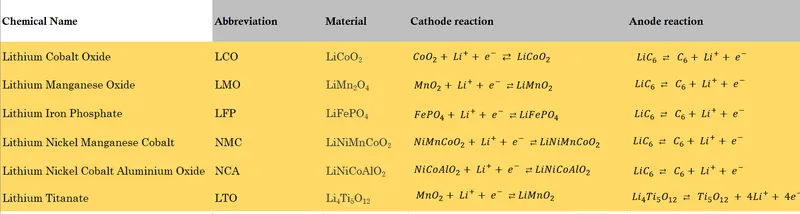
1. Lithium cobalt oxide - LiCoO2 (LCO)
* Also known as lithium cobaltate or lithium-ion cobalt batteries, lithium cobalt oxide batteries are made from lithium carbonate and cobalt.
* They have a cobalt oxide cathode and use graphite carbon as their anode material; during discharge, lithium ions move from anode to cathode, with the flow reversing when the battery is charging.
* This type of battery has some drawbacks, including a relatively short battery life and limited specific power. additionally, these batteries are not as safe as other types.
2. Lithium Manganese Oxide - LiMn204 (LMO)
* The first commercial lithium-ion cells made with lithium manganese oxide as a cathode material were produced in 1996 by Moli Energy.
* Lithium manganese oxide batteries are notable for their high temperature stability and are also safer than other lithium-ion battery types.
* For this reason, they are often used in medical equipment and devices, but they may also be used in power tools, electric bikes and more.
* It is also possible to use lithium manganese oxide batteries to power laptops and electric powertrain cars.
3. Lithium Nickel Cobalt Aluminium Oxide - LiNiCoAlO2 (NCA)
* Lithium nickel cobalt aluminum oxide batteries are also called NCA batteries, and are becoming increasingly important in electric powertrains and in grid storage.
* NCA batteries are not common in the consumer industry, but are promising for the automotive industry.
* NCA batteries provide a high-energy option with a good lifespan, but they are not as safe as they could be compared to other lithium-ion battery types and are quite costly.
4. Lithium Nickel Manganese Cobalt Oxide - LiMnCo02 (NMC)
* Also known as lithium manganese cobalt oxide or NMC batteries, include a cathode made of a combination of nickel, manganese and cobalt
* Like other lithium-ion battery varieties, NMC batteries can have either a high specific energy density or a high specific power. They cannot, however, have both properties.
* This battery type is most common in power tool and powertrains for vehicles.
* The cathode combination ratio is usually 60 percent nickel, 20 percent manganese and 20 percent cobalt. This means that the raw material cost is lower than it is for other lithium-ion battery options, as cobalt can be quite expensive.
5. Lithium Iron Phosphate - LiFePo4 (LFP)
* Lithium iron phosphate batteries, also known as li-phosphate batteries, use phosphate as a cathode. They benefit from low resistance properties, which enhance their safety and thermal stability Other benefits include durability and a long lifecycle - fully charged batteries can be stored with little change to the total lifespan of the battery's charge
* Li-phosphate batteries are often the most cost-effective option as well when their long battery life is taken into consideration. However, the lower voltage of the li-phosphate battery means that it has less energy than other types of lithium batteries.
* Accordingly, these batteries are often used in electric motorcycles as well as other applications that need a long lifecycle and significant safety.
6. Lithium Titanium Oxide - LiTio2 (LTO)
* Finally, lithium titanate, also known as li-titanate, is a class of battery that allows for ever-increasing applications. the main advantage of the li-titanate battery is its remarkably fast recharge time.
* Currently, manufacturers of electric vehicles and bikes use li-titanate batteries, and there is potential for this type of battery to be used in electric buses for public transportation.
* However, these batteries have lower inherent voltage, or lower energy density, than other lithium-ion battery varieties, which can present ssues with powering vehicles efficiently. Even so, the density of lithium titanate batteries is still higher than other non-lithium-ion batteries, which is a plus.
2.Compare the differences between each type of Li+ion batteries based on their characteristics
Answer:-
For ease of choosing a battery from laymans perspective, the 6 key features are given a value within 0-5 range for all of the, are given with the same parameters which are considered in case of 5 point hexagonal analysis of the batteries. They are
- Specific energ.
- Specific power.
- Safety .
- Performance.
- Life span.
- Cost.
LCO: Li-Cobalt cell provides a high specific energy but offer only moderate performance, specific power, safety and lifespan
LMO: This type battery provides overall moderate performance, specific energy, specific power and lifespan with moderate cost
NMC: NMC cell has good overall performance and specific energy. this battery is a preferred candidate for the electric vehicle and has the lowest self-heating rate.
LEP: Li-phosphate has excellent safety and long life span but moderate specific energy. it has excellent specific power with with good safety.
NCA: Nca it has high energy and power density as well as good lifespan make an a candidate for EV powertrain. high cost and marginal safety are negative.
LTO: Li-titanate has good safety, low temperature performance and life span efforts are being made to improve the specific energy and lower the cost.