Week 1 Understanding Different Battery Chemistry
1.
Lithium Cobalt Oxide:
Anode Reaction--- Graphite
`C_6 Li→6C+ 〖Li〗^++e^+`
Cathode reaction--- Lithium Cobalt Oxide
`〖Li〗_(1-x) 〖CO〗_2 (s)+x〖Li〗^++xe^-→ 〖LiCO〗_2 (s)`
Separator: Polyolefin
Electrolyte: Ethylene Carbonate
Overall Reaction:
`C_6+〖LiCO〗_2→〖LiC〗_6+〖CoO〗_2`
|
Lithium Cobalt Oxide: LiCoO2 cathode (~60% Co), graphite anode |
|
|
Voltages |
3.60V nominal; typical operating range 3.0–4.2V/cell |
|
Specific energy (capacity) |
150–200Wh/kg. Specialty cells provide up to 240Wh/kg. |
|
Charge (C-rate) |
0.7–1C, charges to 4.20V (most cells); 3h charge typical. Charge current above 1C shortens battery life. |
|
Discharge (C-rate) |
1C; 2.50V cut off. Discharge current above 1C shortens battery life. |
|
Cycle life |
500–1000, related to depth of discharge, load, temperature |
|
Thermal runaway |
150°C (302°F). Full charge promotes thermal runaway |
|
Applications |
Mobile phones, tablets, laptops, cameras |
Lithium Manganese Oxide (LMO):
Anode Reaction: Graphite
`C_6 Li→6C+ 〖Li〗^++e^+`
Cathode Reaction:
`〖MnO〗_2+ 〖Li〗^++e^-→ 〖MnO〗_2 Li`
Separator: Polyolefin
Electrolyte: Lithium halide
Overall Reaction:
`C_6+ 〖MnO〗_2 Li→ 〖MnO〗_4+C_6 Li`
|
Lithium Manganese Oxide: LiMn2O4 cathode. graphite anode |
|
|
Voltages |
3.70V (3.80V) nominal; typical operating range 3.0–4.2V/cell |
|
Specific energy (capacity) |
100–150Wh/kg |
|
Charge (C-rate) |
0.7–1C typical, 3C maximum, charges to 4.20V (most cells) |
|
Discharge (C-rate) |
1C; 10C possible with some cells, 30C pulse (5s), 2.50V cut-off |
|
Cycle life |
300–700 (related to depth of discharge, temperature) |
|
Thermal runaway |
250°C (482°F) typical. High charge promotes thermal runaway |
|
Applications |
Power tools, medical devices, electric powertrains |
Lithium Nickel Manganese Cobalt (NMC):
NMC 811`LiNi0.8Mn0.1Co0.1O2`
Anode Reaction: Graphite
`C_6 Li→6C+ 〖Li〗^++e^+`
Cathode Reaction:
`〖NiMnCoO〗_2+ 〖Li〗^++e^-→ 〖LiNiMnCoO〗_2`
Separator: Polyolefin
Electrolyte: Lithium Salt
Overall Reaction
`〖LiNiMnCoO〗_2+ C_6→ 〖LiC〗_6+ 〖NiMnCoO〗_2`
|
Lithium Nickel Manganese Cobalt Oxide: LiNiMnCoO2. cathode, graphite anode |
|
|
Voltages |
3.60V, 3.70V nominal; typical operating range 3.0–4.2V/cell, or higher |
|
Specific energy (capacity) |
150–220Wh/kg |
|
Charge (C-rate) |
0.7–1C, charges to 4.20V, some go to 4.30V; 3h charge typical. Charge current above 1C shortens battery life. |
|
Discharge (C-rate) |
1C; 2C possible on some cells; 2.50V cut-off |
|
Cycle life |
1000–2000 (related to depth of discharge, temperature) |
|
Thermal runaway |
210°C (410°F) typical. High charge promotes thermal runaway |
|
Cost |
~$420 per kWh[1] |
|
Applications |
E-bikes, medical devices, EVs, industrial |
Lithium iron Phosphate:
Anode Reaction: Graphite
`C_6 Li→6C+ 〖Li〗^++e^+`
Cathode Reaction:
`〖Fe〗^III 〖PO〗_4+ 〖Li〗^++e^-→〖LiFe〗^II 〖PO〗_4`
Separator: Polyolefin
Electrolyte: Ethylene Carbonate
Overall Reaction:
`〖LiFe〗^II 〖PO〗_4+ C_6→C_6 Li+〖Fe〗^III 〖PO〗_4`
|
Lithium Iron Phosphate: LiFePO4 cathode, graphite anode |
|
|
Voltages |
3.20, 3.30V nominal; typical operating range 2.5–3.65V/cell |
|
Specific energy (capacity) |
90–120Wh/kg |
|
Charge (C-rate) |
1C typical, charges to 3.65V; 3h charge time typical |
|
Discharge (C-rate) |
1C, 25C on some cells; 40A pulse (2s); 2.50V cut-off (lower that 2V causes damage) |
|
Cycle life |
2000 and higher (related to depth of discharge, temperature) |
|
Thermal runaway |
270°C (518°F) Very safe battery even if fully charged |
|
Cost |
~$580 per kWh[1] |
|
Applications |
Portable and stationary needing high load currents and endurance |
Lithium Nickel Cobalt Aluminum Oxide (NCA)
Anode Reaction: Graphite
`C_6 Li→6C+ 〖Li〗^++e^+`
Cathode Reaction:
`〖NiAlCoO〗_2+〖Li〗^++e^+ → 〖LiNiAlCoO〗_2`
Separator: Polyolefin
Electrolyte: Ethylene Carbonate
Overall Reaction:
`〖LiNiAlCoO〗_2+C_6+C_6 Li+〖NiAlCoO〗_2`
|
Lithium Nickel Cobalt Aluminum Oxide: LiNiCoAlO2 cathode (~9% Co), graphite anode |
|
|
Voltages |
3.60V nominal; typical operating range 3.0–4.2V/cell |
|
Specific energy (capacity) |
200-260Wh/kg; 300Wh/kg predictable |
|
Charge (C-rate) |
0.7C, charges to 4.20V (most cells), 3h charge typical, fast charge possible with some cells |
|
Discharge (C-rate) |
1C typical; 3.00V cut-off; high discharge rate shortens battery life |
|
Cycle life |
500 (related to depth of disc`〖4Mn〗_2 O_4+〖Li〗_4 〖Ti〗_5 O_12→〖4LiMn〗_2 O_4+〖Ti〗_5 O_12`harge, temperature) |
|
Thermal runaway |
150°C (302°F) typical, High charge promotes thermal runaway |
|
Cost |
~$350 per kWh[1] |
|
Applications |
Medical devices, industrial, electric powertrain (Tesla) |
Lithium Titanate (LTO)
Anode Reaction: Graphite
`〖Li〗_4 〖Ti〗_5 O_12 〖→ 〖Ti〗_5 O_12+4Li〗^++〖4e〗^+`
Cathode Reaction:
`〖4Mn〗_2 O_4 〖+4Li〗^++〖4e〗^+→ 〖4LiMn〗_2 O_4`
Separator: Polyolefin
Electrolyte: Lithium Salt
Overall Reaction:
|
Lithium Titanate: Cathode can be lithium manganese oxide or NMC; Li2TiO3 (titanate) anode |
|
|
Voltages |
2.40V nominal; typical operating range 1.8–2.85V/cell |
|
Specific energy (capacity) |
50–80Wh/kg |
|
Charge (C-rate) |
1C typical; 5C maximum, charges to 2.85V |
|
Discharge (C-rate) |
10C possible, 30C 5s pulse; 1.80V cut-off on LCO/LTO |
|
Cycle life |
3,000–7,000 |
|
Thermal runaway |
One of safest Li-ion batteries |
|
Cost |
~$1,005 per kWh[1] |
|
Applications |
UPS, electric powertrain (Mitsubishi i-MiEV, Honda Fit EV), solar-powered street lighting |
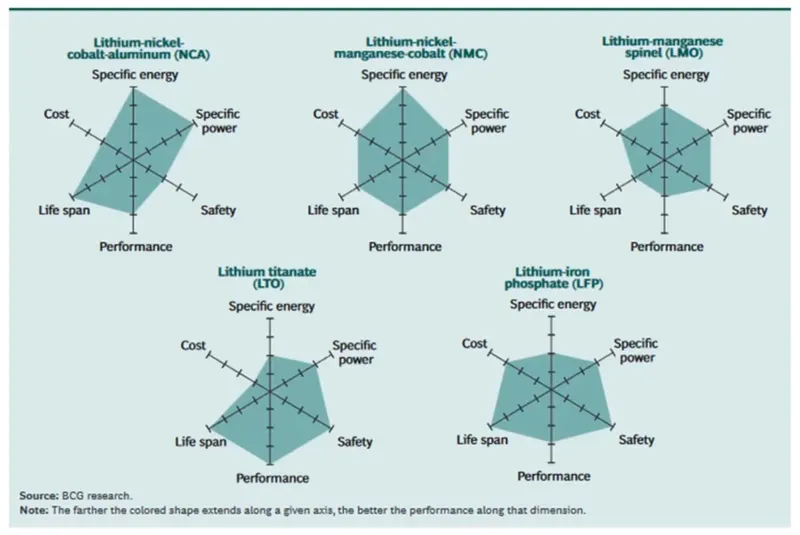
2.Difference between all the lithium Ion Batteries:
|
Lithium-ion battery Types |
Specific power |
Specific energy |
Safety |
Lifespan |
Cost |
Performance |
|
Lithium Cobalt Oxide |
Low |
High |
Low |
Low |
Low |
Medium |
|
Lithium Manganese Oxide |
Medium |
Medium |
Medium |
Low |
Low |
Low |
|
Lithium Nickel Manganese Cobalt Oxide |
Medium |
High |
Medium |
Medium |
Low |
Medium |
|
Lithium Iron Phosphate |
High |
Low |
High |
High |
Low |
Medium |
|
Lithium Nickel Cobalt Aluminium Oxide |
Medium |
High |
Low |
Medium |
Medium |
Medium |
|
Lithium Titanate |
Medium |
Low |
High |
High |
High |
High |
This difference can be very well understood by the figure given below: