Week 1 Understanding Different Battery Chemistry
Aim:-
To understand different battery chemistry.
Objective:-
1) Prepare a table which includes materials & chemical reactions occurring at the anode and cathode of LCO, LMO, NCA, NMC, LFP and LTO type of lithium ion cells. Give your detailed explanation on it
2) Compare the differences between each type of Li+ion batteries based on their characteristics.
Answer [1]:-
Different types of lithium ion battery are:-
- Lithium Cobalt Oxide (LCO)
- Lithium-ion Manganese oxide (LMO)
- Lithium Nickel Cobalt Aluminum oxide (NCA)
- Lithium Nickel Manganese Cobalt oxide (NMC)
- Lithium Iron Phosphate (LFP)
- Lithium Titanate (LTO)
1) Lithium cobalt oxide (LCO):-
Lithium cobalt oxide (LCO) batteries have high specific energy but low specific power. This means that they do not perform well in high-load applications, but they can deliver power over a long period.
They are used for:-
LCO batteries were common in small portable electronics such as mobile phones, tablets, laptops, and cameras. However, they are losing popularity to other types of lithium batteries due to the high cost of cobalt and concerns around safety.
Benefits:-
The key benefit to LCO batteries is their high specific energy. This allows them to deliver power over a relatively long period under low-load applications.
Drawbacks:-
LCO batteries have some significant drawbacks resulting in them becoming less popular in recent years. First, LCO batteries suffer from a relatively short lifespan, usually between 500-1,000 cycles. Additionally, cobalt is fairly expensive. Expensive batteries that don’t last a long time are not cost-effective.
LCO batteries also have low thermal stability, which leads to safety concerns. Furthermore, their low specific power limits the ability of LCO batteries to perform in high-load applications.
2) Lithium Manganese Oxide (LMO):-
Lithium Manganese Oxide (LMO) batteries use lithium manganese oxide as the cathode material. This chemistry creates a three-dimensional structure that improves ion flow, lowers internal resistance, and increases current handling while improving thermal stability and safety.
They are used for:-
LMO batteries are commonly found in portable power tools, medical instruments, and some hybrid and electric vehicles.
Benefits:-
LMO batteries charge quickly and offer high specific power. This means they can deliver higher current than LCO batteries, for example. They also offer better thermal stability than LCO batteries, meaning they can operate safely at higher temperatures.
One other benefit to LMO batteries is their flexibility. Tuning the internal chemistry allows LMO batteries to be optimized to handle high-load applications or long-life applications.
Drawbacks:-
The main downside to LMO batteries is their short lifespan. Typically, LMO batteries will last 300-700 charge cycles, significantly fewer than other lithium battery types.
3) Lithium nickel cobalt aluminum oxide (NCA):-
Lithium nickel cobalt aluminum oxide (NCA) batteries offer high specific energy with decent specific power and a long lifecycle. This means they can deliver a relatively high amount of current for extended periods.
They are used for:-
The ability to perform in high-load applications with a long battery life makes NCA batteries popular in the electric vehicle market. Specifically, NCA is the battery of choice for Tesla.
Benefits:-
The biggest benefits of NCA batteries are high energy and a decent lifespan.
Drawbacks:-
With NCA technology, the batteries aren’t as safe as most other lithium technologies and are expensive in comparison.
4) Lithium Nickel Manganese Cobalt oxide(NMC):-
Lithium nickel manganese cobalt oxide (NMC) batteries combine the benefits of the three main elements used in the cathode: nickel, manganese, and cobalt. Nickel on its own has high specific energy but is not stable. Manganese is exceptionally stable but has a low specific energy. Combining them yields a stable chemistry with a high specific energy.
They are used for:-
Similar to LMO batteries, NMC batteries are popular in power tools as well as electronic powertrains for e-bike, scooters, and some electric vehicles.
Benefits:-
The benefits of NMC batteries include high energy density and a longer lifecycle at a lower cost than cobalt-based batteries. They also have higher thermal stability than LCO batteries, making them safer overall.
Drawbacks:-
The major drawback to NMC batteries is that they have a slightly lower voltage than cobalt-based batteries.
5) Lithium lron Phosphate (LFP):-
Lithium lron Phosphate (LFP) batteries use phosphate as the cathode material and a graphitic carbon electrode as the anode. LFP batteries have a long life cycle with good thermal stability and electrochemical performance.
They are used for:-
LFP battery cells have a nominal voltage of 3.2 volts, so connecting four of them in series results in a 12.8-volt battery. This makes LFP batteries the most common type of lithium battery for replacing lead-acid deep-cycle batteries.
Benefits:-
There are quite a few benefits to lithium iron phosphate batteries that make them one of the most popular options for applications requiring a large amount of power. The primary benefits, however, are durability, a long life cycle, and safety.
LFP batteries typically have a lifecycle rating of 2,000 cycles or more. Unlike lead-acid batteries, depth of discharge has a minimal impact on the lifespan of LFP batteries. Most LFP manufacturers rate their batteries at 80% depth of discharge, and some even allow 100% discharging without damaging the battery.
The materials used in lithium iron phosphate batteries offer low resistance, making them inherently safe and highly stable. The thermal runaway threshold is about 518 degrees Fahrenheit, making LFP batteries one of the safest lithium battery options, even when fully charged.
Drawbacks:-
There are a few drawbacks to LFP batteries. The first is that compared to other lithium battery types, they have a relatively low specific energy. Their performance can also suffer in low temperatures. Combining the low specific energy and reduced performance in cold temperatures means LFP batteries may not be a great fit in some high cranking applications.
6) Lithium Titanate (LTO):-
Lithium titanate (LTO) batteries replace the graphite in the anode with lithium titanate and use LMO or NMC as the cathode chemistry. The result is an extremely safe battery with a long lifespan that charges faster than any other lithium battery type.
They are used for:-
Many applications use LTO batteries. Electric vehicles and charging stations, uninterrupted power supplies, wind and solar energy storage, solar street lights, telecommunications systems, and aerospace and military equipment are just some of the use cases.
Benefits:-
LTO batteries offer many benefits, including fast charging, an extremely wide operating temperature, a long lifespan, and superb safety because of their stability.
Drawbacks:-
There are a couple of significant hurdles for LTO batteries to overcome. They offer low energy density, which means it stores a lower amount of energy relative to its weight when compared to some other lithium technologies. Additionally, they are very expensive.
- Table which includes materials & chemical reactions occurring at the anode and cathode of different types of lithium ion cells is:-
| MATERIALS AND CHEMICAL REACTIONS IN DIFFERENT TYPES OF Li-Ion CELLS | ||||||
| BATTERY TYPE | CATHODE | ANODE | ELECTROLYTE | CATHODE REACTION | ANODE REACTION | |
| SALT | SOLVENT | |||||
| Lithium Cobalt Oxide (LCO) | Lithium Cobalt oxide | Graphite(C) | Lithium hexafluorophosphate |
Ethylene Carbonate |
CoO2 + Li+ + e- ↔ LiCoO2 | LiC6 ↔ C6 + Li+ + e- |
| Lithium-ion Manganese oxide (LMO) | Lithium Manganese Oxide | Graphite(C) | Lithium hexafluorophosphate | Ethylene Carbonate |
MnO2 + Li+ + e- ↔ LiMnO2 |
LiC6 ↔ C6 + Li+ + e- |
| Lithium Nickel Cobalt Aluminum oxide (NCA) | Lithium Nickel Cobalt Aluminum oxide | Graphite(C) | Lithium hexafluotophosphate | Ethylene Carbonate |
NiCoAlO2 + Li+ + e- ↔ LiNiCoAlO2 |
LiC6 ↔ C6 + Li+ + e- |
| Lithium Nickel Manganese Cobalt oxide(NMC) | Lithium Nickel Mansanese Cobalt Oxide |
Graphite(C) | Lithium hexafluorophosphate | Ethylene Carbonate |
NiMnCoO2 + Li+ + e- ↔ LiNiMnCoO2 |
LiC6 ↔ C6 + Li+ + e- |
| Lithium lron Phosphate (LFP) | lithium Iron Phosphate | Graphite(C) | Lithium hexafluorophosphate | Ethylene Carbonate |
FePO4 + Li+ + e- ↔ LiFePO4 |
LiC6 ↔ C6 + Li+ + e- |
| Lithium Titanate (LTO) | Lithium Manganese Oxide | Titanate | Lithium hexafluorophosphate | Ethylene Carbonate |
MnO2 + Li+ +e- ↔ LiMnO2 |
Li4Ti5O12 ↔ Ti5O12 + 4Li+ + 4e- |
Answer [2]:-
Compare the differences between each type of Li+ion batteries based on their characteristics:-
There are different types of lithium-ion batteries and the main difference between them lies in their cathode materials. Different kinds of lithium-ion batteries offer different features, with trade-offs between specific power, specific energy, safety, lifespan, cost, and performance.
Before choosing the type of battery there are some points to be considered which affects the battery performance and these points are:-
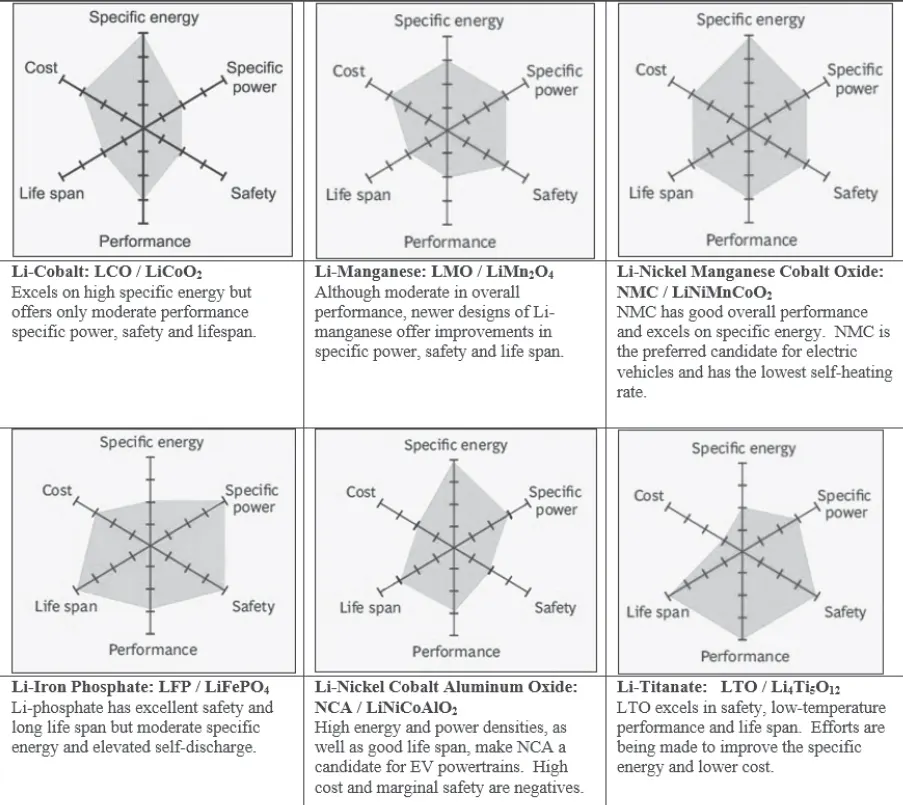
- Specific energy: This defines the battery capacity in weight (Wh/kg). The capacity relates to the runtime. Products requiring long runtimes at moderate load are optimized for high specific energy.
- Specific power: It's the ability to deliver a high current and indicates loading capability. Batteries for power tools are made for high specific power and come with a reduced specific energy.
- Performance: This measures how well the battery works over a wide range of temperatures. Most batteries are sensitive to heat and cold and require climate control. Heat reduces life, and cold lowers performance temporarily.
- Lifespan: This reflects cycle life and longevity and is related to factors such as temperature, depth of discharge, and load. Hot climates accelerate capacity loss. Cobalt blended lithium-ion batteries also usually have a graphite anode that limits the cycle life.
- Safety: This relates to factors such as the thermal stability of the materials used in the batteries. The materials should have the ability to sustain high temperatures before becoming unstable. Instability can lead to thermal runaway in which flaming gases are vented. Fully charging the battery and keeping it beyond the designated age reduces safety.
- Cost: Demand for electric vehicles has generally been lower than anticipated and this is mainly due to the cost of lithium-ion batteries. Hence cost is a huge factor when selecting the type of lithium-ion battery.
The table below provides a simple comparison of the six lithium-ion battery types based on characteristics:-
| Lithium-ion battery Types | Specific Power | Specific Energy | Safety | Lifespan | Cost | Performance |
|---|---|---|---|---|---|---|
|
Lithium Cobalt Oxide |
Low |
High |
Low |
Low | Low |
Moderate |
|
Lithium Manganese Oxide |
Moderate |
Moderate | Moderate |
Low |
Low | Low |
|
Lithium Nickel Manganese Cobalt Oxide |
Moderate |
High |
Moderate |
Moderate |
Low |
Moderate |
|
Lithium Iron Phosphate |
High |
Low |
High |
High |
Low |
Moderate |
|
Lithium Nickel Cobalt Aluminum Oxide |
Moderate |
High |
Low |
Moderate |
Moderate |
Moderate |
|
Lithium Titanate |
Moderate |
Low |
High |
High | High | High |
Conclusion:-
Thus we learnt the different types of lithium ion batteries with its chemical reactions occurring at anode and cathode and its characteristics.