Week 1 Understanding Different Battery Chemistry
Week 1 Challenge : Understanding different Battery Chemistry
Q1.Prepare a table which includes materials & chemical reactions occurring at the anode and cathode of LCO, LMO, NCA, NMC, LFP and LTO type of lithium ion cells.Give your detailed explanation on it
Soln:
Lithium-ion batteries are a type of Secondary or Rechargeable batteries. Lithium-ion batteries are ubiquitous in our everyday lives. They are commonly used in portable electronic devices like mobile phones, tablets, cameras, laptops, power banks etc. They are also deployed in power tools, UPS, Electric Vehicles, aerospace applications and much more.
A lithium-ion (Li-ion) battery is an advanced battery technology that uses lithium ions as a key component of its electrochemistry. During a discharging, lithium atoms in the anode are ionized and separated from their electrons. The lithium ions move from the anode and pass through the electrolyte until they reach the cathode, where they combine with their electrons and electrically neutralize. Reverse happens in the events of charging.
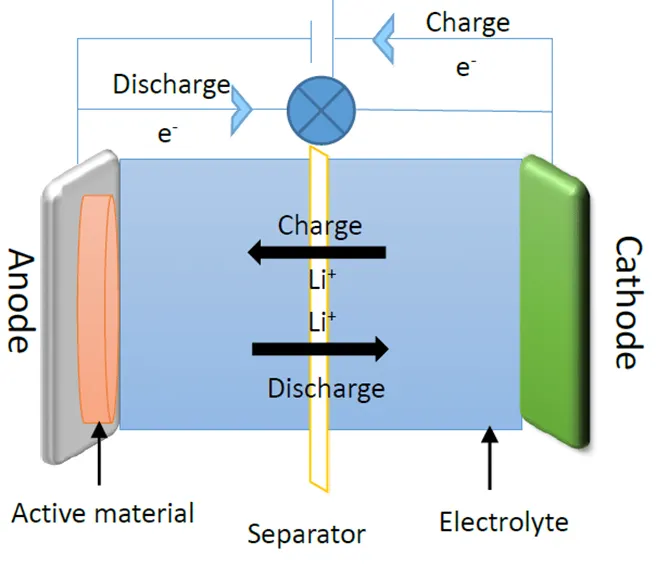
Because of lithium’s small size Li-ion batteries are capable of having a very high voltage and charge storage per unit mass and unit volume. There are several types of lithium-ion batteries. The main difference between them is their cathode chemistry. The different types of li-on batteries along with their chemical reactions are listed below in the table -
|
Sl no. |
Types of Li-ion Cell |
Anode |
Cathode |
Cell reaction |
Application |
|
1 |
Lithium Cobalt Oxide(LiCoO2) - LCO |
Graphite |
Cobalt Oxide |
Cathode half- reaction: CoO2 + Li+ + e- ⇌ LiCoO2 Anode half-reaction: LiC6 ⇌C6 + Li++ e- Full reaction: LiC6 + CoO2 ⇌ C6 + LiCoO2 |
Mobile Phones, Tablets, Laptop, Cameras |
|
2 |
Lithium Manganese Oxide(LiMn2O4) – LMO |
Graphite |
Manganese Oxide |
Cathode half- reaction: Mn2O4 + Li+ +e- ⇌ LiMn2O4 Anode half-reaction: LiC6⇌ C6+Li++e‑ Full reaction: LiC6+Mn2O4⇌C6+LiMn2O4 |
Power Tools, Medical Devices, Electric Powertrains |
|
3 |
Lithium Nickel Cobalt Aluminium Oxide (LiNiCoAlO2) – NCA |
Graphite |
Nickel Cobalt Aluminium Oxide |
Cathode half- reaction: NiCoAlO2+Li++e-⇌ LiNiCoAlO2 Anode half-reaction: LiC6⇌C6+Li++e- Full reaction: LiC6+ NiCoAlO2⇌ C6+ LiNiCoAlO2 |
Medical devices, industrial, electric powertrain (Tesla) |
|
4 |
Lithium Nickel Manganese Cobalt Oxide (LiNiMnCoO2) - NMC |
Graphite |
Nickel Manganese Cobalt Oxide |
Cathode half- reaction: NiMnCoO2+Li++e-⇌LiNiMnCoO2 Anode half-reaction: LiC6⇌ C6+Li++e- Full reaction: LiC6+ NiMnCoO2 ⇌ C6+ LiNiMnCoO2 |
E-bikes, medical devices, EV, industrial |
|
5 |
Lithium Iron Phosphate (LiFePO4) - LFP |
Graphite |
Iron Phosphate |
Cathode half- reaction: FePO4+Li++e-⇌ LiFePO4 Anode half-reaction: LiC6⇌ C6+Li++e- Full reaction: FePO4+ LiC6⇌ C6+ LiFePO4 |
Portable and stationary needing high load currents and endurance |
|
6 |
Lithium Titanate (Li2TiO3) - LTO |
Lithium Titanate (Li2TiO3) |
Manganese Oxide Or NMC |
Cathode half- reaction: Mn2O4+Li++e-⇌ LiMn2O4 Anode half-reaction: Li2TiO3⇌ TiO3+2Li++2e- Full reaction: 2 Mn2O4+Li2TiO3⇌ TiO3+ 2LiMn2O4 |
UPS, electric powertrain (Mitsubishi i-MiEV, Honda Fit EV), solar-powered street lighting |
Q2.Compare the differences between each type of Li-ion batteries based on their characteristics.
Soln:
The characteristics of each types of Li-ion battery is tabulated and compared below-
|
Battery Type |
Voltages |
Specific energy (capacity) |
Charge (C-rate) |
Discharge (C-rate) |
Cycle life |
Thermal runaway |
|
Lithium Cobalt Oxide - LCO |
3.60V nominal; typical operating range 3.0–4.2V/cell |
150–200Wh/kg. Specialty cells provide up to 240Wh/kg. |
0.7–1C, charges to 4.20V (most cells); 3h charge typical. Charge current above 1C shortens battery life. |
1C; 2.50V cut off. Discharge current above 1C shortens battery life. |
500–1000, related to depth of discharge, load, temperature |
150°C (302°F). Full charge promotes thermal runaway |
|
Lithium Manganese Oxide - LMO |
3.70V (3.80V) nominal; typical operating range 3.0–4.2V/cell |
100–150Wh/kg |
0.7–1C typical, 3C maximum, charges to 4.20V (most cells) |
1C; 10C possible with some cells, 30C pulse (5s), 2.50V cut-off |
300–700 (related to depth of discharge, temperature) |
250°C (482°F) typical. High charge promotes thermal runaway |
|
Lithium Nickel Manganese Cobalt Oxide - NMC |
3.60V, 3.70V nominal; typical operating range 3.0–4.2V/cell, or higher |
150–220Wh/kg |
0.7–1C, charges to 4.20V, some go to 4.30V; 3h charge typical. Charge current above 1C shortens battery life. |
1C; 2C possible on some cells; 2.50V cut-off |
1000–2000 (related to depth of discharge, temperature) |
210°C (410°F) typical. High charge promotes thermal runaway |
|
Lithium Iron Phosphate - LPF |
3.20, 3.30V nominal; typical operating range 2.5–3.65V/cell |
90–120Wh/kg |
1C typical, charges to 3.65V; 3h charge time typical |
1C, 25C on some cells; 40A pulse (2s); 2.50V cut-off (lower that 2V causes damage) |
2000 and higher (related to depth of discharge, temperature) |
270°C (518°F) Very safe battery even if fully charged |
|
Lithium Nickel Cobalt Aluminium Oxide - NCA |
3.60V nominal; typical operating range 3.0–4.2V/cell |
200-260Wh/kg; 300Wh/kg predictable |
0.7C, charges to 4.20V (most cells), 3h charge typical, fast charge possible with some cells |
1C typical; 3.00V cut-off; high discharge rate shortens battery life |
500 (related to depth of discharge, temperature) |
150°C (302°F) typical, High charge promotes thermal runaway |
|
Lithium Titanate -LTO |
2.40V nominal; typical operating range 1.8–2.85V/cell |
50–80Wh/kg |
1C typical; 5C maximum, charges to 2.85V |
10C possible, 30C 5s pulse; 1.80V cut-off on LCO/LTO |
3,000–7,000 |
One of safest Li-ion batteries |
From the above table it can be observed that NMC has good overall performance and excels on specific energy. It is well suited for the electric vehicle application and has the lowest self-heating rate.