Week 1 Understanding Different Battery Chemistry
Challenge Title: Understanding Different Battery Chemistry.
Aim: The following challenge has 2 exercises:
1.Prepare a table which includes materials & chemical reactions occurring at the anode and cathode of LCO, LMO, NCA, NMC, LFP and LTO type of lithium ion cells.Give your detailed explanation on it
2.Compare the differences between each type of Li+ion batteries based on their characteristics
Software Used: MS Word.
Solution:
- Prepare a table which includes materials & chemical reactions occurring at the anode and cathode of LCO, LMO, NCA, NMC, LFP and LTO type of lithium ion cells.Give your detailed explanation on it.
Lithium-ion battery technology has become very important in recent years as these batteries promise power and energy sources applicable for energy storage or power backup systems. Long cycling life, high energy efficiency and fast charge are among the advantages of this technology.
There are several technologies for lithium-ion cells: lithium iron phosphate (LFP), lithium nickel manganese cobalt oxide (NMC), lithium nickel cobalt aluminium oxide (NCA), lithium cobalt oxide (LCO), lithium titanate (LTO), lithium manganese oxide (LMO). The positive plate (cathode) has metal oxides compounds and the negative plate (anode) with graphite. Selection of any of these technologies will depend on the requirements of energy, power, cycle life etc.
|
Lithium-ion cell type |
Anode |
Cathode |
Overall Reaction |
|
Lithium Cobalt Oxide (LCO) |
Anode Material: Graphite. At the anode, lithium is oxidised. Lithium ions are released from the carbon, along with electrons: LiC6 → Li+ + e− + C6 |
Cathode Material: Lithium Cobalt Oxide (LiCoO2). At the cathode, lithium-ions are absorbed by the Cobalt dioxide, and the electrode is reduced as it also receives the electrons from the circuit: MnO2 + Li+ + e− → LiCoO2 |
LiC6 + CoO2 ⟷ C6 + LiCoO2 Left to right reaction: Charging. Right to left reaction: Discharging. |
|
Lithium Manganese Oxide (LMO) |
Anode Material: Graphite. At the anode, lithium is oxidised. Lithium ions are released from the carbon, along with electrons: LiC6 → Li+ + e− + C6 |
Cathode Material: Lithium Manganese Oxide (LiMnO2). At the cathode, lithium-ions are absorbed by the Manganese dioxide, and the electrode is reduced as it also receives the electrons from the circuit: CoO2 + Li+ + e− → LiCoO2 |
LiC6 + MnO2 ⟷ C6 + LiMnO2 Left to right reaction: Charging. Right to left reaction: Discharging. |
|
Lithium Nickel Cobalt Aluminium Oxide (NCA) |
Anode Material: Graphite. At the anode, lithium is oxidised. Lithium ions are released from the carbon, along with electrons: LiC6 → Li+ + e− + C6 |
Cathode Material: Lithium Nickel Cobalt Aluminium Oxide (LiNi0.8Co0.15Al0.05O2) At the cathode, lithium-ions are absorbed by the Nickel Cobalt Aluminium Oxide, and the electrode is reduced as it also receives the electrons from the circuit: Ni0.8Co0.15Al0.05O2 + Li+ + e− → LiNi0.8Co0.15Al0.05O2 |
LiC6 + Ni0.8Co0.15Al0.05O2 ⟷ C6 + LiNi0.8Co0.15Al0.05O2 Left to right reaction: Charging. Right to left reaction: Discharging. |
|
Lithium Nickel Manganese Cobalt Oxide (NMC) |
Anode Material: Graphite. At the anode, lithium is oxidised. Lithium ions are released from the carbon, along with electrons: LiC6 → Li+ + e− + C6
|
Cathode Material: Lithium Nickel Manganese Cobalt Oxide (LiNi0.8Mn0.1Co0.1O2). At the cathode, lithium-ions are absorbed by the Nickel Manganese Cobalt Oxide, and the electrode is reduced as it also receives the electrons from the circuit: Ni0.8Mn0.1Co0.1O2+ Li+ + e− → LiNi0.8Mn0.1Co0.1O2 |
LiC6 + Ni0.8Mn0.1Co0.1O2⟷ C6 + LiNi0.8Mn0.1Co0.1O2 Left to right reaction: Charging. Right to left reaction: Discharging
|
|
Lithium Iron Phosphate (LFP) |
Anode Material: Graphite. At the anode, lithium is oxidised. Lithium ions are released from the carbon, along with electrons: LiC6 → Li+ + e− + C6 |
Cathode Material: Lithium Iron Phosphate (LiFePO4). At the cathode, lithium ions are absorbed by the Iron Phosphate, and the electrode is reduced as it also receives the electrons from the circuit: FePO4 + Li+ + e− → LiFePO4 |
The overall reaction is: LiC6 + FePO4 ⟷ LiFePO4 + C6 Left to right reaction: Charging. Right to left reaction: Discharging |
|
Lithium Titanate (LTO). |
Anode Material: Lithium Titanate (Li4Ti5O12) Lithium ions are released from the Lithium Titanate, along with electrons: Li4Ti5O12 → 4Li+ + 4e− + Ti5O12 |
Cathode Material: Manganese (III,IV) Oxide (Mn2O4) At the cathode, lithium ions are absorbed by the Manganese (III,IV) Oxide, and the electrode is reduced as it also receives the electrons from the circuit: 4Mn2O4 + 4Li+ + 4e− → 4LiMn2O4 |
Li4Ti5O12 + 4Mn2O4 ⟷ 4LiMn2O4 + Ti5O12 Left to right reaction: Charging. Right to left reaction: Discharging
|
- Compare the differences between each type of Li+ion batteries based on their characteristics
The following image shows the differences between each type of Lithium-ion cell:
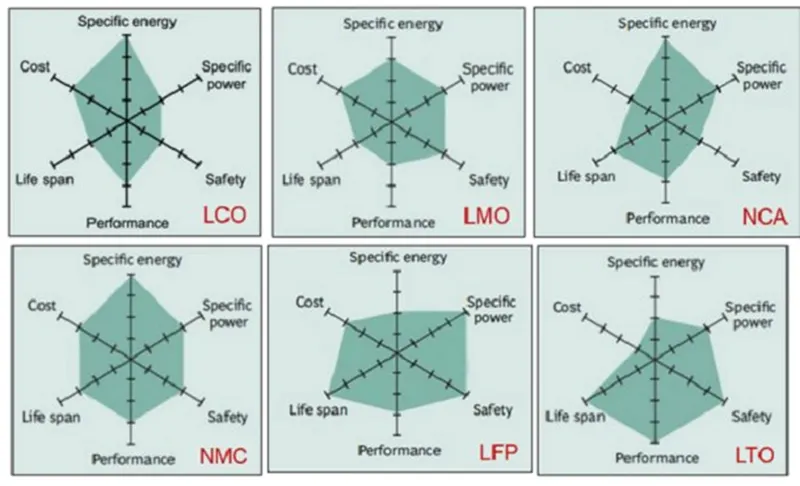
All the cells are classified using 6 classifications i.e., Energy, Power, Safety, Performance, Life Span and Total Cost. The higher the cost indicator, the lower the cost of the cells.
LCO cell has the highest specific energy of 150-190 Wh/kg compared to NCA and NMC of 120-150 Wh/kg and 100-135 Wh/kg and rest are comparatively lower, it also has less cost compared to other cells.
LFP offers the least resistance to electric current, therefore it generates the most specific power compared to other cells.
LTO cells are safest, highest performing and has the highest lifespan compared to other cells.
Considering all the factors, NMC is the most satisfying cell which has better specific energy and average points in all other factors.