Week 1 Understanding Different Battery Chemistry
1.Prepare a table which includes materials & chemical reactions occurring at the anode and cathode of LCO, LMO, NCA, NMC, LFP and LTO type of lithium ion cells.Give your detailed explanation on it
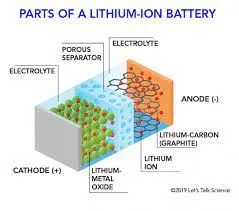
| Battery Type | cathode | anode | Carrier | Chemical reaction | Nominal Voltage | Applications | |
| LCO | Lithium Cobalt Oxide | Graphite carbon | Lithium ions |
`C_6+LiCoO_2⟷Li_xC_6+Li_(1−x)CoO_2` |
3.6V |
|
|
| LMO | Lithium Manganese oxide | Graphite | Lithium ions | `LiMn_2O_4+C_6 harr LiC_6+ Mn_2O_4` | 3.7V | Power tools, medical devices, electric powertrains | |
| NCA | Lithium Nickel Cobalt Aluminium Oxide | Graphite | Lithium ions | `LiNiCoAlO_2+C_6 harr LiC_6+ NiCoAlO_2` | 3.6V | Medical devices, industrial, electric powertrain (Tesla) | |
| NMC | Lithium Nickel manganese cobalt oxide | Graphite | Lithium Ions | `LiNi_0.8Mn_0.1Co_0.1O_2+C_6 harr LiC_6 + Ni_0.8Mn_0.1Co_0.1O_2` | 3.7V |
|
|
| LFP | Lithium Iron Phosphate | Graphite | Lithium ions | `LiFePO_4+6C→LiC_6+FePO_4` | 3.3V | Portable and stationary needing high load currents and endurance | |
| LTO | Lithium Manganese Oxide | Titanate | Lithium ions | `Li_4Ti_5O_12+ 4Mn_2O_4 harr 4LiMn_2O_4+Ti_5O_12` | 2.4V | UPS, electric powertrain (Mitsubishi i-MiEV, Honda Fit EV), solar-powered street lighting |
2.Compare the differences between each type of Li+ion batteries based on their characteristics
Lithium Cobalt Oxide(LiCoO2) — LCO
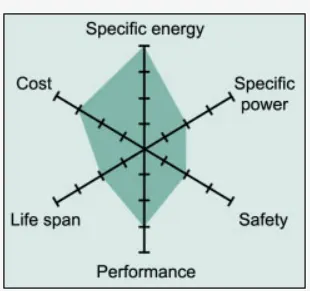
It has very high specific energy but limited specific power. Cobalt is expensive. Serves as Energy Cell. Market share has stabilized.
Early version, it is no longer relevant.
Lithium Manganese Oxide (LiMn2O4) — LMO
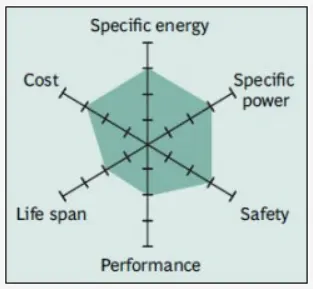
It has high power but less capacity. It is safer than Li-cobalt battery. It is commonly mixed with NMC to improve performance.
Less relevant now, has limited growth potential.
Lithium Nickel Manganese Cobalt Oxide (LiNiMnCoO2) — NMC
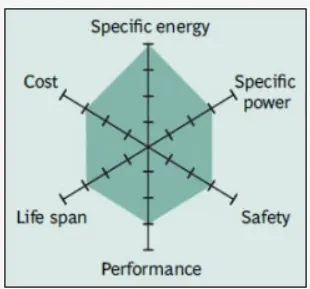
It provides high capacity and high power. Serves as Hybrid Cell. Favorite chemistry for many uses. It's market share is increasing.
Leading system due to dominant cathode chemistry.
Lithium Iron Phosphate(LiFePO4) — LFP
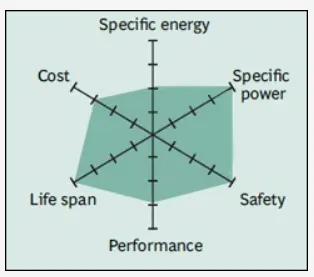
It has very flat voltage discharge curve but low capacity. One of safest Li-ion batteries.
It is used for special markets. It has elevated self-discharge.
Used primarily for energy storage, has moderate growth.
Lithium Nickel Cobalt Aluminum Oxide (LiNiCoAlO2) — NCA
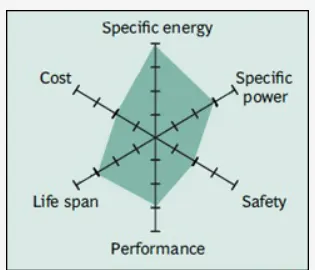
It shares similarities with Li-cobalt batteries. Serves as Energy Cell.
Mainly used by Panasonic and Tesla, has growth potential.
Lithium Titanate (Li2TiO3) — LTO
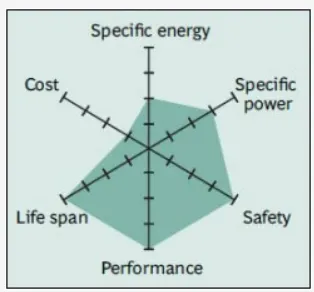
It has Long life, is fast charging, has wide temperature range but low specific energy and is expensive.
It is among the safest Li-ion batteries.
It has ability to ultra-fast charge but its high cost limits it to special application.