Week 1 Understanding Different Battery Chemistry
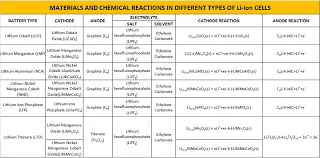
1.Prepare a table which includes materials & chemical reactions occurring at the anode and cathode of LCO, LMO, NCA, NMC, LFP and LTO type of lithium ion cells.Give your detailed explanation on it
Li-ion Batteries:
A lithium-ion battery is li-ion battery is a type of rechargable battery.Lithium -ion battery are commonly used for portable electronics and electric vehicles and are growing in popularity for military and aerospace applications.
Similar to the lead and nickel based architecture,lithium ion uses a cathode (positive electrode),an anode(negative electrode) and electrolyte as conductor.The cathode is a metal oxide and the anode consists of porous carbon.During the discharge the ions flows from the anode to cathode through the electrolyte and seperator charge reverses the direction and the ions flow from the cathode to the anode.
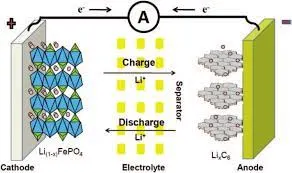
This figure gives the process of charge and discharge
Types of Lithium ion cells:
Lithium Cobalt Oxide(LiCoO2)-LCO:
Its a high specific energy makes Li-cobalt the popular choice for mobile phones,laptops and digital cameras.The battery consists of a cobalt oxide cathode and a graphite carbon anode.The cathode has a layered structure and during discharge ,lithium ions move from the anode to the cathode.The flow reverses on charge.The drawback of Li-cobalt is a relatively short life span , low thermal stability and limited load capabilites(specific power).
Lithium Manganese Oxide(LiMn2O4)-LMO:
Li-ion with manganese spinel was first published in the materials research bulletin in 1983.In addition to containing inexpensive materials, the three-dimensional structure of LiMn2O4 lends itself to high rate capability by providing a well connected framework for the insertion and de-insertion of Li+ ions during discharge and charge of the battery.In particular, the Li+ions occupy the tetrahedral sites within the Mn2O4 polyhedral frameworks adjacent to empty octahedral sites.As a consequence of this structural arrangement, batteries based on LiMn2O4 cathodes have demonstrated a higher rate-capability compared to materials with two-dimensional frameworks for Li+
diffusion.
The disadvantage of cathodes based on LiMn2O4 is the surface degradation observed when the average oxidation state of the manganese drops below Mn+3.5.
Lithium Nickel Cobalt Aluminium Oxide(LiNiCoAlO2)-NCA:
Lithium Nickel cobalt aluminium oxide battery has been around since 1999 for special applications.It shares similarities with NMC by offering high specific energy,reasonably good specific power and a long life span.Less flattering are safety and cost.NCA is a further development of lithium nickel oxide adding aluminium gives the chemistry greater stability.
Lithium Nickel Manganese Cobalt Oxide(LiNiMnCoO2)-NMC:
One of the most successful Li-ion systems is a cathode combination of nickel -manganese-cobalt(NMC).Similar to Li-manganese,these system can be tailored to serve as energy cells or power cells.Ex:NMC in an 18650 cell for moderate load condition has a capacity of about 2,800mAh and can deliver 4A to 5A ,NMC in the same cell optimized for specific power has a capacity of only about 2,000mAh but delivers a continuous discharge current of 20A.
Lithium Iron Phosphate(LiFePO4)-LFP:
Li-phosphate offers good electrochemical performance with low resistance.This is made possible with nano scale phosphate cathode material.The key benefits are high current rating and long cycle life,besides good thermal stability,enhanced safety and tolerance if abused.Loi phosphate is more tolerate to full charge conditions and is less stressed than other lithium ion system if kept at high voltage for a prolonged time.As a trade off its lower nominal voltage of 3.2V/cell reduces the specific energy below that of cobalt-blended lithium-ion.
Lithium Titanate(Li2TiO3)-LTO:
Batteries with lithium titanate anodes have been known since the 1980s.Li-titanate replaces the graphite in the anode of a typical lithium ion battery and the material forms into a spinel structure.The cathode can be lithium manganese oxide or NMC.Li titanate has a niominal cell voltage of 2.40V ,can be fast charged and delivers a high discharge current of 10C, or 10 times the rated capacity.The cycle count is said to be higher than that of a regular Li-ion.Li titanate is safe,has excellent low temperature discharge characteristics and obtains a capacity of 80 %-30'C.
The materials & chemical reactions occuring at the anode,cathode and overall reactions of all the types of Li-ion cvells are given in the table below:
2.Compare the differences between each type of Li+ion batteries based on their characteristics
Specific energy: This defines the battery capacity in weight (Wh/kg). The capacity relates to the runtime. Products requiring long runtimes at moderate load are optimized for high specific energy.
Specific power: It's the ability to deliver a high current and indicates loading capability. Batteries for power tools are made for high specific power and come with a reduced specific energy.
A high specific power usually comes with reduced specific energy and vice versa. The pouring of bottled water in a glass is a perfect analogy of the relationship between specific power and specific energy.
Performance: This measures how well the battery works over a wide range of temperatures. Most batteries are sensitive to heat and cold and require climate control. Heat reduces life, and cold lowers performance temporarily.
Lifespan: This reflects cycle life and longevity and is related to factors such as temperature, depth of discharge, and load. Hot climates accelerate capacity loss. Cobalt blended lithium-ion batteries also usually have a graphite anode that limits the cycle life.
Safety: This relates to factors such as the thermal stability of the materials used in the batteries. The materials should have the ability to sustain high temperatures before becoming unstable. Instability can lead to thermal runaway in which flaming gases are vented. Fully charging the battery and keeping it beyond the designated age reduces safety.
Cost: Demand for electric vehicles has generally been lower than anticipated and this is mainly due to the cost of lithium-ion batteries. Hence cost is a huge factor when selecting the type of lithium-ion battery.
Conclusion:
As we discussed the types and characteristics of the Lithium ion battery.