Week 1 Understanding Different Battery Chemistry
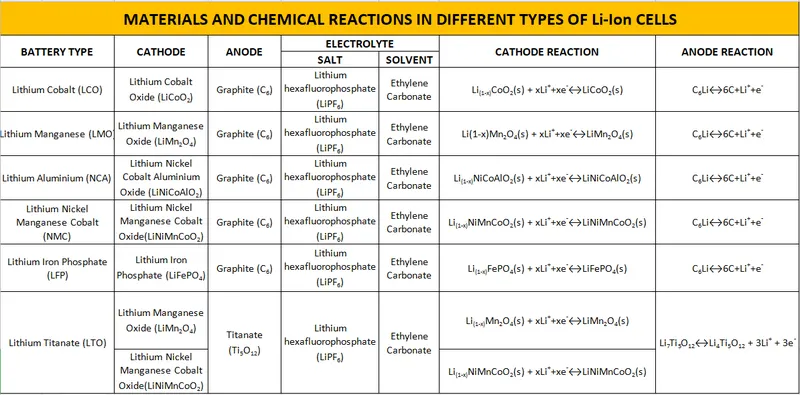
1. Prepare a table that includes materials & chemical reactions occurring at the anode and cathode of LCO, LMO, NCA, NMC, LFP and LTO type of lithium-ion cells. Give your detailed explanation on it
2. Compare the differences between each type of Li+ion batteries based on their characteristics
Explanation
Lithium-ion Battery
A lithium-ion (Li-ion) battery is an advanced battery technology that uses lithium ions as a key component of its electrochemistry. During a discharge cycle, lithium atoms in the anode are ionized and separated from their electrons. The lithium ions move from the anode and pass through the electrolyte until they reach the cathode, where they recombine with their electrons and electrically neutralize. The lithium ions are small enough to be able to move through a micro-permeable separator between the anode and cathode. In part because of lithium’s small size (third only to hydrogen and helium), Li-ion batteries are capable of having a very high voltage and charge storage per unit mass and unit volume.
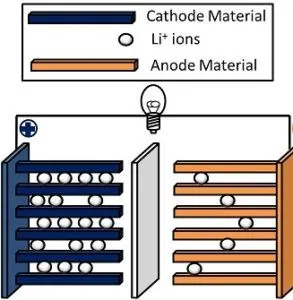
Li-ion batteries can use several different materials as electrodes. The most common combination is that of lithium cobalt oxide (cathode) and graphite (anode), which is most commonly found in portable electronic devices such as cellphones and laptops. Other cathode materials include lithium manganese oxide (used in hybrid electric and electric automobiles) and lithium iron phosphate. Li-ion batteries typically use ether (a class of organic compounds) as an electrolyte.
Components of Li-ion Cell
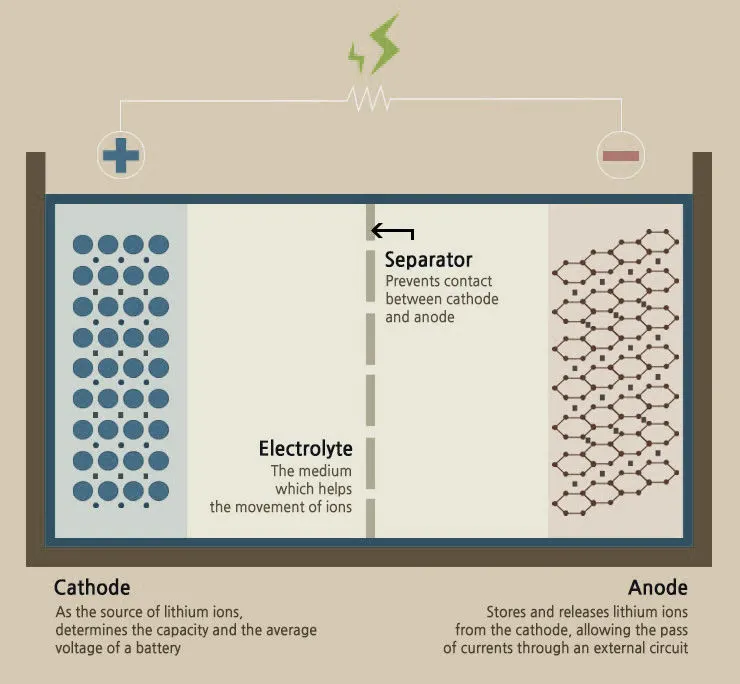
Like any other cell, Li-ion cells are also made up of different components. These internal components help in shaping the features and other characteristics of a Li-ion cell. The Li-ion cell has 4 main components that are Cathode, Anode, Electrolyte, and Separator. The image below shows the different components of a Li-ion cell.
Cathode:
The material used in the cathode determines the capacity and voltage of the Li-ion battery. This material is called the active material. The active material plays a crucial role in the chemical reaction in the battery which causes the flow of current. The capacity of a cell depends on the size of the active material at the cathode, i.e. for the higher capacity of the cell, we need to have bigger cathodes. Meanwhile, the voltage of the cathode depends on the element used as a cathode.
The nomenclature of the battery usually depends on the cathode, like a Lithium-ion battery has a cathode made up of Lithium. But because lithium is highly reactive and unstable making it difficult to contain and use directly, therefore a combination of lithium and oxygen is used as a cathode.
Anode:
Similar to the cathode, an anode is the other electrode, which is also coated with an active material. It is the negative electrode and its property decides the rate of charge and discharge of the battery. We try to maximize the surface area of the anode which affects the rate of flow of electric current through the external circuit, resulting in a higher rate of absorption or emission of lithium ions released from the cathode. Anode stores the lithium ions during the charge cycle of the battery. The image below shows the discharging and charging states of the battery showing the flow of electrons and ions during the process.
The different types of materials of Li-ion battery and their chemical reaction of anode and cathode have been explained below the table
Comparison of different types of Li-ion battery Based on their characteristics
There are different types of lithium-ion batteries and the main difference between them lies in their cathode materials.
Different kinds of lithium-ion batteries offer different features, with trade-offs between specific power, specific energy, safety, lifespan, cost, and performance.
The six lithium-ion battery types that we will be comparing are Lithium Cobalt Oxide, Lithium Manganese Oxide, Lithium Nickel Manganese Cobalt Oxide, Lithium Iron Phosphate, Lithium Nickel Cobalt Aluminum Oxide, and Lithium Titanate. Firstly, an understanding of the key terms below will allow for a simpler and easier comparison.
Specific energy:
This defines the battery capacity in weight (Wh/kg). The capacity relates to the runtime. Products requiring long runtimes at moderate load are optimized for high specific energy.
Specific power:
It's the ability to deliver a high current and indicates loading capability. Batteries for power tools are made for high specific power and come with reduced specific energy.
A high specific power usually comes with reduced specific energy and vice versa. The pouring of bottled water in a glass is a perfect analogy of the relationship between specific power and specific energy. The water in the bottle can be thought of as specific energy. Pouring the water at a slow rate doesn’t provide enough force (low specific power) but the water lasts longer in the bottle (high specific energy). On the other hand, if we pour the water out at a faster rate it provides a greater impact (high specific power). However, the water wouldn’t last very long in the bottle ( low specific energy).
Performance:
This measures how well the battery works over a wide range of temperatures. Most batteries are sensitive to heat and cold and require climate control. Heat reduces life, and cold lowers performance temporarily.
Lifespan:
This reflects cycle life and longevity and is related to factors such as temperature, depth of discharge, and load. Hot climates accelerate capacity loss. Cobalt blended lithium-ion batteries also usually have a graphite anode that limits the cycle life.
Safety:
This relates to factors such as the thermal stability of the materials used in the batteries. The materials should have the ability to sustain high temperatures before becoming unstable. Instability can lead to thermal runaway in which flaming gases are vented. Fully charging the battery and keeping it beyond the designated age reduces safety.
Cost:
Demand for electric vehicles has generally been lower than anticipated and this is mainly due to the cost of lithium-ion batteries. Hence cost is a huge factor when selecting the type of lithium-ion battery.
| Lithium-ion battery Types | specific power | specific energy | safety | lifespan | cost | performance |
| Lithium Cobalt Oxide | L | H | L | L | L | M |
| Lithium Manganese Oxide | M | M | M | L | L | L |
| Lithium Nickel Manganese Cobalt Oxide | M | H | M | M | L | M |
| Lithium Iron Phosphate | H | L | H | H | L | M |
| Lithium Nickel Cobalt Aluminum Oxide | M | H | L | M | M | M |
| Lithium Titanate | M | L | H | H | H | H |
Where,
L is for Low
M is for Moderate
L is for Large
Explanation of the different battery types concerning the table shown above
Lithium Cobalt Oxide has high specific energy as compared to the other batteries which make it the preferred choice for laptops and mobile phones. It also has a low cost and a moderate performance. However, it is highly unfavourable in all the other aspects when compared to the other lithium-ion batteries. It has a low specific power, low safety, and a low lifespan.
Lithium Manganese Oxide has a moderate specific power, moderate specific energy, and a moderate level of safety when compared to the other types of lithium-ion batteries. It has the added advantage of a low cost. The downsides are its low performance and low lifespan. It is usually used in medical devices and power tools.
Lithium Nickel Manganese Cobalt Oxide has two major advantages as compared to the other batteries. The first one is its high specific energy which makes it desirable in electric powertrains, electric vehicles, and electric bikes. The other is its low cost. It is moderate in terms of specific power, safety, lifespan, and performance when compared to the other lithium-ion batteries. It can be optimized to either have high specific power or high specific energy.
Lithium Iron Phosphate only has one major disadvantage when compared to other types of lithium-ion batteries and that is its low specific energy. Other than that, it has moderate to high ratings in all the other characteristics. It has a high specific power, offers a high level of safety, has a high lifespan, and comes at a low cost. The performance of this battery is also moderate. It is often employed in electric motorcycles and other applications that require a long lifespan and a high level of safety.
Lithium Nickel Cobalt Aluminum Oxide offers one strong advantage as compared to the five other batteries and that is high specific energy. It is pretty moderate in the rest of the characteristics like performance, cost, specific power, and lifespan. The only downside to this battery type is its low level of safety. Its high specific energy and moderate lifespan make it a good candidate for electric powertrains.
Lithium Titanate offers high safety, high performance, and a high lifespan which are very important features every battery should have. Its specific energy is low compared to the five other lithium-ion batteries but it compensates for this with a moderate specific power. The only major disadvantage of lithium titanate as compared to the other lithium-ion batteries is its extremely high cost. Another important feature of this battery worthy of mention is its remarkably fast recharge time. It can be used for storing solar energy and creating smart grids.
References
https://owlcation.com/stem/Comparing-6-Lithium-ion-Battery-Types