Week 1 Understanding Different Battery Chemistry
Objective:- To do a comparative study of various type of lithium ion batteries with respect to chemistry and characteristics.
The lithium-ion battery is an advanced battery technology that uses lithium ions as a major component of its electrochemistry.
During a discharge cycle, lithium atoms in the anode are ionized and separated from their electrons. The lithium ions move from the anode and pass through the electrolyte until they reach the cathode, where they recombine with their electrons and electrically neutralize. The lithium ions are small enough to be able to move through a micro-permeable separator between the anode and cathode. In part because of lithium’s small size, Li-ion batteries are capable of having a very high voltage and charge storage per unit mass and unit volume.
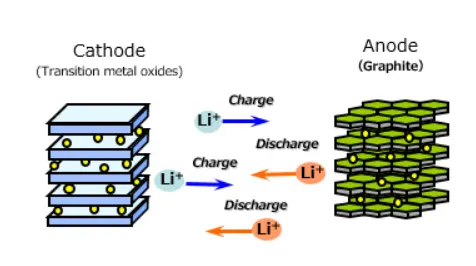
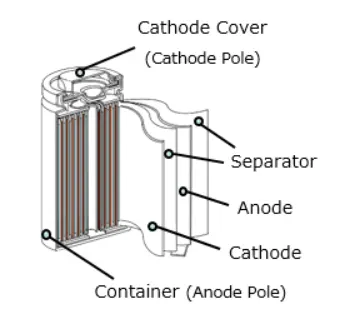
Parts of a Lithium-ion battery:-
(i) Cathode and anode :- reaction site and material that take part in reaction
(ii) Electrolyte:- medium for charge transfer
(iii) Seperator:- insulator for ccharges and permeable to ions only
(iv) Current collector:- bridging components to collect current generated at the electrodes and connect with external circuits.
| Sl. No | Type | Cathode | Anode | Electrolyte | Reaction |
| 1. | Lithium Cobalt Oxide (LCO) | `Li_(x)CoO_2` | `Li_xC_6` | `LiPF_6` or similar lithium salt and Ethylene Carbonat` |
`LiC_6-> 6C+ Li^+ + e^-` `Li_(1-x)CoO_2 (s) + x *Li ^+ + x e ^(- ) -> LiCoO_2 (s)` Overall:- `C_6 + LiCoO_4 -> LiC_6 + CoO_4` |
| 2. | Lithium ion manganese Oxide (LMO) | `LiMn_2O_4` | `LiC_6` | `LiPF_6 text( in ethylene carbonate` |
`LiC_6-> 6C+ Li^+ + e^-` `Li_(1-x)CoO_2 (s) + x *Li ^+ + x e ^(- ) -> LiMn_2O_4` Overall:- `C_6 + LiMn_2O_4 -> LiC_6 + Mn_2O_4` |
| 3. | Lithium Iron Phosphate(LFP) | `LFePO_4` | `LiC_6` | `LiPF_6 text( in ethylene carbonate` |
`LiC_6-> 6C+ Li^+ + e^-` `Li_(1-x)feFePO_4 + xLi^+ + xe^-) -> LiFePO_4` Overall:- `C_6+ LiFePO_4 -> LiC_6 +FePO_4` |
| 4. | Nickel Cobalt Aluminium (NCA) | `LiNiCoAlO_2` | `LiC_6` | `LiPF_6 text( in ethylene carbonate` |
`LiC_6-> 6C+ Li^+ + e^-` `Li_(1-x)CoAlO_2 (s) + x *Li ^+ + x e ^(- ) -> LiNiCoAlO_2` `C_6 + LiCoAlO_2 -> LiC_6 + NiCoAlO_2` |
| 5. | Lithium Nickel Manganese Cobalt Oxide (NMC) | `Li_0.8Mn0.1Co0.1O_2` | `LiC_6` | `LiPF_6 text( in ethylene carbonate` |
`LiC_6-> 6C+ Li^+ + e^-` `Li_(1-x)Ni_0.8Mn_0.1Co_0.1O_2+ xli^++xe^-)-> LiNi_0.8Mn0.1Co_0.1O_2` |
| 6. | Lithium titanium Oxide (LTO) | `LiMn_2O_4` | `Li_4Ti_5O_12` | `LiPF_6 text( in ethylene carbonate` |
`Li_4Ti_5O_12->Ti_5O_12+Li^++4e^-` `4li_(1-x)Mn_2O_4+4Li^++4e^-)->4LiMn_2O_4` Overall:- `Li_4Ti_5O_12+4Mn_2O_4->4LiMn_2O_4+Ti_5O_12` |
We will now do a comparative study of six different types of lithium ion batteries namely:-
(i) Lithium Cobalt Oxide (LCO)
(ii) Lithium Nickel Manganese Cobalt Oxide (NMC)
(iii) Lithium Manganese Oxide (LMO)
(iv) Lithium Iron Phosphate (LFP)
(v) Lithium Nickel Cobalt Aluminum Oxide (NCA)
(vi) Lithium Titanate (LTO)
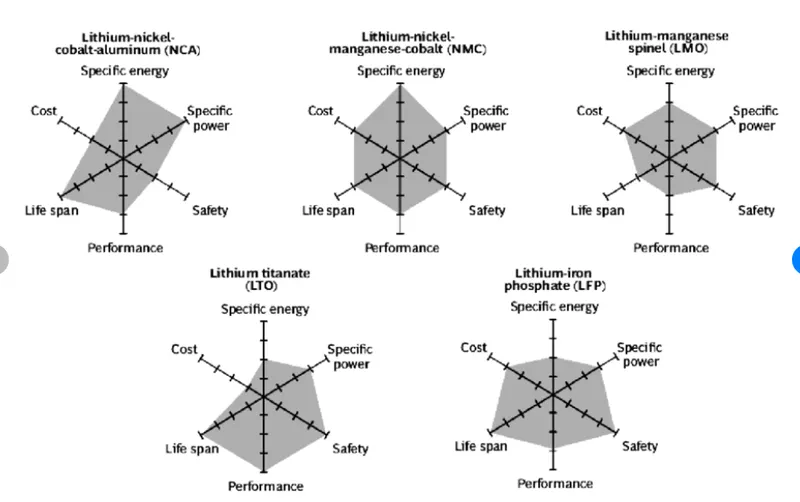
Our study will be based on some parameters which are mentioned below:-
Performance(PF): This measures how well the battery works over a wide range of temperatures.
Specific energy(SE): This defines the battery capacity in weight (Wh/kg). The capacity relates to the runtime.
Specific power(SP): It's the ability to deliver a high current and indicates loading capability.
Lifespan(LS): This reflects cycle life and longevity and is related to factors such as temperature, depth of discharge, and load.
Safety(SF): This relates to factors such as the thermal stability of the materials used in the batteries.
Cost(CS): Demand for electric vehicles has generally been lower than anticipated and this is mainly due to the cost of lithium-ion batteries.
| SL.No. | Battery TYPE | SP | SE | SF | LS | CS | PF |
| 1. | LCO | Low | High | Low | Low | Low | Moderate |
| 2. | LMO | Moderate | Moderate | Moderate | Low | Low | Low |
| 3. | NCA | Moderate | High | Moderate | Moderate | Low | Moderate |
| 4. | LFP | High | Low | High | High | Low | Moderate |
| 5. | NCA | Moderate | High | Low | Moderate | Moderate | Moderate |
| 6. | LTO | Moderate | Low | High | High | High | High |