Week 1 Understanding Different Battery Chemistry
1. Please find below the table with comparison of various lithium ion batteries material and chemical reaction.
| LCO | LMO | NCA | NMC | LFP | LTO | |
| FULLFORM | Lithium Cobalt Oxide | Lithium Manganese Oxide | Lithium Nickel Cobalt Aluminium Oxide | Lithium Nickel Cobalt Manganese Oxide | Lithium Iron Phosphate | Lithium Titanium Oxide |
| ANODE | Graphite | Graphite | Graphite | Graphite | Graphite | Lithium |
| CATHODE | Lithium Cobalt Oxide | Lithium Manganese Oxide | Lithium Nickel Cobalt Aluminium Oxide | Lithium Nickel Cobalt Manganese Oxide | Lithium Iron Phosphate | Lithium nickel Manganese cobalt oxide |
| ELECTROLYTE | Ethylene Carbonate | Lithium Halide | Ethylene Carbonate | Lithium salt | Ethylene Carbonate | Lithium salt |
| SEPARATOR | Polyethylene (PE) and Polypropylene (PP) | Polyethylene (PE) and Polypropylene (PP) | Polyethylene (PE) and Polypropylene (PP) | Polyethylene (PE) and Polypropylene (PP) | Polyethylene (PE) and Polypropylene (PP) | Polyethylene (PE) and Polypropylene (PP) |
| CHEMICAL REACTION | REDUCTION: CoO2 + Li+ + e- → LiCoO2 OXIDATION: LiC6 → C6 + Li+ + e- FULL REACTION: LiC6 + CoO2 ⇄ C6 + LiCoO2 |
REDUCTION: MnO2 + Li+ + e- → LiMnO2 OXIDATION: LiC6 → C6 + Li+ + e- FULL REACTION: LiC6 + Mn2O4 ⇄ C6 + LiMn2O4 |
REDUCTION: NiCoAlO2 + Li+ + e- → LiNiCoAlO2 OXIDATION: LiC6 → C6 + Li+ + e- FULL REACTION: LiC6 + NiCoAlO2 ⇄ C6 + LiNiCoAlO2 |
REDUCTION: NiMnCoO2 + Li+ + e- → LiNiMnCoO2 OXIDATION: LiC6 → C6 + Li+ + e- FULL REACTION: LiC6 + NiMnCoO2 ⇄ C6 + LiNiMnCoO2 |
REDUCTION: FePO4 + Li+ + e- → LiFePO4 OXIDATION: LiC6 → C6 + Li+ + e- FULL REACTION: LiC6 + FePO4 ⇄ C6 + LiFePO4 |
REDUCTION: 4Mn2O4 + 4Li+ + 4e- → 4LiMn2O4 OXIDATION: Li4Ti5O12 → Ti5O12 + 4Li+ + 4e- FULL REACTION: 4Mn2O4 + Li4Ti5O12 ⇄ 4LiMn2O4 + Ti5O12 |
In Lithium ion battery cell, during discharge, the electron flows from anode electrode to cathode electrode through external load during discharge and the positive ions pass from anode to cathode through separator. The process of anode giving up electrons during discharge is called oxidation.
During charging, the electron flows from cathode electrode to anode electrode through external load and the positive ions pass from cathode to anode through separator. The process of gaining electrons on anode duirng charging is called reduction.
The whole cycle of charging and discharging resembles the Redox reaction.
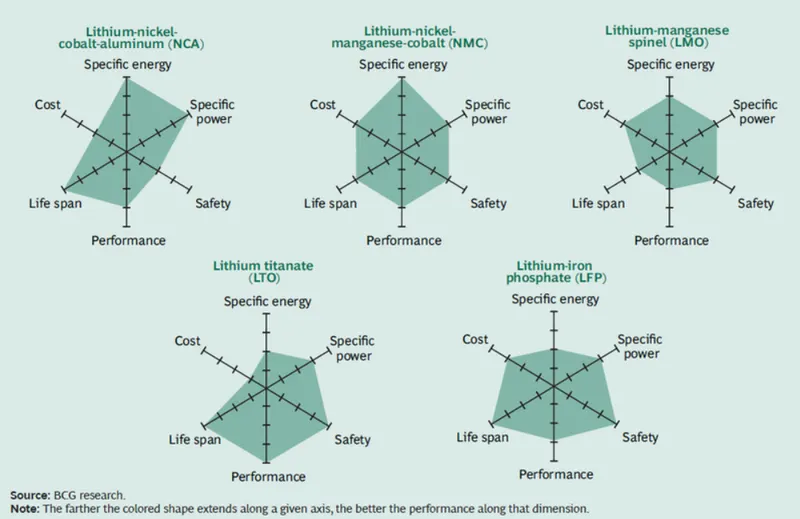
2. Please find below the comparison of characteristics of various Li ion batteries.
| LCO | LMO | NCA | NMC | LFP | LTO | |
| Fullform | Lithium Cobalt Oxide | Lithium Manganese Oxide | Lithium Nickel Cobalt Aluminium Oxide | Lithium Nickel Cobalt Manganese Oxide | Lithium Iron Phosphate | Lithium Titanium Oxide |
| Anode | Graphite | Graphite | Graphite | Graphite | Graphite | Lithium |
| Cathode | Lithium Cobalt Oxide | Lithium Manganese Oxide | Lithium Nickel Cobalt Aluminium Oxide | Lithium Nickel Cobalt Manganese Oxide | Lithium Iron Phosphate | Lithium nickel Manganese cobalt oxide |
| Energy Density (Wh/kg) | 560 | 420 | 600 | 580 | 333 | 177 |
| Safety | Medium | Less | Low | Less | High | High |
| Life (years) | 500-1000 | 300-700 | 500-1000 | 1000+ | 2000+ | 3000-7000 |
| Voltage (V) | 3.6 | 3.9 | 3.6 | 3.6 | 3.2 | 2.3 - 2.4 |
| Thermal Runway (deg C) | 150 | 250 | 150 | 210 | 270 | Highest |
| Charge current rate C | 0.7-1 C | 0.7-1 C | 0.7 C | 0.7-1 C | 1 C | 1 C |
| Discharge current rate C | 1 C | 1 C | 1 C | 1-2 C | 1 C | 10 C |
Energy Density: the energy density is factor to figure the capacity of 1 kilogram of battery chemistry can hold.
Safety: LFP & LTO are the safest among the all other Li-ion batteries
Voltage: LTO has low nominal voltage of 2.3V and LMO has high nominal voltage of 3.9V
Thermal Runway: It is the temperature above which the battery starts derate/malfunction. By the above data, we can see that LFP & LTO has highest thermal runway.
Charge current rate: Higher charge rate reduces the charging time of the battery.
Discharge current rate: Higher discharge rate drains the battery at faster rate. From the data, LTO has higher discharge rate.