Week 1 Understanding Different Battery Chemistry
- Prepare a table which includes materials & chemical reactions occurring at the anode and cathode of LCO, LMO, NCA, NMC, LFP and LTO type of lithium ion cells.Give your detailed explanation on it
Lithium ion batteries are batteries that function based on the transfer of lithium ions between a cathode and an anode. Lithium ion batteries have higher specific energies than batteries made from other materials such as zinc and lead due to the relatively light weight and low density of lithium. Lithium batteries are also more stable over charge/recharge cycles due to the small radii of lithium ions, which causes fewer disruptions of the electrode structure during ion transfer. Lithium ion batteries commonly use graphite and cobalt oxide as additional electrode materials. Lithium ion batteries work by using the transfer of lithium ions and electrons from the anode to the cathode. At the anode, neutral lithium is oxidized and converted to Li + . These Li+ ions then migrate to the cathode, where they are incorporated into LiCoO2 . This results in the reduction of Co(IV) to Co(III) when the electrons from the anode reaction are received at the cathode. Because lithium is involved in the reactions at both electrodes, the battery can be recharged by running the reactions in reverse.
The different types of batteries which are going to been seen are as follows :-
- LITHIUM COBALT OXIDE (LiCoO2) LCO
- LITHIUM MANGANESE OXIDE (LiMn2O4) LMO
- lithium nickel cobalt aluminium oxides (NCA)
- Lithium Nickel Manganese Cobalt Oxide Batteries (NMC)
- Lithium iron phosphate (LFP)
- Lithium–titanate (LTO)
LITHIUM COBALT OXIDE (LiCoO2) LCO:-
The most common lithium-ion cells have an anode of carbon (C) and a cathode of lithium cobalt oxide (LiCoO2). In fact, the lithium cobalt oxide battery was the first lithium-ion battery to be developed from the pioneering work of R Yazami and J Goodenough, and sold by Sony in 1991. The cobalt and oxygen bond together to form layers of octahedral cobalt oxide structures, separated by sheets of lithium. It’s important that this structure allows the cobalt ions to change their valence states between Co+3 and Co+4 (lose and gain a negatively-charged electron) when charging and discharging.
Of all the various lithium-ion batteries, these guys have the greatest energy density, which is why they’re currently the batteries found in our phones, digital cameras and laptops. Their drawback is their thermal instability. Their anodes can overheat and, at high temperatures, the cobalt oxide cathode can decompose, producing oxygen.
LITHIUM MANGANESE OXIDE (LiMn2O4) LMO :-
This type of lithium battery uses a cathode made from lithium-manganese spinel (Li+Mn3+Mn4+O4). Spinel is a type of mineral with a distinctive AB2O4 structure. The spinel structure has very good thermal stability, improving the battery’s safety. It also promotes ion flow within the electrolyte and lessens the internal resistance that contributes to the loss of a battery’s power over time.
While this type of lithium battery offers high discharge and recharge rates (also due to the spinel structure of the cathode) it has a lower capacity and shorter lifetime.
lithium nickel cobalt aluminium oxides (NCA) :-
The lithium nickel cobalt aluminium oxides (NCA) are a group of substances comprising metal oxides. Some of them are important due to their application in lithium-ion batteries. NCAs are used as active material on the positive pole (which is the cathode when the battery is discharged). NCAs are mixed oxides comprising the cations of the chemical element’s lithium, nickel, cobalt and aluminium. The most important representatives have the general formula LiNixCoyAlzO2 with x + y + z = 1. In case of the NCA comprising batteries currently available on the market, which are also used in electric cars and electric appliances, x ≈ 0,8, and the voltage of those batteries is between 3.6 V and 4.0 V, at a nominal voltage of 3.6 V or 3.7 V. A version of the oxides currently in use in 2019 is LiNi0,84Co0,12Al0,04O2.
Lithium Nickel Manganese Cobalt Oxide Batteries (NMC):-
Adding nickel and cobalt back into the mix changes things slightly again. Nickel provides a high specific energy and, when added to the stable structure of the manganese spinel, also results in a battery with the benefits of the manganese spinel structure (low internal resistance, high charging rate, good stability and safety).
These batteries are generally made with a cathode with one-third nickel, one-third manganese and one-third cobalt, but the ratio can vary according to manufacturers’ secret formulas. These batteries are used in power tools, electric vehicles and medical devices.
Lithium manganese batteries are often coupled with a lithium nickel manganese cobalt oxide battery, producing a combination that is used in many electric vehicles. High bursts of energy (for rapid acceleration) are provided by the lithium-manganese component, and a long driving range is provided by the lithium nickel manganese cobalt oxide component.
Lithium iron phosphate (LFP) :-
This cell has a high discharge rate and, because phosphate (PO4) can cope with high temperatures, the battery has good thermal stability, improving its safety. This makes it a good choice for things like electric vehicles and power tools, and for storing energy at power stations. It also has a long cycle life, meaning it can be discharged and charged many times. However, it has a lower energy density than a lithium cobalt oxide cell, and a higher self-discharge rate.
A lithium iron phosphate battery cell is similar to the lithium cobalt oxide cell. The anode is still graphite and the electrolyte is also much the same. The difference is that the lithium cobalt dioxide cathode has been replaced with the more stable lithium iron phosphate. In fact, no lithium or iron ions remain in the iron phosphate (FePO4) cathode of a fully charged cell. The lithium ions can intercalate into or out of the cathode material through well-defined tunnels in its structure without significantly altering the iron phosphate framework.
The cathode of this type of cell is made of negatively charged phosphate anions, bonded with positively charged iron cations in a structure that is capable of storing lithium ions within the iron phosphate molecules. The bonding arrangement in this structure means that the oxygen atoms are tightly bonded into the structure, which gives the cathode its chemical stability.
Lithium–titanate (LTO) :-
The lithium-titanate-oxide (LTO) battery is a type of rechargeable battery which has the advantage of being faster to charge than other lithium-ion batteries, but the disadvantage of having a much lower energy density.
A lithium-titanate battery is a modified lithium-ion battery that uses lithium-titanate nanocrystals, instead of carbon, on the surface of its anode. This gives the anode a surface area of about 100 square meters per gram, compared with 3 square meters per gram for carbon, allowing electrons to enter and leave the anode quickly. This makes fast recharging possible and provides high currents when needed. Lithium-titanate cells also last for 3000 to 7000 charge cycles; one source claims a cycle life of ~1000 cycles before reaching 80% capacity when charged and discharged at 55 °C (131 °F), rather than the standard 25 °C (77 °F).
A disadvantage of lithium-titanate batteries is that they have a lower inherent voltage (2.4 V), which leads to a lower specific energy (about 30–110 Wh/kg) than conventional lithium-ion battery technologies, which have an inherent voltage of 3.7 V, although some lithium-titanate batteries are reported to have an energy density of up to 177 Wh/L.
|
Battery type |
Anode |
Cathode |
Electrolyte |
Chemical Reaction |
|
Lithium Cobalt Oxide (LiCoO2) LCO |
Graphite‡, Carbon |
Lithium cobalt oxide |
ethylene carbonate–dimethyl carbonate (EC–DMC) |
C6+LiCoO2⟷LixC6+Li1−xCoO2 |
|
LITHIUM MANGANESE OXIDE (LiMn2O4) LMO |
Graphite‡ |
lithium-manganese spinel (Li+Mn3+Mn4+O4) |
---------------------------------- |
|
|
lithium nickel cobalt aluminium oxides (NCA) |
Graphite‡ |
Lithium nickel cobalt aluminium oxide |
---------------------------------- |
|
|
Lithium Nickel Manganese Cobalt Oxide Batteries (NMC) |
Graphite‡ |
Lithium nickel manganese cobalt oxide |
---------------------------------- |
|
|
Lithium iron phosphate (LFP) |
graphite or hard carbon with intercalated metallic lithium |
C-LiFePO4, grade Phos-Dev-12 |
LiFePO4⟶FePO4+Li++e− |
|
|
Lithium–titanate (LTO) |
Lithium |
Lithium manganese oxide or Lithium nickel manganese cobalt oxide |
Li4Ti5O12 + 3Li+ + 3e- = Li7Ti5O12 |
2.Compare the differences between each type of Li+ion batteries based on their characteristics
- LITHIUM COBALT OXIDE (LiCoO2) LCO
- LITHIUM MANGANESE OXIDE (LiMn2O4) LMO
- lithium nickel cobalt aluminium oxides (NCA)
- Lithium Nickel Manganese Cobalt Oxide Batteries (NMC)
- Lithium iron phosphate (LFP)
- Lithium–titanate (LTO)
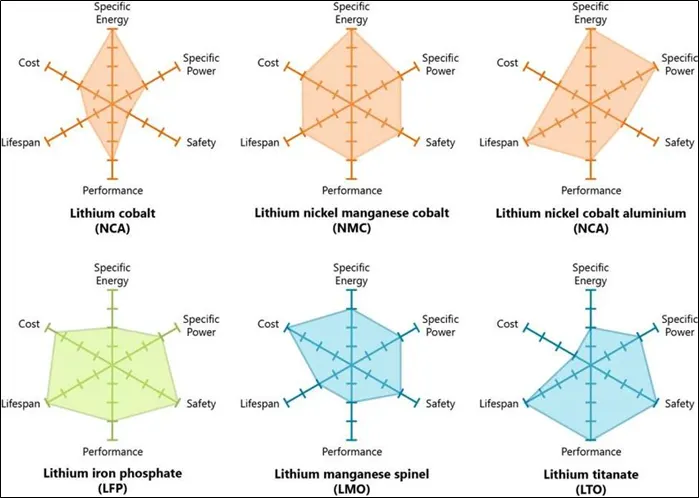
In the above fig 6 different types of batteries are been compared on the basis of there characteristic like .
- Specific energy
- Specific power
- Safety
- Performance
- Lifespan
- Cost
The batteries which are compared are :-
Lithium cobalt (NCA)
Lithium Nickle manganese cobalt (NMC)
Lithium Nickle cobalt aluminium (NCA)
Lithium Ion Phosphate (LFP)
Lithium manganese spinal (LMO)
Lithium Titanate (LTO)
From the detail given in the fig we can conclude that the ,
NCA battery has higher specific energy and performance but the cost is very high and we have to compromise in the safety , lifespan and specific power of the battery.
One of the most successful li-ion cathode formulas developed to date is obtained by combining nickel, manganese, and cobalt. Lithium-Nickel-Manganese-Cobalt-Oxide (LiNiMnCoO2), abbreviated as NMC, has become the go-to cathode powder to develop batteries for power tools, e-bikes and other electric powertrains. It delivers strong overall performance, excellent specific energy, and the lowest self-heating rate of all mainstream cathode powders, which makes it the preferred option for automotive batteries.
While NMC powder can refer to a variety of blends, the formula typically consists of 33% nickel, 33% manganese and 33% cobalt. This blend, sometimes referred to as 1-1-1, is a popular option for mass-produced cells in applications requiring frequent cycling (automotive, energy storage) due to the reduced material cost resulting from lower cobalt content.
NCA batteries are good in specific energy , specific power and lifespan but the safety is lower as compared to other parameters and cost is also more.
Lithium Iron phosphate (LFP) is a popular, cost-effective cathode material for lithium-ion cells that is known to deliver excellent safety and long life span, which makes it particularly well-suited for specialty battery applications requiring high load currents and endurance.
LFP cathode offers several key advantages including a high current rating, long cycle life, and superior thermal stability, which makes it one of the safest and most abuse-tolerant cathode material options available to manufacturers. On the other hand, LFP delivers a lower nominal voltage, which results in lower specific energy when compared to other cathode materials on the market. Consequently, LFP batteries tend to have a higher self-discharge than other Li-ion battery types.
LMO batteries the cost is very low as compared to all other batteries but other characteristics are not that great the performance is very low and even the life of battery is less.
LTO batteries has the highest performance as compared to all other types and safety is very good , no problem of overheating and even the specific power is moderate but the cost of this batteries is the drawback as this type of batteries cost very high.