Week 1 Understanding Different Battery Chemistry
1) Types of Lithium ion cells:
Lithium ion battery uses the lithium ion for driving the batteries. Lithium is the lightest metal and light solid element. And it has the atomic number of 3. Hence it has the one free electron in the outer atomic shell. It is highly reactive to lose the electrons to attain the stable state. Being small and light, more lithium is stored in the electrode, hence it has high energy density. Upon many experiments Sony commercialized the first Lithium ion battery.
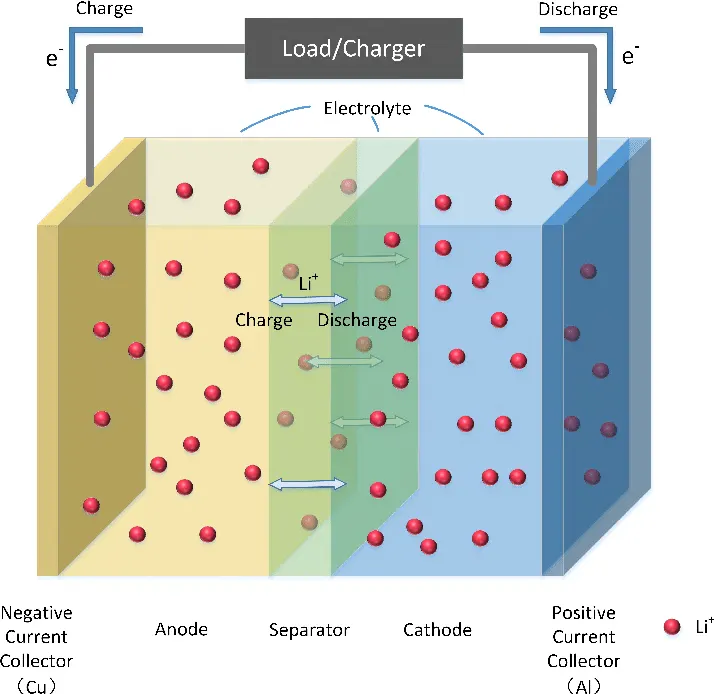
- Cathode is usually made of Lithium metal oxide and the anode is usually graphite.
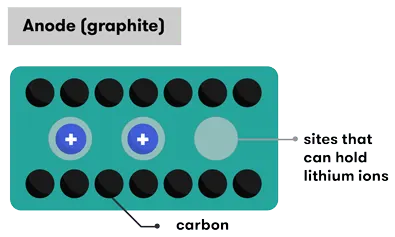
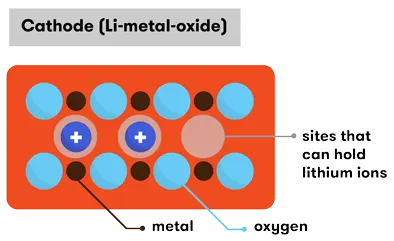
- Both anode and cathode can absorb lithium ions.
- During charging the lithium ions absorbed by anode. During the discharge the lithium ions are absorbed by cathode.
- Separator is used to isolate the electrodes. It is permeable only to ions. It does not allows the electrons between the electrodes.
- Electrolyte is usually the lithium salts in a solvents like dimethyl carbonate or diethyl carbonate.
- During charging, an oxidation reaction occurs at the cathode, meaning that it loses some negatively charged electrons.
- To maintain the charge balance in the cathode, an equal number of some of the positively charged lithium ions are dissolved into the electrolyte solution and is absorbed by the anode.
- This intercalation reaction also deposits electrons into the graphite anode, to tie up the lithium ion.
- During discharge, the lithium ions moves from the anode and travel back through the electrolyte to the cathode.
- This releases the electrons to the anode through the external connecting wires, providing the electric current.
- When the electrons are free to travel, so are the positively charged lithium ions that will balance the movement of their negative charge.
- When the cathode becomes full of lithium ions, the reaction stops and the battery is flat and it needs to charge again.
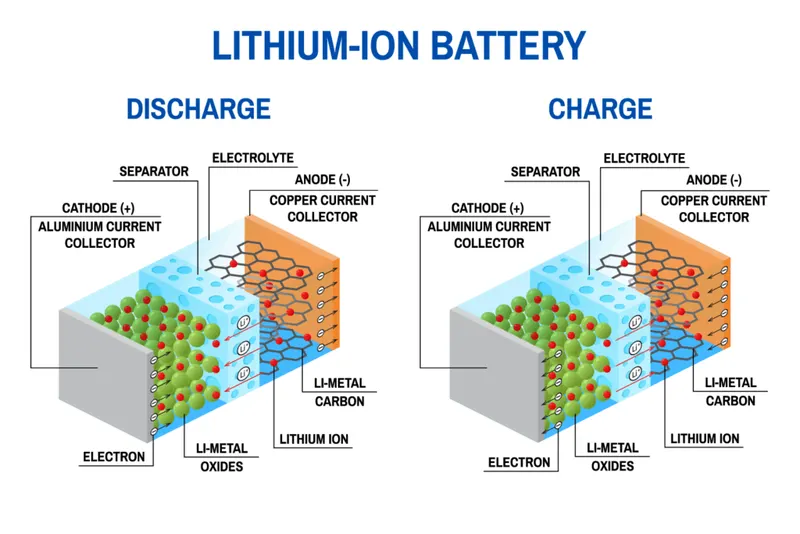
Types of the Cathode used it has different types and characteristics. They are
- Lithium Cobalt Oxide (LCO)
- Lithium Manganese Oxide (LMO)
- Lithium Iron Phosphate (LFP)
- Lithium Nickel Manganese Cobalt Oxide (NMC)
- Lithium Nickel Cobalt Aluminum Oxide (NCA)
- Lithium Titanate (LTO)
Lithium Cobalt Oxide (LCO):
In this type of battery, graphite act as anode and Lithium Cobalt Oxide act as cathode.
During dicharging,
At anode,
LiC6 -> C6 + Li+ + e-
Anode gets oxidized and releases the electrons
At Cathode:
CoO2 + Li+ + e- -> LiCoO2
Cathode gets reduced with the absorption of electrons.
Overall reaction,
LiC6 + CoO2 -> C6 + LiCoO2
This process can be reversed while charging.
Lithium Manganese Oxide (LMO):
In this type of battery, graphite act as anode and Lithium Manganese Oxide act as cathode.
During dicharging,
At anode,
LiC6 -> C6 + Li+ + e-
Anode gets oxidized and releases the electrons.
At Cathode:
Mn2O4 + Li+ + e- -> LiMnO2
Cathode gets reduced with the absorption of electrons.
Overall reaction,
Mn2O4 + LiC6 -> C6 + LiMnO2
This process can be reversed while charging.
Lithium Iron Phosphate (LFP):
In this type of battery, graphite act as anode and Lithium Iron Phosphate act as cathode.
During dicharging,
At anode,
LiC6 -> C6 + Li+ + e-
Anode gets oxidized and releases the electrons.
At Cathode:
FePO4 + Li+ + e- -> LiFePO4
Cathode gets reduced with the absorption of electrons.
Overall reaction,
FePO4 + LiC6 -> C6 + LiFePO4
This process can be reversed while charging.
Lithium Nickel Manganese Cobalt Oxide (NMC):
In this type of battery, graphite act as anode and Lithium Manganese Cobalt Oxide act as cathode.
During dicharging,
At anode,
LiC6 -> C6 + Li+ + e-
Anode gets oxidized and releases the electrons.
At Cathode:
NiMnCoO2 + Li+ + e- -> LiNiMnCoO2
Cathode gets reduced with the absorption of electrons.
Overall reaction,
NiMnCoO2 + LiC6 -> C6 + LiNiMnCoO2
This process can be reversed while charging.
Lithium Nickel Cobalt Aluminum Oxide (NCA):
In this type of battery, graphite act as anode and Lithium Nickel Cobalt Aluminum Oxide act as cathode.
During dicharging,
At anode,
LiC6 -> C6 + Li+ + e-
Anode gets oxidized and releases the electrons.
At Cathode:
NiCoAlO2 + Li+ +e- -> LiNiCoAlO2
Cathode gets reduced with the absorption of electrons.
Overall reaction,
NiCoAlO2 + LiC6 -> C6 + LiNiCoAlO2
This process can be reversed while charging.
Lithium Titanate (LTO):
In this type of battery, graphite act as anode and Lithium titanate act as cathode.
During dicharging,
At anode,
LiTiO3 -> TiO3 + Li+ + e-
Anode gets oxidized and releases the electrons.
At Cathode:
Mn2O4 + Li+ + e- -> LiMn2O4
Cathode gets reduced with the absorption of electrons.
Overall reaction,
Mn2O4 + LiTiO3 -> TiO3 + LiMn2O4
This process can be reversed while charging.
|
LCO |
LMO |
LFP |
NMC |
NCA |
LTO |
|
|
Cathode |
Lithium Cobalt oxide (LiCoO2) |
Lithium manganese oxide (LiMn2O4) |
Lithium Iron phosphate (LiFePO4) |
Lithium Nickel Manganese Cobalt oxide (LiNiMnCoO2) |
Lithium Nickel Cobalt Aluminum oxide (LiNiCoAlO2) |
Lithium manganese oxide (LiMn2O4) or Lithium Nickel Manganese Cobalt oxide (LiNiMnCoO2) |
|
Anode |
Graphite |
Graphite |
Graphite |
Graphite |
Graphite |
Lithium Titanate |
|
Electrolyte |
Ethylene carbonate |
Lithium halide |
Ethylene carbonate |
Lithium salt |
Ethylene carbonate |
Lithium salt |
|
Seperator |
Polyolefin |
Polyolefin |
Polyolefin |
Polyolefin |
Polyolefin |
Polyolefin |
|
Cathode reaction |
CoO2 + Li+ + e- <-> LiCoO2 |
Mn2O4 + Li+ + e- <-> LiMnO2 |
FePO4 + Li+ + e- <-> LiFePO4 |
NiMnCoO2 + Li+ + e- <-> LiNiMnCoO2 |
NiCoAlO2 + Li+ +e- <-> LiNiCoAlO2 |
Mn2O4 + Li+ + e- <-> LiMn2O4 |
|
Anode reaction |
LiC6 <-> C6 + Li+ + e- |
LiC6 <-> C6 + Li+ + e- |
LiC6 <-> C6 + Li+ + e- |
LiC6 <-> C6 + Li+ + e- |
LiC6 <-> C6 + Li+ + e- |
LiTiO3 <-> TiO3 + Li+ + e- |
|
Overall reaction |
LiC6 + CoO2 <-> C6 + LiCoO2 |
Mn2O4 + LiC6 <-> C6 + LiMnO2 |
FePO4 + LiC6<-> C6 + LiFePO4 |
NiMnCoO2 + LiC6 <-> C6 + LiNiMnCoO2 |
NiCoAlO2 + LiC6 <-> C6 + LiNiCoAlO2 |
Mn2O4 + LiTiO3 <-> TiO3 + LiMn2O4 |
|
Nominal Voltage |
3.60V |
3.7V |
3.2V |
3.6V |
3.6V |
2.4V |
|
Operating voltage |
3.0 - 4.2V |
3.0 - 4.2V |
2.5 – 3.65V |
3.0 - 4.2V |
3.0 - 4.2V |
1.8 – 2.85V |
|
Charge current rate |
0.7 – 1C |
0.7 – 1C |
1C |
0.7 – 1C |
0.7C |
1C |
|
Discharge current rate |
1C |
1C |
1C |
1 – 2C |
1C |
10C |
|
Specific energy |
150 - 200Wh/kg |
100 - 150Wh/kg |
90 - 120Wh/kg |
150 - 220Wh/kg |
200 - 260Wh/kg |
50 - 80Wh/kg |
|
Thermal runaway |
150°C |
250°C |
270°C |
210°C |
150°C |
Safest |
|
Applications |
Mobile phones, games, laptops, tablets, e-readers |
Power tools, medical tools, electric powertrain |
Power tools, medical tools |
Electric powertrain |
Medical, industrial, electric powertrain |
Electric powertrain, energy storage |
|
Battery life |
500 - 1000 cycles |
400 - 750 cycles |
2000 cycles |
1000 - 2000 cycles |
500 - 1000 cycles |
3000 – 7000 cycles |
2) Characteristics of different types of Li ion Batteries:
Lithium Cobalt Oxide (LCO):
Its high specific energy makes Li-cobalt the popular choice for mobile phones, laptops and digital cameras. The drawback of Li-cobalt is a relatively short life span, low thermal stability and limited load capabilities. Li-cobalt has a graphite anode that limits the cycle life by a changing solid electrolyte interface (SEI), thickening on the anode and lithium plating while fast charging and charging at low temperature. Li-cobalt should not be charged and discharged at a current higher than its C-rating. The battery protection circuit limits the charge and discharge rate to a safe level of about 1C for the Energy Cell.
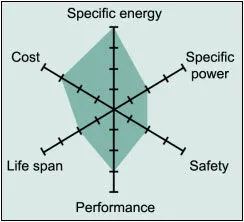
- Lithium Cobalt oxide (LCO) has high specific energy hence it can be used for long runtime.
- But it can’t able deliver the high current because of the low specific power.
- It is less safe and requires the battery protection circuit to control thre charging and discharging.
- It exhibits moderate performance both on hot and cold conditions.
- It has less lifespan it starts to degrade after few cycles of usage.
- And it is comparitively costly, because cobalt is costly than nickel and manganese.
Lithium Manganese Oxide (LMO):
Lithium Manganese Oxide architecture forms a three-dimensional spinel structure that improves ion flow on the electrode, which results in lower internal resistance and improved current handling. A further advantage of spinel is high thermal stability and enhanced safety, but the lifecycle is limited. Low internal cell resistance enables fast charging and high-current discharging. Li-manganese can be discharged at currents of 20–30A with moderate heat buildup. It is also possible to apply one-second load pulses of up to 50A. A continuous high load at this current would cause heat buildup and the cell temperature cannot exceed 80°C. Li-manganese is used for power tools, medical instruments, as well as hybrid and electric vehicles.
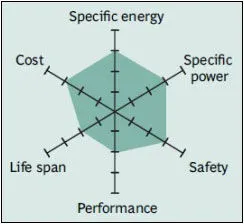
- This type of battery has the less the capacity than cobalt type and has less runtime than cobalt but can deliver high current LCO.
- Its has less performance in the extreme conditions and it may lead to develop heat during hot condition during high load.
- It is comparatively more safe and cheaper than LCO. Manganese is cheaper than cobalt.
Lithium Iron Phosphate (LFP):
Lithium Iron phosphate offers good electrochemical performance with low resistance. This is made possible with nano-scale phosphate cathode material. Li-phosphate is often used to replace the lead acid starter battery. Li-phosphate is more tolerant to full charge conditions and is less stressed than other lithium-ion systems if kept at high voltage for a prolonged time.
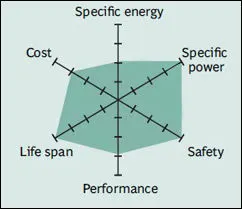
- It has less specific power because of the low nominal cell voltage. Hence cannot be used for long time.
- It has high specific power hence it can able to supply high current to meet the requiremenr.
- It has equivalent performance to LCO but the cold condition can affect the performance.
- It is more safe and is tolerant to overcharge addition to that is experirnce less stress than lithium ion batteries.
- It has high Life span if manufactured and maintained properply. It has high self discharge than other batteries it affect the life span.
- It is not tolerant to moisture and reduces the lifecycle to 50.
- It is costly when we go for a high quality batteries and the control electronics.
Lithium Nickel Manganese Cobalt Oxide (NMC):
Nickel-manganese-cobalt (NMC) cathode combination is one of the most successful Li-ion systems. Similar to Li-manganese, these systems can be used serve as Energy Cells or Power Cells. Nickel has high specific energy but poor stability and manganese has the benefit of forming a spinel structure to achieve low internal resistance but offers a low specific energy. Combining the metals enhances each other strengths. Nickel-based systems have higher energy density, lower cost, and longer cycle life than the cobalt-based cells but they have a slightly lower voltage. NMC is the battery of choice for power tools, e-bikes and other electric powertrains. The cathode combination is typically one-third nickel, one-third manganese and one-third cobalt, also known as 1-1-1. This offers a unique blend that also lowers the raw material cost due to reduced cobalt content.
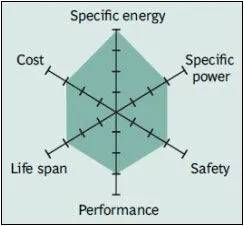
- It has good overall performance.
- It has high specific energy and power hence it can be used as power cells or energy cells.
- With less current extraction it act as enegy cell and runtime is increases and with higher current extraction it can be used as power cell with less runtime.
- The area under the graph is more for this battery. Hence it is more efficient.
- It can be normally used in the electrical vehicle powertrain.
Lithium Nickel Cobalt Aluminum Oxide (NCA):
NCA is a further development of lithium nickel oxide; adding aluminum gives the chemistry greater stability.
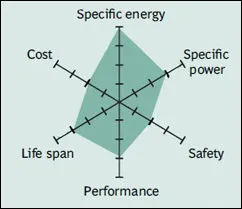
- It has less safety and high cost when compared to NMC.
- But specific energy, specific power and the performance is same as NMC.
- It is also used as energy cells or power cells.
- It can be used in electric vehicle but the safety electronics is needed in additional. This increases the cost.
- Life span is good with the use of controlled charging with the safety electronics.
Lithium Titanate (LTO):
Li-titanate is used as anode of a typical lithium-ion battery and the material forms into a spinel structure. The cathode can be lithium manganese oxide or NMC. Li-titanate has a nominal cell voltage of 2.40V, can be fast charged and delivers a high discharge current of 10C. The cycle count is higher as 3000 to 7000 cycles . Li-titanate is safe, has excellent low-temperature discharge characteristics and obtains a capacity of 80 percent at –30°C. LTO attains zero-strain property, no SEI film formation and no lithium plating when fast charging and charging at low temperature.
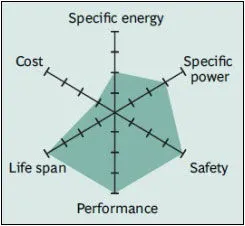
- It is one of the safest Lithium ion battery.
- It has high span as there is SEI formation or Lithium plating occurs when fast
- The performance of the battery is high upto 3000 – 7000 cycles.
- But it has less specific energy due to low nominal volatage of 2.4V
- It has high specific power it can provide high current and discaaahrge at the rate of 10C.
- Titanium is mosre costly. Hence this increases the cost of the battery.