Week 1 Understanding Different Battery Chemistry
What is Lithium ion battery
Lithium-ion batteries are extremely popular and versatile. Found in cell phones, automobiles, power tools, and several other types of electronic devices, these rechargeable batteries are also making an impact powering material handling and airport ground support equipment.
The technology behind lithium-ion batteries make them a great choice because of their distinct advantages and environmentally-friendly benefits.
But, how exactly do lithium-ion batteries work? And, what makes them so popular in so many applications?
Here’s what you need to know about the components that make up a lithium-ion battery and how they work together to create high-functioning and long-lasting sources of power.
The Components
Lithium-ion batteries are available in many different shapes and sizes. Inside, however, they typically look the same. To understand how a lithium-ion battery works, it’s important to know the role that individual parts play.
The Cell
A lithium-ion battery is made up of several parts. The cell, serving as the workhorse of the battery, is the most critical component of the battery.
The cell is comprised of the following battery materials:
- Electrodes are the two battery ends. One is the anode and the other is the cathode.
- The anode stores the lithium and is typically made from carbon.
- The cathode also stores the lithium and is made from a chemical compound that is a metal oxide.
- The separator blocks the flow of negative and positive electrons inside the battery but allows for ions to pass through.
- The electrolyte liquid sits between the two electrodes. It carries the positively charged lithium ions from the anode to the cathode and vice versa depending on whether the battery is charging or discharging.
The Battery Pack
The battery pack, which holds the lithium-ion cells, operates much like a computer. It contains the following:
- At least one temperature sensor to monitor the battery’s temperature.
- A voltage converter and regulator circuit that focuses on keeping the voltage and current at safe levels.
- A Euro connector, which allows power and information to move in and out of the battery pack.
- The cell tap, which oversees the cells’ voltages in the battery pack.
- A battery monitoring system, a small computer that oversees the whole battery and ensures safety to the user.
Movement in the Cell
So how does the cell provide power to the equipment?
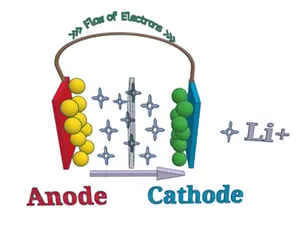
When you plug a lithium-ion battery into a device or piece of equipment, the positively-charged ions move from the anode to the cathode. As a result, the cathode becomes more positively charged than the anode. This, in turn, attracts negatively-charged electrons to the cathode.
A separator in the cell includes electrolytes that form a catalyst. This promotes ion movement between the . The movement of ions through the electrolyte solution is what causes the electrons to move through the device the battery is plugged into.
Lithium-ion batteries are rechargeable. When recharging, the lithium ions go through the same process, but in the opposite direction. This restores the battery for additional use.
The overall design of a lithium-ion battery provides many benefits for equipment users:
- Run times dramatically increase with their use compared to other battery types.
- Fast-charging capabilities provide less downtime for shift workers, and greater productivity.
- They feature flat discharge curves and provide higher constant power. This means no more annoying sluggishness in equipment as the battery charge level decreases.
When storing energy (i.e., during charging)
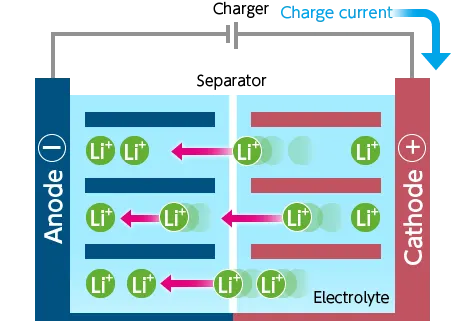
- The charger passes current to the battery.
- Lithium ions move from the cathode to the anode through the electrolyte.
- The battery is charged by a potential difference between the two electrodes.
When using energy (i.e., during discharging)
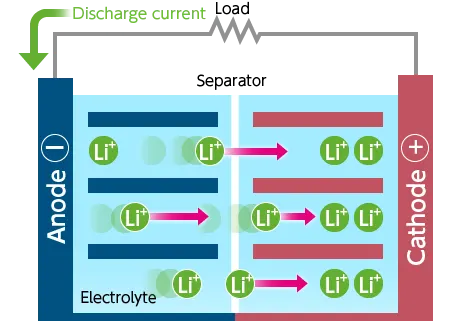
- A discharge circuit is formed between the anode and the cathode.
- Lithium ions stored in the anode move to the cathode.
- Energy is used.
Comparision Table:
| Li - ion cell Type | Cathode | Anode | Electrolyte | Seperator | Overall Reaction at Cathode & Anode | Application |
| LCO | Graphite | Lithium Cobalt Oxide | Ethylene Carbonate + Li salt |
Polyolefin | Li1-xCoO2(s) + x Li+ + x e- → LiCoO2(s) | Mobile phones, laptops and digital cameras |
| LMO | lithium manganese oxide | Graphite carbon | Methyl carbonate + Li salt | Polyolefin |
Mn2+ + 2 LiC6 → Mn + 2 Li++ graphite |
Power tools, medical devices, electric powertrains |
| NCA | Comprised of Nickel cobalt & Aluminium | Graphite carbon | Propylene carbonate + Li salt | Polyolefin |
Li(1−x)NiO2 → (2 − x)Li(1−x)/(2−x)Ni1/(2−x)O + x/2O2 |
Medical devices, industrial, electric powertrain (Tesla) |
| NMC | Comprised of Nickel cobalt & Manganese | Lithium metal Graphite | Methyl carbonate + Li salt | Polyolefin | Li(x)MO2(s) → Li+(org) + Li(x-1)MO2(s) + e-. | E-bikes, medical devices, EVs, industrial |
| LFP | Comprised of Lithium, Iron & Phosphate | Graphite Carbon | Propylene carbonate + Li salt | Polyolefin |  |
Portable and stationary needing high load currents and endurance |
| LTO | Comprised of Nickel cobalt & Manganese |
Lithium–titanium oxide |
Propylene carbonate + Li salt | Polyolefin | Li4Ti5O12 + 3Li+ + 3e → 4 Li7Ti5O12 | UPS, electric powertrain (Mitsubishi i-MiEV, Honda Fit EV), solar-powered street lighting |
2. Compare the differences between each type of Li+ion batteries based on their characteristics
Although all lithium ion batteries, or li-ion batteries have many aspects in common, there is a variety of different types of lithium ion battery that are available.
Each lithium ion battery type has its own characteristics and this means that different types of Li-ion battery will be used in different areas.
Accordingly it is necessary to choose the right type of lithium ion battery for any application - understanding the different types and their characteristics enables the right type to be chosen for any particular application.
Lithium ion battery types
Parameters such as the chemistry, the cost, size, weight, capacity and many more attributes vary across the different types of lithium ion battery.
Items such as handheld items of electronic equipment ranging from mobile phones, to tablet computers, games, e-readers and more require high energy density levels combined with high levels of safety. For these applications Lithium Cobalt Oxide types of battery are normally used.
In other applications a lower energy density can be tolerated, but a longer battery life may be needed. The type of li-ion battery used for these applications is often the lithium ion phosphate battery type or lithium nickel manganese cobalt oxide as these lithium ion battery types offer longer usable life times at the expense of the very high energy density.
For automotive applications where high current is a necessity, the lithium nickel manganese cobalt oxide battery type is often used.
There are also other types of li-ion battery that are used for particular roles. With Lithium ion battery technology moving forward apace, new types of lithium ion battery are bound to appear on the market at frequent intervals.
There is a good variety of different types of lithium ion battery. The main differences are the anode and cathode materials.
Each of the different types of lithium ion battery provide different characteristics and accordingly they tend to be used in different applications. The main types are summarised in the sections below.
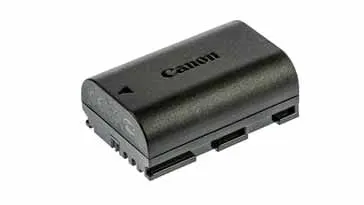
Lithium Cobalt Oxide, LCO
The Lithium Cobalt Oxide, LiCoO2, battery is a type of lithium ion battery that find uses in many consumer items of electronic equipment. It provides a very high level of specific energy density along with a good level of safety.
The battery consists of a cobalt oxide cathode with a layered structure. The anode is graphite (carbon). During the discharge cycle, lithium ions move from the anode to the cathode, and in the reverse direction during charge.
The graphite anode limits the battery life as the solid electrolyte interface changes and also as a result of anode thickening. Newer batteries may incorporate nickel or manganese to improve the lifetime as well as reducing manufacturing costs.
One of the drawbacks of the LCO battery is that its current capability in both charge and discharge is limited. As a guide, it should not be charged or discharged at a greater rate than its capacity, i.e. a 2400mAh battery should not be charged or discharged with a current greater than 2400mA. Often figures of 0.8 of the charge level are recommended.
The LCO battery is now being supplanted in some applications by Lithium Manganese, as well as NMC and NCA types. This is occurring as a result of the improved performance of these other types as development improves the performance and as a result of cost.
| SUMMARY OF LITHIUM COBALT OXIDE BATTERY, LCO | |
|---|---|
| ATTRIBUTE | DETAILS |
| Key features | High energy density; high level of safety |
| Main disadvantages | Relatively short life-span; limited high load capability. |
| Main applications | Consumer electronics:- mobile phones, games, laptops, tablets, e-readers, etc. |
| Voltage | 3.60V nominal with typical operating rate between 3.0 - 4.2 V/cell |
| Specific energy (capacity) | 150 - 200Wh/kg typical |
| Battery life | 500 - 1000 cycles |
Lithium Iron Phosphate Battery, LFP
The Lithium Iron Phosphate, LFP type of lithium ion battery provides a low internal resistance and high current capability.
In order to provide its high of current capability, this type of li-ion battery uses a nano-scale phosphate cathode material.
In terms of performance this type of lithium ion battery provides a slightly lower terminal voltage and it has a slightly higher self-discharge rate than other forms. However against this it provides a high current rating, and good thermal stability combined with a good level of, and good thermal stability.
| SUMMARY OF LITHIUM IRON PHOSPHATE, LFP BATTERY | |
|---|---|
| ATTRIBUTE | DETAILS |
| Key features | High current capability, longer calendar lifespan. |
| Main disadvantages | Slightly higher self-discharge rate; low cell voltage (3.3V) |
| Main applications | Power tools, some medical tools, hobbyist |
Lithium Manganese Oxide, LMO
This type of lithium ion battery uses Lithium Manganese Oxide, LiMn2O4 as its cathode material. This type of lithium ion battery is structured to allow high currents to flow and this enables it to provide very high current levels and also to be fast charged as well.
It generally uses a three-dimensional spinel structure, i.e. one in which the crystal structure in the cubic, isometric, system, with the oxide anions arranged in a cubic close-packed lattice. This structure improves the flow of ions on the electrode, thereby increasing he current capability and lowering the internal resistance of the cell. A typical 1500mAh battery may be able to deliver steady currents of up to 20 A, obviously for a relatively short time because of the overall battery capacity.
The structure of this type of lithium ion battery also has the advantage that it improves the thermal stability and improves the safety of the cell.
However the disadvantage of the cell is the limited number of charge discharge / cycles as well as the limited calendar life, i.e. the degradation over time since manufacture.
| SUMMARY OF LITHIUM MANGANESE OXIDE, MNO BATTERY | |
|---|---|
| ATTRIBUTE | DETAILS |
| Key features | High current capability for charge and discharge. |
| Main disadvantages | Lower energy density than other types of lithium ion battery, low cycle life and calendar life. |
| Main applications | Power tools, some medical tools some vehicles. |
| Voltage | ~3.70V nominal |
| Specific energy | 100 - 150Wh/kg |
| Life expectancy | 400 - 750 cycles |
Lithium Nickel Cobalt Aluminium Oxide, NCA
The Lithium Nickel Cobalt Aluminium Oxide battery, or NCA, is a li-ion battery type that is rarely seen in consumer applications but is being investigated for the automotive industry. Its main advantage is that it has a good life span and high energy and power density figures.
However these features come at a cost and in view of the safety elements, it must be used with care. Further development is also required to bring it to a state where this type of li-ion battery can be more widely used.
| SUMMARY OF LITHIUM NICKEL COBALT ALUMINIUM OXIDE, NCA | |
|---|---|
| ATTRIBUTE | DETAILS |
| Key features | High energy density, high power density, good life span. |
| Main disadvantages | High cost; safety requires more care in the design and use. |
| Main applications | |
Lithium Nickel Manganese Cobalt Oxide, NMC
The lithium nickel manganese cobalt oxide lithium battery type uses a cathode comprising of a combination of nickel, manganese, and cobalt.
The key to this lithium ion battery type is the combination of nickel and manganese. Nickel is known for its high specific energy, but poor stability whereas manganese provides low internal resistance but at the cost of low specific energy. Combining both in a cell in the correct manner is able to provide the required balance of the properties of both metals.
The cathode combination often consists of a combination of nickel, manganese and cobalt in equal proportions in a combination known as 1-1-1. This combination reduces cost by reducing the cobalt content, whilst still retaining some of the key performance parameters.
Another popular combination consists of 5 parts nickel, 3 parts cobalt & 2 parts manganese (5-3-2).
The NMC type of lithium ion battery can be optimised for either to high specific power or high specific energy. With the high cost of cobalt, manufacturers are trying to move away from its use, often increasing the use of nickel, so this is often a major fact in the choice of composition of the battery.
| SUMMARY OF LITHIUM NICKEL MANGANESE COBALT OXIDE, NMC | |
|---|---|
| ATTRIBUTE | DETAILS |
| Key features | High specific power or energy. |
| Main disadvantages | Power / energy density not as high as some other types. |
| Main applications | Power tools and electric vehicles. |
| Voltage | 3.60 - 3.70 V |
| Specific energy | 160 - 230Wh/kg |
| Life expectancy | 1000 - 2000 cycles. |
These types of lithium ion battery are some of the more popular ones available. However as the technology is continually seeing more development, new lithium ion technologies are always being developed and those which exist are being developed. This has arisen from the needs of the equipment manufacturers. Battery technology in general is forcing development forwards and significant amounts are being invested. As a result, this is a particularly fast moving area of technology where improvements are always being seen.
Lithium Titanium Oxide LTO
* Finally, lithium titanate, also known as li-titanate, is a class of battery that allows for ever-increasing applications. the main advantage of the li-titanate battery is its remarkably fast recharge time.
* Currently, manufacturers of electric vehicles and bikes use li-titanate batteries, and there is potential for this type of battery to be used in electric buses for public transportation.
* However, these batteries have lower inherent voltage, or lower energy density, than other lithium-ion battery varieties, which can present issues with powering vehicles efficiently. Even so, the density of lithium titanate batteries is still higher than other non-lithium-ion batteries, which is a plus.