Understanding Different Battery Chemistry
1. Prepare a table that includes materials & chemical reactions occurring at the anode and cathode of LCO, LMO, NCA, NMC, LFP, and LTO type of lithium-ion cells. Give your detailed explanation on it.
Lithium-ion batteries are essential to today’s technology and can be found in nearly every portable device, as well as electric vehicles. Smartphones, laptops, tablets, cordless power tools, and grid-energy storage are just a few examples that are powered by the excellent battery, which have been a mainstay of electronics since their commercialization back in 1991. The battery’s popularity is due in part to its ability to pack a significant amount of energy into a relatively small space with low weight.
Lithium-ion batteries can be designed for optimal capacity with the drawback of limited loading, slow charging, and reduced longevity. An industrial battery may have a moderate Ah rating but the focus is on durability. Specific energy only provides part of battery performance.
Before looking into the materials and chemical reactions of different types of lithium-ion batteries, we will first look into the working principle.
A battery is made up of an anode, cathode, separator, electrolyte, and two current collectors (positive and negative). The anode and cathode store the lithium. The electrolyte carries positively charged lithium ions from the anode to the cathode and vice versa through the separator. The movement of the lithium ions creates free electrons in the anode which creates a charge at the positive current collector. The electrical current then flows from the current collector through a device being powered (cell phone, computer, etc.) to the negative current collector. The separator blocks the flow of electrons inside the battery.
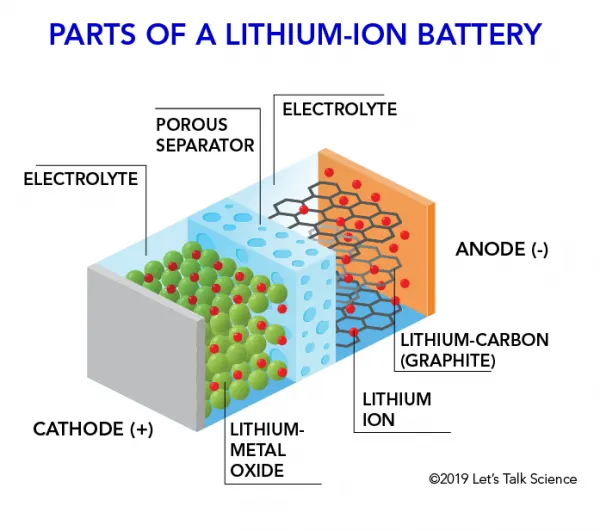
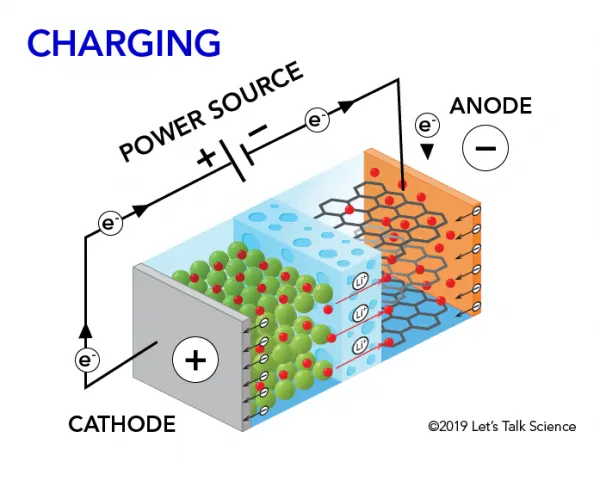
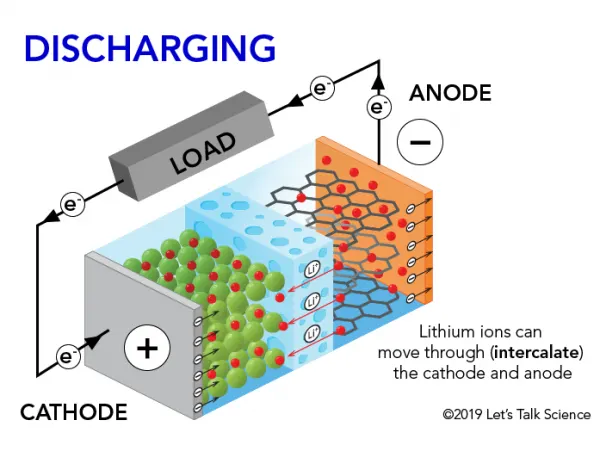
While the battery is discharging and providing an electric current, the anode releases lithium ions to the cathode, generating a flow of electrons from one side to the other. When plugging in the device, the opposite happens: Lithium ions are released by the cathode and received by the anode.
The charging and discharging processes are shown in the below images.
There are 6 commonly used Lithium-ion battery types and are listed below -
- Lithium Cobalt Oxide (LiCoO2) - LCO
- Lithium Manganese Oxide (LiMn2O4) - LMO
- Lithium Nickel Manganese Cobalt Oxide (LiNiMnCoO2) - NMC
- Lithium Iron Phosphate (LiFePO4) - LFP
- Lithium Nickel Cobalt Aluminium Oxide (LiNiCoAlO2) - NCA
- Lithium Titanate (Li2TiO3) - LTO
Each of the different types of lithium-ion batteries provides different characteristics and accordingly, they tend to be used in different applications. The main types are summarised in the sections below.
| TYPE | ANODE | CATHODE | ELECTROLYTE | SEPARATOR |
| LCO | Graphite | Lithium Cobalt Oxide (LiCoO2) |
Lithium salts such as LiBF4, LiClO4, LiPF6 In organic solvents such as ethylene carbonate, dimethyl carbonate, and diethyl carbonate. |
Polyolefin or ethyl-cellulose modified PE membrane |
| LMO | Graphite | Lithium Manganese Oxide (LiMn2O4) |
Lithium salts such as LiBF4, LiClO4, LiPF6 In organic solvents such as ethylene carbonate, dimethyl carbonate, and diethyl carbonate. |
Polyolefin or ethyl-cellulose modified PE membrane |
| NMC | Graphite | Lithium Nickel- Manganese-Cobalt oxide (LiNiMnCoO2) |
Lithium salts such as LiBF4, LiClO4, LiPF6 In organic solvents such as ethylene carbonate, dimethyl carbonate, and diethyl carbonate. |
Polyolefin or ethyl-cellulose modified PE membrane |
| NCA | Graphite |
Lithium Nickel cobalt aluminum oxide (LiNiCoAlO2) |
Lithium salts such as LiBF4, LiClO4, LiPF6 In organic solvents such as ethylene carbonate, dimethyl carbonate, and diethyl carbonate. |
Polyolefin or ethyl-cellulose modified PE membrane |
| LFP | Graphite | Lithium phosphate (LiFePO4) |
Lithium salts such as LiBF4, LiClO4, LiPF6 In organic solvents such as ethylene carbonate, dimethyl carbonate, and diethyl carbonate. |
Polyolefin or ethyl-cellulose modified PE membrane |
| LTO | Lithium titanate (Li2TiO3) | Lithium manganese oxide or NMC |
Lithium salts such as LiBF4, LiClO4, LiPF6 In organic solvents such as ethylene carbonate, dimethyl carbonate, and diethyl carbonate. |
Polyolefin or ethyl-cellulose modified PE membrane |
We will now look into what a battery separator is and what are materials can be used.
A battery separator is a polymeric membrane placed between the positively charged anode and negatively charged cathode to prevent an electrical short circuit. The separator is a microporous layer that is moistened by the electrolyte that acts as a catalyst to increases the movement of ions from one electrode to the other electrode. When the battery is charging the ions moves from cathode to anode and when the battery gets discharged the ions will move in the reverse direction. The separator controls the number of ions moving between the positive and negative terminal and hence it is responsible for the leakage of ions (self-discharge) when the battery is ideal. Although the ions pass through the separator freely they will not have any electrical conductivity and it always acts as an isolator.
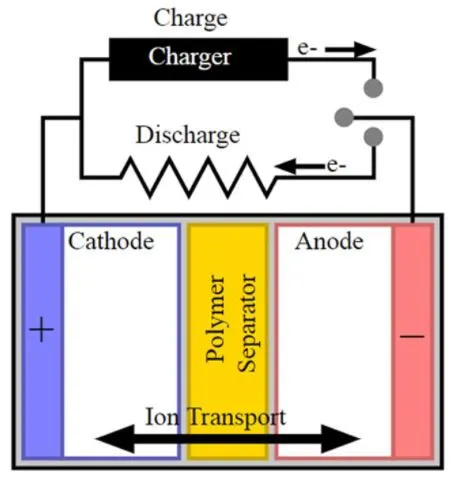
The lithium-ion battery separator cells are made from polyolefin as they have a good mechanical property, chemically stable, and available at low cost. The polyolefin is created from polyethylene, polypropylene, or by laminating them both. At present, the separators are developed from various types of materials such as cotton, nylon, polyesters, glass, ceramic, polyvinyl chloride, tetrafluoroethylene, rubber, asbestos, etc.
A good battery separator should possess the following property
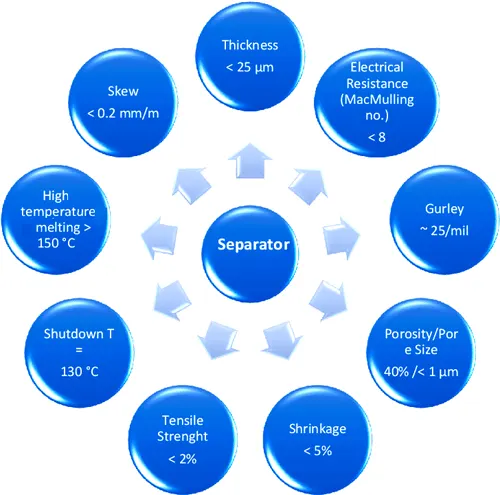
- Chemical Stability: The separator’s material should not have any reaction with the electrode or the electrolyte, they should be chemically stable and should not get degraded.
- Thickness & Strength: The battery separator should be thin enough to facilitate the battery’s energy and power density and it should also have sufficient tensile strength to prevent stretching during the winding process. The standard thickness of a separator is fixed at 25.4μm, but as the technology developed the thickness of the separators got reduced down to 20μm, 16μm and even 12μm without compromising the cell properties.
- Porosity & Pore Size: The separator should have a pore density that can hold the electrolyte and also allows the ion to move between the electrodes. If the porosity is larger it’ll be hard to close the pores when a battery shutdown is to be made. The typical porosity of the Li-ion battery separator is 40%. The size of the pores should be smaller than the particle size of the electrode components and the pores should be uniformly distributed in a tortuous structure.
- Thermal stability and shutdown: The separator should be stable for a wide range of temperatures without curling or puckering and it should be able to shut down at a temperature slightly lower than the temperature where thermal runaway occurs.
With this let us now look into the chemical reactions taking place in each of the lithium-ion batteries discussed above.
1. Lithium Cobalt Oxide battery (LCO) -
During discharge -
At the anode or the negative electrode, Lithium is oxidized. Lithium ions are released along with electrons. It can be shown as below-

At the cathode, Lithium ions are abandoned by the lithium dioxide and the electrode is reduced as it also receives the electrons from the circuit:

The overall reaction would be-

The reaction is reversible and hence the same reaction takes place during charging in the opposite direction.
2. Lithium Manganese Oxide (LiMn2O4 - LMO)-
During Discharge
Reaction at anode : Li --> Li+ + e-
Reaction at cathode : MnO2 + Li+ + e- --> LiMnO4
3. Lithium Nickel Manganese Cobalt Oxide (LiNiMnCoO2 - NMC) -
Reaction at the anode:

Reaction at the cathode:

The overall reaction:

4. Lithium Iron Phosphate (LiFePO4 - LFP) -
During Discharge:
At the anode, lithium is oxidized. Lithium ions are released from the carbon, along with electrons:
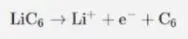
At the cathode, Lithium ions are absorbed by the lithium dioxide, and the electrode is reduced as it also receives the electrons from the circuit:
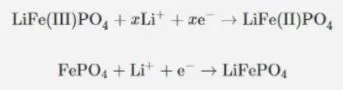
The overall reaction is:

5. Lithium Nickel Cobalt Aluminium Oxide (LiNiCoAlO2 - NCA) -
The reactions taking place in this type of battery is shown below -

6. Lithium Titanate (Li2TiO3 - LTO) -
Reaction at Anode :


Reaction at Cathode: As we use an NMC in the cathode, the reaction would be as explained above.
2.Compare the differences between each type of Li+ion batteries based on their characteristics
The characteristic differences between each type of Lithium-ion batteries are tabulated below -
| TYPE | VOLTAGES | SPECIFIC ENERGY | CHARGE | DISCHARGE | CYCLE LIFE | THERMAL RUNAWAY | APPLICATIONS |
| LCO | 3.60V nominal; typical operating range 3.0–4.2V/cell |
150–200Wh/kg. Specialty cells provide up to 240Wh/kg. |
0.7–1C, charges to 4.20V (most cells); 3h charge typical. Charge current above 1C shortens battery life. | 1C; 2.50V cut off. Discharge current above 1C shortens battery life | 500–1000, related to the depth of discharge, load, temperature | 150°C (302°F). Full charge promotes thermal runaway | Mobile phones, tablets, laptops, cameras |
| LMO | 3.70V (3.80V) nominal; typical operating range 3.0–4.2V/cell | 100–150Wh/kg | 0.7–1C typical, 3C maximum, charges to 4.20V (most cells) | 1C; 10C possible with some cells, 30C pulse (5s), 2.50V cut-off | 300–700 (related to the depth of discharge, temperature) | 250°C (482°F) typical. High charge promotes thermal runaway | Power tools, medical devices, electric powertrains |
| NMC | 3.60V, 3.70V nominal; typical operating range 3.0–4.2V/cell, or higher | 150–220Wh/kg |
0.7–1C, charges to 4.20V, some go to 4.30V; 3h charge typical. Charge current above 1C shortens battery life. | 1C; 2C possible on some cells; 2.50V cut-off | 1000–2000 (related to the depth of discharge, temperature) | 210°C (410°F) typical. High charge promotes thermal runaway | E-bikes, medical devices, EVs, industrial |
| LFP | 3.20, 3.30V nominal; typical operating range 2.5–3.65V/cell | 90–120Wh/kg | 1C typical charges to 3.65V; 3h charge time typical | 1C, 25C on some cells; 40A pulse (2s); 2.50V cut-off (lower than 2V causes damage) | 2000 and higher (related to the depth of discharge, temperature) |
270°C (518°F) Very safe battery even if fully charged | Portable and stationary needing high load currents and endurance |
| NCA | 3.60V nominal; typical operating range 3.0–4.2V/cell | 200-260Wh/kg; 300Wh/kg predictable | 0.7C charges to 4.20V (most cells), 3h charge typical, fast charge possible with some cells | 1C typical; 3.00V cut-off; high discharge rate shortens battery life | 500 (related to the depth of discharge, temperature) | 150°C (302°F) typical, High charge promotes thermal runaway | Medical devices, industrial, electric powertrain (Tesla) |
| LTO | 2.40V nominal; typical operating range 1.8–2.85V/cell | 50–80Wh/kg | 1C typical; 5C maximum, charges to 2.85V | 10C possible, 30C 5s pulse; 1.80V cut-off on LCO/LTO | 3,000–7,000 | One of the safest Li-ion batteries | UPS, electric powertrain (Mitsubishi i-MiEV, Honda Fit EV), solar-powered street lighting |
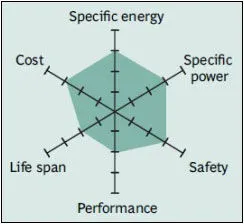
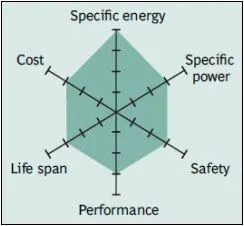
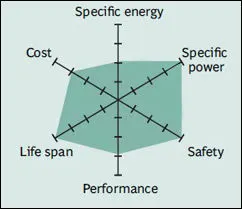
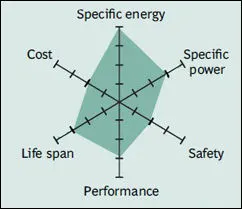
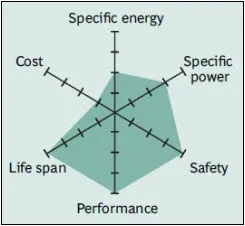
The above table can be further summarized through the use of structures and is tabulated below. We can understand the difference better through the pictorial representation of its characteristics.
| TYPE | PICTORIAL REPRESENTATION |
| LCO |
Li-cobalt excels on high specific energy but offers only moderate performance specific power, safety, and life span. |
| LMO |
Although moderate in overall performance, newer designs of Li-manganese offer improvements in specific power, safety, and life span. |
| NMC |
NMC has good overall performance and excels on specific energy. This battery is the preferred candidate for the electric vehicle and has the lowest self-heating rate |
| LFP |
Li-phosphate has excellent safety and long life span but moderate specific energy and elevated self-discharge. |
| NCA |
High energy and power densities, as well as a good life span, make NCA a candidate for EV powertrains. High cost and marginal safety are negatives. |
| LTO |
Li-titanate excels in safety, low-temperature performance, and life span. Efforts are being made to improve the specific energy and lower the cost. |
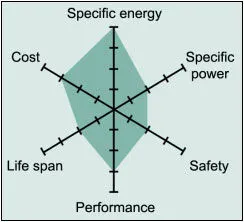
These types of lithium-ion batteries are some of the more popular ones available. However, as technology is continually seeing more development, new lithium-ion technologies are always being developed and those which exist are being developed. This has arisen from the needs of the equipment manufacturers. Battery technology, in general, is forcing development forwards and significant amounts are being invested. As a result, this is a particularly fast-moving area of technology where improvements are always being seen.