Week 1 Spur Gear Challenge
Static and Structural analysis of Spur Gear
AIM:
- Run the simulation for the Spur Gear with different materials and find out the Total Deformation, Equivalent stress, and Stress Intensity.
OBJECTIVE:
- To perform a Structural Analysis on the spur gear for all three cases with different materials such as Cast Steel, Cast Bronze, and Cast Iron.
- To add the required materials to the case, set up from the Engineering data source.
- To find the location of the fracture, Where it occurs on the gear.
- To compare the simulation results for those three materials.
- To find out the Stress intensity in the spur gear.
CONCEPT:
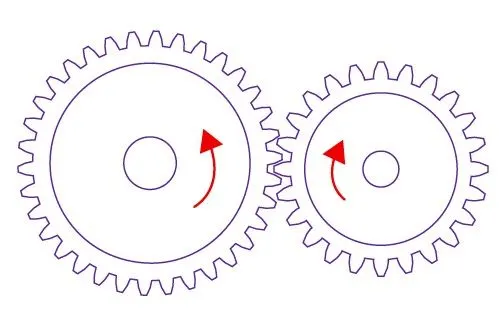
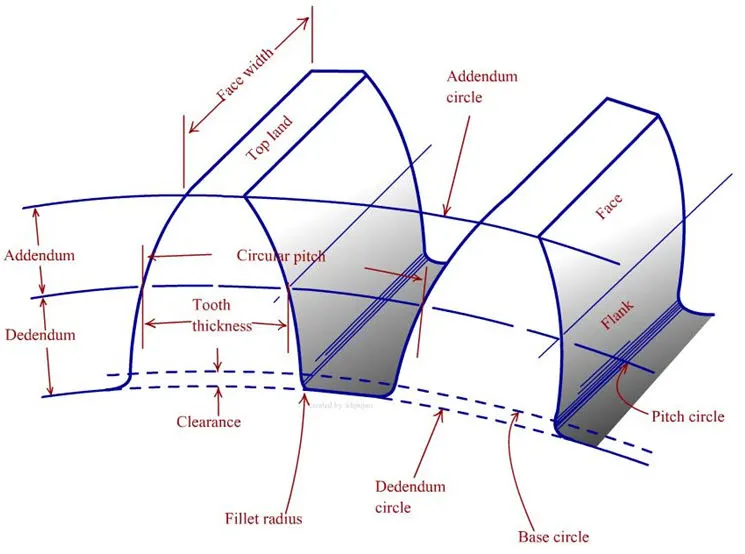
- Spur gears are a cylindrical-shaped toothed component used in industrial equipment to transfer mechanical motion as well as control speed, power, and torque. These simple gears are cost-effective, durable, reliable, and provide a positive, constant speed drive to facilitate daily industrial operations.
Industrial applications of Spur Gear
- Transmissions.
- Conveyor systems.
- Speed reducers.
- Engines and mechanical transportation systems.
- Gear pumps and motors.
- Machining tools.
What is Stress intensity?
- In Fracture mechanics, the stress intensity factor (K) is used to predict the Stress state ("stress intensity") near the tip of a crack or notch caused by a remote load or Residual stresses.
PROCEDURE:
- For both cases, We use Static Structural tool in the analysis system tool box to Define the geometry and other input parameters for the same.
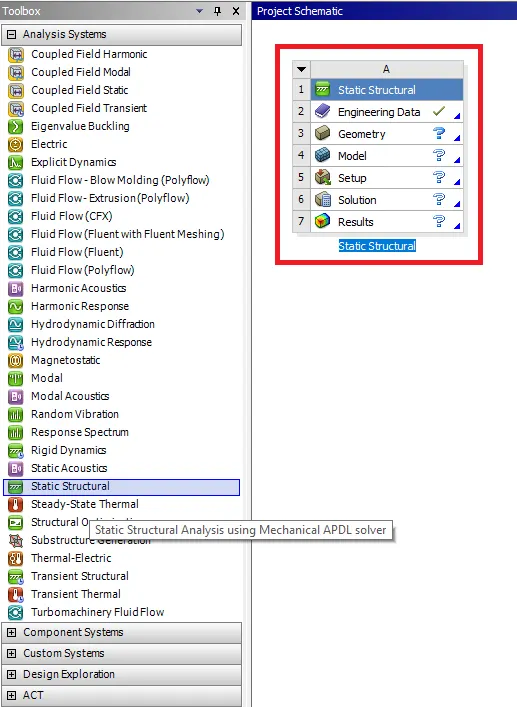
- In the engineering data, We can Input the material and its properties. (e.g. Structural steel, is a default One)
- Here, the required materials are Cast iron, Cast Steel, Bronze-cast
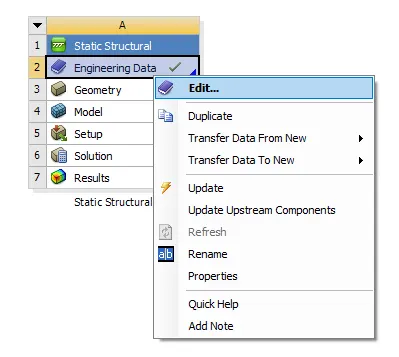
If we don't have the materials in your library, you can create a new material with the properties
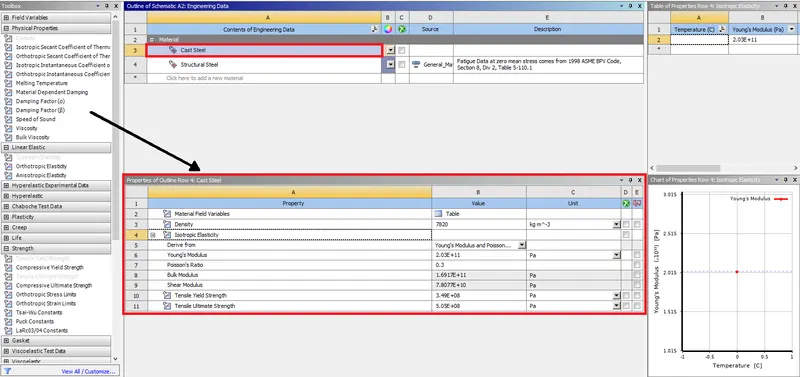
- In the above images, we can create a new material by using the given value for the Cast Steel and bronze
IMPORTING THE GEOMETRY
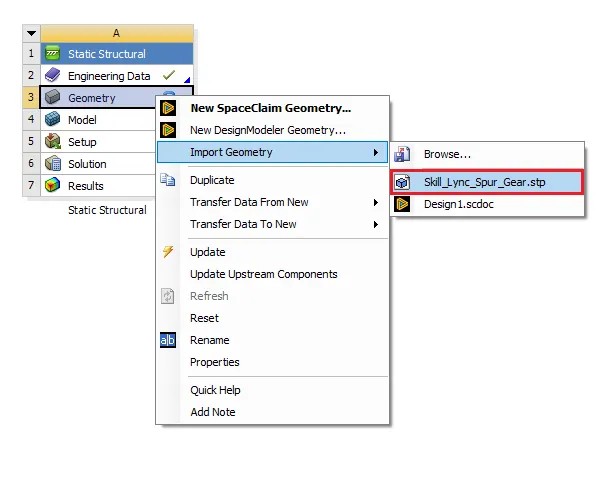
- In the Structural Static window we can add the given model by the option Click on geometry --> Import Geometry --> select the Model --> It will be loaded to the Ansys mechanical window.
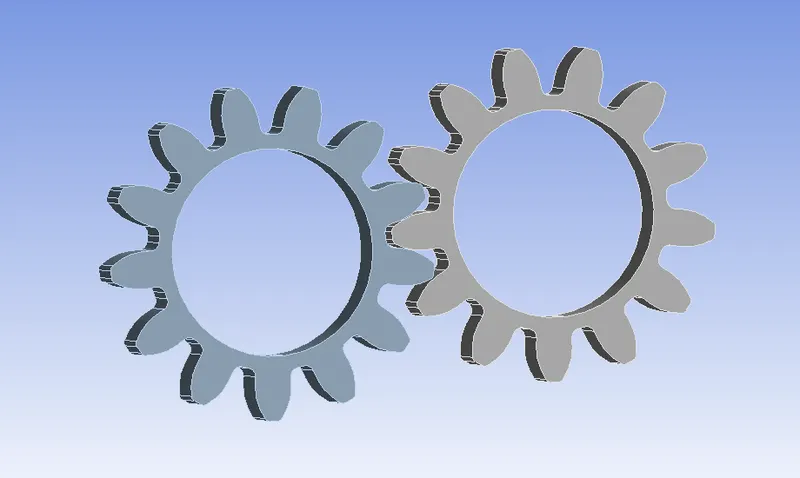
figure - Spur Gear (Given model)
SETTING UP THE BOUDRY CONDITIONS, MESHING AND SOLUTION REQUIREMENTS:
- Next define the , material as cast iron for the spur gear which showes in the Image below.
- Simillarly define the material for all the cases.
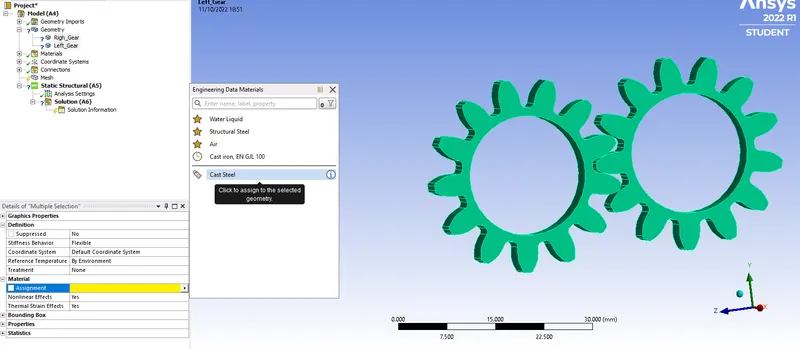
figure - Assigning material to gears
- Now define the contact which is shown in below.
- Select the Contact and Target faces of the gears which is shown in below.
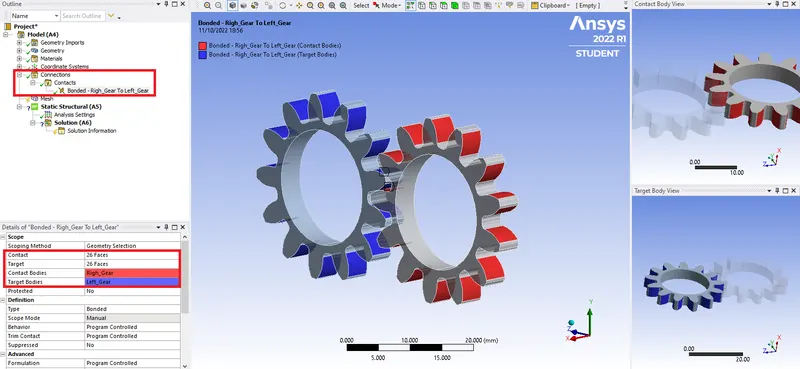
- As like shown in the above image to set up the connection between two Gears Go to --> Connections in the MODEL Tree --> click on contacts --> edit the contacts of all the teeths wher the friction would happend while the gear is in rotating motion.
Connections
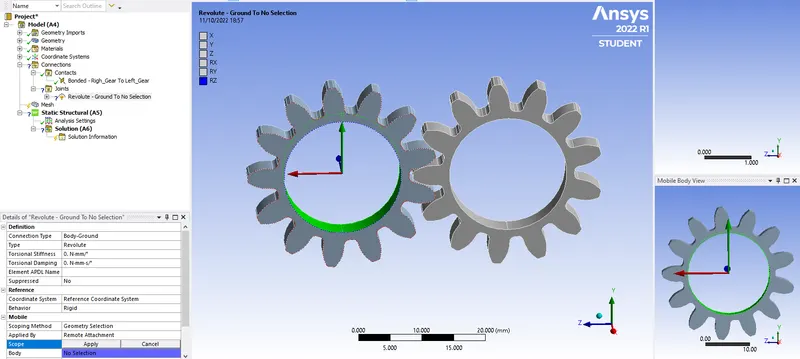
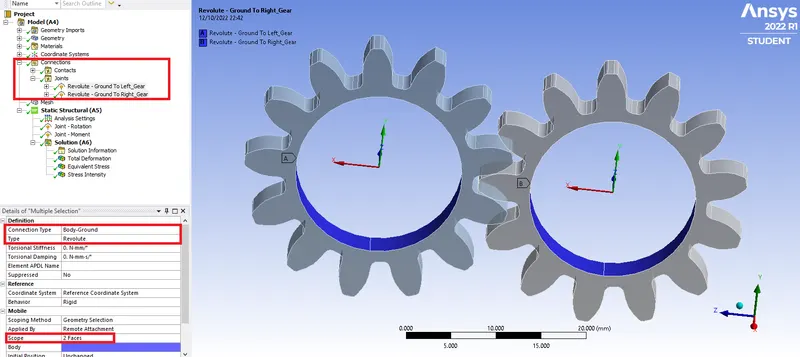
- After that to make connection with revolute to support the gears to rotate.
- As per showing in the above image, create two Joints under Contacts, set up the connection type as Body to ground--> Type as Revolute --> Select the inner side of the Gear faces --> click apply
- The both Revolute joints has been set.
Meshing
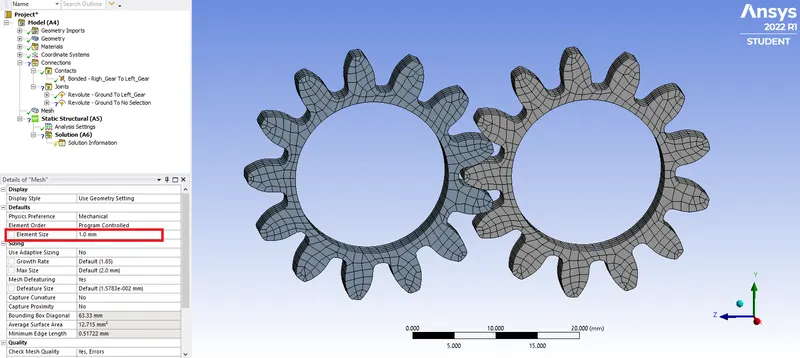
- In the above image we can see after setting up the required Meshing element size as 1mm --> Click on the Generate button
- The meshing is done with Quad Elements, this will be changable.
Analysis Settings
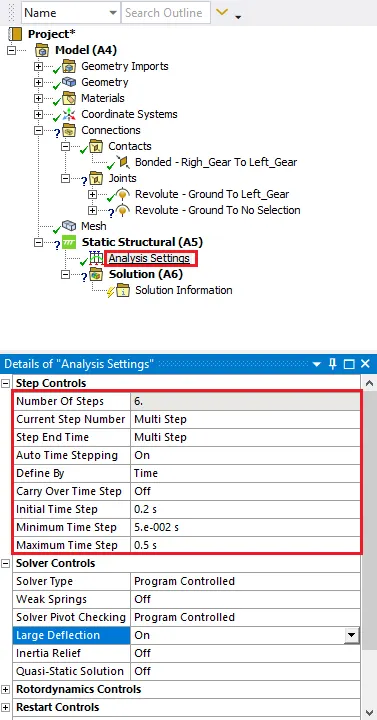
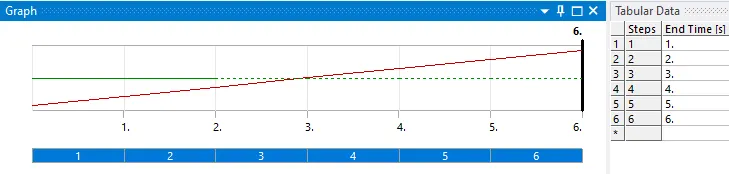
- In Static Structural we can set 'Analysis settings' --> set the Step controls --> For the rotation split the steps into 6 --> Auto time stepping ON --> Defined by time --> Set the Initial / Minimum / Maximum time steps as per requirments
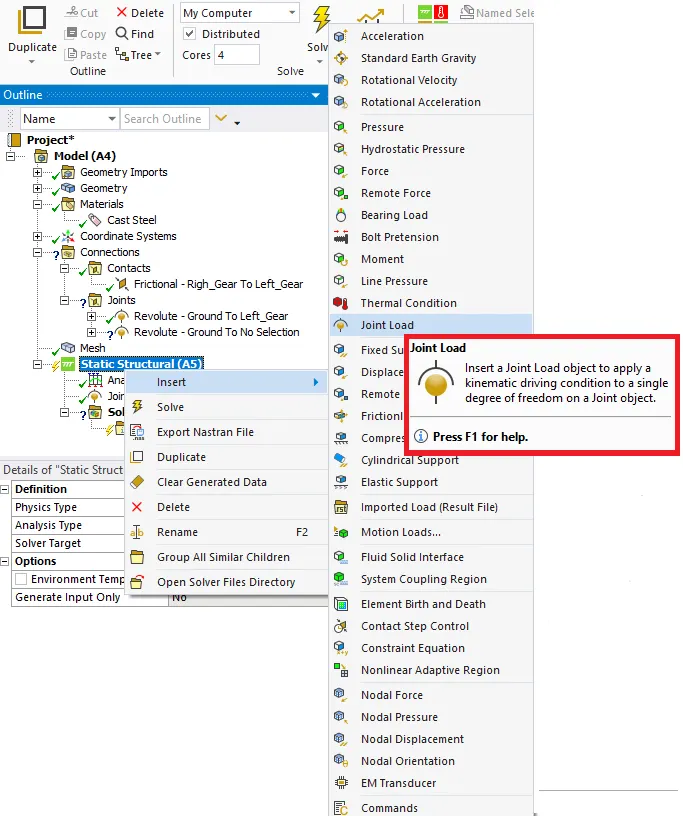
- And then two Joint loads are added in Static structural Tab
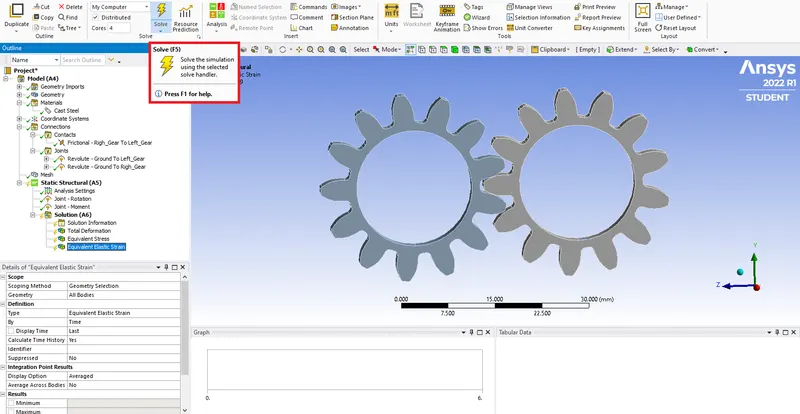
SOLVING RESULTS:
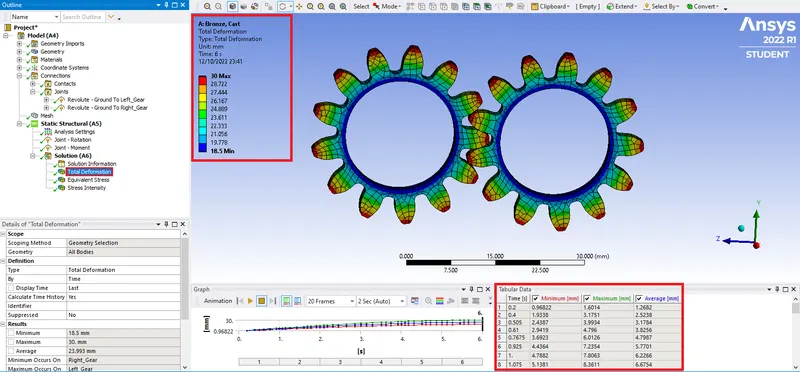
Total Deformation [Case 1] : Bronze, cast
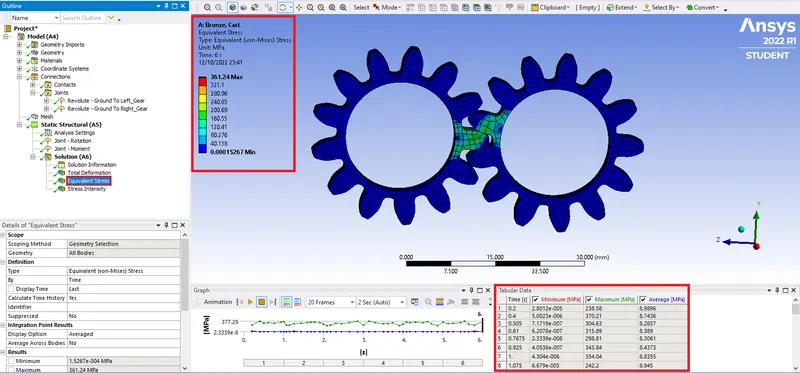
Equivalent Stress [Case 1] : Bronze, cast
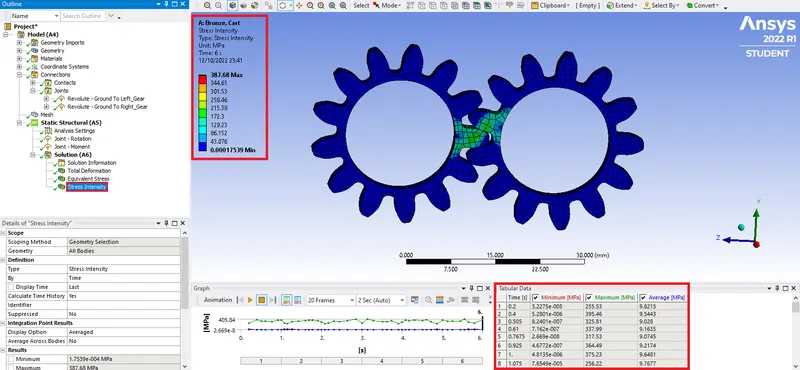
Stress Intensity [Case 1] : Bronze, cast
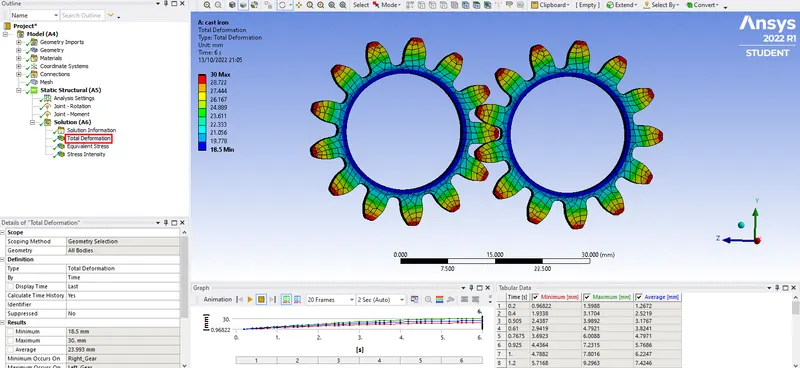
Total Deformation [Case 2] : Cast iron
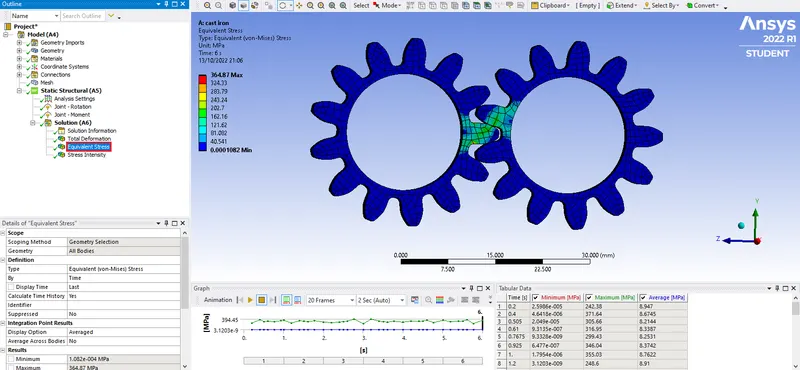
Equivalent Stress [Case 2] : Cast iron
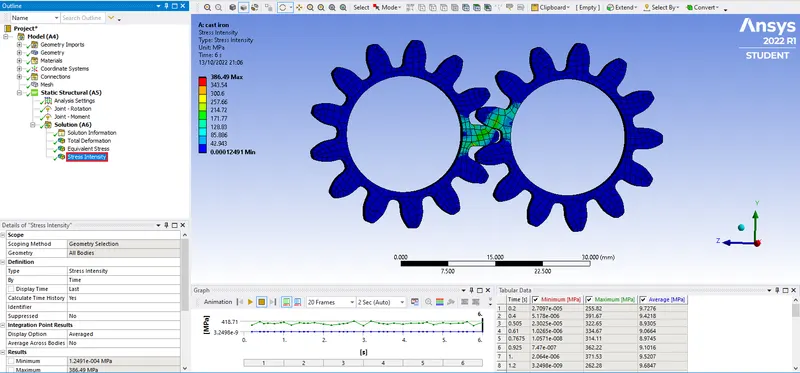
Stress Intensity [Case 2] : Cast iron
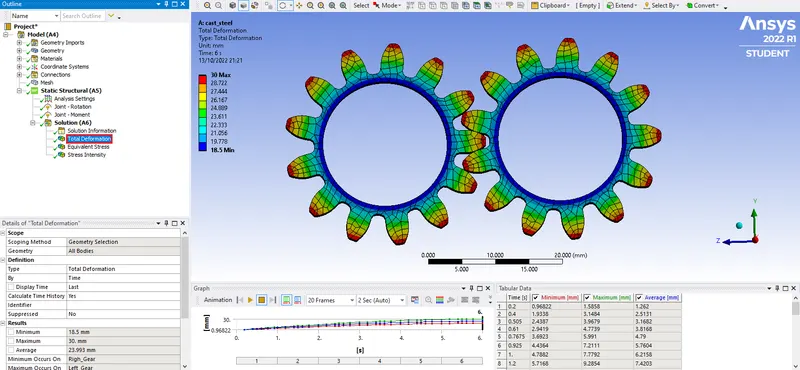
Total Deformation [Case 3] : Cast steel
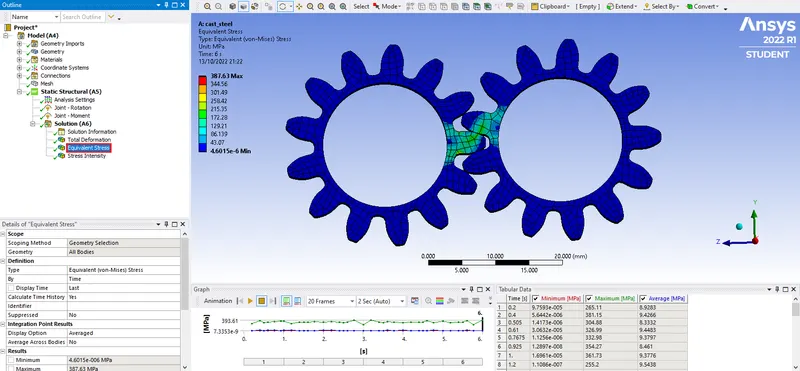
Equivalent Stress [Case 3] : Cast steel
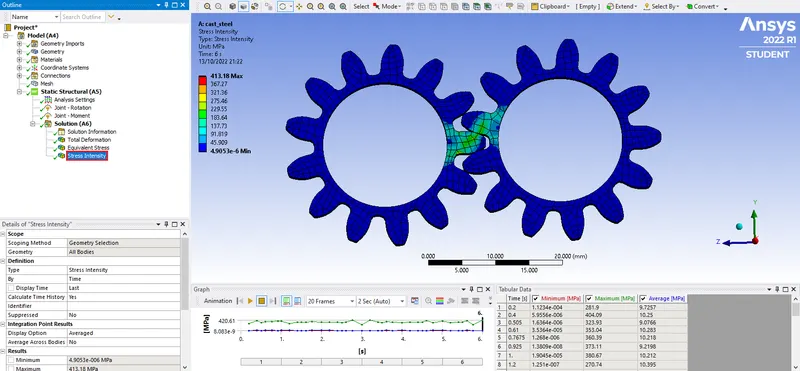
Stress Intensity [Case 3] : Cast steel
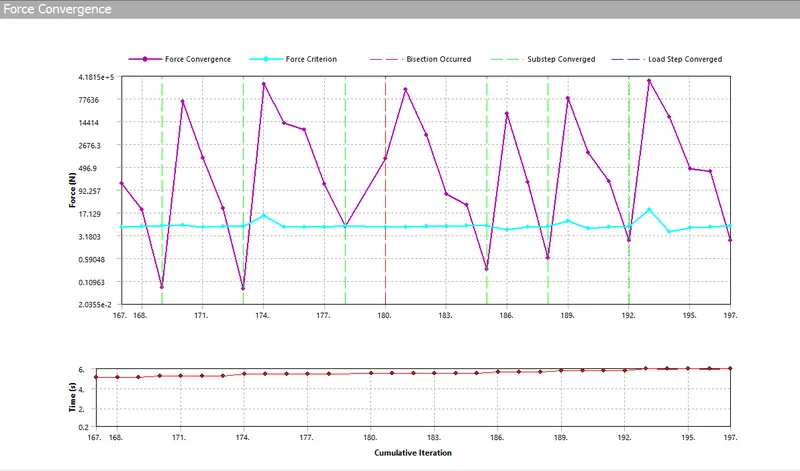
Force Convergence Graph [Case-1] : Bronze, Cast
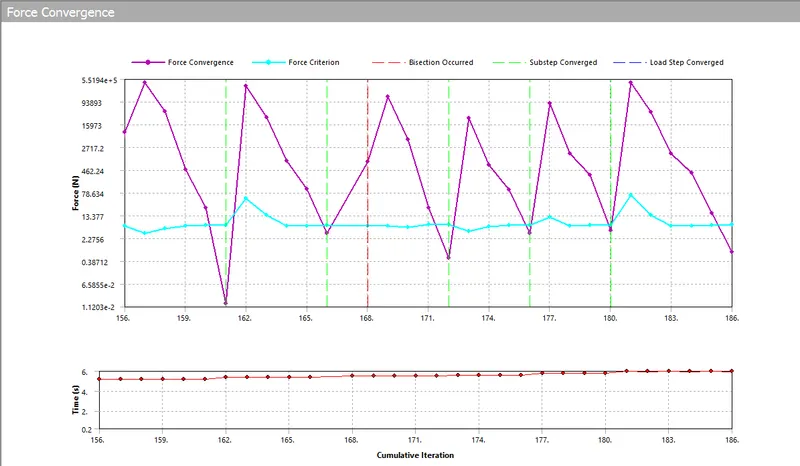
Force Convergence Graph [Case-2] : Cast iron
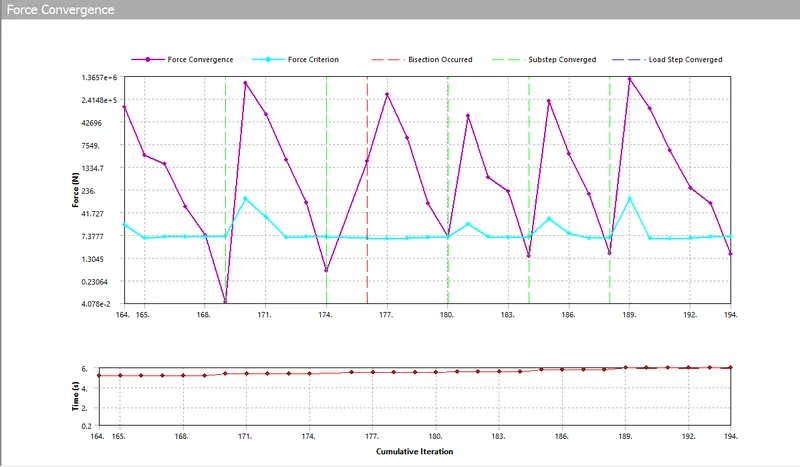
Force Convergence Graph [Case-3] : Cast steel
COMPARISON OF RESULTS:
|
Cases |
Von-Misses Stress (MPa) |
Total Deformation (mm) |
Stress Intensity (MPa) |
|||
|
Max. |
Min. |
Max. |
Min. |
Max. |
Min. |
|
|
Bronze |
361.24 MPa |
0.00015267 MPa |
30 mm |
18.5 mm |
387.68 Mpa |
0.00017539 Mpa |
|
Cast-iron |
364.87 MPa |
0.0001082 MPa |
30 mm |
18.5 mm |
386.49 Mpa |
0.00012491 Mpa |
|
Cast-steel |
387.63 Mpa |
4.6015e-6 Mpa |
30 mm |
18.5 mm |
413.18 Mpa |
4.9053e-6 Mpa |
Here while comparing the results,
- The maximum value of Von-Misses Stress is developed in Cast_steel, The minimum value of Von-Misses Stress is developed in Bronze.
- The maximum and minimum deformation is same for all the three cases.
- The maximum stress intensity is occured in the Bronze and the minimum stress intensity is occured in Cast_iron.
- According to the simulation results for the each case, I'm concluding that Cast Bronze is best in the strenght of materials point of view,Cause the maximum stress developed in the (Cast Bronze) is very less when compared to the other two cases and materials.
- When you see in the fracture point of view,The Cast Iron is preferrable, Cause the stress intensity is very low when you compared to the other two cases and materials.
- The fracture will be occuring at the teeth, Where the gears tooth will be having contact with each other in the spur gears.
- The preferrable material according to the simulation results is Cast Iron, Cause the Stress Intensity is low when compared to the other two cases and if we use Cast Iron as the material for the gears, It lasts longer life.
CONCLUSTION:
In this Week 1 Spur Gear Challenge, I came to know about
- Learned about Stress intensity.
- Learned how and where the stress intensity is occurring.
- Learned how to create manual material cards.
- Learned how to apply boundary conditions to the model.
- Learned how to request outputs and solve the