Week 1 Spur Gear Challenge
Objective: In this challenge, we perform the static structural analysis of spur gears which are made up of three different materials ( Cast Iron, Cast Steel, and Cast Bronze) and we compare these results for total deformation, Stress.
Spur Gears: Gears are the toothed members which transmit power and motion between two shafts by meshing without any slip.
Spur Gears have their teeth parallel to the axis.
Spur Gears transmit the power between two parallel shafts.
Spur Gears are used in high-speed and high-load applications.
Given Geometry: Open the new ANSYS Environment and select the Static Structural Deck.
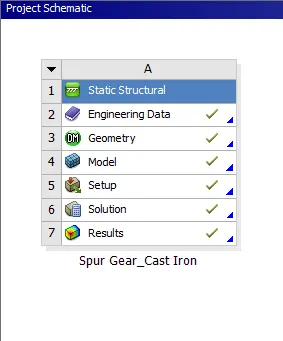
Right Click on the Geometry and Import Spur Gear Geometry.
The Geometry is shown in fig. below
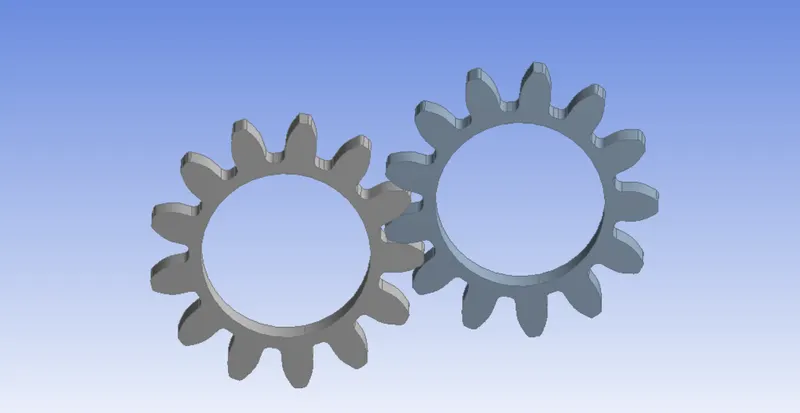
Materials: We want to perform the simulation for three different materials.
Go to Engineering data and search for the materials. If materials are not found there then create the new material library.
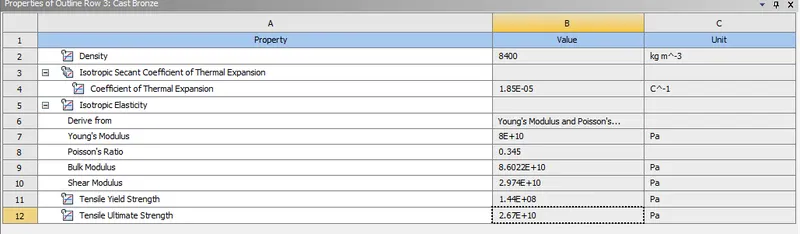
The created materials are shown below.
1) Cast Iron (Ductile):
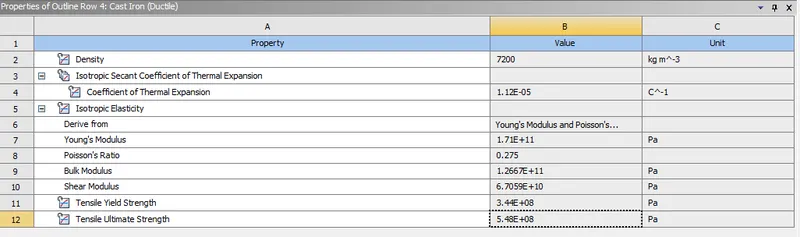
2) Cast Steel:
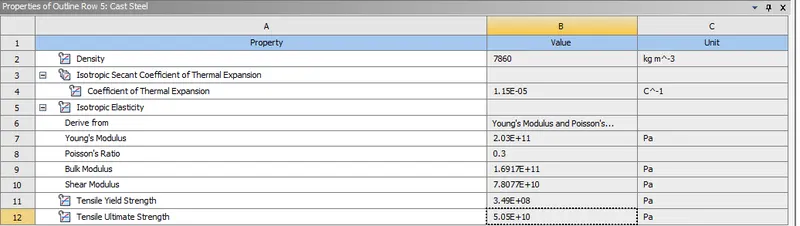
3) Cast Bronze:
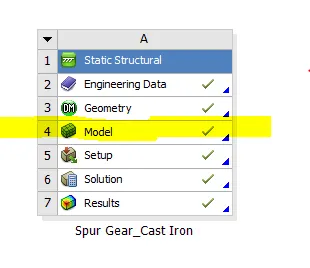
Now, double click on the Modal cell to enter ANSYS Mechanical.
Once we enter in ANSYS Mechanical, Click on the Geometry
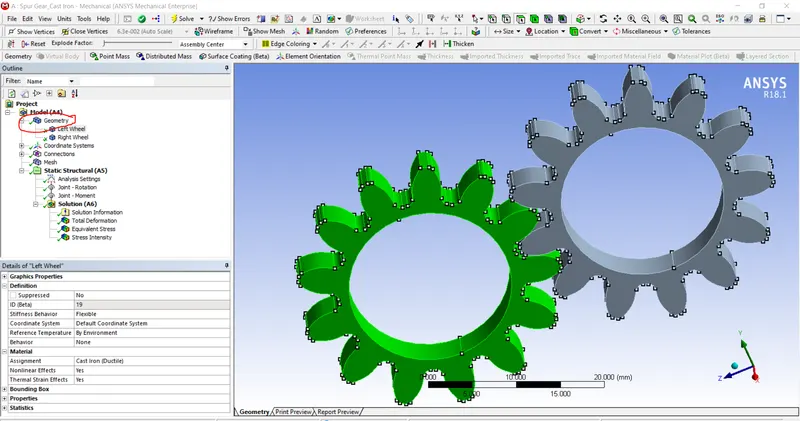
In the detailed box change the material to any one of three which we have created.
Contact: Whenever we import the assembly an automatic contact is generated under the connection branch.
But it is always recommended to create our own contacts as we are familiar with the physical situation of the assembly under which it will operate.
Go to the Connection branch on the left-hand side of the window and right-click > insert > manual contact region
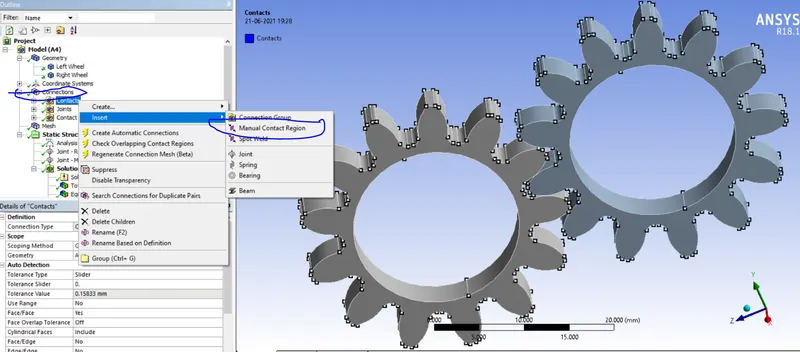
See the Graphics window.
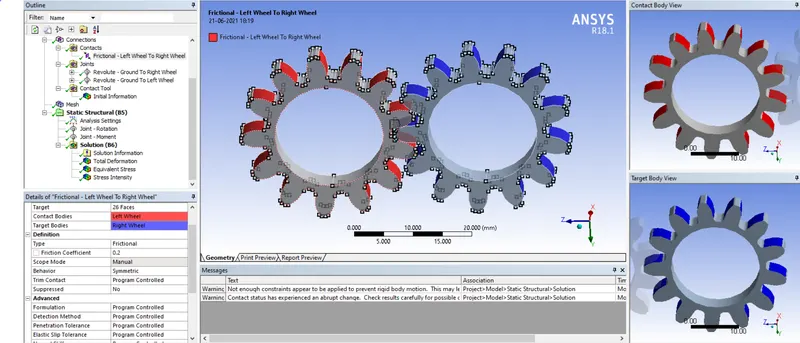
As we can see, we can choose contact and target faces to define the contacts. as this tooths has similar geometry. We can choose a tooth on any one wheel as contacts and a tooth on another wheel as a target.
Keep in mind number of the tooth to be selected is our choice as we are going for analysis of all the tooths when gear rotates, we will select all the tooth faces.
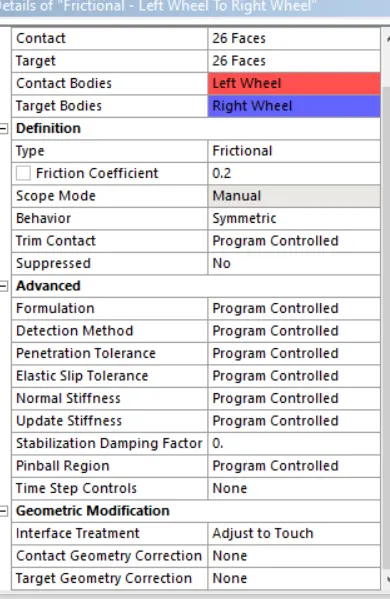
As we want the contact between all the tooths to happen in such case we are allowing the sliding of the tooths so we will be providing the "Frictional" contacts with "symmetric" behavior and "Augmented Lagrange" formulation.
Another thing to keep in mind, as there is a small gap is present in the tooths we have to provide interface treatment as "Adjust to touch".
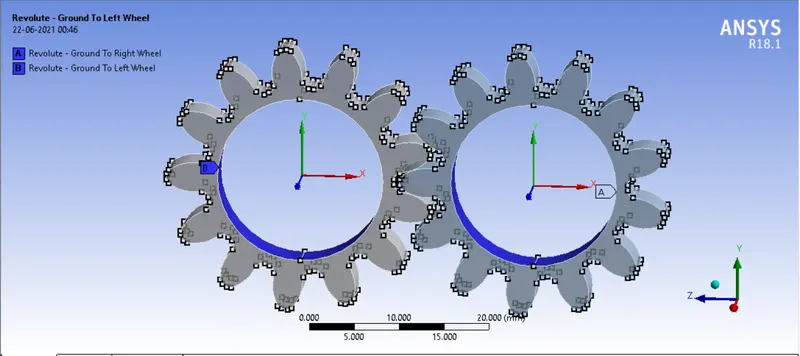
Joints: As we want to rotate the gear we have to provide the "Revolute Joints" at its center.
Go to "Connection > Insert > Joint"
Analysis Settings: As we are provided the "Frictional Contact" the analysis is going to be non linear one.
Hence, in analysis settings we use "Large Deflection: on" and "Auto Timestepping: on"
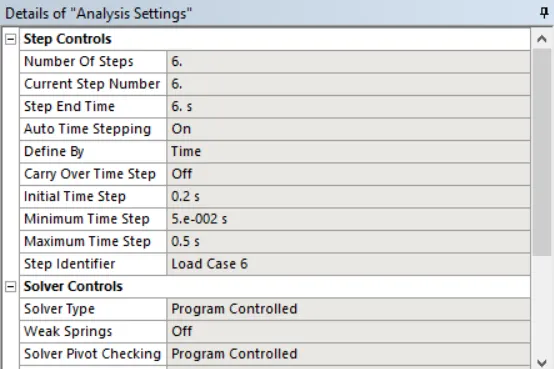
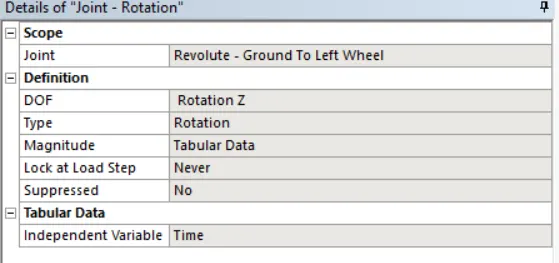
Load Conditions: We are rorting one gear about Z-direction through 180 degrees so, we have given the 6 load steps. in each load step, the rotation of the wheel is 30 degrees.

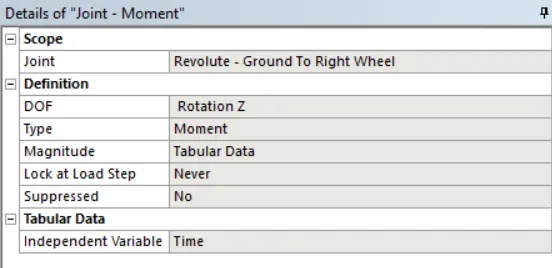
Now, we will give the moment of 10000 N-mm to the other gear, this load is constant through all 6 steps.

Now, solve the deck.
Results:
1) CAST IRON:
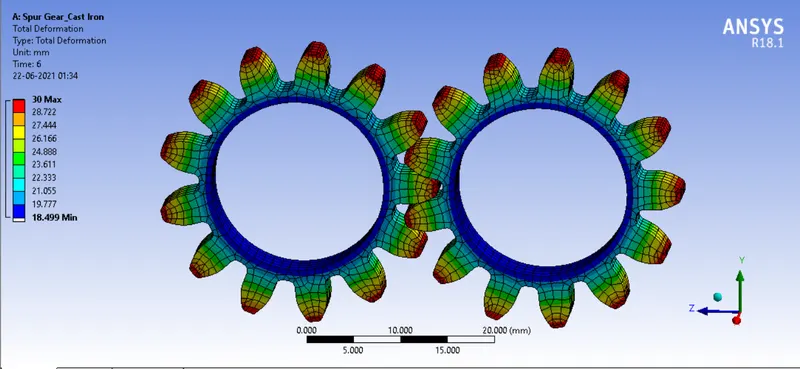
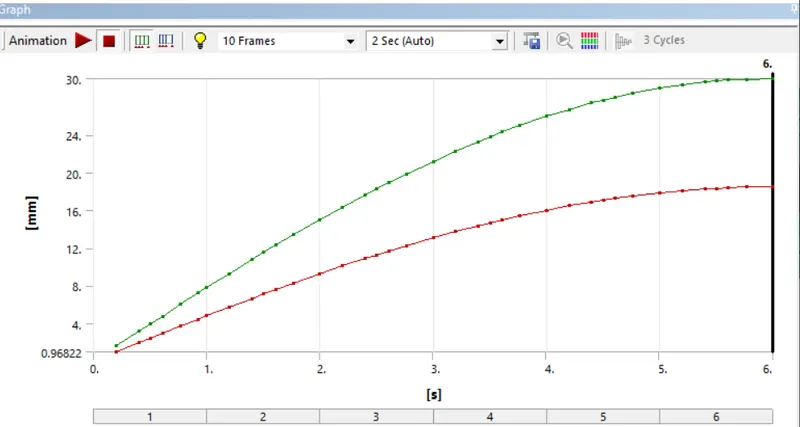
a) Total Deformation:
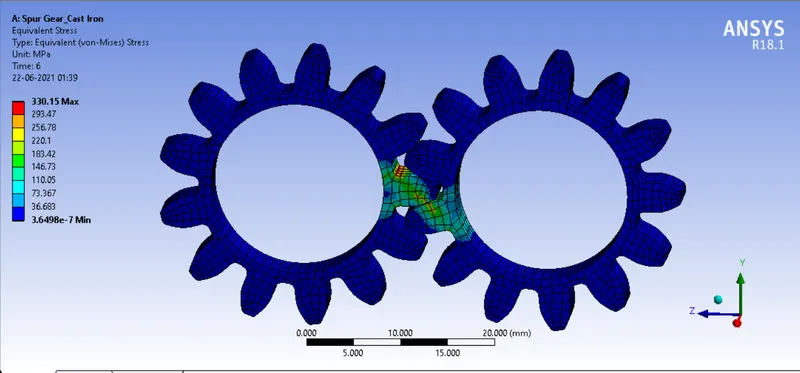
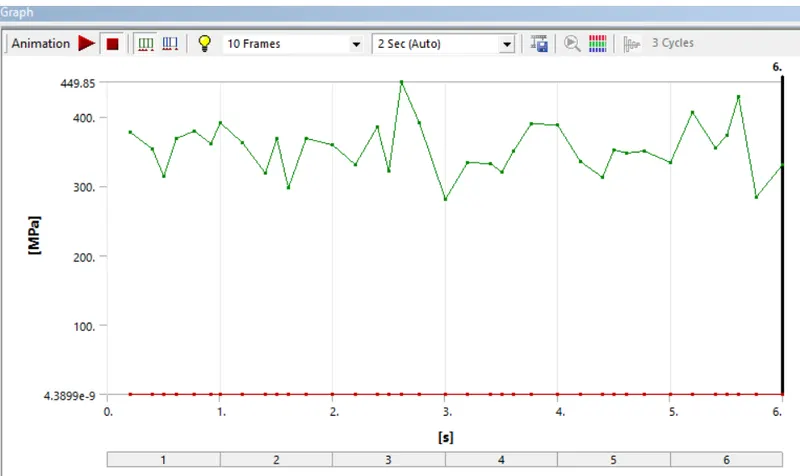
b) Maximum Equivalent Stress:
c) Stress Intensity:
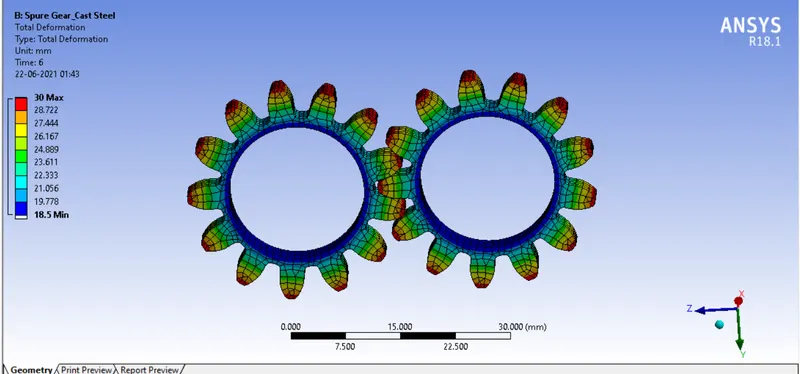
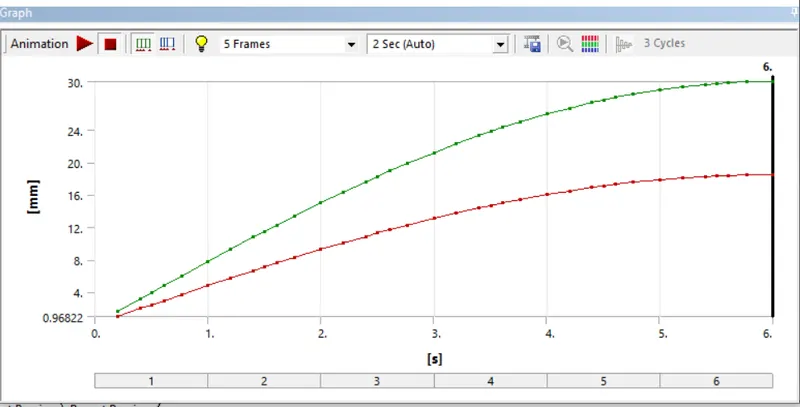
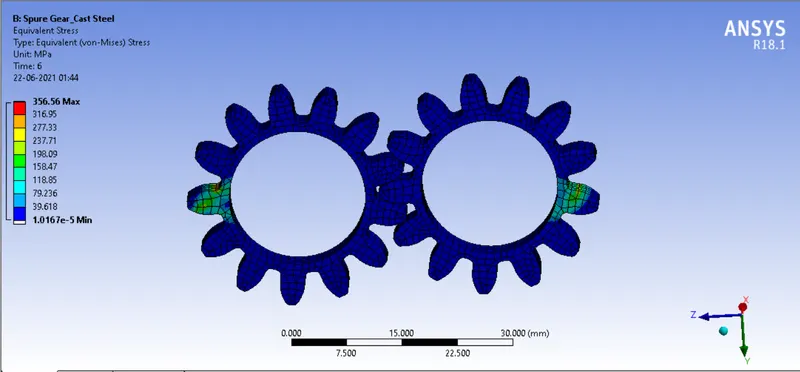
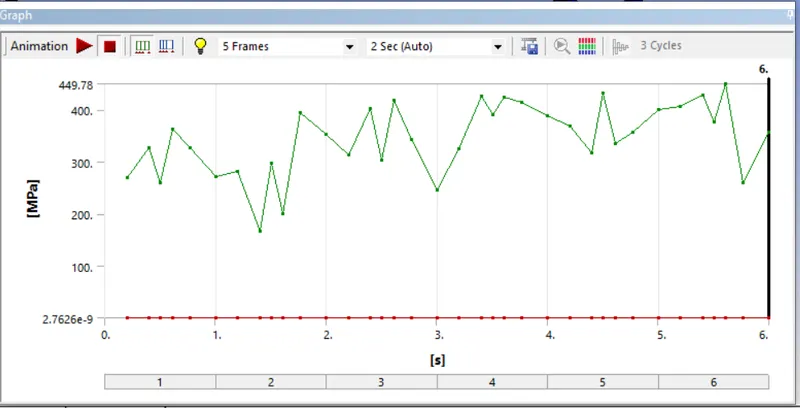
2) CAST STEEL
a) Total Deformation:
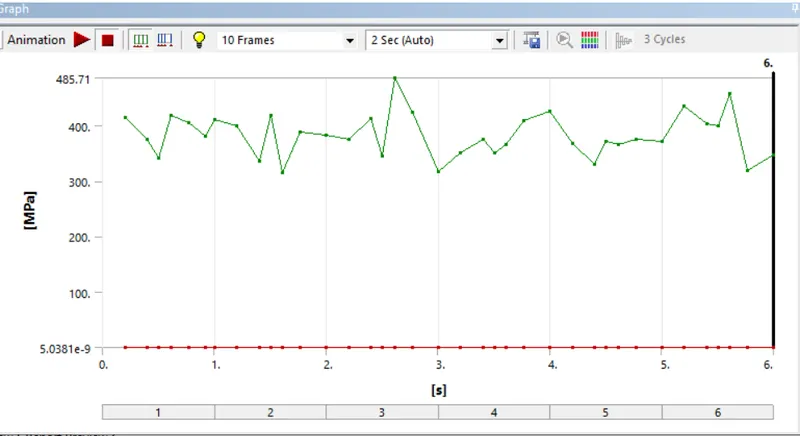
b) Maximum Equivalent Stress:
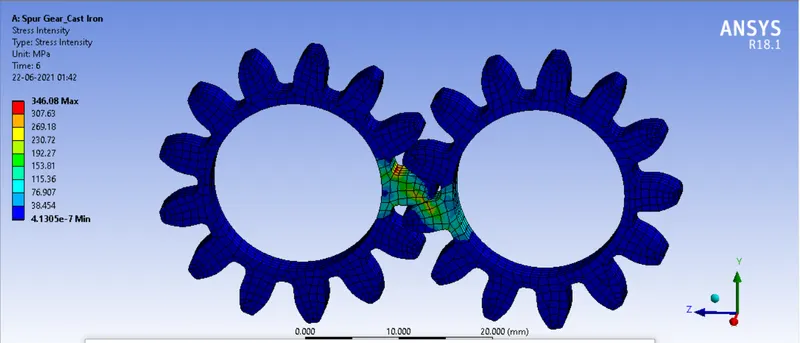
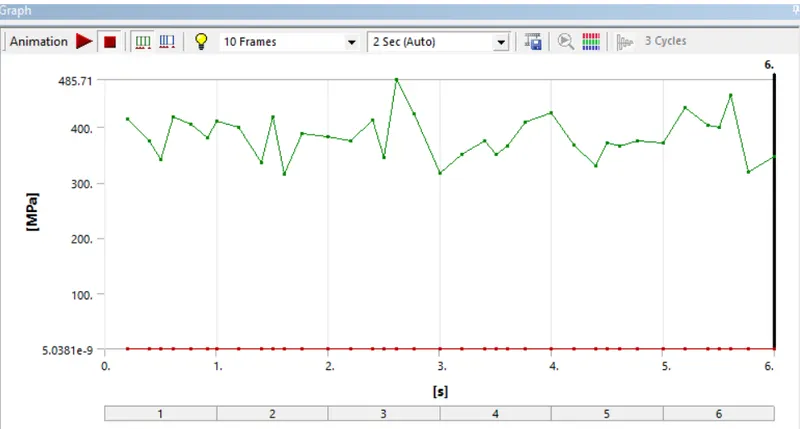
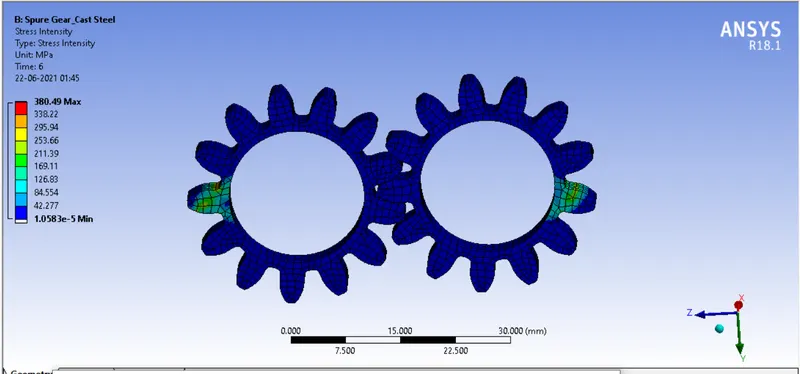
c) Stress Intensity:
3) CAST BRONZE:
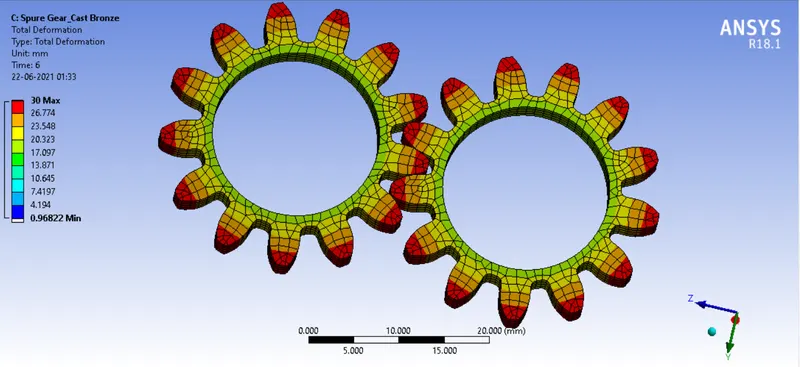
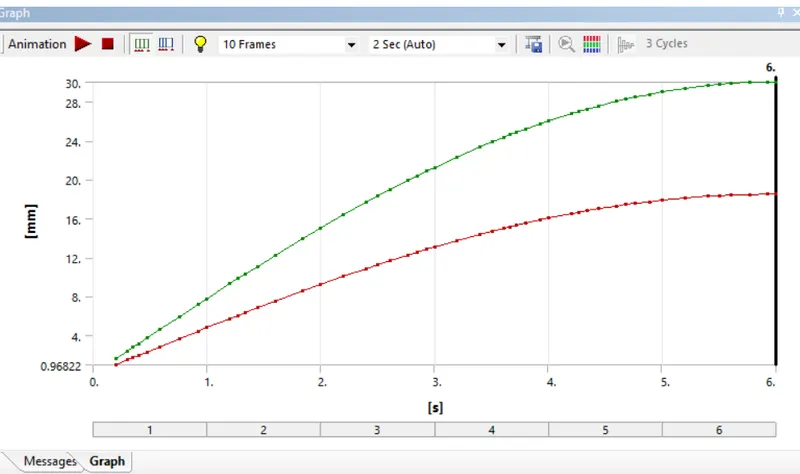
a) Total Deformation:
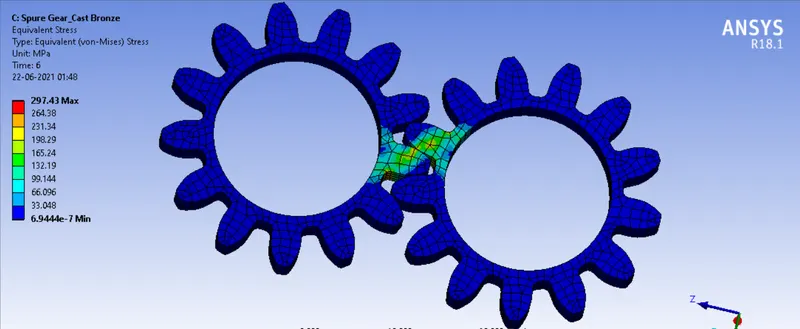
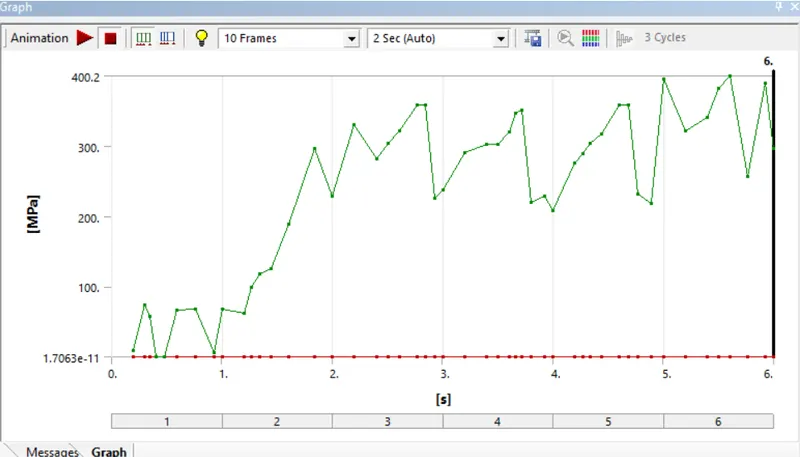
b) Maximum Equivalent Stress:
c) Stress Intensity:
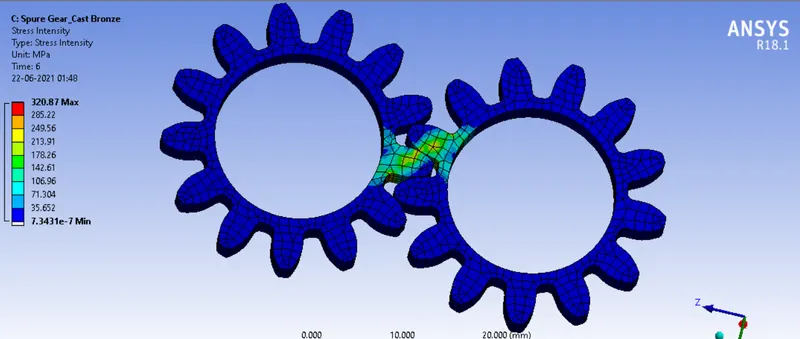
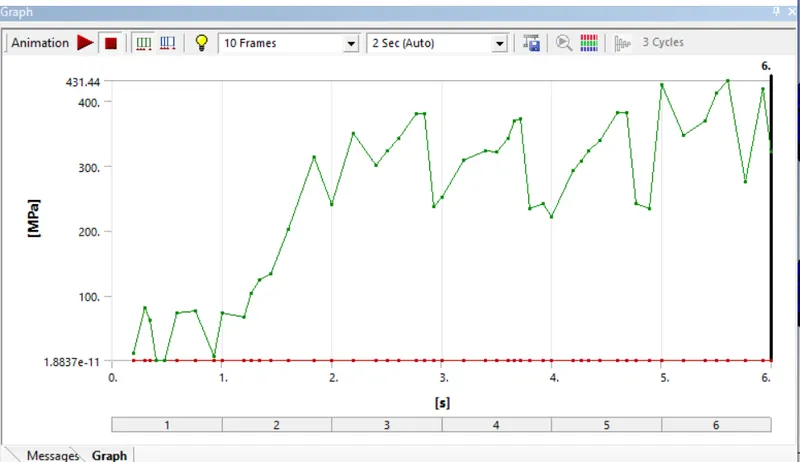
Stress Intensity: Stress intensity is a state of stress near the discontinuity or near notch, and it signifies that at the particular location the fracture may start or crack may generate.
Conclusion:
| Material | Total Deformation ( in mm) | Max. Stress ( in Mpa) | Yield Limit |
| Cast Iron | 30 | 330.15 | 344 |
| Cast Steel | 30 | 356.56 | 349 |
| Cast Bronze | 30 | 297.47 | 144 |
From the stresses induced ( as shown in the table), we can see that Cast Iron is the most suitable material for the manufacturing of the gears.