Week 1- Mixing Tee
Mixing Tee
Aim:-
- Set up steady-state simulations to compare the mixing effectiveness when the hot inlet temperature is 36C, and the cold inlet is 19C.
- Try both the k-epsilon and k-omega SST models for the first case to get proper judgment about each method; later, use the most suitable model for further simulations.
- Simulate each case for the given velocity and momentum ratio.
- Compare results from the 2 cases about cell count, average outlet temperature, and the number of iterations for convergence.
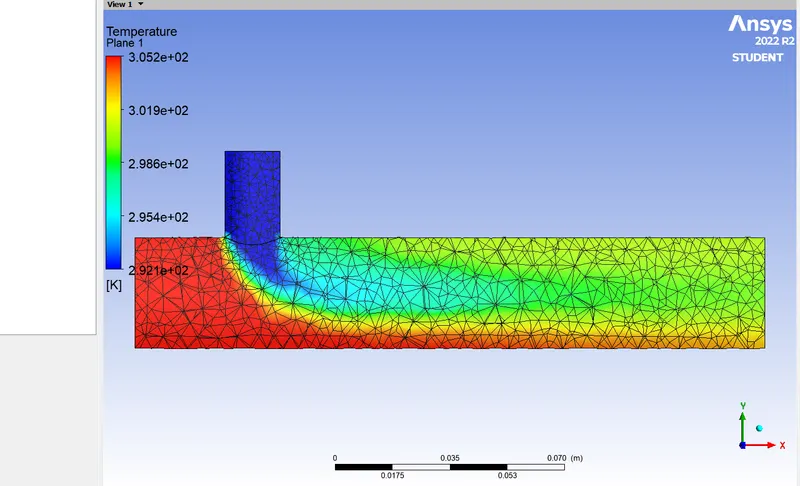
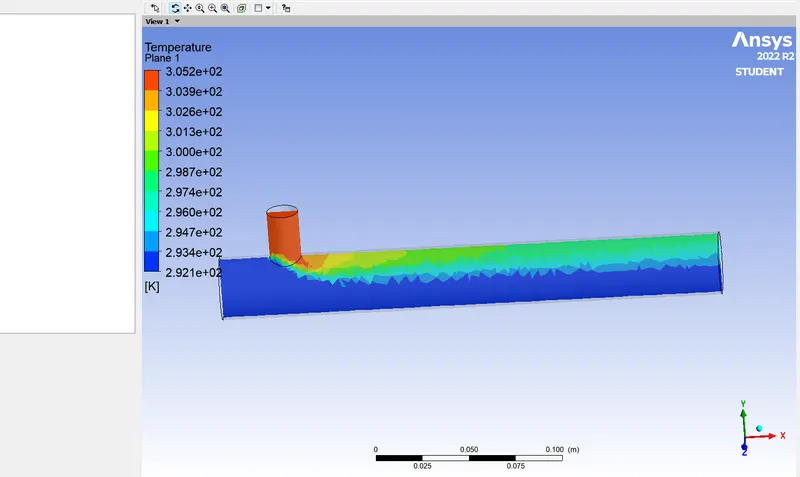
- Plot the velocity and temperature contour plots on the cut plane along and across the pipe.
- Also, plot the velocity and temperature line plots along and across the length of the pipe.
- Perform Mesh independent study for any one case.
- Moreover, discuss the effect of length and momentum ratio on results.
- Lastly, for each simulation, show the convergence plot.
Objective:-
- Understand and define the problem statement for each case.
- Open Ansys workbench and set up a fluent simulation setup, and rename it accordingly.
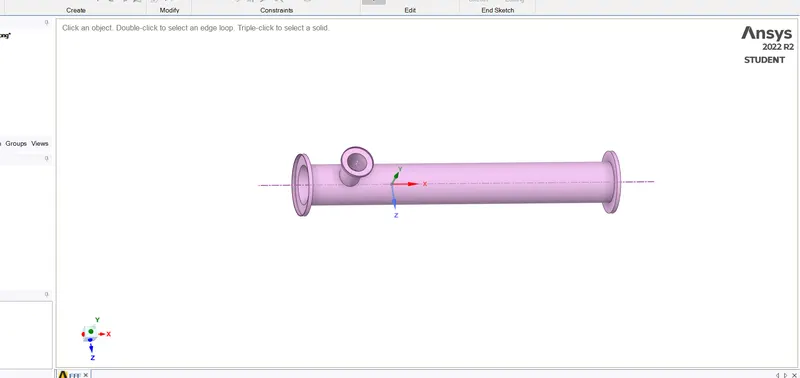
- From fluent setup, open space claims, and Load the geometry. Extract the working fluid region from the loaded geometry to compute simulation in that particular region. And then close space claim.
- Next, in mesh setup, provide boundary names for each surface and generate mesh to the fluid flow volume. Close mesh setup and update the mesh.
- Later, in the setup section, provide all the required parameters according to the simulation, such as simulation type, input velocity and temperature, materials (working fluid), and other user-defined parameters.
- In setup parameters, understand the concept of k-epsilon and k-omega SST and find out which is convenient for the current simulation.
- Afterward, simulate our problem setup for the number of iteration required to converge our results.
- Then, close and update the setup. Open the results section to see all the simulated results.
- Juxtapose generated results from each case for their cell count, average outlet temperature, and the number of iteration for convergence.
- Display contour plot on the cut plane to visualize velocity and temperature distribution along and across the mixing tee’s length.
- For a more detailed examination, plot velocity and temperature line chart along the mixing tee’s length.
- Validate the test by performing a mesh independence study on any one case.
- Study the effect of length and momentum ratio on the results of each case.
- Plot the convergence graph to verify that all the results are fully converged after running numerous iterations.
Problem Setup
Understand k-epsilon and k-omega SST by considering case-1
Case-1
Short mixing tee
a - Simulation-1
hot Inlet velocity - 3m/s
Momentum ratio - 4
b - Simulation-2
hot Inlet velocity - 3m/s
Momentum ratio - 2
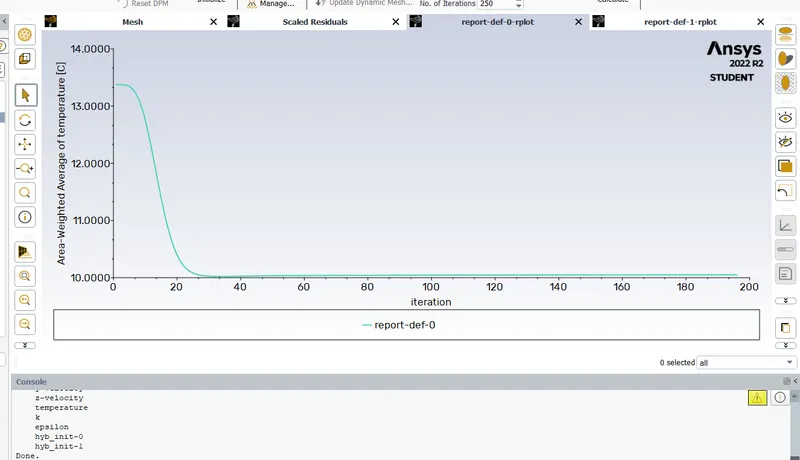
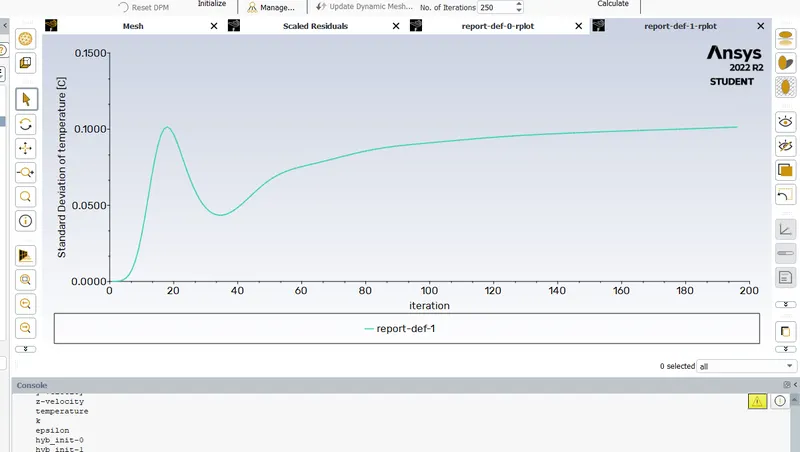
Let us start with analyzing the best method to converge the solution for this particular case by studying two methods: k-epsilon and k-omega SST.
The aforementioned methods use simulation of turbulence modeling where k-epsilon models predict flow virtually far from the boundaries (wall), and the k-omega model predicts near the wall.
The selection of model depends on the specific problem; no turbulence model suit for every case. Fine-tuning requires the SST model that used good mesh at the boundary, and with wall treated usually works in the most case; it is a problem specific.
Our first study will set two setups, one for k-epsilon and another for k-omega SST. Here, we are going to use the same geometry and mesh for both cases of simulation. Hence, we are going to use a short mixing tee model and mesh it.
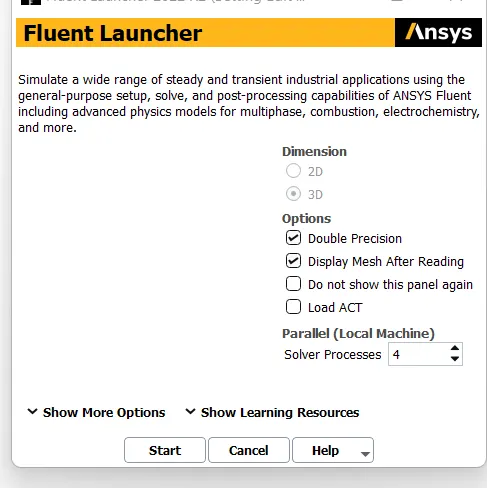
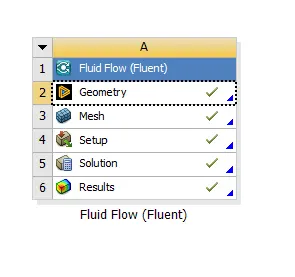
At first i have to open workbench. then first drag the fluid flow fluent option for working on it.
then i have to open the file that i have to work on it, then go to the geometry space claim option, then open the file then go to prepare option then go to volume extract option then select the edges of the surface and go to suppress for physics,
then close that
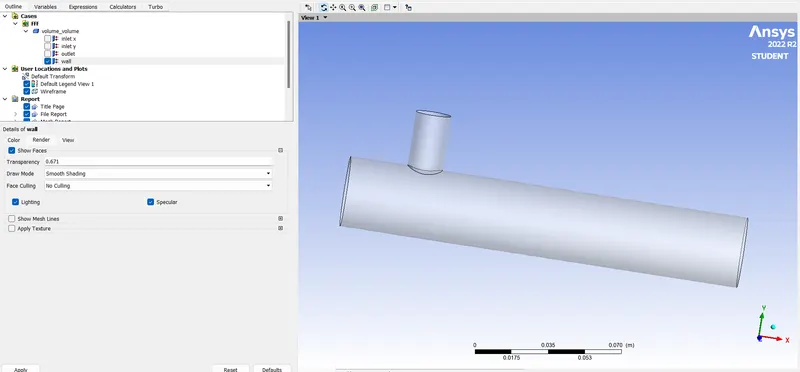
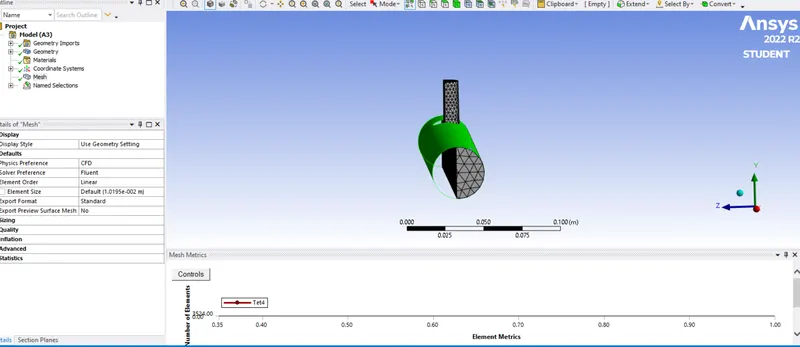
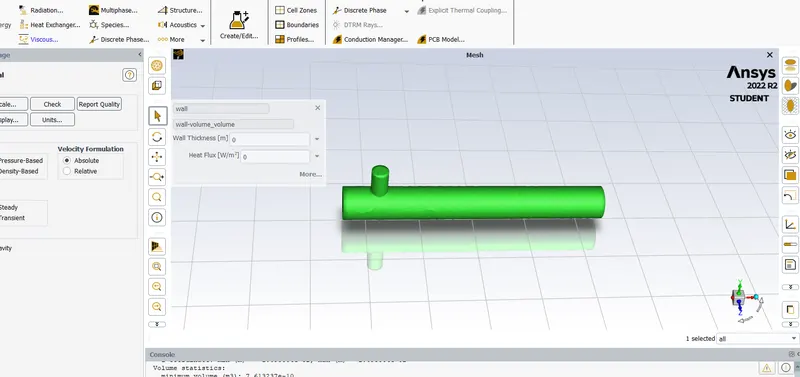
after closing this we have to go to mesh process where i can name the edges then i have to name the surface mouth then name inlet 1 inlet 2 and outlet and wall also,
then mesh it and close it
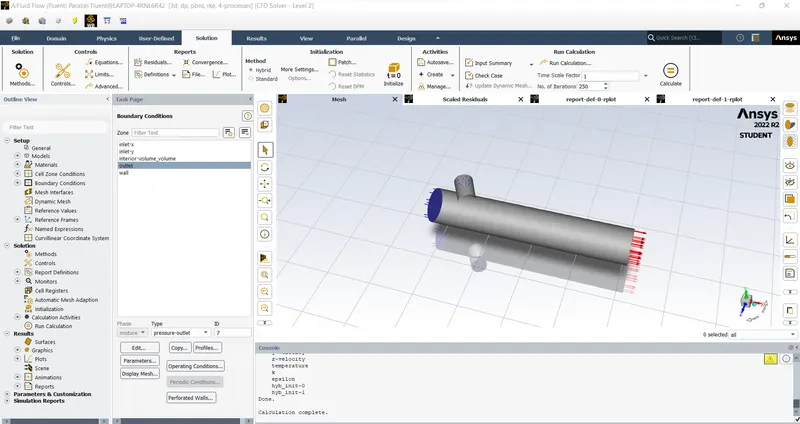
then go to set up option and there many option available.
cell zone , boundary zone etc.
there we worked very well.
then go to solution and then initialize. then close it,
then go to the result then work on it,

final thing
Case-2
Long mixing tee
a - Simulation-3
hot Inlet velocity - 3m/s
Momentum ratio - 4
b - Simulation-4
hot Inlet velocity - 3m/s
Momentum ratio - 2
same process for mixing tea long
At first i have to open workbench. then first drag the fluid flow fluent option for working on it.
then i have to open the file that i have to work on it, then go to the geometry space claim option, then open the file then go to prepare option then go to volume extract option then select the edges of the surface and go to suppress for physics,
then close that
after closing this we have to go to mesh process where i can name the edges then i have to name the surface mouth then name inlet 1 inlet 2 and outlet and wall also,
then mesh it and close it
then go to set up option and there many option available.
cell zone , boundary zone etc.
there we worked very well.
then go to solution and then initialize. then close it,
then go to the result then work on it,
Conclusion:
- k-epsilon models predict flow virtually far from the boundaries (wall), and the k-omega model predicts near the wall. As in this case we need a flow simulation turbulent model far from the wall, therefore, the k-epsilon method is used.
- Solving the first simulation on the fluid domain using coarse mesh gives an initial overview of the analysis which converges results fast. As element number increases the convergence time also increases. Therefore, after obtaining the rough results using coarse mesh simulation successfully we can improve mesh quality and get to final accurate results doing this saves a lot of time which is also extremely helpful for mesh independence test.
- To get better mixing at outlet high velocity of flow is very effective. Therefore, a higher momentum ratio gives better mixing of hot and cold fluid stream at the outlet.
- As the Length of the mixing tee increases because diffusion flow always gives slightly better mixing of two-fluid.
- Finally, in the above cases, it is very important to use a short mixing tee with a momentum ratio of 4 to get precise results but one has to consider the diffusion of flow along the length of the mixing tee, a long mixing tee with momentum will be the greater option.