Week 2 Challenge : Surface meshing on a Pressure valve
Aim: Surface meshing of pressure valve with different target length.
- Target length = 1mm, 3 mm and 5 mm (i.e. 3 cases)
- Element type = Tria
Procedure
- Topo-Cleanup:
- The first thing need to be done is to check for single cons and triple cons in the model. Sinle cons are cons that are shared with one surface only which indicates open surface. Such open surfaces are not expected in a closed geometry so that need to be resolved. Triple cons are formed due to con shared with three surfaces and that also need to be resolved on the basis of weather it is desired on that place or not. Triple cons are not always errors but that shows the local volume may form due to those faces. These single and triple cons are identified using Geometric checks.
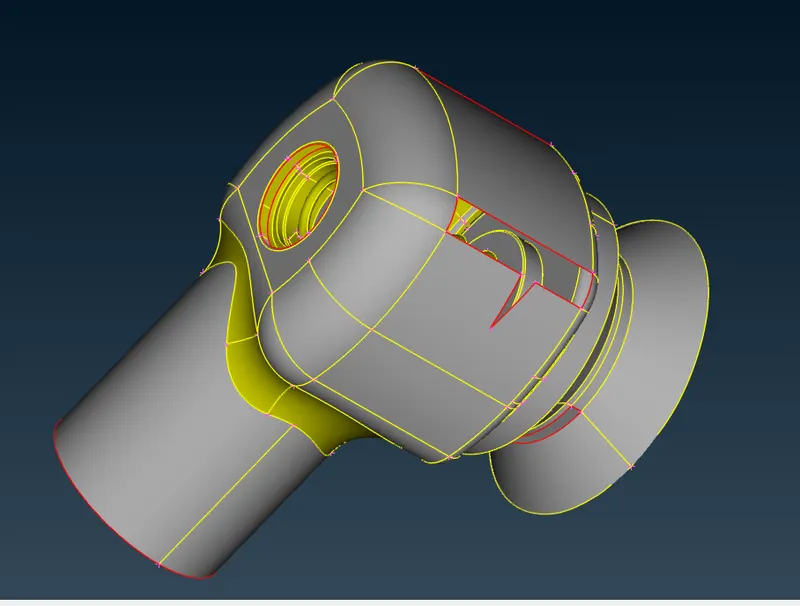
Figure 1
- It can also be seen by disabling the double cons from bottom bar with wire frmae mode (cntrl+shift). We observed various single cons and few triple cons. There are few open surfaces that are forming single cons and it is filled by creating surfaces in FACES option.
Faces - New - COONS / Fitted / Existing Surface/ Planar - suitable option is selected accordingly and surfaces are filled.
- At many places the one or more than one of these options may give satisfactory results, so suitable method is chosen based on most satisfactory surface creation. For a closed regions we also can use Fill hole option, under CONS section inside ‘Topo’ Deck.
- In a complicated geometry forming a whole surface may not work properly so surface need to be created in small parts. Geometry should be closed for CFD analysis so surface at bottom , top and at side are closed using fill hole option or Coons option.
- At the bottom hole the triple con is formed after closing the surface and that triple con is obvious there due to three surfaces are coming in contact, so it is not treated as an error there.
The final model after topo-cleanup will be free from single con, undesired triple con and unnecessary surfaces as shown in figure.
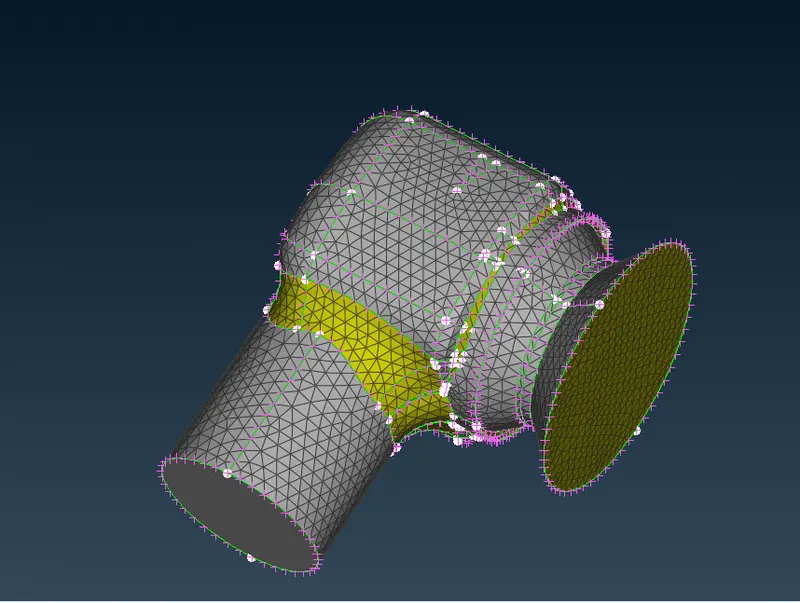
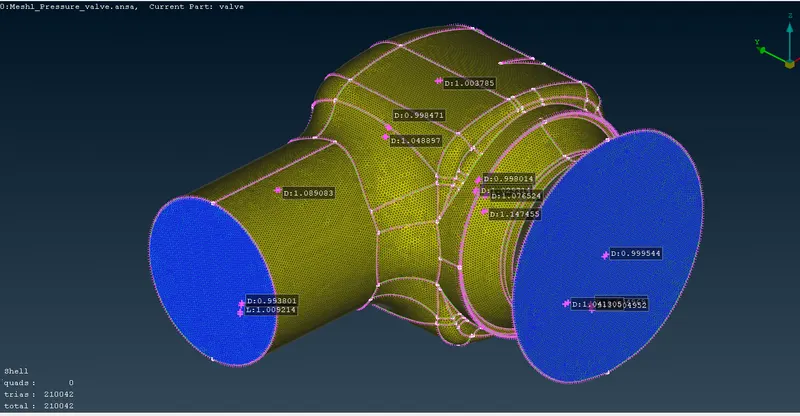
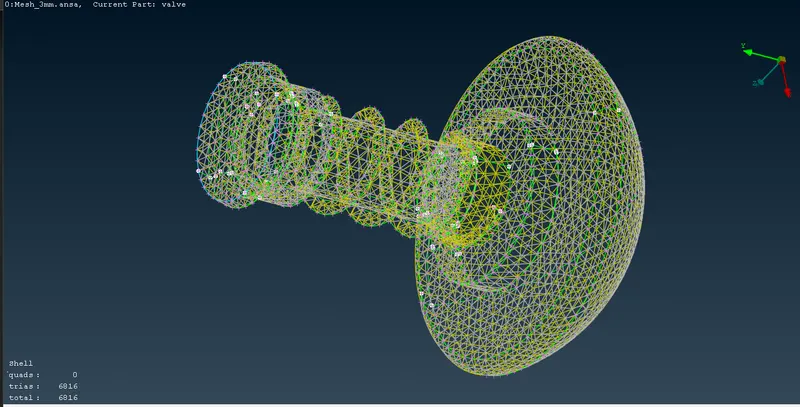
Mesh is generated for three lengths 5mm, 3mm,1 mm respectively.
with the help of these tools i can get the meshes.
shows the pressure valve for 5mm.
shows the pressure valve for 1mm.
shows the pressure valve for 3mm.
Conclusions
1. Mesh size of 1mm will be more suitable as compared to 5mm and 3mm due to accuracy in capturing exact profiles of spring and head which are free from any distortion of surfaces. This also verify that when ver the mesh length exceeds the size of any geometrical entity it tends to distort the geometry which may led to wrong interpretation of physics happening at that location and may also cause error in transforming information from neighbouring cells.
2. As mesh size becmes finer the number of cells increases rapidly. So the differnt mesh zise for different component will we suitable to avoid usage of more computational resources and computational cost.
links :
3mm : https://drive.google.com/file/d/1d7yKm9H0DihTEu1O0gkBsDbeUb_k9fBo/view?usp=sharing
1mm : https://drive.google.com/file/d/1UKJVCV0dwZtCR7S9UEqx9iBIRy3z7kWs/view?usp=sharing
5mm : https://drive.google.com/file/d/1MfcUnLXCVzoCZ26K3FZBKjbSN57ZvG_D/view?usp=sharing\
Thank You.