Week 1- Mixing Tee
AIM- To simulate the mixing of the cold and the hot air in the tee and the mixing will get the desired quantities. To give different velocities of the cold air and the length of the tee is varied to find ou the value of the temperature of the resultant mixed air.
Introduction- The functioning of the mixing tee is to provide mixing of the quantities to get the desired result as an outlet.
By controlling the desired velocity of chilled air we can get the desired temperature in the room.
Geometry- Construct a 2 or 3D representation of the object whose design is being provided in the video section. The object to be modeled and tested using the work plane coordinate system with Ansys.
Procedure- 1) The geometry of the section is opened in the spaceclaim CAD software package of the Ansys workbench.
2) Then the unnecessary corner areas are removed from the geometry by using the prepare option and in this volume extract and select the edges and surfaces are suppressed and the solid part of the geometry is only taken into consideration for the meshing part.
3) Next step is the meshing of the geometry to obtain the finer cells containing a node in the cell where the governing equations are to be solved to obtain the velocity and temperature distribution. \
Meshing is the process of generating the numerical grid to a fluid body and boundary so that the velocity and temperature distribution is obtained in each of the nodes. When you need to solve a differential equation or a system of differential equations, it’s often the case that a numerical technique is used. Flows in systems with simple geometry can sometimes be solved by hand, but even simple flows in complex geometries require numerical solution methods. With these numerical methods comes the need to define a grid of points in space and time to define the solution space for the problem at hand.
#) The geometry of the T joint-
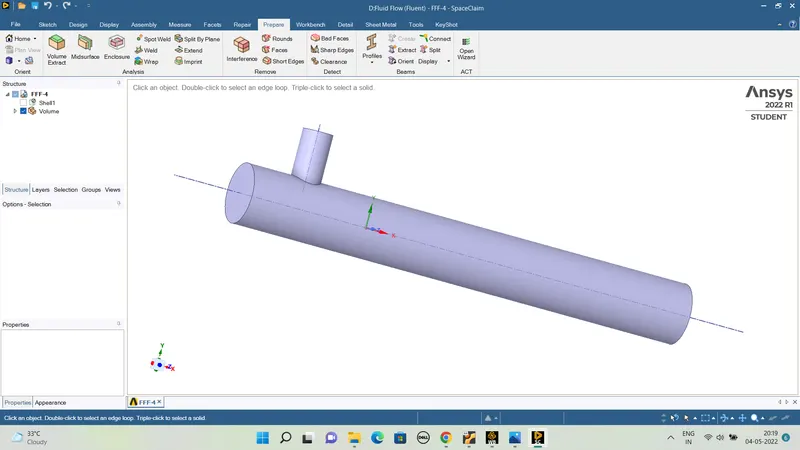
#) Case 1-Short tee with the k-epsilon and the k - omega model and the two cases of momentum ratio of MR = 2 or 4.
#) The names given to the point where air enters into the face 1 , face2 and the outlet of face3-
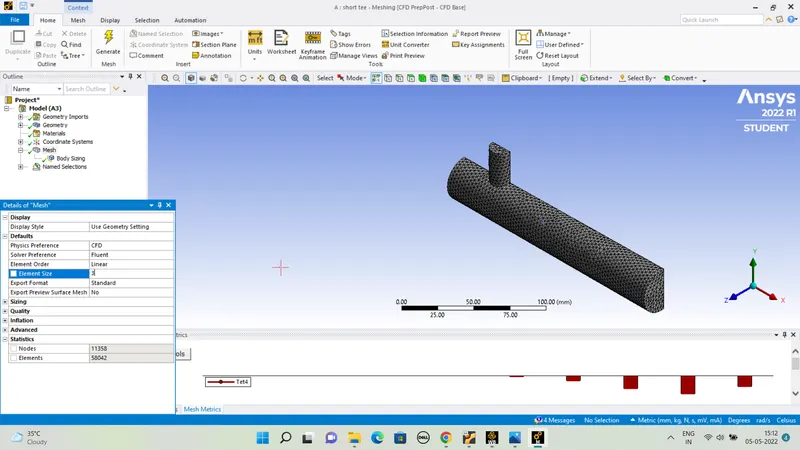
3) The structure of the meshed short Tee structure-
#) Setup and the solution-
case1-
- Short mixing tee with a hot inlet velocity = 3m/sec.
-momentum ratio of 2 to 4 .
Case 1.1-
- Short mixing tee with hot inlet velocity = 3 m/sec.
- momentum ratio = 2 .
Short tee(MR=2, Hot inlet velocity =3 m/sec)
Setups-
K-epsilon K-omega
1) Solver type- Pressure based Pressure based
2) Velocity formulations Absolute Absolute
3) Time steady steady
4)Viscous model Realizable k-epsilon with standard K-omega shear stress transport
wall function
5)material Air Air
6)Cell zones
Fluid type-air fluid type - air
Fluid type-air
inlet_x(velocity inlet) inlet_x(velocity inlet)
velocity magnitude = 3 m/sec.
velocity magnitude = 3 m/sec Temp = -36 deg celsius
Temp = -36 deg celsius inlet_y(velocity inlet)
inlet_y(velocity inlet)
#) Boundaries- velocity magnitude = 6 m/sec velocity magnituder= 6 m/sec.
Temp = -19 deg celsius temp = -19 deg celsius
outlet(pressure outlet) Outlet(pressure outlet)
Gauge pressure = 0 pascal gauge pressure = 0 pascal
walls- stationary walls walls- stationary walls
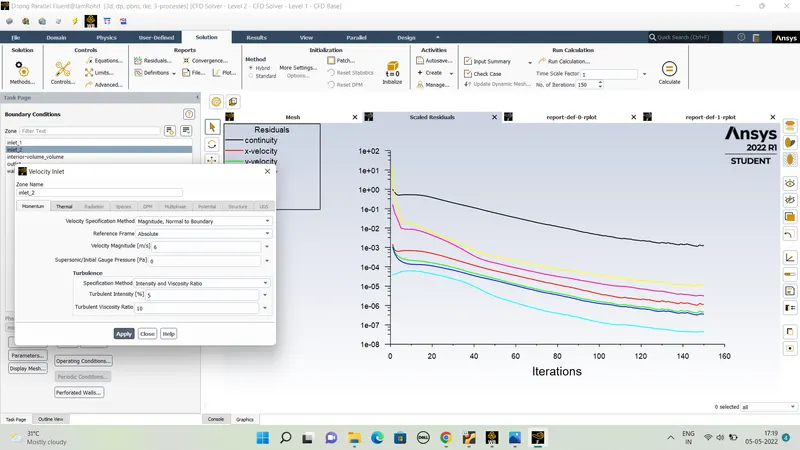
#) The hybrid scheme is used for iniialization and the number of iterations are setup
3) The results for the k- epsilon model and the velocity for v = 3m/sec and the momentum ratio of 2=
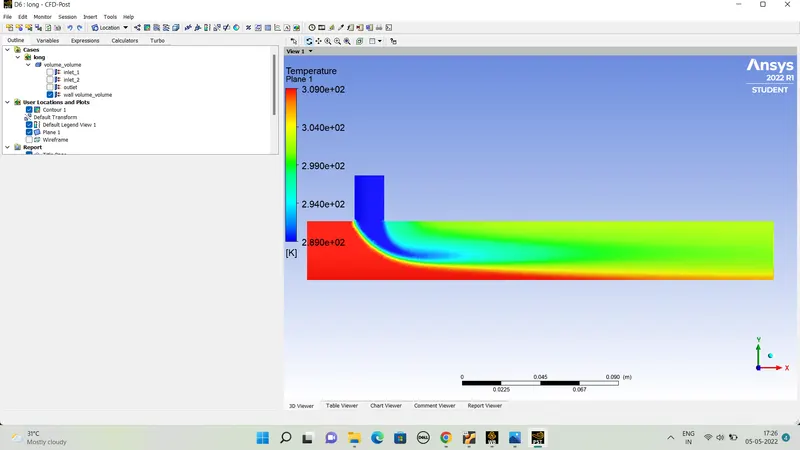
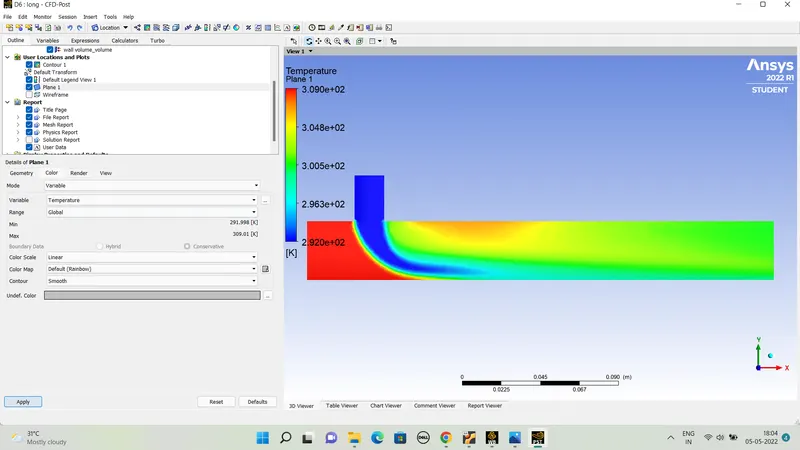
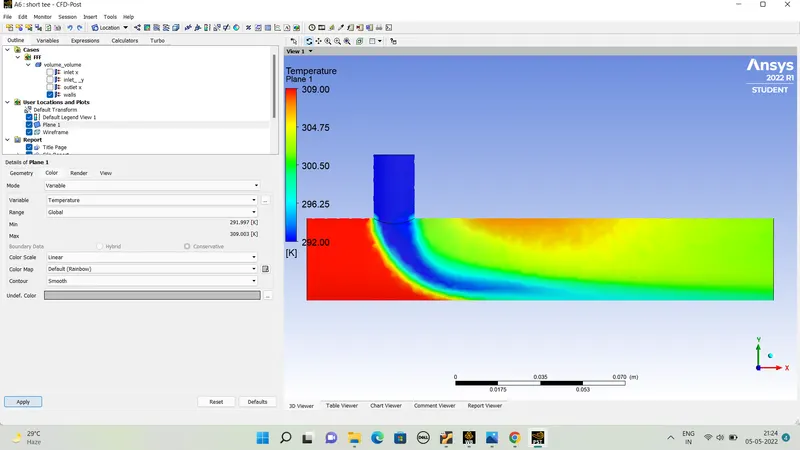
The temperature contour-
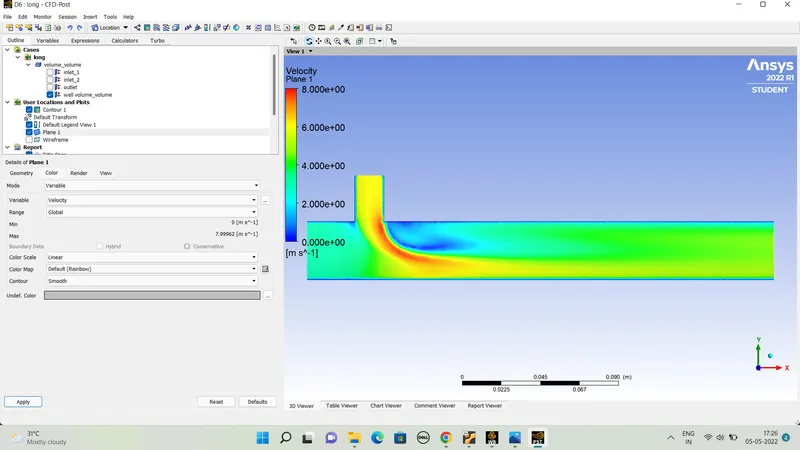
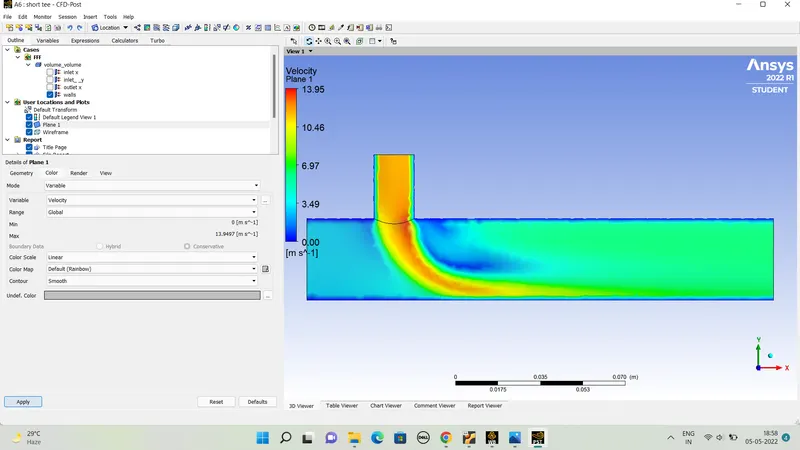
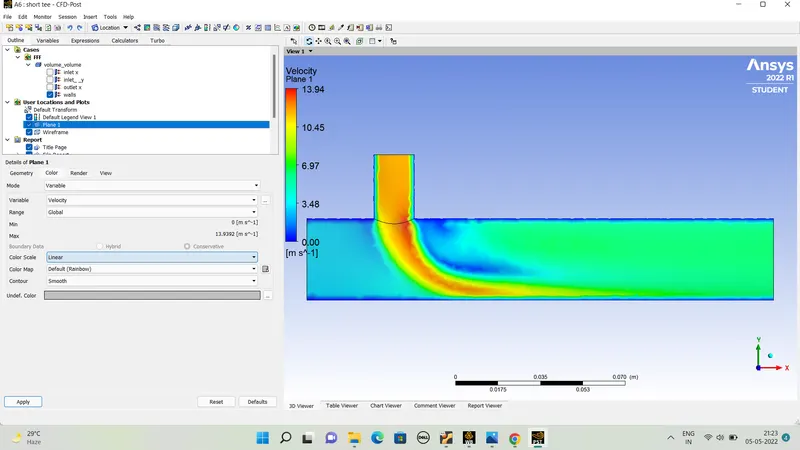
#) The Velocity contour-
#) The pressure contour-
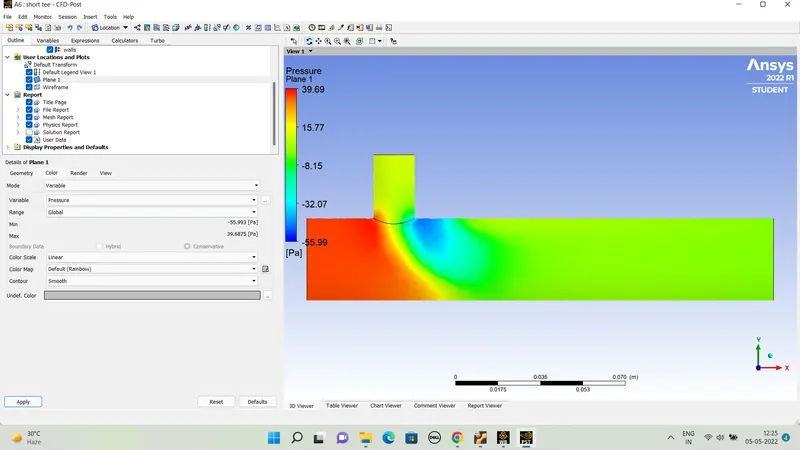
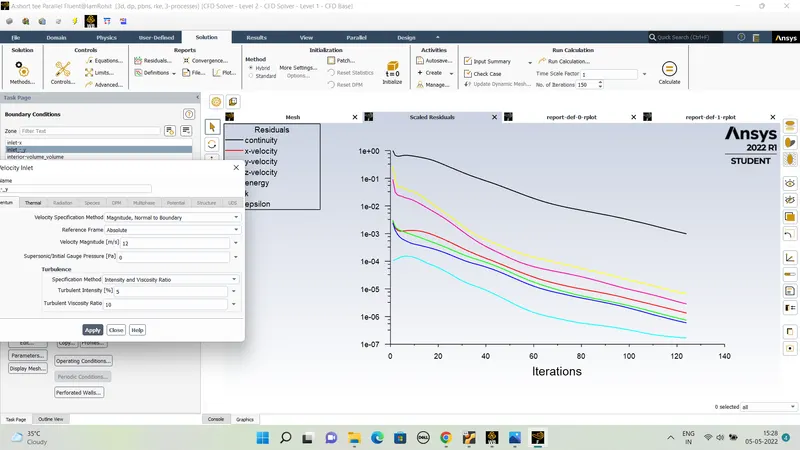
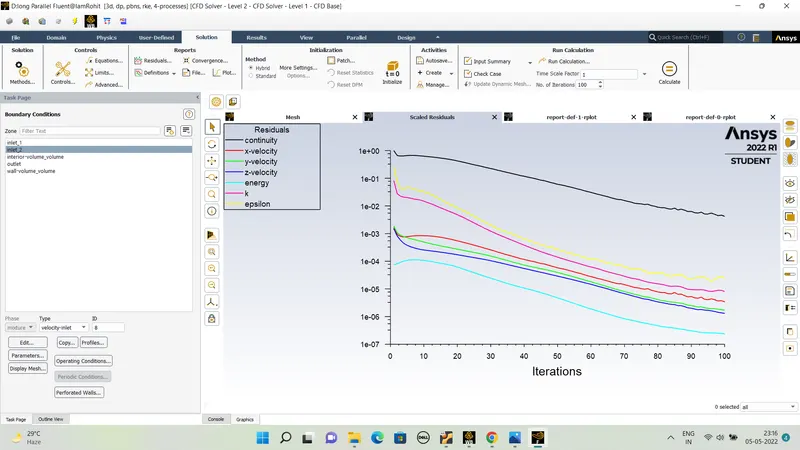
#) the residuals
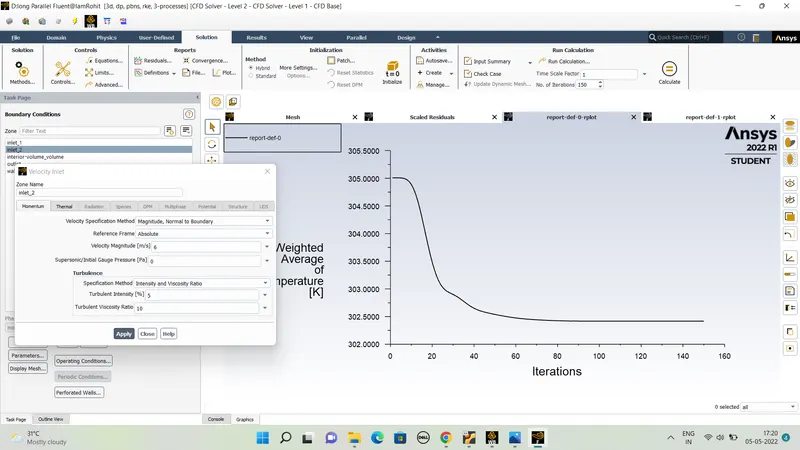
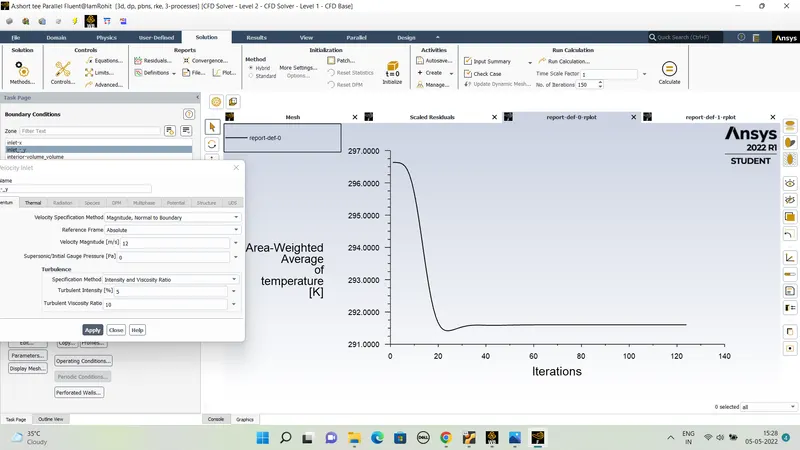
#) The area weighted average-
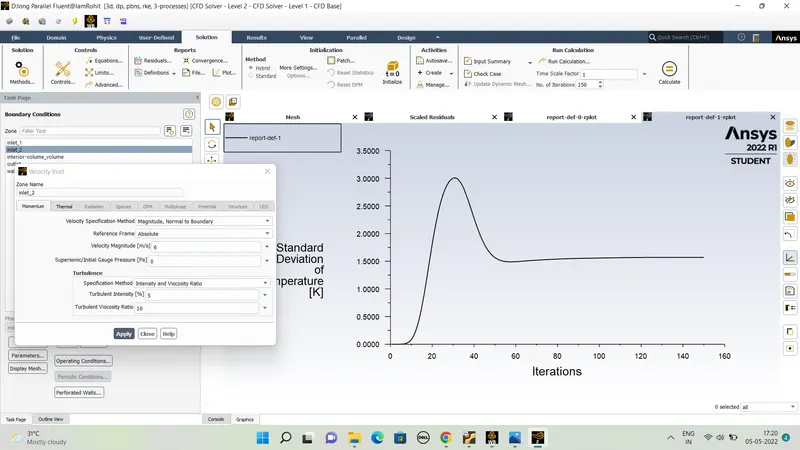
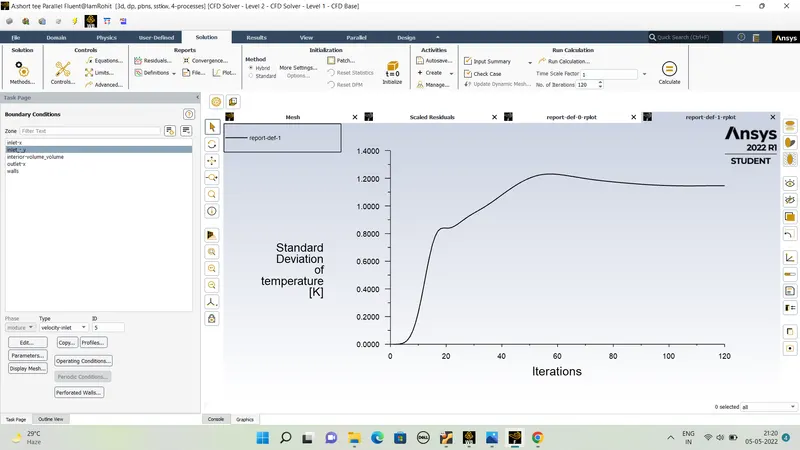
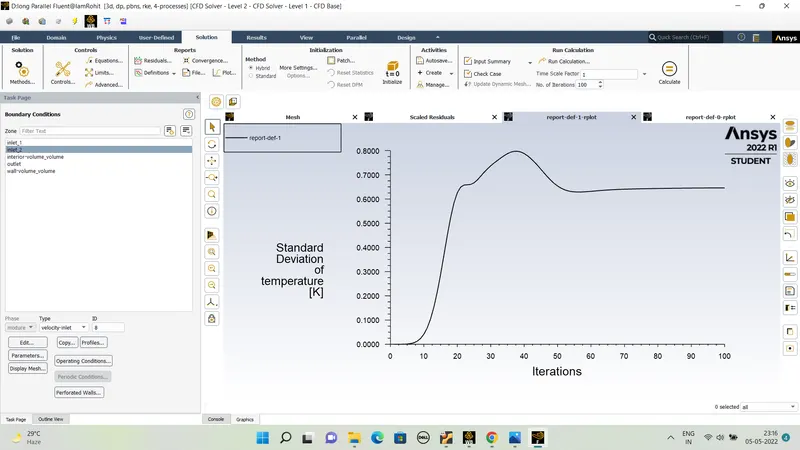
3) The standard deviation of temperature-
2) Short tee with inlet x velocity of 3 m/sec and the momentum ratio of 4 using the k-epsilon model-
#) Velocity contour-
The residuals , standard deviationa nd the report plot
#) The standard deviation of temperature-
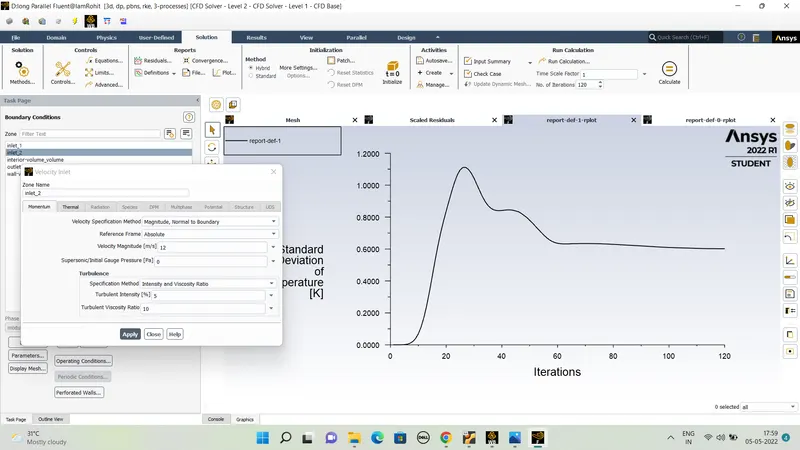
#) Doing these short tee simulation using the k-omega turbulence model
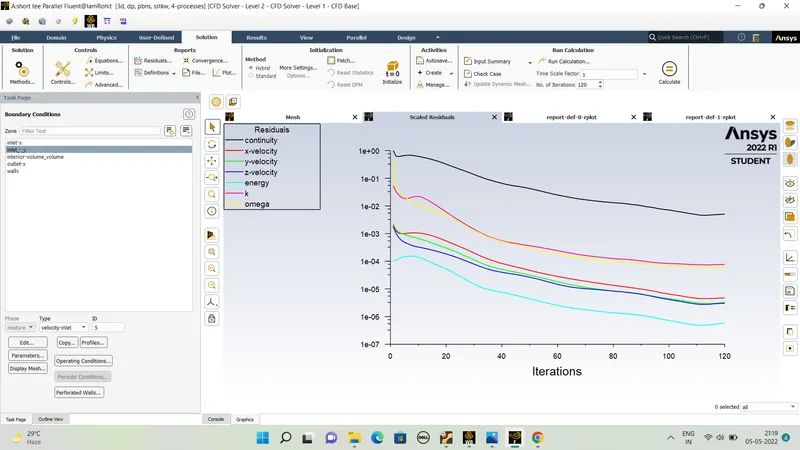
1) Residual plot-
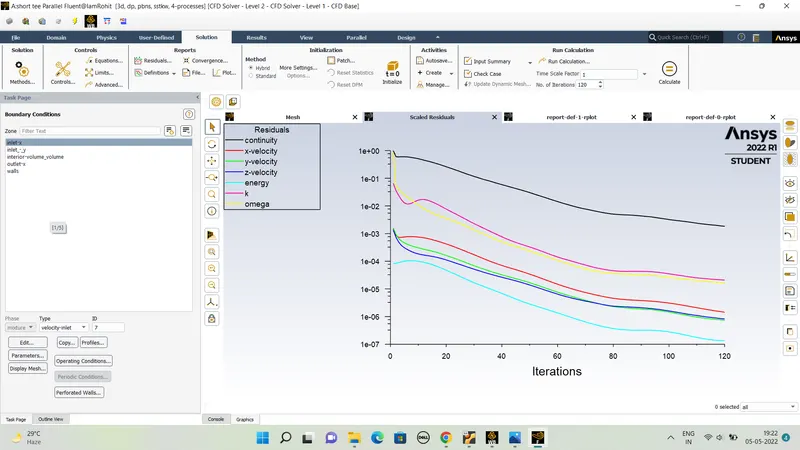
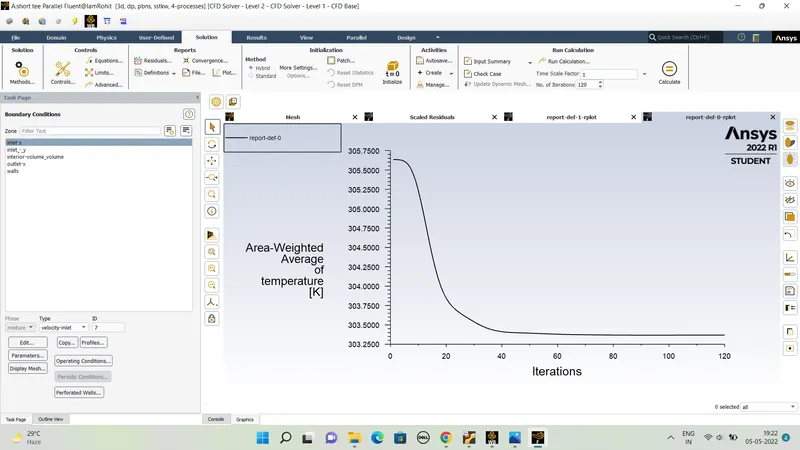
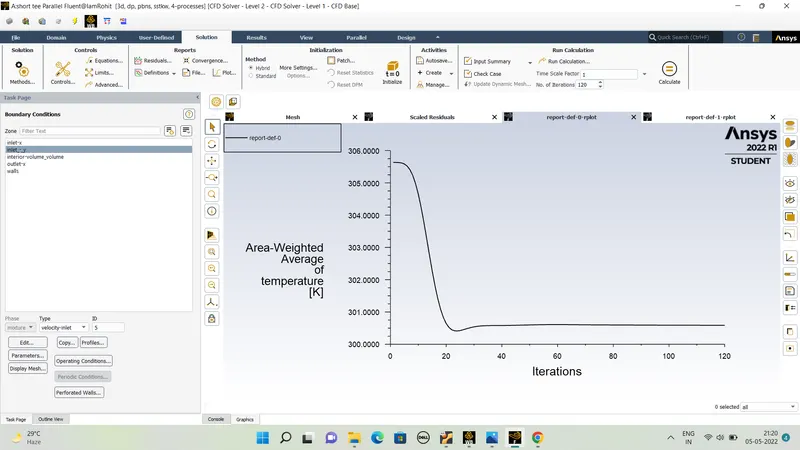
2) Area weighted average of temperature -
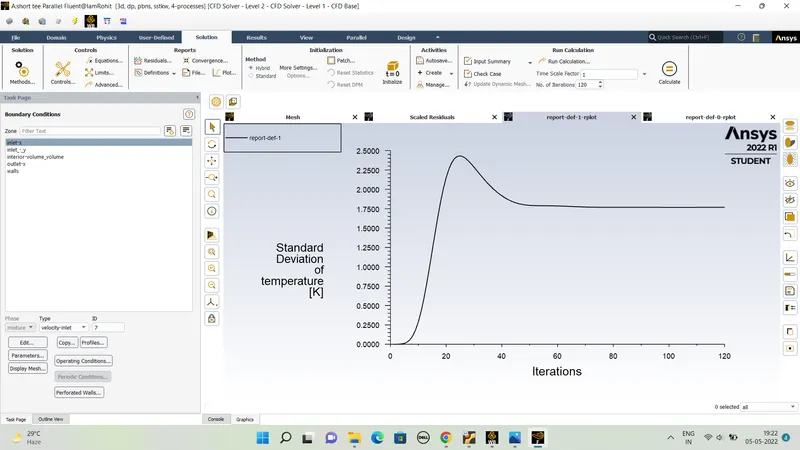
3) Standard deviation of temperature-
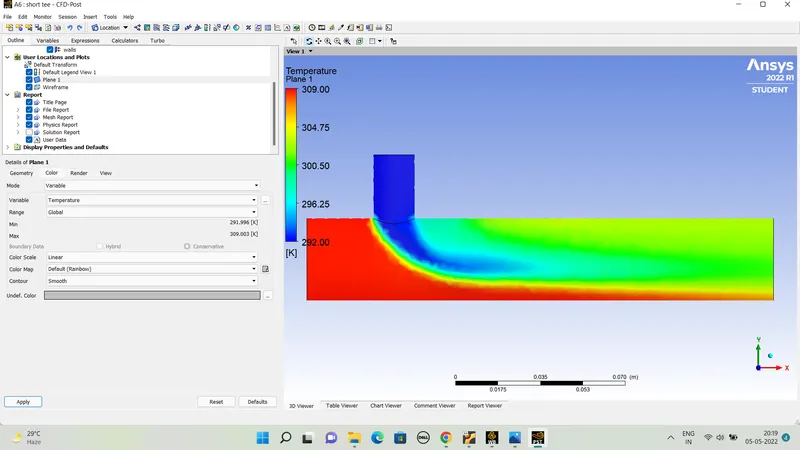
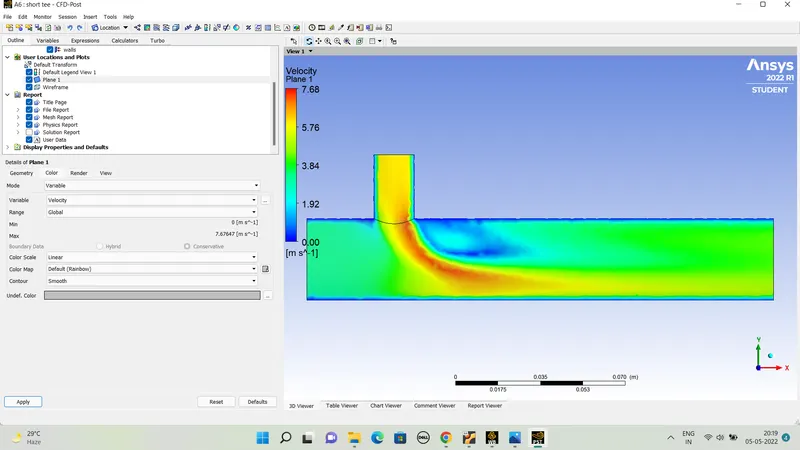
4) The contour plots-
Temperature plot-
The velocity contour-
#) Te plots containg the temperature , velocity contour for the k-omega turbulence model-
#) Summary of the short tee-
Short tee with momentum ratio(MR = 2) k-epsilon k-omega
1) Average outlet tempearature(k) = 303.413 303.458
2) Standard deviation- 1.5 1.6
3) No of iteration = 150 120
Short tee with the momentum ratio(MR= 4) k-epsilon k-omega
1) Average outlet temperature(k) 300.396 300.38
2) Standard deviation 1.1 1.2
3) Number of iteration 150 120
3) Summary-
- Analytical solution-
Momentum ratio of 2
mass of the ho fluid (mh) = rho*a*vh = 997*0.0009*3 = 2.69 kg/sec
mass of the cold fluid =rho*a*vc= 1.35 kg/sec
Temperature of the mixture = (mh*Th+mc*Tc)/(mc+mh) = 303.9 k.
#) Momentum ratio of 4
1) mass of the hot fluid = 2.69 kg/sec
mass of the cold fluid (mc) = 2.3928 kg/sec
temperature of the mixture = 300.99k.
#) Conclusion-
1) Average outlet temperature on comparing both the analytical and the computational answere are the same almost.
2) The Number of iterations to converge are more or less than the same.
3) the standard K-epsilon model is much better than the k-omega model the standard deviation of the k-epsilon is less than the k-omega model. K-epsilon provides better mixing efficiency.
2) The long tee problem-
-) The long tee CAD model-
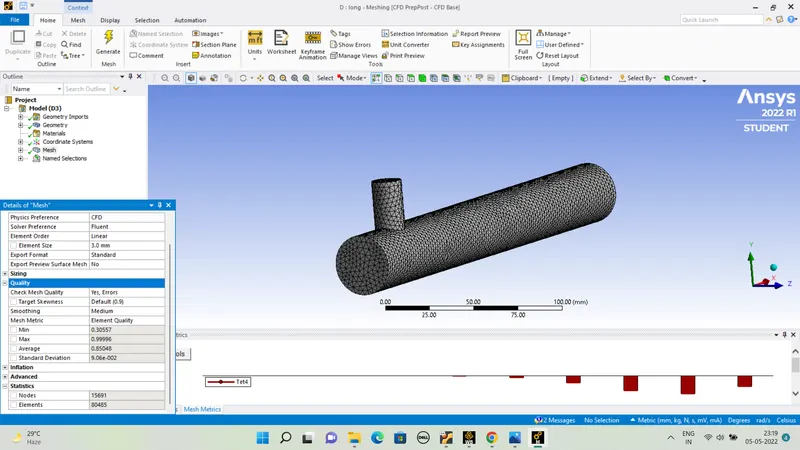
#) The mesh of the above long teee geometry-
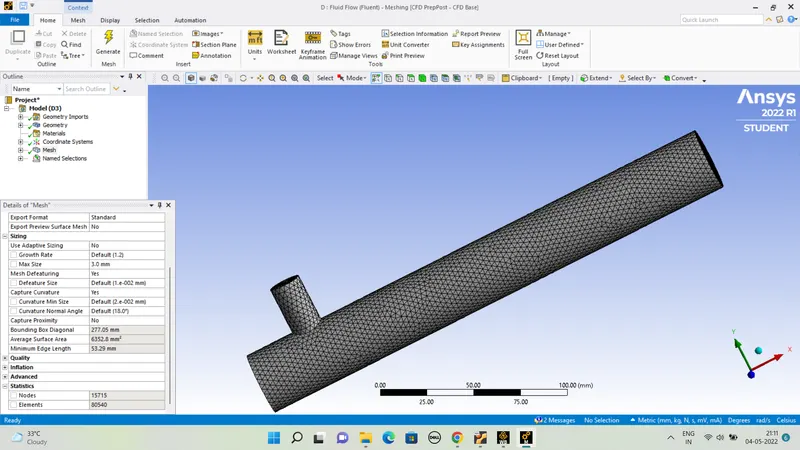
The meshing contains the elemenst of more than the 80000 and the element sizing is kept at a very low of 3 mm to keep the mesh much finer.
The solution for the Momentum ratio = 2 for the long tee using the k- epsilon turbulence model to model tubulent mixing-
The residual plots-
The weighted average of the temperature-
The standard deviation of the temperature-
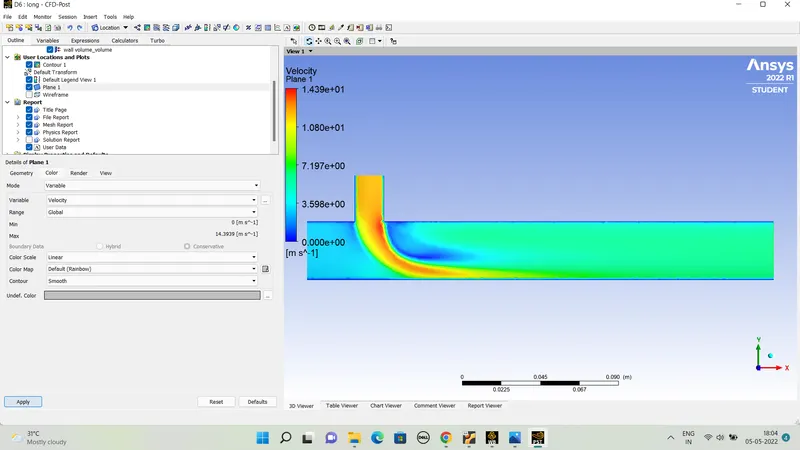
#) The contour of the velocity-
#) The contours of the velocity of the hot and the cold air-
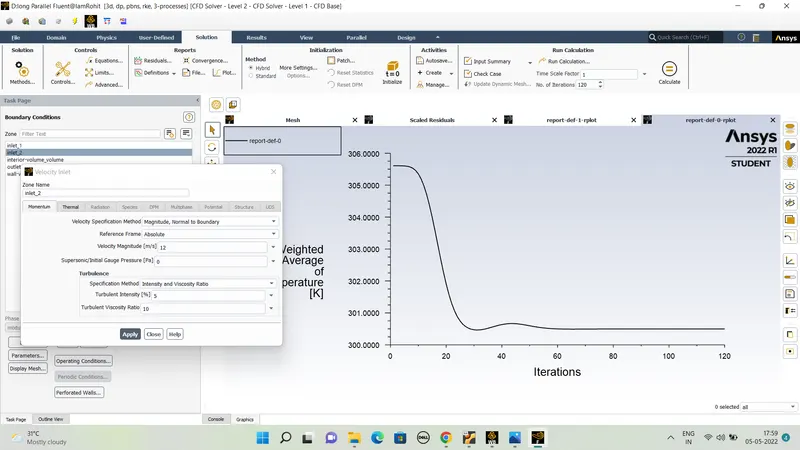
#) For the momentum ratio 0f mr - 4 and using the k-epsilon turbulence model-
The plot of the residuals-
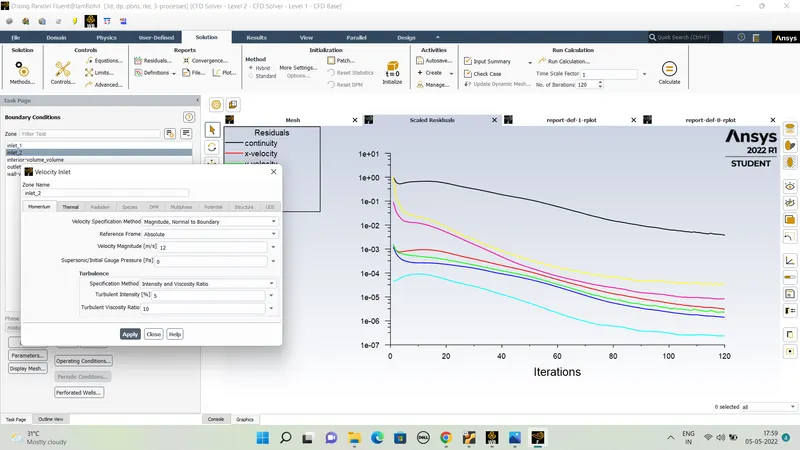
The plot of the standard deviation of temperature-
Weighted average of the temperature-
The contour of the temperature-
The contour of the velocity-
#) Conclusion of the long tee-
Long tee( MR = 2) long tee(MR = 4)
Average outlet
1)Temperature(k) 303.367 300.449
2) Standard deviation 1.2 0.8
3) Number of iteration 150 120
#) Grid independent study of the long tee using a larger element and less number of nodes-
The results obtained after simulation-
The velocity contour-
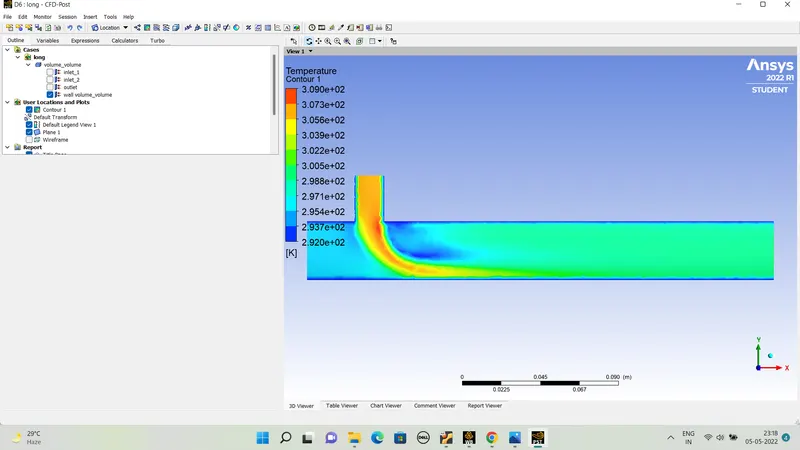
The temperature contour-
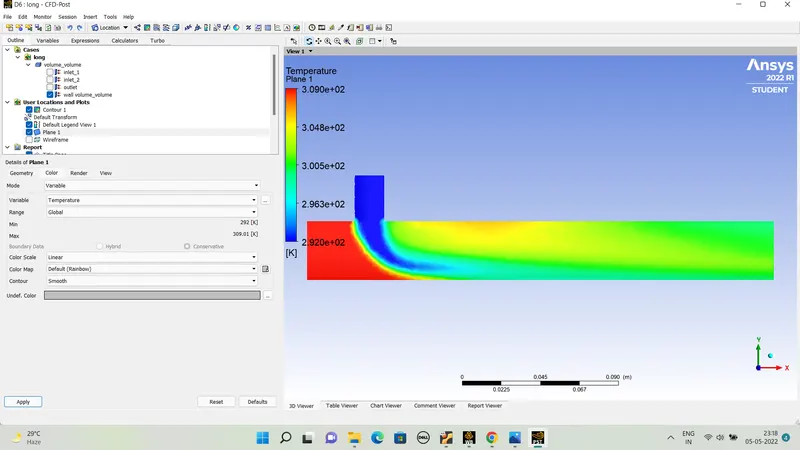
#) For another grid of element size of the 4mm and the number of the elements reduces so the answere becomes less accurate and more deviation is observed The results obtained after 120 iterations-
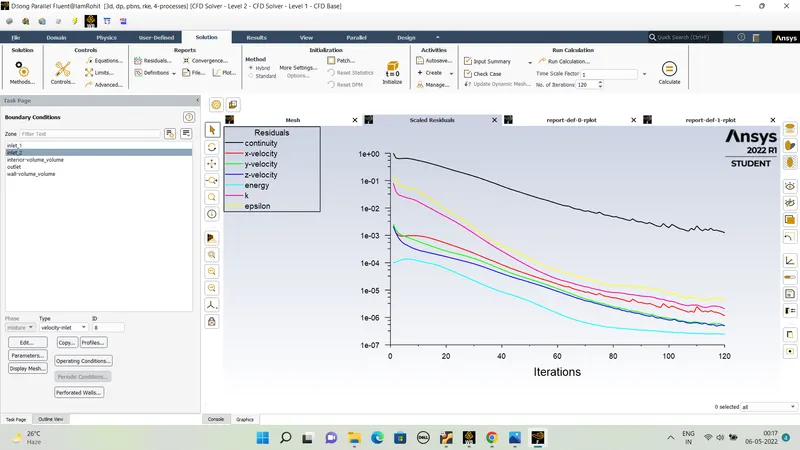
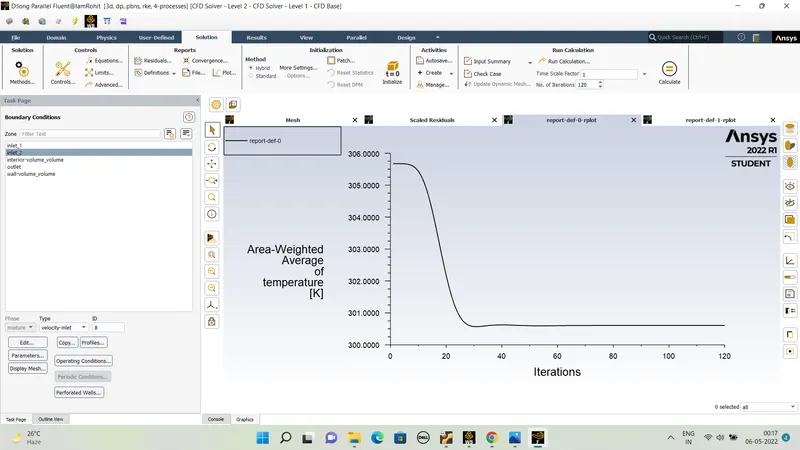
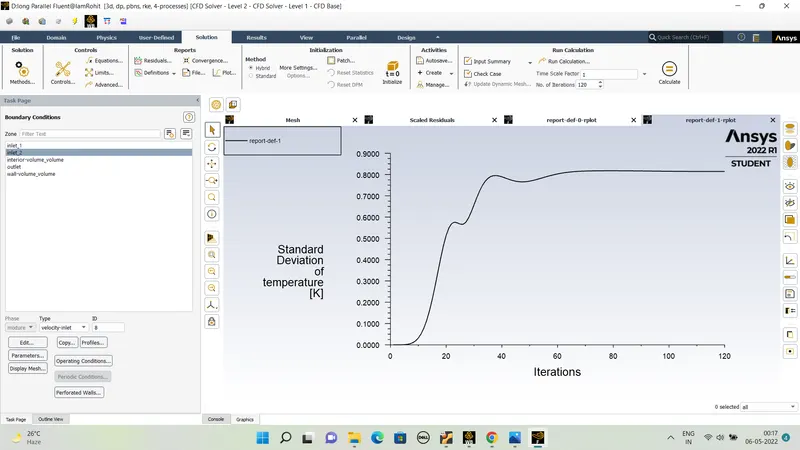
#) Summary of the Grid independent study-
Mesh size no of elements no of nodes temperature iteration
5mm 16143 3460 303.251 120
4mm 23007 4925 303.246 120
3mm 39921 8369 303.292 120
Final result-
1) Increasing the length of the tee does not have much effect on the final temperature after mixing but increasing the momentum ratio or the velocity of the cold incoming air which mixes with the hot air reduces the temperature of the hot air in a much effective manner. So for momentum ratio = 4 the final temperature is less than the longer tee.
2) Reducing the mesh size the average outlet temperature tends to converge towards the analytical temperature.
3) The mesh size of 3mm gives the best predicted temperature than others like the 4mm element size.