Week 1 Challenge
1 – What is the full form of OEM ?
ans:- The full form of OEM is (Original Equipment Manufacturer)
2 – How the Design Responsibility goes in Automotive ?
ans:- OEM (Original Equipment Manufacturer)
Tier 1 Suppliers
Tier 2 and Subsequent Tier Suppliers
Engineering and Design Firms
Regulatory Authorities
Cross-Functional Teams
3 – Name some Tire 4 Supplier and what they Manufacture?
ans:- Tier 4 Supplier" is not commonly used in the automotive industry. Typically, the automotive supply chain is categorized into tiers, with Tier 1, Tier 2, and Tier 3 suppliers being the most common distinctions. However, it's possible that the term "Tier 4 Supplier" could refer to a supplier further downstream in the supply chain, providing specialized components or services to Tier 3 suppliers.
4 – When was the first Car Made?
ans:-On January 29, 1886, Carl Benz applied for a patent for his “vehicle powered by a gas engine.” The patent – number 37435 – may be regarded as the birth certificate of the automobile.
5 – What kind of Seats are used in the first Car?
ans:-On 13 November 1953 the first car rolled off the assembly line: the SEAT 1400, with just 925 employees in the factory. In 1957, SEAT launched the 600, designed to enable Spanish families to enjoy mobility and independence that no car in Spain had offered before.
6 – Define 3D reference System?
ans:-A 3D reference system refers to a coordinate system that uses three dimensions—typically represented as length (X), width (Y), and height (Z)—to specify the position or location of objects or points within a three-dimensional space.
7 – Why 3D reference System is needed ?
ans:- A 3D reference system is needed for a variety of practical reasons across different fields and industries.It provides a way to accurately describe and work with objects, spaces, and phenomena that exist in three-dimensional space. Here are some key reasons why a 3D reference system is essential:
8 – What is X Plane and in a Car what is positive “x”?
ans:-Front view of the Car.Positive X towards rear Bumper
9 – What is “Zero Plan”?
ans:-Normally Center of front drive shaft where either of X,Y,Z Coordinates are zero.
10 – Define Point of origin?
ans:-Normally Center of zero Plane
11 – Where Most OEM Point of Origin keep ?
ans:-It depends on the OEM. Mostly on Front drive shaft.Some consider FR Bumper as Origin
12 – Difference between Work Line and Grid Lines ?
ans:- Grid lines for the working plane. Work plane for the parts to be studied
13 – Are Work Line and Grid Lines are inter connected?
ans:-They are not interconnected by defalut. But when he part lies on one of the plane. In this case work line and Grid lines are the same.
14 - What is Body Position?
ans:-Layout of Part with respect to Mannikin
15 – When a Car comes out of OEM Yard ,Seat will be at what position?
ans:-Body position
16 – How Center Line is used in terms of Car Design ?
ans:-FR Bumper will be symmetrical about Center line.
17 – Usually Center Line is Placed at _____Y0____?
ans:-
18 – What is Positive Z Direction ?
ans:-Towards the Roof of the Car
19 – What is Positive Y Direction ?
Tans:-owards the Right Headlamp
20 – What is LHD and RHD?
ans:-Left hand Drive, Right Hand Drive
21 – A Driver driving a Car in US will be sitting which side of Car?
ans:-Left Side
22 – Driver in US is in __Y Direction..
ans:-negative
23 – A Indian Cab Driver went to USA and started driving a Car, which side of the Car he will be sitting?
ans:-left hand side
24- I opened the Door of my Car and saw my room keys on center console , so my keys are _____ against the Door.
ans:-Negative, Left
25 – Belt Buckle attached on the _____Side of the Seat.
ans:- Negative, Left
26-The Recliner handle is placed ______side of the seat.
ans:-Positive, Right
27 – Inboard/Outboard is a _______ based system.
ans:-Refference
2 8 – IB: Inboard, OB: Outboard
ans:-
29 – Going from rear bumper to forward is __Fore___ Movement.
ans:-
30 – C- Pillar to B – Pillar movement is _______ Movement.
ans:- Fore
31 – A aft movement of seat is__Movement
ans:-Positive X
32 – Volume wise which country produce max number of Cars ?
ans:-China
33 – Volume wise production please place all OEM in global?
ans:-
| Rank | Group | Country | Vehicles |
| 1 | Toyota | Japan | 10,466,051 |
| 2 | Volkswagen Group | Germany | 10,382,334 |
| 3 | Hyundai / Kia | South Korea | 7,218,391 |
| 4 | General Motors | United States | 6,856,880 |
| 5 | Ford | United States | 6,386,818 |
| 6 | Nissan | Japan | 5,769,277 |
| 7 | Honda | Japan | 5,235,842 |
| 8 | FCA | Italy / United States | 4,600,847 |
| 9 | Renault | France | 4,153,589 |
| 10 | Groupe PSA | France | 3,649,742 |
| 11 | Suzuki | Japan | 3,302,336 |
| 12 | SAIC | China | 2,866,913 |
| 13 | Daimler | Germany | 2,549,142 |
| 14 | BMW | Germany | 2,505,741 |
| 15 | Geely | China | 1,950,382 |
| 16 | Changan | China | 1,616,457 |
| 17 | Mazda | Japan | 1,607,602 |
| 18 | Dongfeng Motor | China | 1,450,999 |
| 19 | BAIC | China | 1,254,483 |
| 20 | Mitsubishi | Japan | 1,210,263 |
34 – Which country India will replace in next 10 year in term of Volume production ?
ans:-Germany
35 - Volume wise production please place all OEM in India?
ans:-
| Rank | OEM | Units(2020) |
| 1 | Maruti Suzuki | 1,485,943 |
| 2 | Hyundai | 510,260 |
| 3 | Mahindra | 219,663 |
| 4 | Tata Motors | 152,944 |
| 5 | Honda | 134,741 |
| 6 | Toyota | 126,701 |
| 7 | Renault | 88,869 |
| 8 | Ford | 73,636 |
| 9 | Kia | 45,494 |
| 10 | Volkswagen | 32,324 |
| 11 | Nissan-Datsun | 23,580 |
| 12 | MG Motor | 15,930 |
| 13 | Škoda | 15,284 |
| 14 | Fiat Chrysler | 11,238 |
36 – Name Countries which follow LHD Drive ?
ans:- US, All European countries except England
37 - Name Countries which follow RHD Drive ?
ans:- India, England, Ssouth Africa. Australia
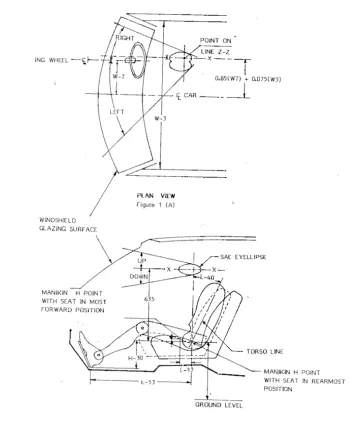
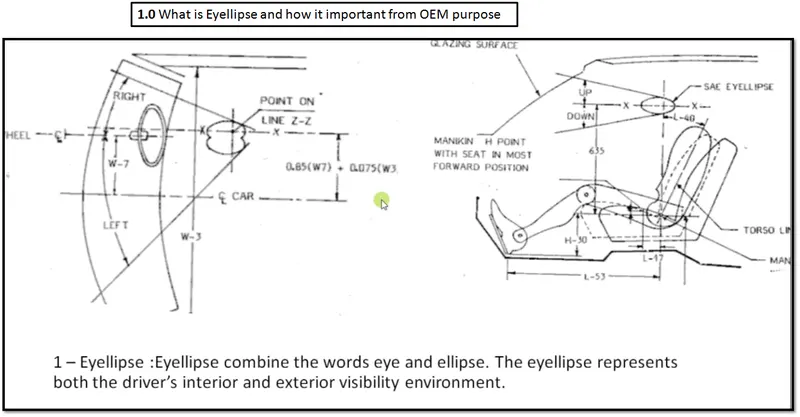
1.What is Eyellipse and how it important from OEM purpose ?
ans:- To define drivers eye position. To define Vision angle for pedestrian safety, to minimise vision angle by optimising BIW Design.
2.Draw the complete Eyellipse Zone in a OEM environment ?
ans:-
3.What is E – Point ?
ans:- Drivers eye position for 95% Manniquin.They are 65mm apart from each other.
4.What is P – Point ?
ans:- Neck pivot point
5.Correlation between E Point and P Point ?
ans:- For 95% Manniquin, Eye points are 65mm apart from each other and P Point at a ditance 98mm from the centroid of Eyepoints
6.Eyellipse calculation as per E – Point and P – Point ?
ans:- For 95% Manniquin, Eye points are 65mm apart from each other and P Point at a ditance 98mm from the centroid of Eyepoints
7.What is full form of “SgRP” ?
ans:-Seating Reference Point
8.What is H – Point ?
ans:- Hip Point onwhich maniquin placed on Seats for Ergonomy evaluation
9.Difference between “SgRP” and “ H – Point “ ?
ans:- Both are same. From the Supplier point of View, H-Point will be considered as SgRP
10.What is heel point ?
ans:- Point of Contact of Foot of the Occupant in the floor of the Vehicle. For the driver, Heel Point is Accelerator PedaL point and for the other occupants it will be considered as heel point
11.What is Oscar ?
ans:- Its a dummy to measure vehicle seating accomodation.
12.Difference between Oscar and Oscar Templet ?
ans:- 3D representation of Ddummy - Oscar
2D representation of Ddummy - Oscar Template
12.What is the purpose of Oscar ?
ans:-To evaluate Roominess and Ergfonomic constraints
13.What is Design H – Point and Actual H - Point?
ans:-Design Hpoint - H point determined through 2D (Ocar Template)
Actual Hpoint - H Point recorded through Oscar machine
14.What is H-Point Window ?
ans:-Zone in which H- Point can vary taking seat adjustments along the XYZ directions into consideration
15.Type of Oscar ?
ans:-
Small women - 104lbs (5% drivers)
Mid sized man -169 lbs (50% Drivers)
Large sized Man - 226lbs (95% Drivers)
16.What is the weight (in Kg) of 95 % Oscar ?
ans:-226lbs
17.What is the Importance of H – Point ?
ans:-Evalutae Ergonomie,design of seating Compenents.
It influences other compenent design through Vision angle, head room,shoulder room etc
To evaluate Seat comfort
18.How the tolerance of H – Point Given ?
ans:-Its either a Circular or rectangular zone, most OEM's preffer Circular zone
19.What is D – Point regarding a Seat ?
ans:-Lowest point of Buttock contour of Manniquin
20.What is the full form of AHP ? Define its usage for seats ?
ans:-Accelerator Heel Point. Defines postion of the foot, when manniquin placed on H-Point.
Its normally 87 deg of foot angle.
21.What is Hand Reach Envelop ?
ans:-Defines the zone, accesible by the maniquinn, when it is placed on H-Point.
22.Types of Hand Reach Envelop ? And how it is categories ?
ans:-Primary Hand envelop: Zone reached by the Maniquinn without any constraints or movement
Secondary Hand envelop: Zone reached by the Maniquinn with allowable constraints or movement
23.What is Back/Cushion Angle ?
ans:-Back Angle: Angle of inclination of Torso with respect to Vertical
Cushion Angle: Angle of inclination of Cushion with respect to Horizontal
24.What is Ischium?
ans:-Lowest point of the three major bones of pelvis. It is the point, where support of Maniquin sits on the seat
25.What is Tail Burn ?
ans:-Condition when an occupant is seated for an extended period of time
26.How lumber help driver ?
ans:-Lowest Vertebrae in the Spinal column located between lowest ribs and Pelvis
Lumber helps support back of the Occupant
27.During RFQ what is expected from OEM?
ans:-
Seat Refference Point
Foot angle
Knee angle
Heel Point
Hip point
Back angle
1.What is the function of a seat ?
ans:-Provide Comfort, support and position for the occupant
2.How the seat Support the Occupant ?
ans:- By providing position for the Occupant, enahancing cofortness through Cushion
3.How the seat Position the Occupant ?
ans:-Roominess: To provide enough roominess to acess gadgets while driving
Vision angle: To provide enough vision of pedestrian and other acesories while driving
4.How seat provide comfort for the occupant ?
ans:-By means of Cushion(foam) optimized to be adjustable based on drivers body size
5.What is the full form of ILD? And how it is define ?
ans:-Indentation Load Deflection - defines how much load cushion can withstand, when the seat pad is reduced to 50% of its origial thickness