Week 1 Challenge
Solution 1:
Types of foundation: -
There are mainly two types of foundations:
- Shallow foundations
Foundation which has Depth of foundation is less than or equal to the width of foundation depending on the site conditions.
- Deep foundations
Foundation which has Depth of foundation is more than the width of foundation.
Shallow foundations are further divided into different categories as:
- Spread/Isolated foundation – Foundation used to carry load only from one column is known as Spread foundation.
This foundation is preferred where area required for foundation is less than the area available at site in such a way doesn’t offers any hindrance to other footing.
- Mat/Raft foundation – When the whole area is covered with single foundation by making all the columns attached to it in order to transfer the load.
This foundation is preferred where area required for foundation is more than the available area or for practical purposes where 80% to 90% area is being already covered by foundation, it is more advisable to use Mat foundation.
- Combined foundation – Foundation which carries loads from two or more two columns are called combined foundation.
This foundation is preferred where desired columns are close to each other in such a way that area required for foundation hinders the other area of footings.
- Strip foundation – Foundation is the type of combined continuous foundation in which line of the loading columns are parallel with the line of foundation.
This foundation is preferred where there is restriction to spread into latitudinal direction or Line of action of loading is same.
- Strap foundation – Foundation in which the footing is tied together with help of footing beam resisting upward pressure from soil and in order to provide tension supports to the adjoining footings.
This foundation is more advantageous to resist the eccentricity from the footing and to resist seismic forces.
Deep foundations are further divided into different categories as:
- Pile foundation – Foundation which resist the upward pressure, they driven into the soil up to greater depth in order to achieve hard and stable strata.
This foundation is preferred where the hard or stable strata of soil is much deeper or water in order to resist pressure either by skin friction or bearing or by both.
- Well foundation – Foundation which are driven below the water bodies bed course in order to achieve hard and stable strata of soil. These foundations are hollow in middle and having the RCC or any material at the periphery having some desirable thickness.
These foundations are mainly used bed has sandy soil and hard strata is at 3m to 4m below the water course bed level.
- Caisson foundation – Foundation which are driven into the soil in order to resist the lateral soil pressure and to provide water tight facility to the structure.
These foundations are mainly provided to the structures at the end of the bridges.
_________________________________________________________________________
Solution 2:
Components of RCC girder bridge resting on open foundation are as follows:
Parapet wall or Crash Barriers – It offers the vehicle from falling off the bridge and provide the safe zone in order to distinguish the path of travel for vehicles coming into opposite direction.
Sidewalks or Footways – It offers the safe path for the movement of pedestrians and cyclist.
Pavement – It is the Super imposed dead load on the bridge which provide the pathways for the vehicles in order to provide smooth finish surface with desirable friction coefficient.
Deck slab – It is slab which provides the supports to the carriage way.
RCC Main Girder Beam - It is the beam which supports the deck slab and spanning into the longitudinal direction connecting the bearing of substructure.
RCC Cross beams – It is the beam which connects the Main girder beam by resting of piers or abutments.
Bearings – It is provided between the Main girder beams and pier cap, to neutralize or absorb the vibrations from the movement of vehicles or lateral forces and prevent it to distribute into different parts of the bridge. It provides the suspense to the bridge deck for the smooth movement.
Pier Cap – It is structure supporting the main girder of beam by provide them a vital space to distribute load and transfer it to the piers. It used to place over the top of the pier.
Pier- It is compression member which transfers the load from above to the foundation beneath it.
Foundation – It is the structure provided at the base which transfers all the loads from above to the earth by distributing it into larger area.
Abutments – It is the structure provided at the ends of the bridge which primarily function is to retain the earth soil’s lateral movement. It can also use for supporting the girder beam of the bridge.
Wing wall or Retaining wall – It is the earth retaining structure which is provided adjacent to the abutments.
(a) If the Seismic forces acts on the bridge, then lateral force will act on the bridge or structure in both longitudinal and transverse direction along horizontal axis.
Structure will also lie under the effect of torsional moment in vertical axis due to vertical dynamic response spectrum.
To reduce that necessary remedies and techniques should take into account as mentioned below,
- Provision expansion joints in order to prevent the thermal expansion and contraction and to divide the mass of bridge into different sections.
- Isolation of bearing with a material such rubber, high isolated polymers etc.
- Provision of suspension strings.
(B) Diagram showing: 3 span continuous bridge Position all the loads on the bridge having 12 m and 7.5 m carriageway transverse width.
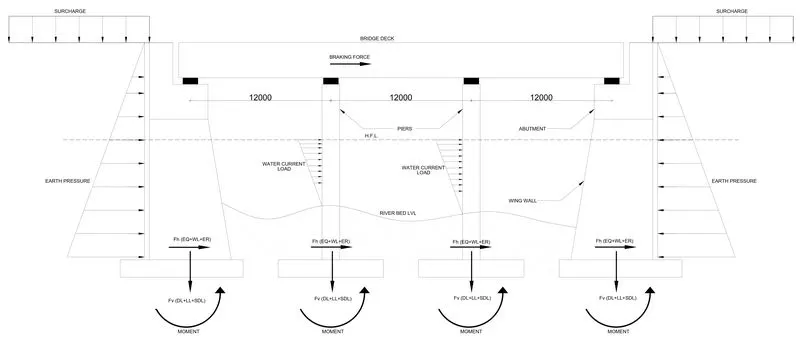
(C) Clause of IRC 6 are as follows:
203 Dead Load
204 Live Loads
206 Foot over bridges, Footway, Kerb, Railing, Parapet and Crash Barriers
210 Horizontal Force due to water currents
211 Longitudinal forces
213 Buoyancy
214 Earth Pressure
215 Temperature
_________________________________________________________________________
Solution 3:
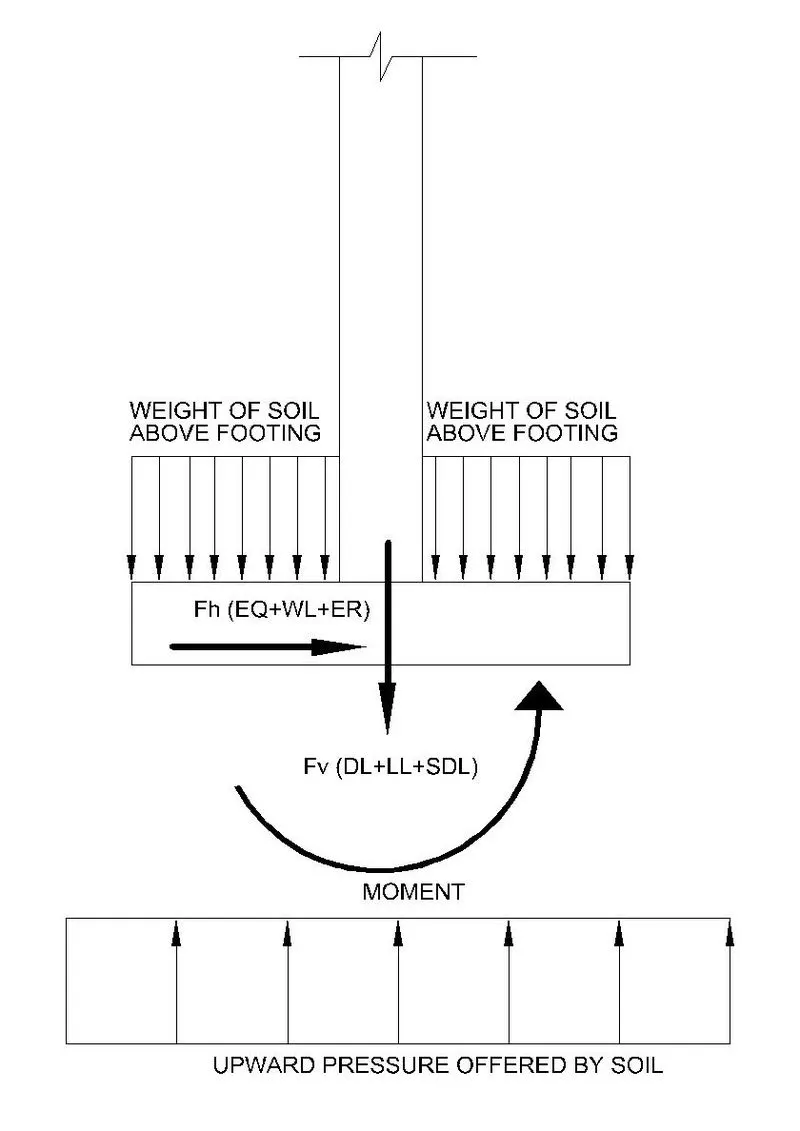
Different forces acting on the shallow foundation are mentioned below:
- Vertical downward forces
Dead Load – They are the load from the self-weight of the structure and its components.
Live Loads – They are the loads from the vehicles or railways or any other mobile, impact loads, Liquid traveling in pipes etc.
Super Imposed Dead Loads – they are the loads from the weight of the pavement, parapet walls, electrical and other utilities etc.
Surcharge – Additional weight acts on the soil or other component such as abutment.
Pressure from soil above foundation – Weight of soil over the footing also needs to be considered.
- Horizontal forces
Lateral Earth pressure – It is the load acts on the structure by the lateral movement of the soil.
Water current forces – It is the transverse thrust acts on the structure by the movement of the water under it.
Braking force – It is the load occurs due to the braking or friction from wheel of the vehicle or any other mobile.
Temperature loads – Due to the different weather conditions, structure acts under the effect of expansion and contraction according to the thermal coefficient of its material.
Seismic Loads – Lateral force created by oscillatory vibrations due to the earthquakes acts transverse on the structure.
Wind Loads - Lateral force created due to the intensity of wind acts transverse on the structure.
- Vertical upward forces
Buoyancy – Upward thrust offers by the water present in the soil supporting the foundation or the water under the bridge deck over the flooded water bodies.
Vertical Seismic forces – Due to the torsional movement from the earthquake tends to uplift the corner or end supports to move in upward direction.
Vertical Wind Forces – Due to the transmission of wind to the different component of bridge, a circular movement creates to the area beneath the deck slab, which results in the uplifting of bridge or any other structure.
All the longitudinal forces from horizontal forces will act on fix pier and fix abutments only. Free pier will not resist against any horizontal forces, it will carry only vertical downward forces as mentioned above.