Week 1 Challenge
Aim : To explain the different types of foundation and list the points to be considered while selection of bridges.
FOUNDATION:
Foundation is the lowest part of the building or the civil structure that is in direct contact with the soil which transfers loads from the structure to the soil safely.
It is the main part which transmit the load from the pier or abutments, wings to the ground. It should be deep enough to prevent scour caused by the flow in river.
Types of foundation are :
SHALLOW FOUNDATION:
A shallow foundation transfers the load to a stratum present in a shallow depth.
When the foundation is placed immediately beneath the lowest part of the super structure, it is termed as shallow foundation. Depth of the foundation is lesser than or equal to its breadth.
TYPES:
Spread Footing
Combined Footing
Mat or raft Foundation
- Spread Footing
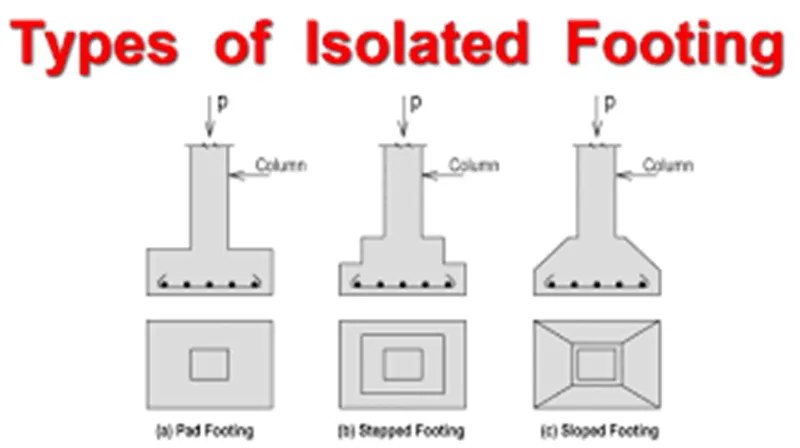
The base of the member transmitting load to the soil is made wider to distribute the load over wider area.
- Combined Footing
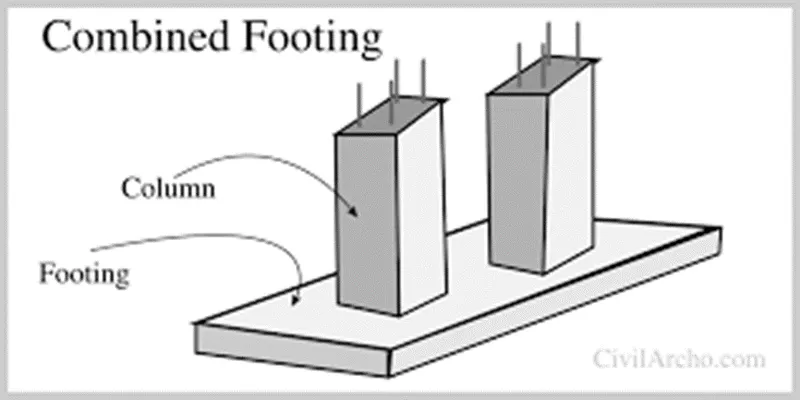
A combined footing supports two or more than two columns in a row. The combined footing can be rectangular in shape if both the columns carry equal loads, or can be trapezoidal if there are space limitations.
- Mat or Raft Foundation
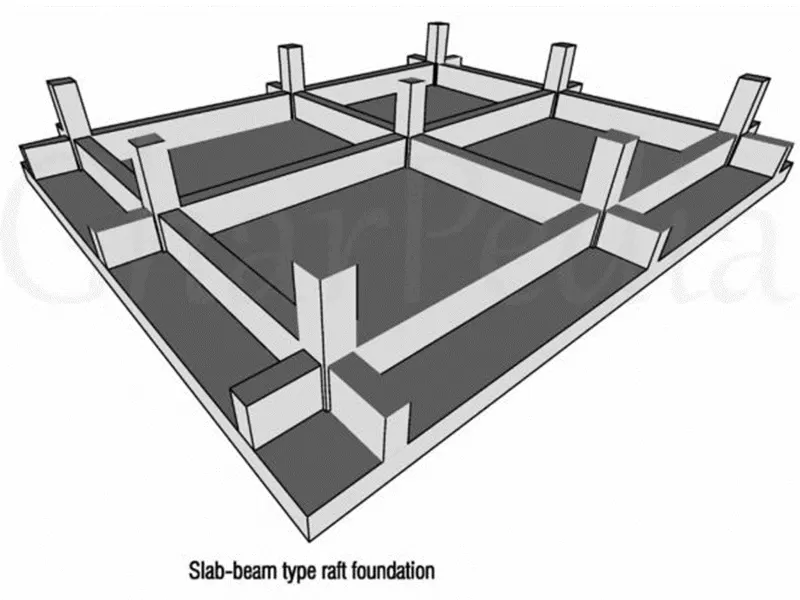
A raft or mat foundation covers the entire built area beneath a structure and supports all the columns. When the structure loads are heavy or the allowable soil pressure is low, the use of spread footings would cover more than half of the building area.
DEEP FOUNDATION:
If the depth of footing greater or equal to the Width of footing, it is known as the deep Foundation. Deep Foundation is used Where the bearing capacity of the soil is very low. The load coming from the superstructure is further transmitted vertically to the soil. Depth of the foundation is lesser greater to its breadth.
Example for deep Foundation
Pile Foundation
In this type of foundation, the load is transmitted by a vertical member. This vertical member is known as a pile. These piles are generally made of steel, concrete and wooden. These days precast members are used but we can create these members on site as well.
Points to be considered for selection of foundation are :
- Poor bearing capacity of soil
- Liquefication of soil strata
- Structure near sea shore or river bed
- Presence of canal or deep drainage liners
Components of a RCC girder bridge :
Major part of Bridge
1.Substructure
2.Superstructure
SUBSTRUCTURE:
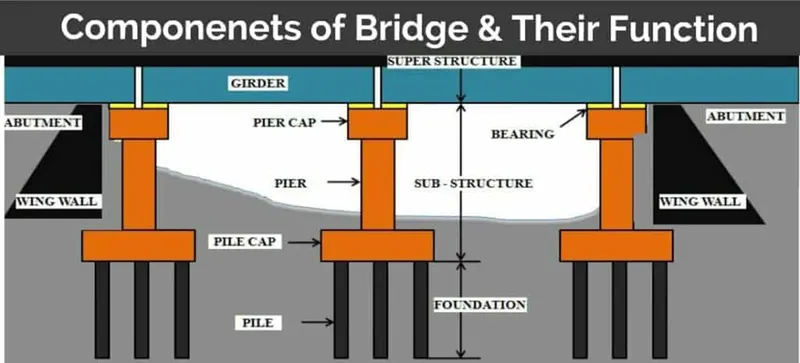
The structure of the bridge below the level of bearings is known as the Substructure.
The function of the substructure is to support the superstructure components and transmit their loads safely to the subsoil.
Abutment
It is a structure mostly used for bridges and dams as a substructure at the ends of a bridge span or dam and on that superstructure is rest.
The abutment can also be defined by the structure supporting one side of an arch, or masonry used to resist the lateral forces.
Piers
Piers provide intermediate support between two bridge spans. Bridge piers mainly support the bridge superstructure element and transfer the load to the foundation.
Pier must be strong to handle the horizontal as well as lateral. Piers are known as compression members of the bridge.
SUPERSTRUCTURE:
The components of the bridge above the bearing are known as superstructures.
It consists of the following.
Beams and girders
Beam
Beam has a rectangle cross-section, whereas girders have composed of I-shaped cross–sections with two load-bearing flanges and a web for stabilization.
Bearing
A bearing is provided between the bridge girder and the pier cap. The main function of the bearing to allow free movement or vibration of the top superstructure and reduce effect stress to reach the bridge foundation.
Arch and Cables
Arched and Cable both have specified used. Arches are used for arch bridge construction and cable is used for suspension, cable-stayed bridges, etc.
Parapet Wall and Handrail
The parapet is one of the safety components of any bridge which prevent the vehicle from falling off where there is a drop. It is also useful for restricting views, preventing rubbish from passing below, and acting as a noise barrier.
Seismic case 5
Earthquake, any sudden shaking of the ground caused by the passage of seismic waves through earth’s rocks. Seismic waves are produced when some form of energy stored in Earth’s crust is suddenly released, usually when masses of rock straining against one another suddenly fracture and “slip.” Earthquakes occur most often along geologic faults, narrow zones where rock masses move in relation to one another. The major fault lines of the world are located at the frings of the huge tectonic plates that make up Earth’s crust.
b).Clause of IRC 6 for Open Foundation to be checked during design.
Check for Loss of equilibrium
overturning
sliding
Bearing Resistance
factor on materials
Calculation of bearing pressure for structural design of foundation
Calculation of allowable bearing capacity
Verification of uplift limit state
Verification of Serviceability limit state
Verification of contact area of base and bearing pressure
Calculation of Settlement
- What are the various forces acting on the shallow foundations. how they will be different in the case free pier, fix pier and abutment. Show a diagram and loads acting on it.
Dead load: A constant load in a structure that is due to the weight of the members, the supported structure, and permanent attachments.
Live load: Live loads can be caused by anything adding, removing, or relocating weight on a structure. This includes people walking across a surface and objects that can be moved or carried.
Impact load: It is defined as the force delivered by the sudden load on a structural member rather than a force applied constantly and sustained over a long period.
Water pressure: The water pressure due to water current is acted on the portions of substructure.
Uplift Pressure: The uplift pressure in the bottom of the foundation due to presence of water table at shallow depth.
Earth pressure: The earth pressure due to the retained soil in abutment and the over burden soil has an major impact on the foundation. The overburden soil acts vertically and the retained soil pressure acts as laterally.
Temperature stresses: The longitudinal forces are resulted because of the temperature changes.
Seismic forces: seismic forces are vital when the foundations are constructed in seismic zones. The seismic forces act on every members of the superstructure. These may act in any direction but generally assumed to act in one direction at a time.
Fixed Piers
Fixed piers support a fixed bearing and subjected both to transverse and longitudinal forces. In case of fixed piers, the structure at the bearing location is fixed so the moment is resisted.
Free Piers
Free piers support free bearings and transfer only axial forces from the bearing to the foundations. In case of free piers due to free bearings it acts as a simply supported beam where no moment will generate only horizontal and vertical movements are allowed.
Abutment
Abutment is the component of a bridge which supports earth pressure. In case of abutment all of above forces will act along with earth pressure which is predominant. Due to this their might have chance to overturn the structure. All these loads and forces generally acts on abutments of bridge.