Week 1 Challenge
1. Aim: Types of foundation and its slection criteria.
Theory:
Foundation is the one which transmits the load from piers, abutments and wings to the ground. It ensures even distribution of the strata. It should be deep enough to prevent scour caused by the flow in the river.
- Foundation is required for structural stability.
- It should not impair the functions of structure.
- As bridge is designed for 100 years durability, foundation should be durable enough for all the loads acting on it.
- The construction method involved should be as simple as possible.
- It should be economical.
There are two types of bridge foundation:
1) Shallow/Open foundation
2) Deep foundation
Explanation:
Shallow foundation: Foundation is rested very close to the ground. When there is not much scour or liquefaction, good Soil Bearing Capacity (SBC) available or good soil strata available near the ground then we can consider shallow foundation.
Here depth of foundation <= breadth of the foundation.
Classification of Shallow foundation:
- Combined footing – When individual footing has to accommodate two, or in exceptional case, two or more piers resting on one footing.
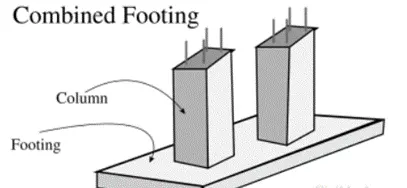
Fig1: Combined Footing
- Mat/Raft footing - Mat footing is the foundation made of concrete that is laid on the ground surface to provide the stability to structure, when the large number of piers exist in the structure supported by it. It is generally used in Box structure.
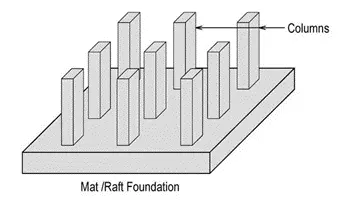
Fig2: Mat footing
- Spread or Isolated footing – Footing for single circular pier. This footing may be square, rectangular, or roundabout.
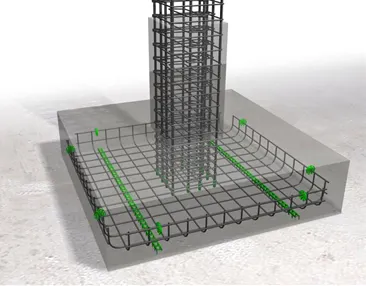
Fig3: Isolated footing
- Strip footing - These footings have a wider base which spreads the weight of the structure to a comparatively larger area and hence provides better stability. Strip footings act as long strip that bears the weight of a complete wall type abutment/pier and are suitable for the structure where the load is being taken by wall type abutment/pier instead of single column pier. Also used when we have wide decks supporting multiple piers. It is very rare in case of Bridges.
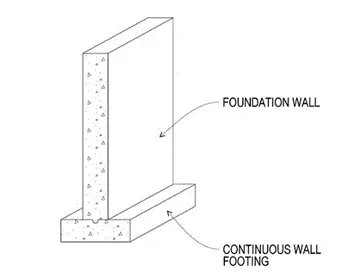
Fig4: Strip footing
- Strap or cantilever footing - The Cantilever or strap footing is used to connect an eccentrically loading column to inside a column, while the strap is used to transmit the moment caused by an eccentricity to the interior columnar foot so that a uniform soil pressure is produced under both footings.
Deep foundation: Foundation having more depth than its width.
There are two types of deep foundation.
- Pile foundation
2. Well foundation
Here depth of foundation > breadth of the foundation.
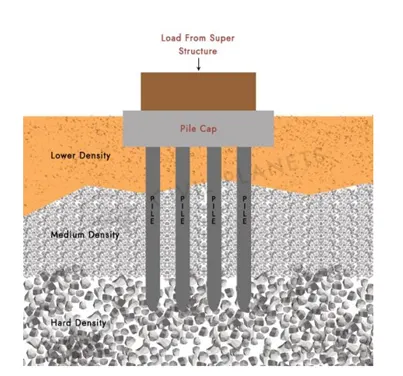
Fig5: Deep Foundation (Pile foundation)
Deep foundations are used when,
- Poor bearing capacity of the top soil
- Liquefaction in soil strata
- Large fluctuations in subsoil water level
- Presence of canal or deep drainage lines near the foundation
- Structures near seashores or riverbed
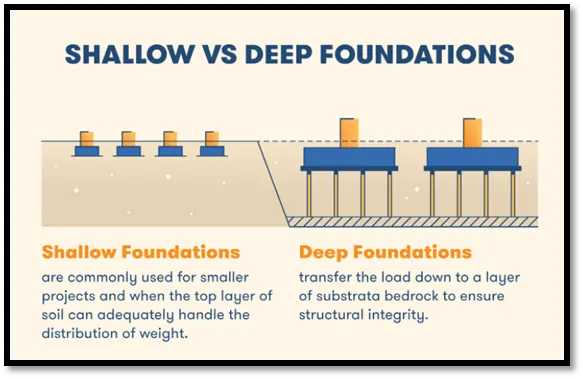
Fig6: Shallow foundation & Deep Foundation
Generally for flyovers, Pile foundation is used and well foundation for bridges in rivers. Main selection criteria for bridges are:
- Bearing capacity of the foundation resting strata
- Location of water table
- Properties of the soil and its condition
- Type of loads acting over it
- Settlement of the soil.
2. Aim: To name all the components of a RCC girder bridge resting on open foundation
Theory: A girder bridge is a bridge that uses girders as the means of supporting its deck.
Explanation:
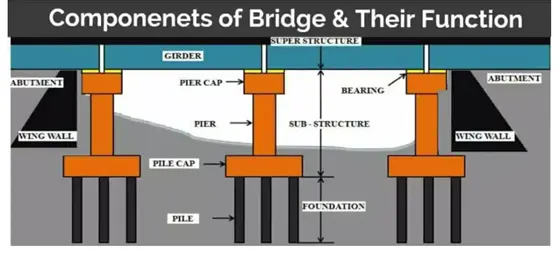
Fig 6: Components of the RCC girder bridges (https://civiconcepts.com/blog/components-of-bridge)
The components of the RCC girder bridges are:
- Superstructure
- Substructure
- Foundation
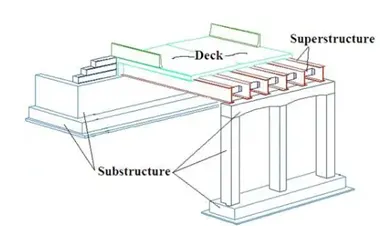
Fig 7: Substructure and superstructure (https://dailycivil.com/structural-elements-bridge/)
Superstructure includes Wearing course, Kerb, footpath, crash barrier, Deck slab, Main girders, Cross girders and Bearing
Substructure includes pedestal, Pier/Abutment cap, Pier shaft/Abutment stem, return wall, wing wall, and seismic stopper
Foundation includes pile cap, pile, well steining in well foundation, top plug and bottom plug of well foundation.
3. Aim : To determine various kinds of forces acting over the foundation.
Theory: Foundation carries the load from the superstructure, substructure and then transfers it to the soil. Various kinds of loads act on the bridge. Foundation should be stable enough to hold all those forces.
Explanation:
Different kinds of loads acting on the bridge foundation are:
- Dead load/Self weight – It is the weight of the structural components like deck slab, girders, Pier/abutment cap, pier shaft/abutment stem (excluding crash barrier, wearing coat, Light pole) in a structure. It acts in vertically downward direction. Mentioned in Clause 203 of IRC 6 - 2017.
- Super imposed dead load - It is the weight of Crash barrier, wearing coat, Light pole over the deck of the superstructure. It acts in vertically downward direction. Mentioned in Clause 206 of IRC 6 - 2017.
- Earth pressure – It is the weight of soil resisted by the pier shaft or abutment stem. It acts in horizontal direction. Mentioned in Clause 214 of IRC 6 - 2017.
- Live load – It is the load of the traffic above the deck due to movement of vehicles. It acts in vertically downward direction. Mentioned in Clause 204 of IRC 6 - 2017.
- Braking load - It is a load induced when brakes are applied in a vehicle. It acts in horizontal direction. Mentioned in Clause 211 of IRC 6 - 2017.
- Temperature load – This load is considered due to fluctuation in temperature of the location where the bridge is built. It acts in horizontal direction. Mentioned in Clause 215 of IRC 6 - 2017.
- Wind load – It is a load exerted by the wind at that particular location where the bridge is built in horizontal direction & vertical direction. Force in vertical direction tends to lift the structure and force in horizontal direction tends to push the structure. Mentioned in Clause 209 of IRC 6 - 2017.
- Seismic load – A force due to earthquake acting in horizontal directions and vertical direction. Force in vertical direction tends to lift the structure and force in horizontal direction tends to push the structure.
- Water pressure – It is a force exerted by the water in a stream/river to pier shaft/ Abutment stem in lateral direction. Mentioned in Clause 210 of IRC 6 - 2017.
All these forces over the superstructure and substructure will transfer to the soil through Foundation.
Free piers: The piers supporting free bearings are called free piers which transfer only axial from the bearing to the foundation.
Fixed piers: The piers supporting fixed bearings are called fixed piers which transfer both transverse and longitudinal forces from the bearing to the foundation.
Abutment: A bridge abutment is a structure which connects the deck of a bridge to the ground, at the ends of a bridge span, helping support its weight both horizontally and vertically. It resists the lateral movement from the earth fill of the bridge approach.
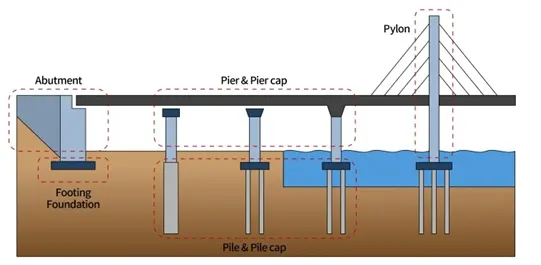
Fig 8: Figure showing Abutment, pier, and deep foundation (pile foundation) (https://www.midasbridge.com/en/solutions/substructures)
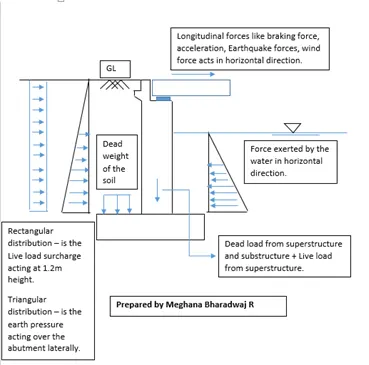
Fig 9 : Forces acting over the foundation through Abutment
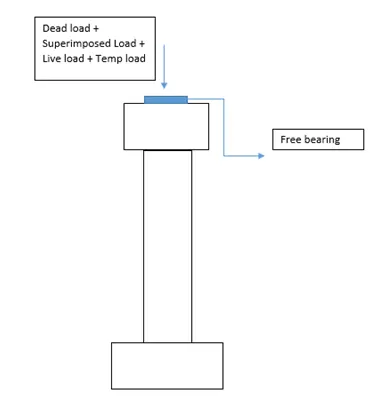
Fig 10 : Forces acting over the foundation through free pier
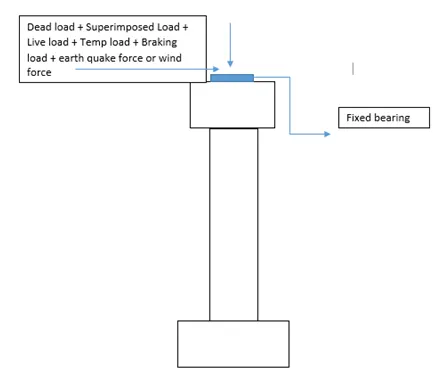
Fig 11 : Forces acting over the foundation through fixed pier