Week 1 Challenge
1) OEM: Original Equipment Manufacturer.
2) At first there comes the OEM who actually manufactures the car, they define how the car design should be or the outline, inline, dashboard and they expect some expertise from the Tier-1 company which manufactures the components and provide to OEM and so on. Then the Tier-2 provides certain requirement of the components to the Tier-1 and this is how the hierarchy works.
Part Design Hierarchy to Design ownership Hierarchy.
3) Tier 3 suppliers are the foundation of the entire supply chain. They provide the required materials, such as metals and plastic, in their raw form or almost raw state to Tier 2 and Tier 1 companies or vehicle manufacturers
Ex: Bosch, E axis, Continentral, Thyssenkrupp Automotive
4) The first car was made in 1866 by CarlBenz.
5) Wooden made seats were used in the First Car.
6) 3D reference system is used to locate all the componets in the vehicle.
7) To locate all the componets in the vehicle.To make it more understandable we locate different components at different position by using 3D reference system. So that different OEMs and Tier1, 2 and 3 can understand and communicate where the focus area is which part they want to work.
8) X- Plane is Vertical Transverese Plane and Backend Part of the vehicle side is the positive X- direction(i.e longitudial side).
9) Zero Plan is nothing but where one of the cordinates in the plane become zero.
10) Point of origin is the intersection point of three planes where all co-ordinates are '0' zero.
11) The point of origin differ from OEM to OEM as well as at individual platforms. Sometimes it lie on bumper and sometimes it lie over ther roof and that depends on the designer.
12) Grid lines are formed due to intersection of planes located at 100mm increments parallel to the X-Z, Y-Z and X-Y planes. They are used to package and locate the objects. Also refered as body lines.
Work Lines are located on individual parts that are mastered to allow gauge points that allows dimensioning of an individual part at different angles.
13) No work lines and grid lines are not conneted. Grid lines are applied for the whole car and work lines are applied to individual part.
14) Body position refers to where a part is located in the vehicle with respect to the body.
15) When a Car comes out of OEM Yard ,Seat will be at Body Position.
16) Centerline: The Centerline is the longitudinal axis of the vehicle that divides it into two halves.
17) The centerline runs down from the middle of vehicle from front bumper to rear bumper. when facing forward in the vehicle the objects to the left of the centerline will have '-ve' Y values and to the right will have '+ve' Y values.
18) Postive-Z dirction is usually in the above direction from the X-Y (i.e horizantal Plane)
19) Positive-Y is for the objects to the right of the center line and to the right of X-Z plane.
20) Left hand refers to a design element or seat system component on the left hand side of the centerline when facing forward in the vehicle and Right hand refers to a design element or seat components on the right hand side of the centerline.
21) A Driver driving a Car in US will be sitting on the left hand side of Car.
22) Driver in US is in negative '-ve' Y-Direction.
23) A Indian Cab Driver went to USA and started driving a Car, He will be sitting on the left side of the car.
24) I opened the Door of my Car and saw my room keys on center console , so my keys are inborard against the Door.
25) Belt Buckle attached on the 'Left' Side of the Seat.
26) The Recliner handle is placed 'Right' side of the seat.
27) Inboard/Outboard refers to a design feature or seats system component lying towards the centerline of the vehicle.
28) Inboard ( IB) refers to a design feature or seats system component lying towards the centerline of the vehicle. Part feature or locations may be referred to as inboard.
Outboard (OB) refers to a design feature or seat system components lying away from the centerline of the vehicle relative to some other reference point or component.
29) Going from rear bumper to forward is a fore Movement.
30) C- Pillar to B – Pillar movement is a fore Movement.
31) A aft movement of seat is a '+ve' X Movement.
32) Volume wise 'China' produce max number of Cars.
33)
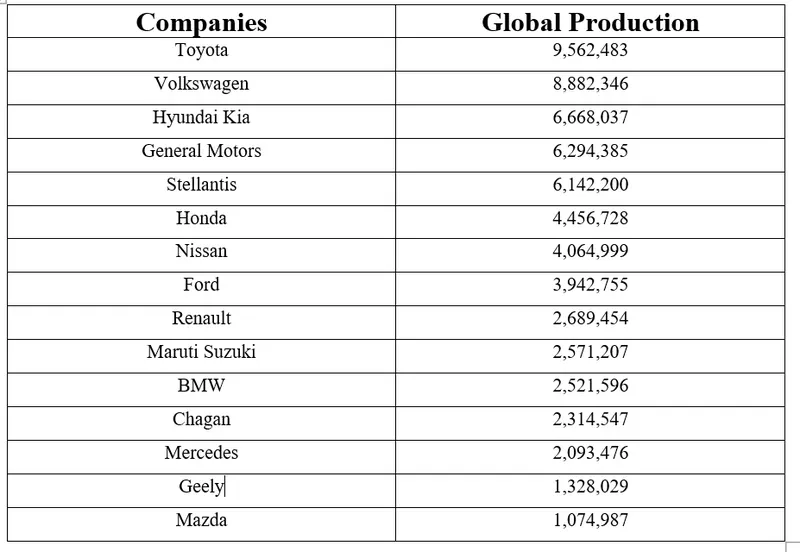
34) India will replace China in next 10 year in term of Volume production.
35)
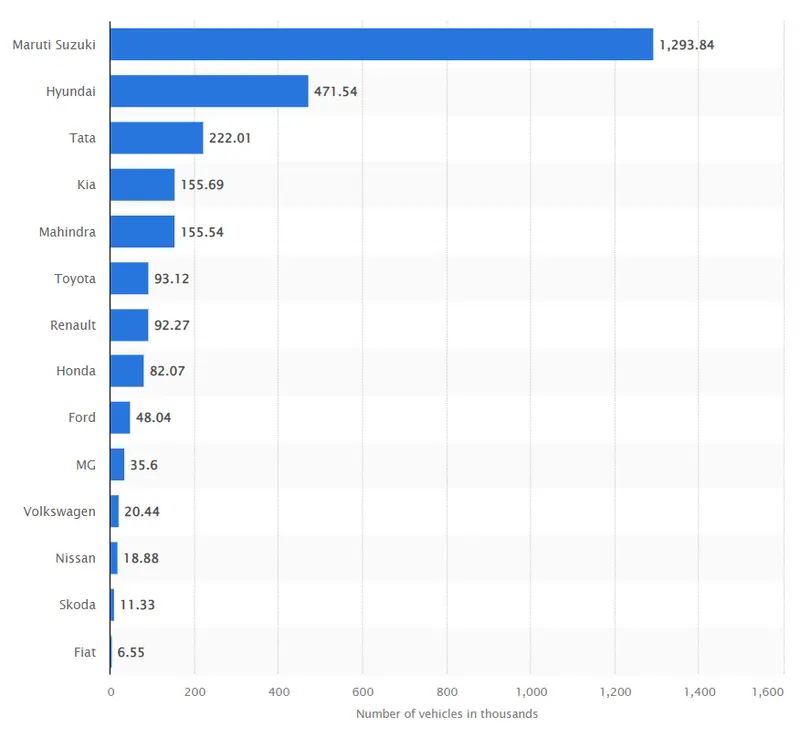
36) File Attached (Countirs following LHD)
37) File Attached (Countirs following RHD)
1) Eyellipse: Eyellipse combine the words eye and ellipse. The eyellipse represents both the driver’s interior and exterior visibility environment.
2)
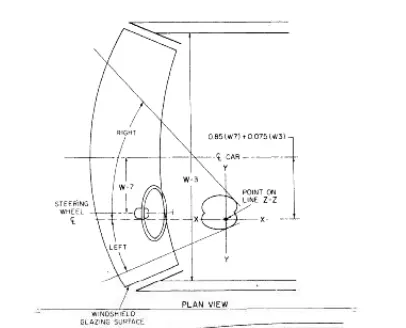
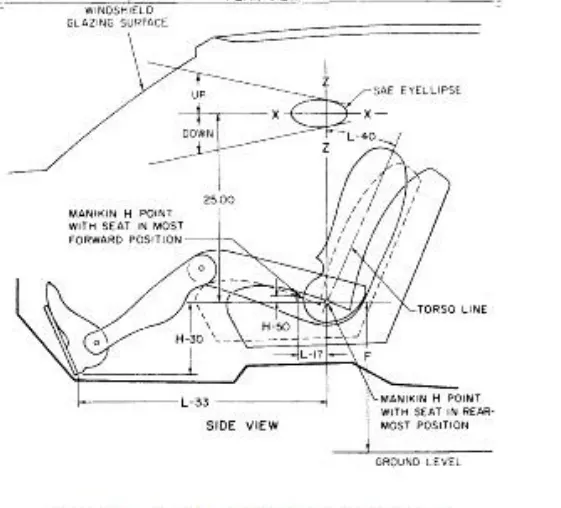
Top View for Eyellipse Side View for Eyellipse
3) E-Point: E – Points are two points that represents the left and right eye of a driver. The E – Points are spaced 65 mm apart of fit 95 % of the driver population. Each eye has its own eyellipse to represent its range of vision.
4) P-Point: The P-Point represents the neck pivot point, the P – Point is the point around which the driver neck turns horizontally to the left and right. Four variations of the P – Point are used in automotive design.
5)
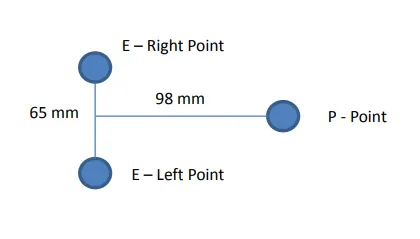
6) The E-point which is at right and to the left are 65mm apart from each other and the P-point which is a neck point is 98mm behind the vicinity of an eyes i.e E points.
7) SGRP: seating reference point
8) The oscar templet gives the designer the approximation of how the occupant will seat in the car. From this a pivot point is discovered of torso point and thigh. This is called as H-point.
9) SGRP is usually designated by the OEM companys and the H-point is designated by the the Tier-1 companys. The purpose of the both point is same.
10) Heel Point is nothing but the H-Point i.e. the theoretical, relative location of an occupant's hip.
11) Oscar is the name given to the 2D and 3D devices used to define and measure vehicle-seating accommodation.
12) The 2D device is called the Oscar template and the 3D device is called the Oscar Machine.
13) The Oscar Templet gives the seat designer an approximation of how the vehicle occupant will sit in the seat. From this approximation, a point is determined that represents the pivot point of Oscar torso and thigh. This is called the “Design H-Point” and should match the seat reference point given by the OEM.
14) If the designated seating position can be adjusted, the path of the design H-Point through the full seat adjustment range establishes the design H-Point travel line. The point along the H-Point travel called as H-Point Window.
15) There are 3 Types of Oscar Templet :
a) Small Women Type: 104 lbs ( Represents the 5th Percentile of driver)
b) Mid Sized Man:169 lbs ( Represents the 50th Percentile of driver)
c) Large Size Man: 226 lbs ( Represents the 95th Percentile of driver)
16) The weight of 95% oscar is 102.512kg.
17) Seat Design has a direct effect on the occupant’s relationship to other vehicle controls. Careful measurements & testing are required to ensure occupant positioning adheres to OEM Specification.
18) The tolerance range for the H-point is given as a tolerance band in the form of circle or in the form of a square which should not get detoriated from the tolerance range.
19) D-point regarding the seat is the lowest point on the buttock contour of the seated oscar template or the oscar machine.
20) AHF: Accelarator heel point
It refers to the oscar's heel point with the shoe on the un-depressed acccelerator pedal & foot angle at a minimum of 87degree.
21) Human access to control is as important as clear field of vision. If the occupant will be able to reach the appropriate controls while in driving position or while the car moves. The reaching distance for specific driver population is called the Hand Reach Envelope.
22) Hand reach envelope are of two types:
Primary Driver Hand Controls: All the necesaary contols comes into consideration by wearing a lap and shoulder belt in driving position.
Secondary Driver Hand Controls: All the necesaary contols comes into consideration by wearing a lap belt.
| Primary Driver Hand Controls | Secondary Driver Hand Controls |
| Steering Control | Climate Control |
| Gear Shift Control | Radio Control |
| Turn Signal Control | Acccessory Control |
| Ignition Control | |
| Audible Horn | |
| Headlamp Control | |
| Hand Break | |
| Wiper/ Defroster control |
23) The back angle is the angle of recline of the torso line relative to the vertical. Back angle doesn’t measure the angle of the seat structure.
Cushion angle is the angle of incline for the cushion relative to horizontal. The cushion angle helps determine the amount of thigh support the occupant will have.
24) Ischium is the lowest of three major bones comprising each half of the pelvis. It is part of the body that support you when you sit in the seat.
25) When a occupants seats for a longer duration of time the discomfortness or a burning sensation over the back is called as Tail burn.
26) Lumbar support in cars is a way to aid both drivers and passengers while sitting in car seats. They are meant to correct poor posture which has resulted in doctors treating an alarming number of patients with lower back pain.
27) During RFQ, OEM should provide some reference for the seat design:
a) Seating reference point
b) Foot Angle
c) Knee Angle
d) Heel Point
e) Hip Point
f) Back Angle
1) There are four main functions of the automotive seat:
a) Support the Occupant
b) Position the Occupant
c) Provide comfort for the occupant
d) Protect the occupant
2) Support of the occupant is the most basic function of the seat system. Improper support will adversely affect the position, comfort and safety of the occupant.
3) The position of the occupant is extremely important to safe vehicle operation. There are three key elements to occupant position :
a) Hand, arm and Leg room
b) Field of vision
c) Driver proximity to hand controls
4)The seat must be designed to provide comfort for the occupant. Factors that must be research on comfort are done are :
a) Determining the amount of Seat padding
b) Locating and avoiding hard points in the seat
c) Determining the angle of the seat back and cushion
d) Deciding on the correct amount of Thigh & Lumber support
e) Establishing seat width and Height
5) ILD: Indentation Load Deflection
ILD is a measurement taken to assess the firmness of the seat. The Load required to compress the seat pad to 50% of its original thickness indicates the firmness of the seat. A seat that is too firm may be uncomfortable. A seat that is too soft may cause fatigue or allow the occupant to come in contact with hard point.