Survey on electric vehicles
Question 1:
What were the first models of fuel cell vehicles developed in Asia, Europe and North America? What were the specifications of these vehicles? Compare them to the specifications of the current model.
The first modern fuel cell vehicle was a modified Allis-Chalmers farm tractor, fitted with a 15 kilowatt fuel cell, around 1959.The Cold War Space Race drove further development of fuel cell technology. Project Gemini tested fuel cells to provide electrical power during manned space missions. Fuel cell development continued with the Apollo Program. The electrical power systems in the Apollo capsules and lunar modules used alkali fuel cells. In 1966, General Motors developed the first fuel cell road vehicle, the Chevrolet Electrovan. It had a PEM fuel cell, a range of 120 miles and a top speed of 70 mph. There were only two seats, as the fuel cell stack and large tanks of hydrogen and oxygen took up the rear portion of the van. Only one was built, as the project was deemed cost-prohibitive.
General Electric and others continued working on PEM fuel cells in the 1970s. Fuel cell stacks were still limited principally to space applications in the 1980s, including the Space Shuttle. However, the closure of the Apollo Program sent many industry experts to private companies. By the 1990s, automobile manufacturers were interested in fuel cell applications, and demonstration vehicles were readied. In 2001, the first 700 Bar (10000 PSI) hydrogen tanks were demonstrated, reducing the size of the fuel tanks that could be used in vehicles and extending the range.
Applications
| Comparison of fuel economy expressed in MPGe for Fuel cell vehicles |
|||||||
|---|---|---|---|---|---|---|---|
| Vehicle | Model year | Combined fuel economy |
City fuel economy |
Highway fuel economy |
Range | Annual fuel cost |
|
| Hyundai ix35 FCEV | 2017 | 49 mpg-e | 48 mpg-e | 50 mpg-e | 265 mi (426 km) | US$1,700 | |
| Toyota Mirai | 2016 | 66 mpg-e | 66 mpg-e | 66 mpg-e | 312 mi (502 km) | US$1,250 | |
| Honda Clarity Fuel Cell | 2017 | 67 mpg-e | 68 mpg-e | 66 mpg-e | 366 mi (589 km) | - | |
| Notes: One kg of hydrogen has roughly the same energy content as one U.S. gallon of gasoline. | |||||||
| Honda FCX-V4 | 2002-2007 | US$11,500 |
to 190 mi (310 km) |
First fuel-cell vehicle to be approved for American roads by the Environmental Protection Agency and the California Air Resources Board, with subsequent leasing in California. Also approved for Japanese roads by Japan's Ministry of Land, Infrastructure and Transport. Approximately 30 are leased in the Los Angeles area and Tokyo.Leasing later expanded to 50 states. |
Question 2:
Show the trend of cost in USD per kW of fuel cell production in the past and the prediction of the cost in the future. What are the probable reasons for the improvement?
TREND OF COST IN USD PER KW OF FUEL CELL PRODUCTION
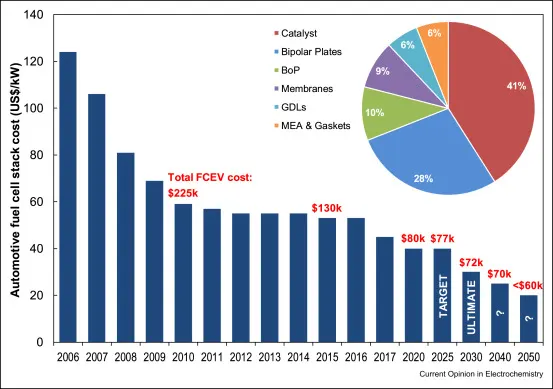
As you can see the price of fuel cell stack system in the year was around 125$/kW. The year 2008 saw the highest dip in the price. As of now the year 2020 and 2021 we didnt saw the dip due to the COVID-19 pandemic. As things get to normal the projected price for the year 2025 is 77$/kW.
The probale reasons for the improvement of FC stack system could be in research in more efficient and advanced FC components which are listed below:
Bipolar Plates
- Plate Forming: Despite the ability to produce bipolar plates at fast rates in progressive stamping presses (a few seconds per plate), the rates are not fast enough for the millions of plates needed per year. High numbers of parallel forming lines would be required, leading to infeasible factory setups and difficult quality control issues. Faster bipolar plate forming systems are needed.
- Plate Coating: There is no clearly identified pathway to a low-cost, high volume-feasible bipolar plate coating (for corrosion resistance and electrical contact improvement).
- Laser welding: (to seal and create a cooling cell between the plates).
- Material: Metal plates (as opposed to graphite, Graf oil, or composite materials) appear to be preferred for automotive applications. Alternate alloys with both lower cost and inherent anticorrosion properties should be explored.
Membranes
- Increased power density remains the number one pathway to reduced system cost.
- While ePTFE has proven to be effective membrane support, its cost is high. Fabrication (at production level) and performance assessment of alternate supports (such as the Ginner DSM) should be conducted.
Catalysts
- Non-Pt-based catalysts: Pt-based catalysts have been demonstrated to be the most cost-effective. To achieve competitiveness, non-Pt catalysts need to substantially improve their power density.
- Pt Usage: Substantial strides have been achieved in reducing Pt usage (and improving kW/gPt). Nonetheless, Pt cost is one of the largest cost elements within the fuel cell system. Efforts to further reduce Pt while maintaining performance and durability should continue.
- Catalyst Synthesis: Synthesis is complicated but appears to be relatively inexpensive (excluding Pt cost), particularly at high-rate production. It appears to be a favorable trade off to exchange synthesis complexity (possibly higher cost) for high polarization performance.
- Durability: Catalyst (and membrane) durability has not been explicitly factored in the cost analyses. However, it is clear that durability improvements are needed to meet minimum customer requirements.
Gas Diffusion Layers
- There is a wide distribution in GDL costs seemingly due to a combination of production scale, material wastage, and GDL company markup. More investigation is warranted to better understand these cost drivers.
Manufacturing Research
- Numerous components can be produced in quantities suitable for 1,000 vehicle systems per year but require manufacturing process development to achieve 100k vehicles per year production capability. They require not only a high-confidence market demand (to allow confidence in capital investment) but also substantial R&D dollars to develop the high-speed production systems