Vehicle Dynamics - Quarter Car Modelling
AIM: To solve the given conceptual numerical question based on 'Quarter Car Model'-
Question:- The sprung parts of a passenger car weigh 11.12 kN (2500 Ib) and the unsprung parts weight 890 N (200 lb). The combined stiffness of the suspension springs is 45.53 kN/m (260 lb/in.) and that of the tires is 525.35 kN/m (3000 lb/in.) (use the mass and stiffness as is – no need to divide)
OBJECTIVES:
1. Determine the two natural frequencies of the bounce motions of the sprung and unsprung masses.
2. Calculate the amplitudes of the sprung and unsprung parts if the car travels at a speed of 48 km/h (30 mph) over a road of a sinewave form with a wavelength of 9.15 m (30 ft) and an amplitude of 5 cm (2 in.)
GIVEN:
Sprung mass, `m_s = 11.2kN`
Unsprung mass, `m_(us) = 890N`
Spring stiffness, `k_s = 45.53(kN)/m`
Tire stiffness, `k_t = 525.35(kN)/m`
Speed of car, `V = 48(km)/h`
Wavelength, `lambda = 9.15m`
Amplitude, `Z_0 = 5cm = 0.05m`
SOLUTION:
Quarter Car Model diagramatic representation-
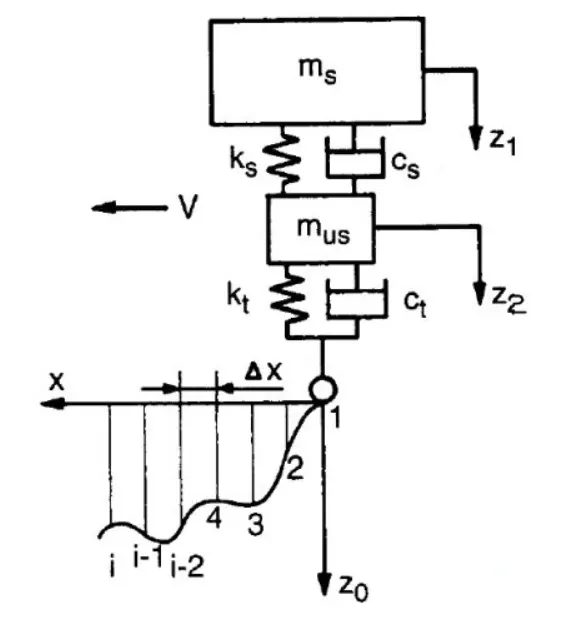
The equations of motion for this system are-
For sprung mass,
`m_sddotz_1 + c_s(dotz_1-dotz_2)+k_s(z_1-z_2)=0`
For unsprung mass,
`m_(us)ddotz_2 - c_s(dotz_1-dotz_2)+k_t(z_2-z_0)-k_s(z_1-z_2)=0`
we write-
`z_1 = Z_1sin(omegat)`
`z_2 = Z_2sin(omegat)`
I. For Free Response/Undamped vibration
the damping is neglected,i.e., `c_s = 0, c_t = 0,Z_0 = 0` and the frequencies are natural frequencies, hence we write`omega=omega_n`
By substituting these in the equations of motion, we get
Sprung mass equation
`m_sd^2/(dt^2)(Z_1sin(omega_n.t))+k_sZ_1sin(omega_n.t)-k_sZ_2sin(omega_n.t)=0`
Unsprung mass equaiton
`m_(us)d^2/(dt^2)(Z_2sin(omega_n.t))-k_sZ_1sin(omega_n.t)+k_sZ_2sin(omega_n.t)+k_tZ_2sin(omega_n.t)=0`
After solving these equations, we have
`(-m_somega_n^2+k_s)Z_1-k_sZ_2=0`
`-k_sZ_1+(-m_(us)omega_n^2+k_s+k_t)Z_2=0`
Writing these equations in matrix form,
`[[-m_somega_n^2+k_s,-k_s],[-k_s,-m_(us)omega_n^2+k_s+k_t]][[Z_1],[Z_2]]=[[0],[0]]`
`because Z_1,Z_2 !=0,`
`=>|[-m_somega_n^2+k_s,-k_s],[-k_s,-m_(us)omega_n^2+k_s+k_t]|=0`
`omega_n^4(m_sm_(us))+omega_n^2(-m_sk_s-m_sk_t-m_(us)k_s)+k_sk_t=0`
After solving, we get the real roots of the equation as
`omega_n=sqrt((k_s.k_t)/((k_s+k_t)m_s)) and sqrt((k_s+k_t)/m_(us))`
Therefore, Natural Frequencies:
`f_(n_s) = 1/(2pi)sqrt((k_s.k_t)/((k_s+k_t)m_s))`
`f_(n_(us))= 1/(2pi)sqrt((k_s+k_t)/m_(us))`
II. Damped condition
When the shock absorber damping and tire damping is considered in the system, we have
`[[-m_somega^2+c_somega+k_s,-k_s-c_somega],[-k_s-c_somega,-m_(us)omega^2+(c_s+c_t)omega+k_s+k_t]][[Z_1],[Z_2]]=[[0],[c_somega+k_t]]Z_0`
This is in the form of-
`AX=B`
`=>X=A^-1B`
After solving, we get
`Z_1/Z_0=(c_sc_(t)omega^2+(k_sc_t+k_tc_s)+k_sk_t)/(m_sm_(us)omega^4+(m_sc_s+m_sc_t+m_(us))omega^3+(k_sm_(us)+m_s(k_s+k_t+c_somega)omega^2)+(k_sc_t+k_tc_s)omega+k_sk_t)`
`Z_2/Z_0=(m_sc_(t)omega^3+(c_sc_t+m_sk_t)omega^2+(k_sc_t+k_tc_s)omega+k_sk_t)/(m_sm_(us)omega^4+(m_sc_s+m_sc_t+m_(us))omega^3+(k_sm_(us)+m_s(k_s+k_t+c_somega)omega^2)+(k_sc_t+k_tc_s)omega+k_sk_t)`
Here, `Z_1/Z_0 and Z_2/Z_0` are called as the 'Transmissibility Ratios'
`Z_1` and `Z_2` can be determined from this formula based on the given data.
SOLUTION:
MATLAB code:
clear all
close all
clc

%givne data/ inputs
Ws = 11.2*10^3;     %sprung weight (N)
Wu = 890;       %unsprung weigth (N)
ks = 45.53*10^3;        %spring stiffness (N/m)
kt = 525.5*10^3;        %tire stiffness

V = 48*5/18;        %speed of car (m/s)
lambda = 9.15;      %wavelength (m)
Z0 = 5;       %amplitude (cm)

%set damping coeff. variables for future use of script
cs = 0;     %spring damping coeff.
ct = 0;     %tire damping coeff.

%sprung and unsprung mass (kg)
ms = Ws/9.81;
mu = Wu/9.81;

%solution
%Natural frequencies
Wn_s = sqrt(ks*kt/((ks+kt)*ms));
Wn_u = sqrt((ks+kt)/mu);
fn_s = (1/(2*pi))*Wn_s      %sprung mass natural frequency (Hz)
fn_u = (1/(2*pi))*Wn_u      %unsprung mass natural frequency (Hz)

%Amplitudes
f = V/lambda;       %frequency (Hz)
W = 2*pi*f;     %omega (rad/s)

%storing the denominator of transmissibility ratio in a temporary variable
%for ease and simplification
temp = ms*mu*W^4 + (ms*cs + ms*ct + mu*cs)*W^3 +(ks*mu + ms*(ks + kt) + cs*ct)*W^2 + (ks*ct + kt*cs)*W + ks*kt;

%sprung mass amplitude (m)
Z1 = Z0*((cs*ct*W^2 + (ks*ct + kt*cs) + ks*kt)/temp)
%unsprung mass amplitude (m)
Z2 = Z0*((ms*ct*W^3 + (cs*ct + ms*kt)*W^2 + (ks*ct + kt*cs)*W + ks*kt)/temp)
OUTPUT:
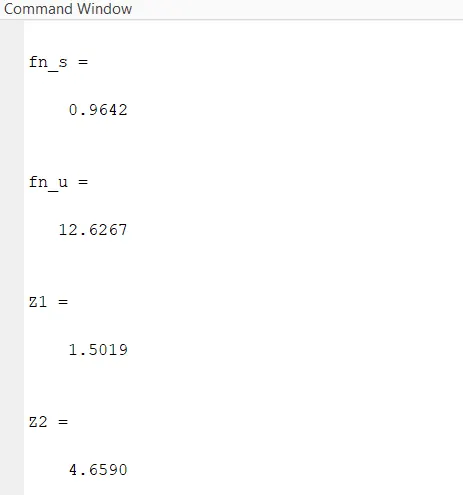
FINAL ANSWERS:
Sprung mass natural frequency, `f_(n_s) = 0.9642 Hz`
Unprung mass natural frequency, `f_(n_(us)) = 12.6267 Hz`
Sprung mass amplitude, `Z_1 = 1.5019 cm = 0.015m`
Unsprung mass amplitude, `Z_2 = 4.6590cm = 0.047m`