Understanding the concepts on Degrees of Freedom
Question 1:
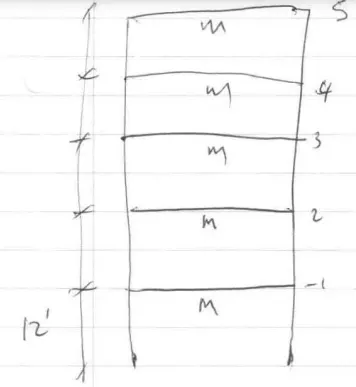
A five storey structure with 5 translational DOF is shown here. Each storey has mass ‘m’. The eigenvalue problem has been solved and the 5 periods of vibration Tn and their corresponding mode shapes, φn has been derived.
- Ln , Mn and Γn for each of the five modes are to be computed from Equations below.
- Also, calculate the effective modal mass Mn* and the modal mass participating ratio for the 5 modes. The mass matrix will be required to evaluate these parameters.

- Finally, obtain the base shear for each of the 5 modes of vibration and the combined base shear as per SRSS rule. The pseudo acceleration design spectrum to obtain the base shear for each mode is provided below.
- How many modes are to be considered such that a modal mass participating ratio of 90% is obtained?
Ans) Model mass (M)
1) The fundamental period of vibration (T1 = 2 seconds) and its associated mode shape:
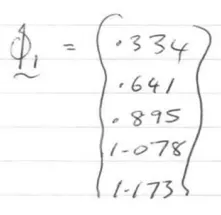
The model mass ratio for the first mode is
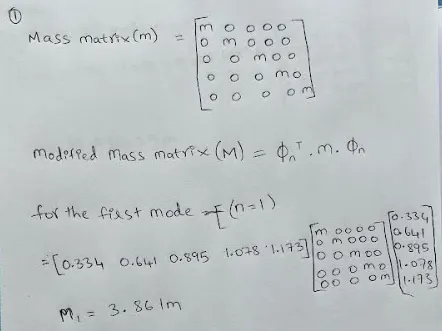
2) The second mode of vibration (T2 = 0.6852 seconds) and its associated mode shape:
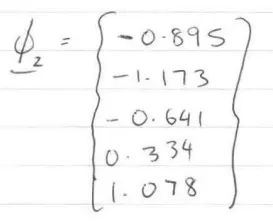
The model mass ratio for the second mode is


where M2 = 7.72275m
3) The third mode of vibration (T3 = 0.4346 seconds) and its associated mode shape:
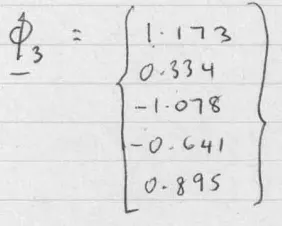
The model mass ratio for the third mode is


where M3 = 11.584425m
4) The fourth mode of vibration (T4 = 0.3383 seconds) and its associated mode shape:
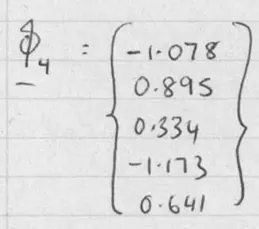
The model mass ratio for the fourth mode is


where M4 = 15.4459m
5) The fifth mode of vibration (T4 = 0.2966 seconds) and its associated mode shape:
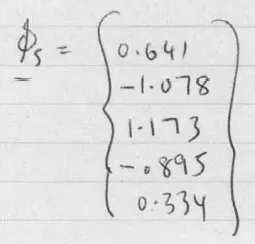
The model mass for the fifth mode is


where M5 = 15.198565m
Model Property:(L)
As the model property equation given

Where l is influence vector ( Assuming 100% utilization of sesimic forces) =
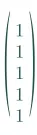
This are constant for all the modes. where we alreay know the mass matrix for the model we apply them in the equation.
i) model Property for the first mode (n=1)
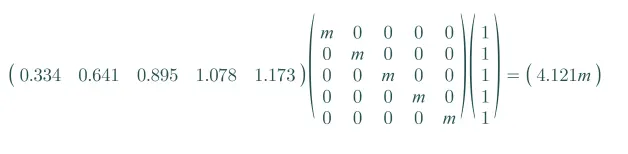
where we get L1 = 4.121m.
ii) Model propert for the second mode (n=2)

L2= -2.594m.
iii) model property for the third mode is (n=3)

where L3= 2.049m.
iv) Model proerty for the fourth mode is (n=4)
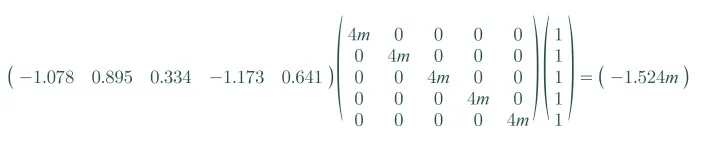
L4= -1.524m.
v) Model property for the fifth mode is (n=5)
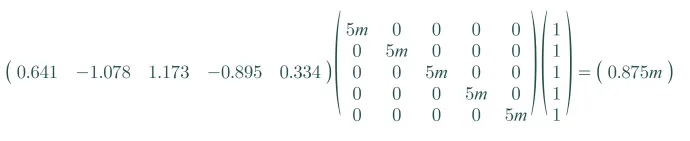
L5= 0.875.
Model participation factor:

where L is the model property and M is the model mass. Now substitute them seperatly from the each mode.
1) Model participation factor for the first mode = 4.121m/3.861m
ɼ1 = 1.067.
2) Model participation factor for the second mode = -2.594m/7.72295m
ɼ2 = -0.335
3) Model participation factor for the third mode = 2.094m/11.584425m
ɼ3 = 0.177
4) Model participation factor for the fourth mode = -1.524m/15.4459m
ɼ4 = -0.098.
5) Model participation factor for the fifth mode = 0.875m/15.198565m
ɼ5 = 0.045.
Effective model mass:

Where L is the model property and m is the model mass. Now substitute them in the equation and calculate seperatly fot the each mode.
i) Effective model mass for the first mode
m*1 = (4.121m)2 /3.861m = 4.398m.
ii) Effective model mass for second mode
m*2 = (-2.594m)2/7.72295m = 0.436m.
iii) Effective model mass for the third mode
m*3 = (2.094m)2/11.584425m = 0.121m.
iv) Effective model mass for the fourth mode
m*4 = (-1.524m)2/15.4459m = 0.038m.
v) Effective model mass for the fifth mode
m*5 = (0.875m)2/15.198565m = 0.008m.
Model mass Participation ratio:
As we know Model mass participation ratio = Mn*/mj
mj = Total mass of the buildings = m+m+m+m+m = 5m.
Where
1) model mass participation ratio for the first mode (n=1)= 4.398m/5m = 0.88.
2) Model mass participation ratio for the second mode (n=2)= 0.436m/5m = 0.09.
3) Model mass participation ratio for the third mode (n=3)= 0.121m/5m = 0.02.
4) Model mass participation ratio for the fourth mode (n=4)= 0.038m/5m = 0.01.
5) Model mass participation ratio for the fifth mode (n=5)= 0.008m/5m = 0.002.
To achive the 90% of the model mass participation ratio only the first two modes are enough where
= 0.88+0.09=0.97.
Hence the forst two modes are enough to achive 90% model mass participation.
Base shear:
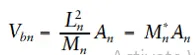
As we know Base shear (VB) = Mn* . An
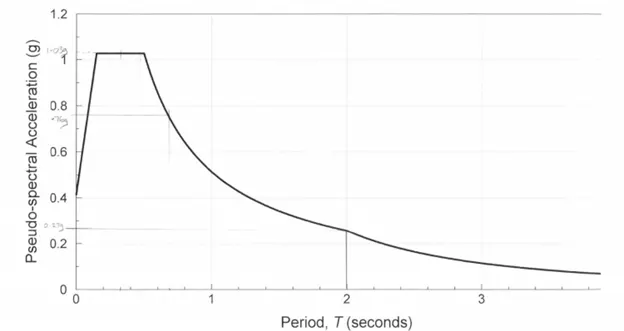
We will substitute valude in the equation seperatly for each mode.
- Base shear for the first mode VB1 = 4.398m X 0.27g = 1.187mg.
- Base shear for the first mode VB2 = 0.436m X 0.76g = 0.327mg.
- Base shear for the first mode VB3 = 0.121m X 1.03g = 0.126mg.
- Base shear for the first mode VB4 = 0.038m X 1.03g = 0.039mg.
- Base shear for the first mode VB5 = 0.008mg.
To get the average base shear we need to use the SRSS method square root of some of squares.


Hence we get The average base shear VB = 1.15mg.