Underbody Coating
Report on Underbody Coating and its purposes:
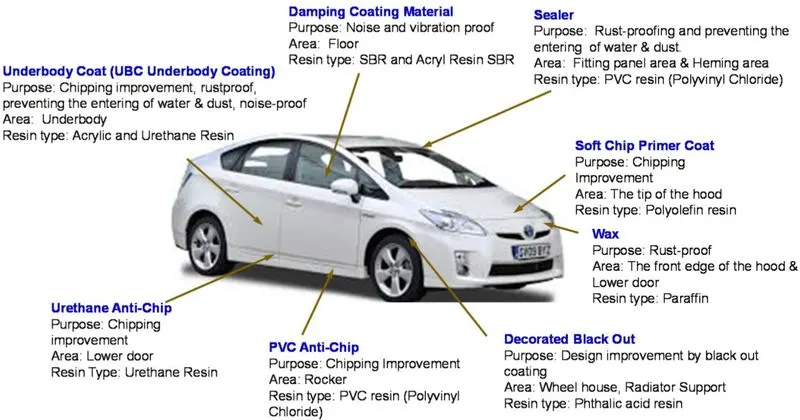
Underseal (often called undercoating in the U.S.) is a thick resilient coating applied to the underbody or chassis of an automobile to protect against impact damage from small stones, which would rapidly chip ordinary paint, allowing rusting to begin.
It's important to protect all aspects of your vehicle from damage, rust, and decay. From the windshield to the tires to the actual body of your car, automobiles need upkeep to prevent them from becoming an undriveable pile of rust. All the moving parts work together to form a well-functioning and safe-to-drive whole, and it's easy to forget about the things on your vehicle that you don't see -- like the underbelly. That's where car undercoating comes into play.
Types of Undercoatings:
Rubberized Undercoating
Rubberized vehicle undercoating is easy to apply and offers sound-cushioning as well as protection from dust, moisture, and dings or dents.
In addition to your undercarriage, rubberized undercoating is also safe to use on wheel wells and quarter panels, and dries to a soft rubbery finish that prevents further rust, damage, or moisture seeps. The coating can be painted over and, if necessary for bodywork, can be easily removed with an undercoating removal spray.
Overall, rubberized coating is generally the best option for protecting your vehicle's undercarriage, as it provides the simplest and best protective measures against rust and moisture.
Polyurethane Undercoating
The other option for undercoating your vehicle is to use a polyurethane-based sealant. This type of vehicle undercoating is a little bit quicker and easier to apply.
Oftentimes, polyurethane undercoating will come in canisters ready to preload into an application gun. This type of sealant works by seeping into all cracks and seams, displacing salt and moisture and oozing around rusty areas to bond with and protect unoxidized metal. It also sands quickly in case you'll need to perform bodywork and can be painted over.
On the flipside, this type of car undercoating generally requires a little bit more surface prep work before applying -- sanding and applying an etching primer to bare metals before using are generally recommended.
Wax-based Undercoating
A paraffin-based undercoating will be the cheapest and quickest option available with which to protect the undercarriage of your vehicle. However, keep in mind that it will wear off quicker than other types of undercoating and will need to be stripped and reapplied at least once every year.
Wax-based undercoatings never truly harden. During application, they drip or flow into seams and cracks to provide protective properties. They are usually available in a spray gun canister or in an aerosol can and offer at least a base protection in moderately humid climates.
Asphalt-based undercoating
For standard vehicles, any of the aforementioned types of undercoating will provide sufficient protection. For large trucks and heavy machinery, asphalt-based undercoating provides a bit of extra durability against rocks, chips, and moisture.
Asphalt-based undercoating generally contains a little bit of rubberized material that sets up firmly and also helps soften noise. Generally sold in five gallon containers, this type of undercoating also needs more cure time than the other three, and is NOT paintable, making it best to use only for undercarriages.
Steps carried out in Underbody coating process:
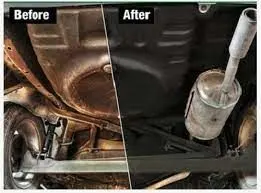
- The car is hoisted on a lift and the underbody is inspected for flaws
- The under body is cleaned removing out the dirt and grease
- Critical components like silencer are covered in a film to avoid the coating from sticking to it
- Rest of the under body is spray painted evenly.
- The silencer film is removed and zinc coating is sprayed on it
- Final inspection is done to look out for flaws
- Done , the car is ready to leave the workshop.
Advantages:
1)It expands the lifespan of the car.
2)Nomore loud road noise
Disadvantages:
The undercoating or rustproofing spray is heavy in pockets. However, it is nothing when you compare it with the cost of replacing a vehicle after corrosion.